Two samples land on the bench with the same INCI name. One is a white powder. The other arrives as a liquid. Purchasing sees two prices; the formulator sees two entirely different afternoons.
Sodium lauroyl glutamate is an anionic amino acid surfactant made from a lauroyl fatty chain and a glutamate-based hydrophilic group. It is used mainly in rinse-off cleansing products, where it can contribute detergency and foam while supporting the design of a milder surfactant system. It may be the main surfactant or part of a blend. The finished result still depends on the grade, pH, water, other surfactants, oils and the way the batch is made.
The useful question, then, is not simply whether sodium lauroyl glutamate is “good.” It is whether a particular grade suits your formula and your production line. The INCI name gets you into the right room. It does not choose the chair.
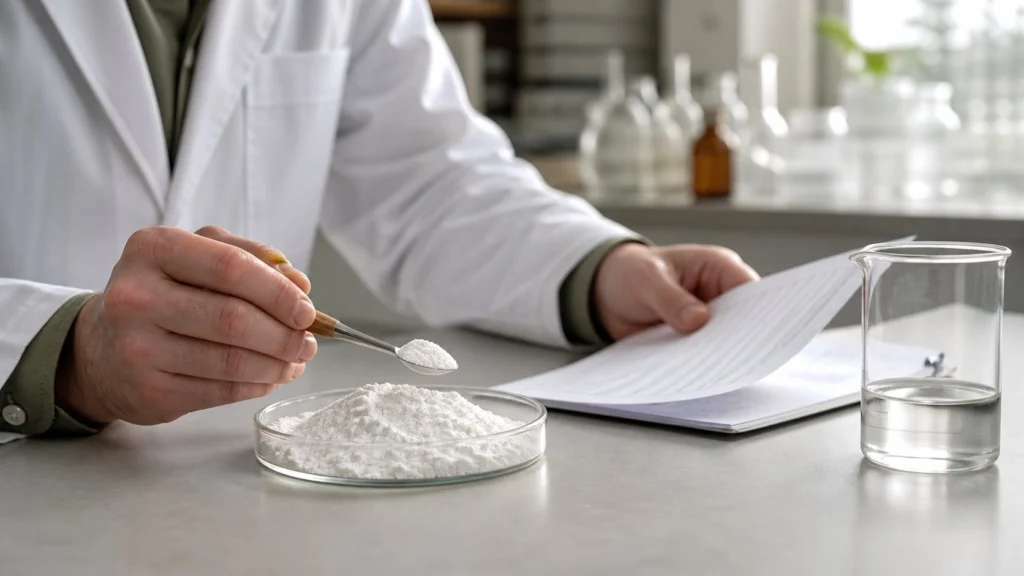
A powder sample can look simple. Its supplied content, water, salts and processing route are where the real comparison begins.
What the name tells you about the molecule
The name is a compact description of the structure. Sodium lauroyl glutamate combines a water-repelling fatty segment with a water-friendly glutamate head group, which is why it can sit at oil-water and air-water interfaces and behave as a surfactant.
Lauroyl supplies the hydrophobic tail
“Lauroyl” refers to the fatty acyl part associated with lauric acid. This segment prefers oils and other non-polar materials over water. In a cleanser, it helps the molecule associate with oily soil and with other surfactant molecules.
Glutamate supplies the polar head
The glutamate-derived head contains carboxyl groups and is joined to the fatty chain through an amide bond. The sodium counterion accompanies the charged form. In water, this polar end interacts with the aqueous phase while the lauroyl end turns away from it. At sufficient concentration, the molecules assemble into aggregates such as micelles.
The PubChem record for sodium lauroyl glutamate lists the molecular formula as C17H30NNaO5, the molecular weight as 351.4 g/mol, and the commonly referenced CAS number as 29923-31-7. Those identifiers confirm the chemical identity. They do not tell you whether a commercial grade is a powder or liquid, how much water it contains, or how it behaves in your blend.
Where sodium lauroyl glutamate fits in personal cleansing
Sodium lauroyl glutamate is most at home in rinse-off products. Facial cleansers, body washes and shampoos are familiar examples. Powder grades also make it relevant to cleansing powders and compressed formats, provided the product disperses properly when the consumer adds water.
In liquid and paste cleansers
In a liquid cleanser, it can provide part of the cleansing and foaming system. Formulators often pair amino acid surfactants with other anionic, amphoteric or nonionic surfactants to adjust foam character, rinse feel, clarity and viscosity. The blend matters more than the family label. A formula described as an “amino acid cleanser” may still contain several surfactant types, each doing a different job.
For a cream or paste cleanser, the same surfactant can sit inside a more structured system. Here, the emollient phase, fatty materials and rheology route become just as important as the surfactant choice.
In dry formats
A concentrated powder grade can suit cleansing powders or tablets because it brings less water into the product. That advantage comes with a practical bill: powder flow, moisture pickup, dust control and use-time dispersion all need attention. A technically elegant ingredient that clumps in the pack is still a clump.
The broader amino acid surfactants guide explains how glutamates compare with other amino acid surfactant families.
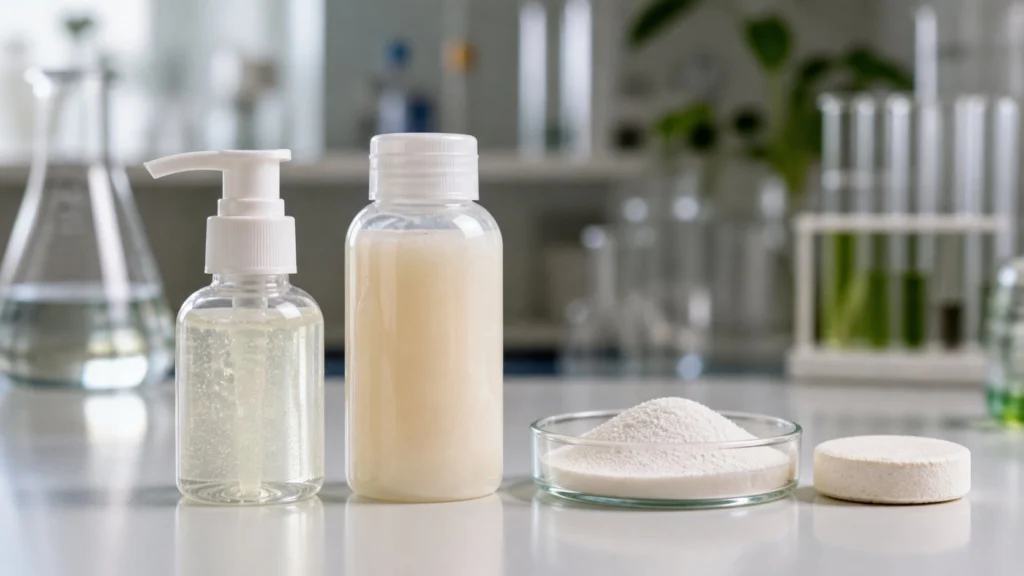
The same ingredient name can lead to very different formulation jobs in a pump cleanser, shampoo, powder or tablet.
The grade parameters worth reading before the price
Two grades with the same INCI name can differ in physical form, supplied surfactant content, water, salts and test methods. Those differences affect dosage, freight, storage, dispersion and sometimes finished-product behavior. Price per kilogram is only useful after the comparison basis is the same.
| Parameter | What it tells you | Why it matters in practice |
| INCI and CAS | The declared ingredient identity | Confirms that you are comparing the intended chemistry |
| Physical form | Powder, granule, paste or liquid | Changes weighing, pumping, dust control, heating and storage needs |
| Supplied surfactant content | How much declared material the grade brings | Lets purchasing and R&D compare use level on a common basis |
| Water and inorganic salts | What arrives with the surfactant | Can affect freight, formula water, electrolyte load, clarity and rheology |
| pH with test method | The reading at a stated dilution and temperature | Makes incoming results comparable and prevents a raw-material value from becoming a finished-product target |
| Appearance and odor | Basic incoming quality characteristics | Helps QA spot a batch that differs from the agreed specification |
| Recommended process | Order of addition, dispersion and heating guidance | Shows whether the grade fits the plant before the first full batch |
A quick supplied-content calculation keeps the commercial comparison honest:
Delivered surfactant basis (%) = raw material use level (%) x specified supplied content (%) / 100
If a formula uses 10% of a grade specified at 95% supplied content, that grade contributes 9.5% on this basis. The calculation is simple; the definition behind the percentage is the part worth checking. Assay, active matter and composition disclosure are not automatically interchangeable terms.
pH changes more than the number on the screen
Sodium lauroyl glutamate contains ionizable carboxyl groups. As pH changes, the balance between protonated and ionized forms changes too. That can alter solubility, aggregation, interfacial behavior and foam. pH belongs near the top of the test sheet, not in the footnotes.
Raw-material pH needs its test method
A supplier pH range normally applies to a stated aqueous preparation at a stated temperature. Change the dilution or temperature and you have changed the measurement. That raw-material result is useful for incoming QC; it is not the pH target for a finished cleanser.
Finished-product pH belongs to the whole formula
The final reading includes the complete surfactant blend, acids or bases, fragrance, polymers and other ingredients. Research on sodium lauroylglutamate has shown that pH and temperature can change its aggregation and foam behavior. The published study on pH, temperature and foam characteristics is a useful reminder that the molecule responds to its surroundings.
For practical formulation consequences, see how pH changes amino acid surfactant system behavior.
The neat molecule meets the messy formula
An ingredient page can make sodium lauroyl glutamate look wonderfully well behaved. A beaker is less polite. Water minerals, electrolytes, fragrance, polymers and co-surfactants all influence the result.
Water and electrolytes can move several properties at once
Hard-water ions and added salts can change surfactant aggregation and the way foam develops. A commercial grade may also carry some sodium chloride or other non-surfactant material, so the raw material itself can contribute to the electrolyte load. This is one reason two “same INCI” samples may not thicken or foam in quite the same way.
If foam changes with different water sources, the water-hardness guide gives a focused troubleshooting route.
Fragrance and rheology usually expose weak assumptions
Fragrance oils and emollients can reduce foam or disturb clarity. Polymers and salt-thickening routes can behave differently after the surfactant balance or pH moves. A clear base that turns cloudy after fragrance addition is not contradicting the TDS. It is reporting on the finished formula.
For an early screen, keep the base formula steady while you compare candidate grades. Use the intended production water, then observe pH, clarity, foam and viscosity after the batch has had time to settle. A short record of addition order and temperature is more useful than a photograph of a mysterious cloudy beaker three days later.
A practical powder-grade example: INNO KWLG-95
KWLG-95 is INNO’s powder grade of sodium lauroyl glutamate. It is best read as one worked example of the grade checklist above, rather than as the definition of the ingredient itself.
| KWLG-95 item | Current product document value |
| Appearance | White solid powder |
| INCI | Sodium Lauroyl Glutamate, Aqua, Sodium Chloride |
| pH | 4.5 to 6.5 in a 10% aqueous preparation at 20 C |
| Water | 5% maximum |
| Acid value | 100 to 140 |
| General use guidance | 5% to 30%, depending on the formulation |
| Documented process | Add to cold water, disperse, then heat |
These values apply to KWLG-95. Another sodium lauroyl glutamate grade may use a different physical form, composition basis or processing route.
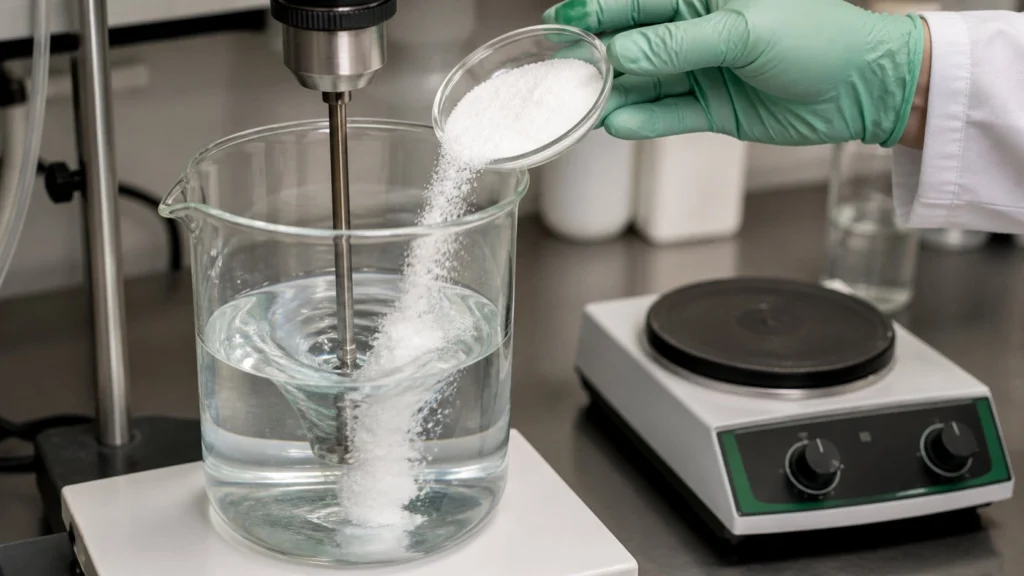
KWLG-95 is dispersed in cold water before heating according to its current TDS.
If a concentrated powder fits your equipment and product format, the KWLG-95 product page is the next place to request the current TDS, SDS or sample information. Include your product type, surfactant blend, target pH and batch sequence. That gives our technical team enough context to discuss the grade without turning the first reply into a guessing game.
Questions that usually come up before sampling
Is sodium lauroyl glutamate the same as sodium cocoyl glutamate?
No. Sodium lauroyl glutamate refers to a lauroyl, commonly C12, fatty segment, while sodium cocoyl glutamate is based on a coconut-derived fatty-acid distribution. They belong to the same acyl glutamate family, but their chain distribution and commercial grade specifications can differ.
Is every sodium lauroyl glutamate powder a 95% grade?
No. Physical form does not establish supplied content. Check the TDS or specification for the percentage definition, water, salts and test method before calculating dosage or cost.
Can sodium lauroyl glutamate make a clear facial cleanser?
It can be used in clear cleanser development, but the ingredient name alone cannot predict clarity. The surfactant blend, pH, water source, fragrance or oil load and rheology system all affect the finished appearance.
Does a powder grade always need hot water?
No. Follow the supplier’s documented order of addition. For KWLG-95, the current TDS calls for cold-water dispersion followed by heating.