Your cleanser was clear before the final pH adjustment. Now it is hazy, thinner, or foaming differently. The pH step is a reasonable suspect, but the meter reading is only part of the story.
Changing pH can alter the charge and association of some amino acid surfactants. The adjustment also adds acid or base, water, and counterions. Addition point, local mixing, temperature, fragrance, salt, and the thickening route can all change what you see. Two batches can finish at the same pH and still have taken very different chemical and process paths.
The fastest way forward is to stop adjusting the full batch and recreate the change in a few small samples from one base. If the same symptom returns near the same pH, investigate pH-related solubility or micelle changes. If it does not, look first at the addition method, ionic load, water, temperature, or measurement timing.
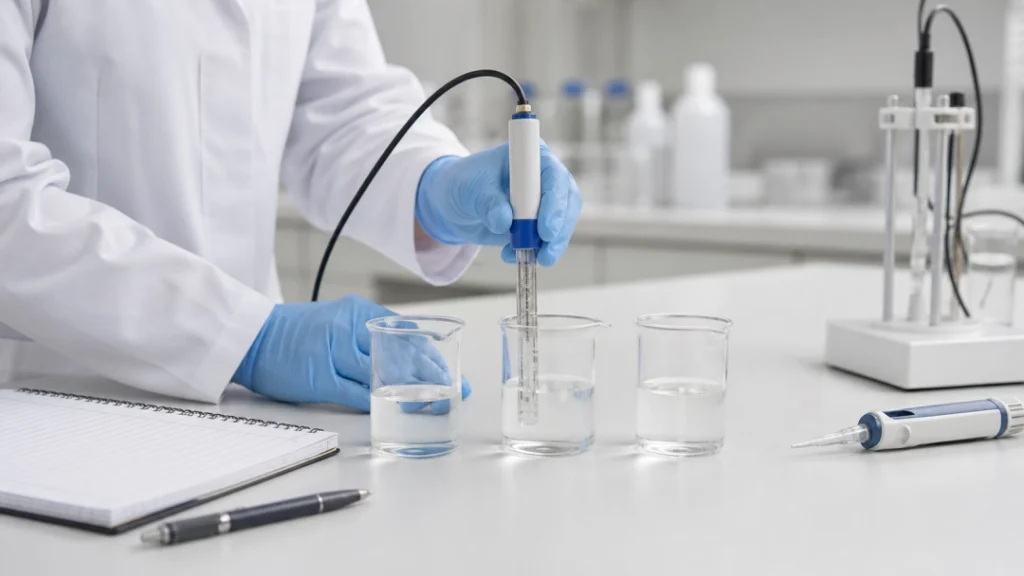
The image illustrates a pH comparison workflow.
The number is only useful if you know what was measured
A pH value on a TDS, a reading during manufacture, and the final pH of a cleanser are not interchangeable. Each one describes a different sample at a different point in its history.
| pH value | What it tells you | What you still need to know |
| TDS dilution pH | The measured pH of a stated raw-material dilution | Sample concentration, water, temperature, and method |
| Applicable pH range | The supplier’s stated range for one grade, if documented | What performance was assessed across that range |
| In-process pH | The condition at one manufacturing step | Addition order, mixing, temperature, and time before reading |
| Finished-formula pH | The state of the complete batch when measured | Whether the batch has equilibrated and which ingredient caused the change |
Our current technical files do not all describe pH on the same basis. Some report the pH of a stated aqueous dilution; others state an applicable range for a specific grade. This is normal, but it means you must read the sample condition before comparing two numbers. The TDS, SDS, and COA guide explains what each document can and cannot establish.
There is also no single useful pH range for every glutamate, glycinate, taurate, and complete cleanser. When a current grade-specific TDS states an applicable range, treat it as one boundary. Your finished formula and stability work decide whether a point inside that boundary is practical.
For the wider differences among surfactant families, active matter, and physical forms, use the amino acid surfactants guide. This page stays with one question: what happened after pH changed?
A pH adjustment changes the chemistry and the batch history
pH is a measure of acidity in the aqueous sample. It does not directly tell you surfactant charge, salt load, micelle shape, or compatibility. Those are possible consequences, and the surfactant family matters.
Carboxylate and sulfonate headgroups do not behave the same way
Many glutamate and glycinate surfactants contain carboxylate groups. As the system becomes more acidic, the balance can shift toward greater protonation. That may change effective charge, hydration, solubility, and the way molecules associate.
Taurates have sulfonate-based headgroups, so you should not apply the same acid-base explanation to them. Even within one family, fatty-acyl distribution, counterion, active matter, and salt content can move the result.
Studies on specific amino acid-derived surfactants show why a simple rule is unsafe. One NMR study of pH-dependent micelle formation found changes in critical micelle concentration and counterion binding in an undecyl phenylalaninate system. A separate solution study reported pH-related changes in dissociation, micelle concentration, and aggregation number for another amino acid-type surfactant. Neither study defines the working pH of an INNO grade or your cleanser.
The titrant can matter as much as the final reading
When you add an acid or base, you also change the ionic environment. The amount and concentration of the adjustment solution, the counterions it introduces, and the extra water can influence viscosity or clarity. A buffered formula may require far more titrant than a lightly buffered one to reach the same pH.
Write down the acid or base, its concentration, the amount added, the batch temperature, and when it entered the process. Without that history, a final pH reading cannot explain the batch.
Start with what changed in the beaker
Do not ask pH to explain three different symptoms at once. Clarity, viscosity, and foam come from different parts of the formula, so begin with the one change you can see or measure.
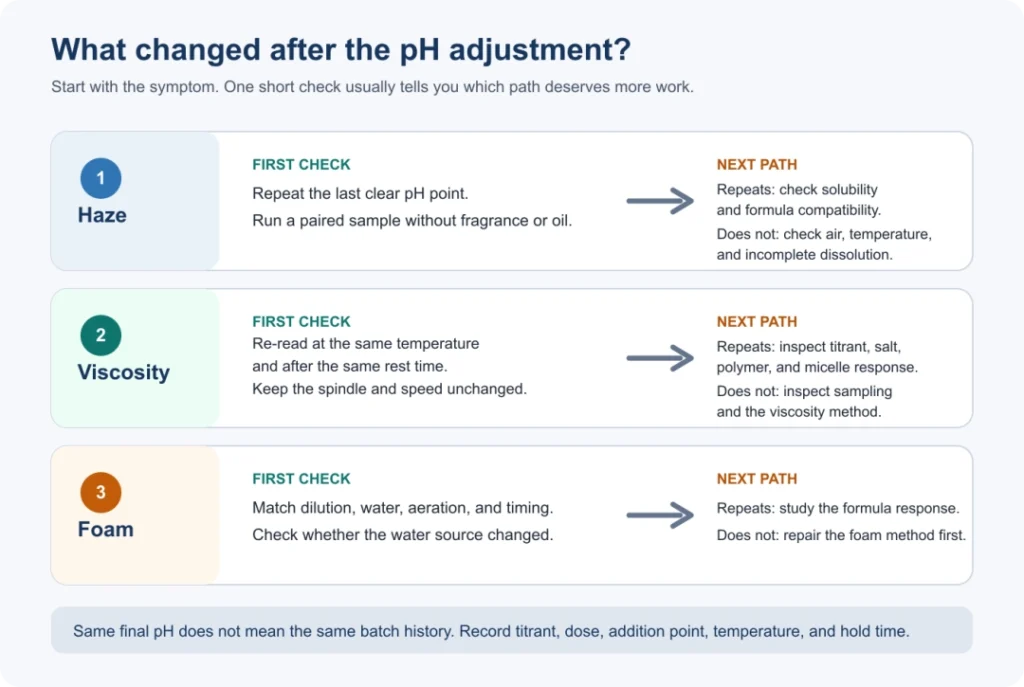
Start with the observed change, then choose the shortest check that separates pH from a process or formulation effect.
The batch turned hazy
Haze can point to reduced solubility or a new interaction among the surfactant, fragrance, oils, polymers, salts, or preservative system. It can also come from air, incomplete dissolution, or a cold sample.
Return to the last clear pH point and repeat the adjustment in a small sample. If the haze returns, prepare a paired sample without the most likely hydrophobic additive, often the fragrance or oil phase. A clear simplified sample tells you that pH is involved, but the compatibility problem belongs to the complete formula rather than the primary surfactant alone.
The batch lost or gained viscosity
pH can change micellar association, but the titrant may also move the system along its electrolyte response. Polymer charge and hydration may change at the same time. This is why a viscosity shift after pH adjustment does not automatically mean that the surfactant became easier or harder to thicken.
Recheck both samples at the same temperature, after the same rest period, with the same spindle and speed. If you are developing the viscosity route, continue with the amino acid surfactant thickening guide. If a previously acceptable production batch suddenly became thin, use the failed-batch diagnosis before changing the formula.
The foam changed
Foam is the weakest stand-alone proof of a pH effect. Sample concentration, water hardness, temperature, aeration, reading time, and oil load can easily cover or imitate a real chemistry change.
Use the same dilution and foam method for the adjusted and unadjusted samples. If the problem appeared after a water-source change, move to the hard-water foam test. Do not rebuild the surfactant blend until the water question is settled.
A four-beaker check usually tells you enough
You do not need a large design of experiments to decide whether pH deserves more attention. Pull one homogeneous base before final adjustment and divide it into four labeled beakers.
Keep one beaker unchanged. Adjust one to the intended target, one slightly below it, and one slightly above it, while staying inside every relevant raw-material and product boundary. The exact points come from your project and current documents, not from a generic web article.
Use the same adjustment solution and mixing approach. Record the dose on each label. If the added liquid changes sample mass enough to matter, make the comparison on a matched dilution basis. Photograph appearance at the same angle and lighting. Read viscosity after the same hold time and at the same temperature.
For pH itself, keep sample preparation, electrode care, temperature, and the reading endpoint consistent. ASTM D1172-15(2024) covers preparation and pH measurement of aqueous soap and detergent solutions. Your laboratory method and the product specification still take precedence for release decisions.
What matters is the shape of the response. A repeatable haze point is useful. A viscosity peak that appears again is useful. Four scattered foam readings are not. They tell you to fix the foam method before touching the formula.
The plant can create a different pH event
A bench beaker is well mixed and easy to observe. A production vessel may receive the adjustment through a narrow addition point, at a different temperature, with fragrance, salt, or polymer already present. The final meter reading can match while the batch history does not.
Watch the addition point, not only the endpoint
Concentrated acid entering a poorly circulated zone can create a temporary local condition that the final pH reading never shows. That short exposure may be enough to create haze, polymer shock, or uneven texture. Record where the adjustment enters, what is already in the vessel, how long mixing continues, and when the sample is taken.
Recheck after the normal hold
Temperature compensation does not make a hot sample identical to a cooled batch. Surfactant association, polymer hydration, dissolved air, and incomplete dissolution may continue to change after manufacture. Use the same sampling point and the same scheduled recheck for good and failed batches.
If the bench samples behave well but the plant batch does not, stop widening the pH specification. Compare the addition sequence and mixing history first.
Before you reformulate, send us the useful data
If the acceptable window is narrow, the batch changes after scale-up, or the symptom refuses to repeat, send us the complete formula and the history of the pH step. Include trade names and INCI names, grade and lot, active-matter basis, water source, acid or base identity and concentration, dose, addition point, temperatures, pH before and after adjustment, pH after the normal hold, viscosity method, and photographs.
With that information, the INNO team can review whether the next step should focus on the grade document, ionic load, addition sequence, thickening route, or a more specific bench comparison. You can send the formula and batch history for technical review.
If you are still choosing the surfactant rather than investigating a failed batch, review the current INNO amino acid surfactant range and request the latest TDS for the grades under consideration.
Quick answers from the bench
Is there one ideal pH range for all amino acid surfactants?
No. Amino acid surfactants include different headgroups, counterions, active levels, and commercial forms. Use the current grade-specific TDS as a boundary, then confirm clarity, viscosity, foam, preservation, and stability in the complete formula.
Why did my cleanser turn cloudy after pH adjustment?
The adjustment may have changed surfactant ionization, solubility, electrolyte load, or compatibility with fragrance, oils, polymers, and other ingredients. Repeat the last clear point in a small sample before assigning the cause.
Can pH increase the viscosity of an amino acid surfactant system?
It can increase, reduce, or barely change viscosity. The response depends on the surfactant blend, electrolyte level, polymer, temperature, and measurement timing. A repeatable small-sample comparison is more useful than a general rule.