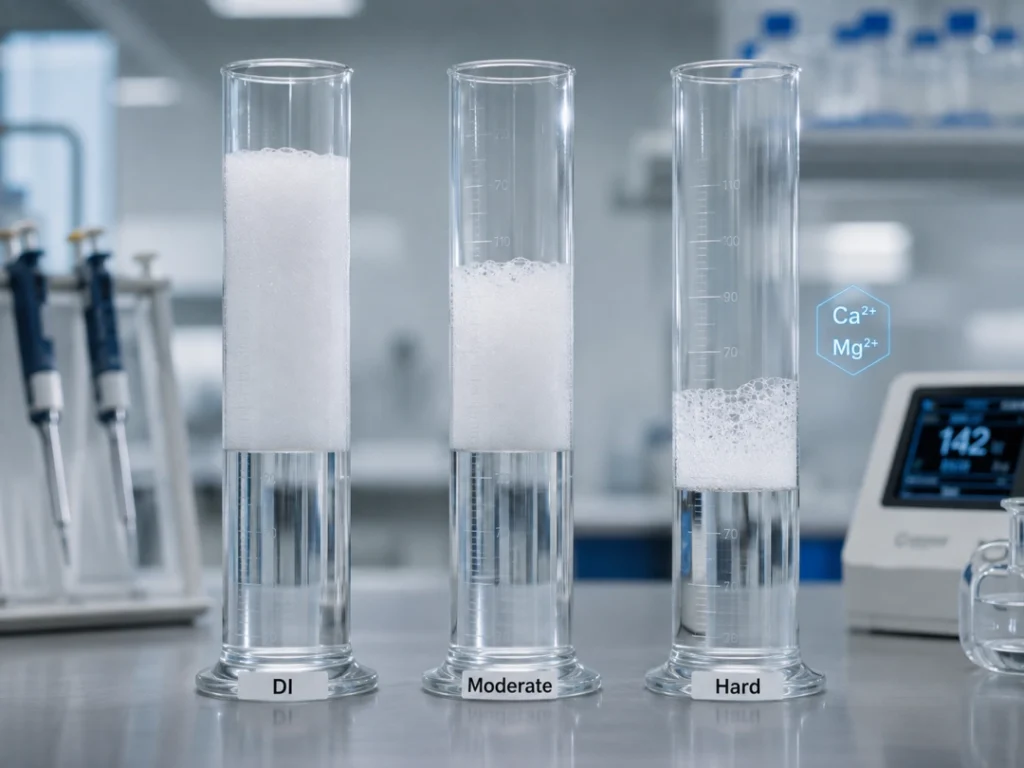
When foam changes after a new water source is introduced, the formula is only one possible cause. Water chemistry, temperature, pH, product concentration, mixing, and sample age can all move the result. Do not compare foam until the water and method are defined.
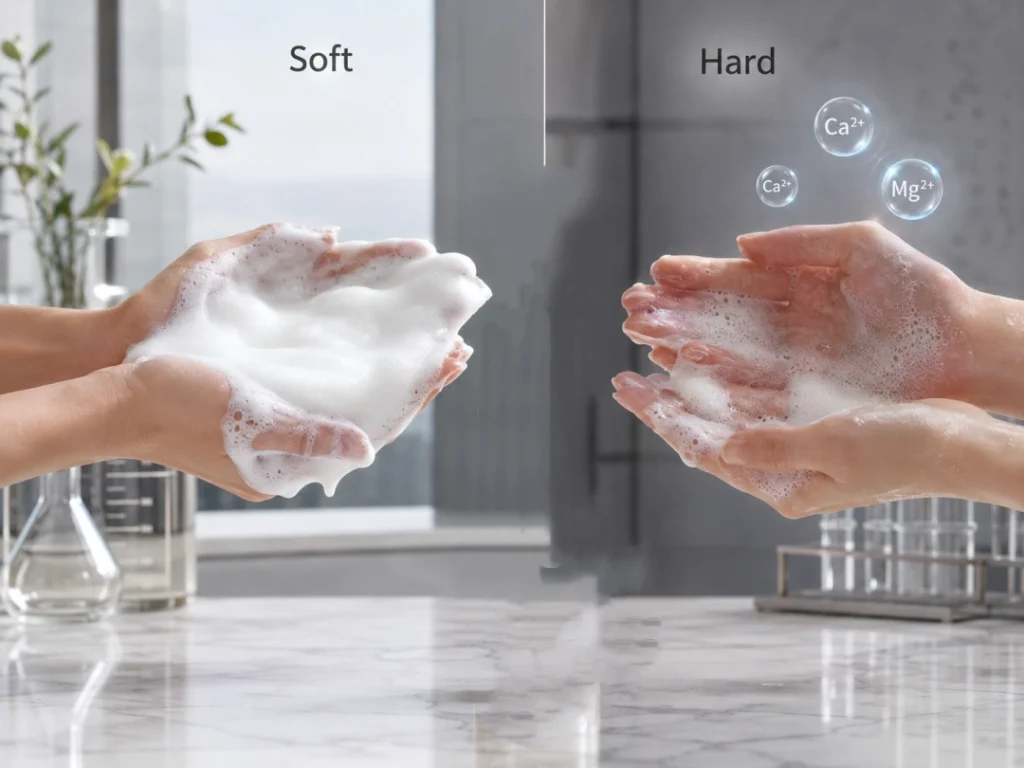
Hard water amino acid surfactant foam is foam generated in water containing measurable calcium and magnesium. Those divalent ions can alter surfactant solubility, interfacial adsorption, and micelle behavior, but the direction and size of the effect depend on the surfactant blend, concentration, pH, temperature, and test method.
This article builds a controlled comparison after a water-source change. Product conclusions require a defined formula and test data. The full amino acid surfactants formulation guide covers the wider formulation framework.
Turn hard water amino acid surfactant foam into a measurable task
Replace “the foam became worse” with a defined output and a repeatable observation. Foam can change in initial volume, rate of generation, bubble texture, drainage, decay, or response to soil and oils. One adjective cannot tell you which of those moved.
Match the reported problem to the right output
Initial foam height alone cannot explain slow lather or rapid collapse. Record decay separately, and keep rinse observations apart from instrumental or visual foam results.
Write the decision before testing. A municipal-water investigation, a water-specification study, and a raw-material investigation are different experiments.
Convert subjective language into recorded observations
Choose a method your lab can repeat. Record concentration, active matter, water preparation, temperature, agitation, vessel geometry, solution age, initial foam, and later readings. Define any bubble-size or drainage observation before testing.
Do not add a new chelant, change pH, or adjust product concentration in the same first comparison. That would test a reformulation, not the water-hardness effect.
Use the mechanism to design the test, not to predict the winner
Calcium and magnesium can interact with ionic surfactant systems, but the result is formulation-specific. They may screen charge, associate with anionic headgroups, change interfacial packing, or reduce the amount of freely soluble surfactant. None of those possibilities proves that a finished amino acid surfactant formula will lose foam.
Divalent ions can change interfaces and micelles
The USGS definition of water hardness is based mainly on dissolved calcium and magnesium. In an anionic system, these divalent ions create a different binding environment from sodium or potassium, which can alter interfacial adsorption and bulk aggregation.
A recent study of three conventional anionic surfactants found surfactant-specific responses to calcium and proposed headgroup binding and interfacial rearrangement. The materials were not amino acid surfactants, so the paper frames variables rather than INNO product performance.
Ion balance and solubility can create non-obvious results
Total hardness is useful, but it does not fully describe water chemistry. Two waters with the same hardness as calcium carbonate can have different calcium-to-magnesium ratios, alkalinity, counter-anions, conductivity, and trace ions. If the field problem is tied to a specific water source, preserve or analyze that water rather than replacing it with an undefined “hard water” recipe.
Hard water does not move every foam measurement in the same direction. A study of SDS and magnesium-induced crystals showed that initial foam, decay, and longer-term stability can diverge. SDS is not an amino acid surfactant, so this is a test-design warning, not a product prediction.
Lock the variables that can overwrite the water effect
Water hardness should be the main changed input in the first matrix. If active matter, pH, temperature, raw-material lot, fragrance, agitation, or sample age also changes, the result cannot be assigned to calcium and magnesium.
Freeze the formula and test-solution inputs
Prepare all test solutions from the same finished-product batch where possible. Use the same dilution basis and calculate concentration on active matter when comparing formulas with different supplied concentrations. Keep pH unchanged unless pH is the planned second experiment. Record fragrance, oils, polymers, electrolytes, and any chelating material already present because they may influence the observed response.
Use the same vessel, fill volume, mixing energy, and temperature. If the product is normally diluted by the user, select a test dilution that reflects the technical question and document it. Do not present that dilution as an industry standard unless a method or product protocol supports it.
Define both water chemistry and material identity
Include a low-hardness or deionized-water baseline, a controlled hard-water series, and the field water when the complaint comes from a real source. Prepare the controlled waters from the same stocks and report hardness as an equivalent concentration of calcium carbonate. Record calcium and magnesium separately when the source profile or mechanism matters.
Also record surfactant product name, INCI, salt form, supplied active matter, lot, and document version. A raw-material lot or grade change can coincide with a water change and create a convincing but false correlation.
Standardize preparation, foam generation, and reading time
A foam result is comparable only when the method conditions match. The ASTM D1173 foaming-properties method specifically calls for reporting test-solution concentration, temperature, water hardness, and foam height, and it warns that controlled results do not necessarily correlate with a specific end use.
Prepare test solutions on one documented basis
Precondition water and product according to the method. Keep the mixing sequence and solution age constant, and avoid uncontrolled air before foam generation. Record cloudiness, sediment, or crystals before agitation.
When comparing two formulas, match total active matter in the test solution rather than only matching grams of supplied product. When testing one formula against several waters, keep the product mass and preparation route identical.
Record initial foam and decay as different measurements
Capture the foam at the first defined reading and at the same later intervals for every sample. Record liquid drainage or visible collapse separately if those observations support the user task. Avoid combining initial height and persistence into a single unvalidated score.
Report apparatus, agitation, vessel dimensions, volume, temperature, hardness, concentration, solution age, reading times, and replicate results. A practical screening method is usable when its conditions are explicit.
Use a one-variable water matrix to test causality
The cleanest first experiment changes the water and nothing else. A compact matrix is usually more useful than a large screen because each lane has a clear purpose and an interpretation limit.
Build a baseline and controlled water conditions
Start with a baseline water whose composition is known. Prepare the planned hardness conditions using one documented stock procedure. Add a field-water lane if it represents the reported problem. Use planned replicates and repeat any condition that shows high variation before interpreting the difference.
| Test lane | Water input | What stays fixed | Main question |
| Baseline | Defined low-hardness or deionized water | Formula, active matter, pH, temperature, method | Does the formula produce a repeatable reference? |
| Controlled hardness | Prepared calcium and magnesium conditions | All non-water inputs and test steps | Does hardness level or ion balance move the foam result? |
| Field water | Characterized source sample | Product batch and foam method | Does the real water reproduce the reported change? |
If the baseline is unstable, stop. The water matrix cannot diagnose a non-repeating formula or method.
Retain samples and review variation before mechanism
Keep water, prepared solutions, photographs, and raw data. Record preparation and storage, then review replicate spread and procedural deviations before assigning a mechanism.
If the prepared hard water behaves differently but the field water does not, the synthetic recipe may not represent the real source. If the field water changes the result while a hardness-matched synthetic water does not, analyze the additional water variables rather than increasing the hardness blindly.
Turn the result into the next engineering action
The result should tell you whether to continue a water-chemistry study, investigate another variable, or move to formulation work. It should not end with the phrase “hard water affects foam” because that statement gives the team no decision.
Use the pattern of results to choose the next test
If only the water condition changes and the foam response moves reproducibly, the next study can separate hardness level, calcium-to-magnesium balance, or the contribution of existing chelating and electrolyte components. If both baseline and hard-water results drift, check the foam method, product batch, pH, temperature, and solution age first. If a field water cannot be reproduced by a hardness-matched synthetic water, expand the water analysis.
Do not claim a family is hard-water tolerant from one formula. A useful conclusion is narrower: under the recorded formula, water composition, and method, a defined change produced a repeatable response.
Send technical review the complete comparison
Provide the full formula, raw-material products and lots, active-matter calculation, finished-product pH, water analysis or preparation recipe, test-solution concentration, temperature, solution age, foam method, reading times, photographs, replicate data, and any appearance changes. Include both the baseline and the field sample when available.
FAQ
Does hard water always reduce amino acid surfactant foam?
No, hard water does not always reduce amino acid surfactant foam in the same way. Calcium and magnesium can change initial foam, decay, solubility, or appearance, but the response depends on the complete surfactant blend, active matter, pH, temperature, other ingredients, and test method.
What is hard water in a surfactant foam test?
Hard water is water containing measurable dissolved calcium and magnesium, usually reported as an equivalent concentration of calcium carbonate. A useful foam test also records the calcium-to-magnesium balance or preparation recipe because total hardness alone may not describe every interaction relevant to the formula.
What must stay constant in a hard water amino acid surfactant foam test?
Keep the product batch, active matter, pH, product concentration, temperature, vessel, foam-generation method, solution age, and reading times constant. Change only the planned water variable in the first comparison, then repeat the result before assigning a mechanism.
Can ASTM D1173 predict consumer foam performance?
ASTM D1173 provides a controlled method for comparing foaming properties, but it does not necessarily predict a specific end use. Use it or a documented internal method for reproducible screening, then confirm any important decision under conditions that represent the product’s actual use.
Technical references
- U.S. Geological Survey, Hardness of Water. Definition and reporting context for calcium- and magnesium-based water hardness.
- ASTM D1173, Standard Test Method for Foaming Properties of Surface-Active Agents. Controlled foam-test variables, reporting fields, and method limitations.
- Du et al., Molecular dynamics simulation of the effect of calcium ions on the foamability of anionic surfactants, Colloids and Surfaces A, 2025. Mechanistic background from non-amino-acid anionic surfactants.
- Rio et al., Aqueous Foams in the Presence of Surfactant Crystals, Langmuir, 2020. Evidence that initial foam and long-term stability can respond differently in an anionic model system.