Three sodium lauroyl glutamate powders arrive on the shortlist. Purchasing adds the prices to one spreadsheet. R&D adds the headline percentages. For a moment, the answer looks wonderfully simple.
Then someone asks the question that matters: How can we quickly and effectively identify which one we really need?
Public specifications answer only the first part. AMISOFT LS-11 reports content calculated from nitrogen. PROTELAN AGL 95 PV is listed by active matter. INNO’s current declared content for KWLG-95 is 98.5%, while its SDS separately gives a composition range and its TDS sets limits for water, acid value and pH. These figures cannot be ranked until their definitions are aligned.
A separate internal screen adds a useful quality check. In that four-sample comparison, the INNO KWLG-95 sample returned the highest measured active content. Compared with the AMISOFT LS-11 reference sample, it also had lower free lauric acid. KWLG-95 holds a lower current price position than the reference branded grades. The declared content, screened result and current quote support the same cost-in-use case.
Use the sample result with the current controlled documents and matched quote.
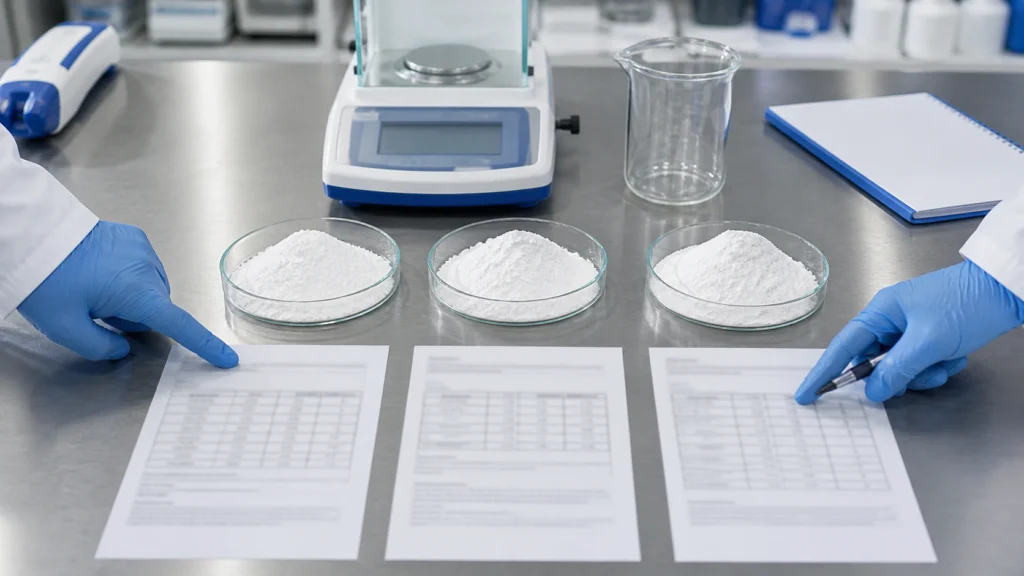
Same INCI, three documents, and one deceptively untidy comparison.
The same INCI gets all three onto the shortlist
KWLG-95, AMISOFT LS-11 and PROTELAN AGL 95 PV are identified as sodium lauroyl glutamate powder grades in the sources reviewed for this article. That establishes the ingredient family and gives the comparison a sensible starting point.
It does not make the grades interchangeable. An INCI name does not describe moisture, inorganic salts, assay method, particle form, processing advice, packaging or the supplier’s release tests. Those details decide whether a substitute is genuinely easy or merely easy to type into a purchasing system.
If your team needs the chemistry and application background before comparing trade grades, start with the amino acid surfactants guide. The comparison here stays with the narrower task of choosing and qualifying a sodium lauroyl glutamate powder.
The public numbers do not share a common grammar
Here is what each reviewed source actually says. A blank means the item was not stated in that particular source, not that the supplier has no data. Current controlled documents may contain more detail.
| Comparison item | INNO KWLG-95 | AMISOFT LS-11 | PROTELAN AGL 95 PV |
| INCI in source reviewed | Sodium Lauroyl Glutamate; KWLG-95 TDS also lists Aqua and Sodium Chloride | Sodium Lauroyl Glutamate | Sodium Lauroyl Glutamate |
| Physical form | White solid powder | White to pale yellow powder | Powder |
| Percentage wording | Current declared content: 98.5%; SDS composition disclosure: Sodium Lauroyl Glutamate 93.5-100% | Content: 93-100%, calculated as 25.4 x nitrogen content | Active matter: greater than 90% |
| Moisture-related item | Water: 5% maximum in TDS; SDS lists Aqua at 0-5% | Loss on drying: not more than 5.0% | Not stated in the public catalogue reviewed |
| Other stated items | Sodium chloride 0-1.5% in SDS; acid value 100-140; pH 4.5-6.5 in 10% aqueous preparation at 20 C | Acid value 105-140; nitrogen 3.6-3.9%; identification and impurity tests are also listed | Anionic classification; other specification details not stated in the public catalogue reviewed |
| Source date or status | Current internal TDS and SDS; SDS enacted 2024-06-17 | Public quality-assurance specification revised 2014-01-01 | Public global product list dated 2023 |
The AMISOFT values come from Ajinomoto’s public quality-assurance specification for LS-11. The PROTELAN entry comes from the Zschimmer & Schwarz global product list. Both are useful public references. Neither should replace the current controlled specification supplied for a live purchase.
Use the table to build a shortlist and supplier questions, not to force a one-number ranking.
Content, active matter and SDS composition are different nouns
AMISOFT LS-11’s public specification defines content through a calculation: 25.4 x nitrogen content (%). That number is tied to a stated analytical route. PROTELAN AGL 95 PV is listed as greater than 90% active matter, but the public catalogue page does not explain the method. KWLG-95’s 93.5-100% figure appears in Section 3 of the SDS as composition information.
Those labels answer related, but not identical, questions. “Content” may refer to an assay based on a defined marker. “Active matter” depends on the supplier’s analytical definition and method. An SDS composition range supports hazard communication; it is not automatically the commercial release specification.
This is why the apparent calculation below needs a condition attached:
Cost at equal declared basis = price per kilogram / declared basis as a decimal
The formula is useful only when the percentage definitions are compatible. Dividing three prices by three unlike numbers produces an impressively precise answer to the wrong question.
Before using a percentage for dosage or cost normalization, ask for its name, method, sample basis and release limit. The TDS, SDS and COA guide explains what each document can and cannot prove.
The practical differences begin after the assay
Once the percentage language is sorted out, the less glamorous details start earning their keep. Powder form affects weighing, dust control, dispersion time and the amount of handling your operators will tolerate before they invent their own shortcut.
Powder is not a complete physical description
Ajinomoto’s current product page describes LS-11 as a powder flake form, while the public Zschimmer & Schwarz catalogue and KWLG-95 documents use the broader word “powder.” The reviewed sources did not give enough particle-size, bulk-density or flow data to rank handling.
A sample tells you more: does the material flow from the bag, bridge in a hopper, dust during charging, wet out evenly and clear the vessel wall?
Water, salts and pH belong in the formula conversation
KWLG-95 documents state up to 5% water, an SDS sodium chloride range of 0-1.5%, and a pH of 4.5-6.5 for a 10% aqueous preparation at 20 C. The reviewed AMISOFT specification gives a loss-on-drying limit but no pH value; the reviewed PROTELAN public catalogue gives neither.
That does not prove one grade is more consistent. It tells you which questions remain open. Moisture and salts can change the amount of surfactant and electrolyte entering the batch. A raw-material pH result is meaningful only with its dilution and temperature. For the finished formula, pH changes amino acid surfactant system behavior in ways that a trade-name comparison cannot predict.
A fair bench comparison is pleasantly boring
The best first screen is not elaborate. It simply gives each candidate the same job. Keep one reference formula, one water source, one batch size and one equipment setup. Record enough detail that the second run is not an archaeological project.
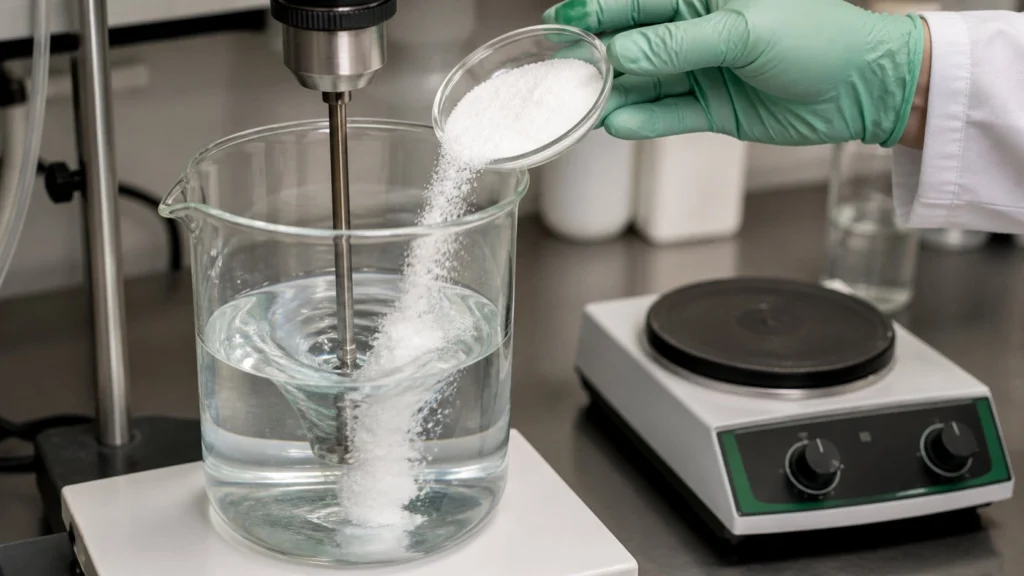
Parallel preparation removes avoidable noise before the formula begins to speak.
Start by checking whether the supplier percentages can be placed on a common supplied-surfactant basis. If they cannot, compare at the quoted as-supplied level first and label that limitation. Then use the same addition order, mixing time and temperature for all three samples. Measure pH by the same method and adjust only when the formula requires it.
The first observation sheet can stay short:
- Charging and wetting: dust, floating powder, wall deposits, lumping and time to disperse.
- Fresh batch: pH, appearance, odor and any obvious undissolved material.
- After the same hold period: appearance, pH and viscosity at a stated temperature and method.
- Use performance: foam and rinse evaluation under the same water and test procedure.
- Stress point: repeat the comparison after the fragrance, polymer or electrolyte step most likely to disturb your real formula.
This screen does not prove universal superiority. It answers the question your plant actually asked: which documented grade reaches the agreed result with the least reformulation and process friction?
A lower price matters most when the sample also delivers
KWLG-95’s commercial advantage begins with a lower current quote position than the reference branded grades. We do not publish a universal saving because volume, packaging, Incoterm and destination can move the landed price. A matched quotation is more useful than a floating percentage.
The internal sample result makes that price difference more meaningful. The current declared KWLG-95 content is 98.5%, and the tested INNO sample had the highest measured active content in the screened set. Its value case was not based on buying a cheaper kilogram with less measured surfactant. When the analytical basis is aligned, compare delivered active content against the live price, then add freight, storage and any process time created by dispersion or rework.
For technical approval, request the current TDS, controlled specification, SDS and a representative COA. The AMISOFT public specification reviewed here was revised in 2014, and the PROTELAN catalogue is dated 2023. They help prepare the conversation; the controlled documents attached to the current offer should govern the purchase.
What the internal screen adds to the decision
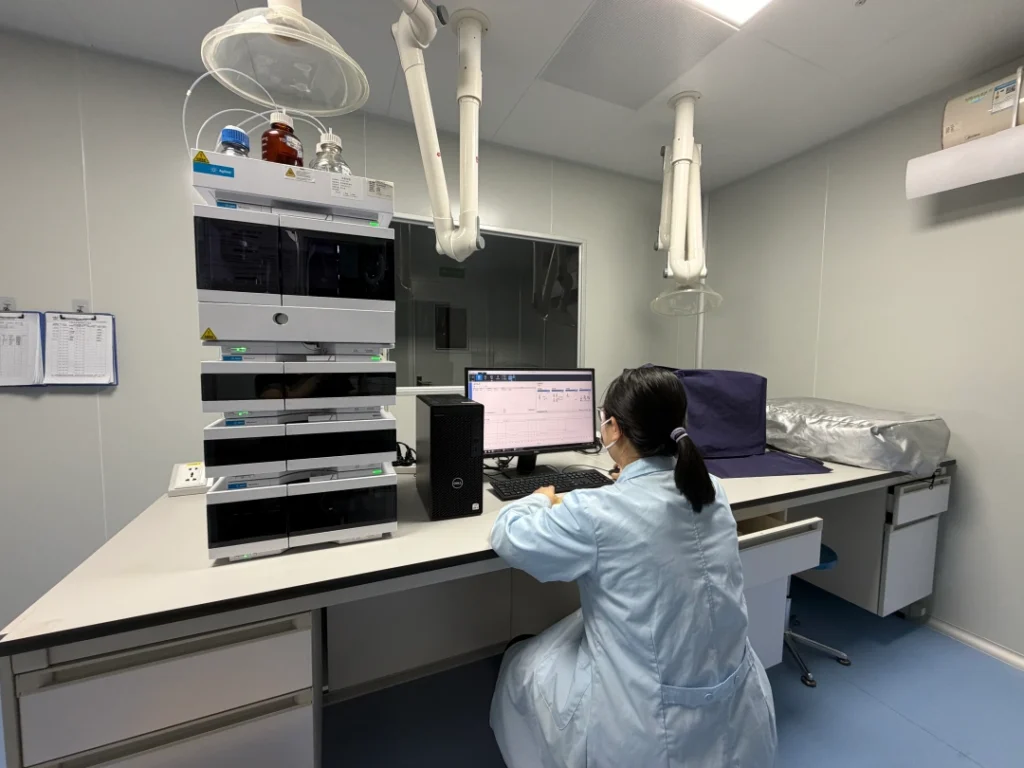
The four-sample internal screen looked at measured active content and free lauric acid as a chromatographic impurity marker. For the AMISOFT comparison in this article, the relevant result is direct.
| Sample | Manufacturer | Lauric Acid Impurity (%) | Sodium Lauroyl Glutamate Assay (%) |
|---|---|---|---|
| LG-95 | Kindwin | 2.68 | 103.90 |
| LG-95 | Yile | 2.70 | 105.60 |
| LG-95 | Ajinomoto | 3.56 | 103.80 |
| Screen item | INNO KWLG-95 versus the AMISOFT LS-11 reference sample | How to use it |
| Measured active content | Higher in the tested samples | A sample-level check, not a universal batch ranking |
| Free lauric acid | Lower in the tested samples | A chromatographic impurity observation for the tested samples |
| Current declared KWLG-95 content | 98.5% | The commercial content figure used for dosage and quote discussions |
The numerical chromatogram, batch identifiers and full test method are not published on this page, so the screen is reported only by direction. The 98.5% figure is INNO’s current declared KWLG-95 content, not the measured result from this screen. PROTELAN AGL 95 PV was not included in the internal screen, so its comparison remains document-based.
KWLG-95’s current internal TDS records a white solid powder, pH 4.5-6.5 in a 10% aqueous preparation, water at 5% maximum, acid value 100-140 and cold-water dispersion before heating. Its SDS separately lists sodium lauroyl glutamate, water and sodium chloride composition ranges.
If you want to compare the technical result and the price on the same basis, visit the KWLG-95 powder product page and send us the competing specification, required quantity, destination and intended use level. We can return a matched quote and agree on a focused sample check before you commit the formula or the purchase order.
Questions buyers and formulators ask before approval
Can AMISOFT LS-11 be replaced 1:1 with KWLG-95?
Not automatically. Confirm that the declared content basis is comparable, then screen KWLG-95 in the same formula and process. Water, salts, particle form, pH and the rest of the surfactant blend can make a nominal 1:1 substitution behave differently.
Is PROTELAN AGL 95 PV exactly 95% active?
The official 2023 public catalogue reviewed here lists active matter as greater than 90%, not exactly 95%. Ask for the current controlled specification and test method before using “95” as a calculation value.
Is KWLG-95 cheaper after active content is considered?
In the current comparison, KWLG-95 starts from a lower quote position, carries a declared content of 98.5%, and the tested INNO sample returned the highest measured active content in the screened set. The exact cost-in-use advantage still depends on the agreed test basis, quantity, Incoterm and destination.
What should I send INNO for a useful grade comparison?
Send the current competing specification, your use level, water source, target pH, addition order and the result that must not change. That is enough to plan a focused first screen.