Picture a facial cleanser prototype that looks promising on the bench. It removes the test residue, the viscosity is close to target, and the foam photograph looks good. Then the team tries it from the intended pump. The dose feels smaller, the lather thins under sunscreen, and the rinse leaves more drag than the brand brief allows.
Several changes now look reasonable. The surfactant blend could change. So could the active matter, fragrance route, rheology, or package. Changing them together would create another sample, but it would give the team very little help in deciding what worked.
A more useful next round separates three outcomes: cleansing, lather, and after-feel. The approach below helps you define the wash job, compare mild facial cleanser surfactants on the same basis, and carry the preferred route into the package and production process. The benefit is a shorter list of worthwhile changes and a clearer technical discussion with your supplier.
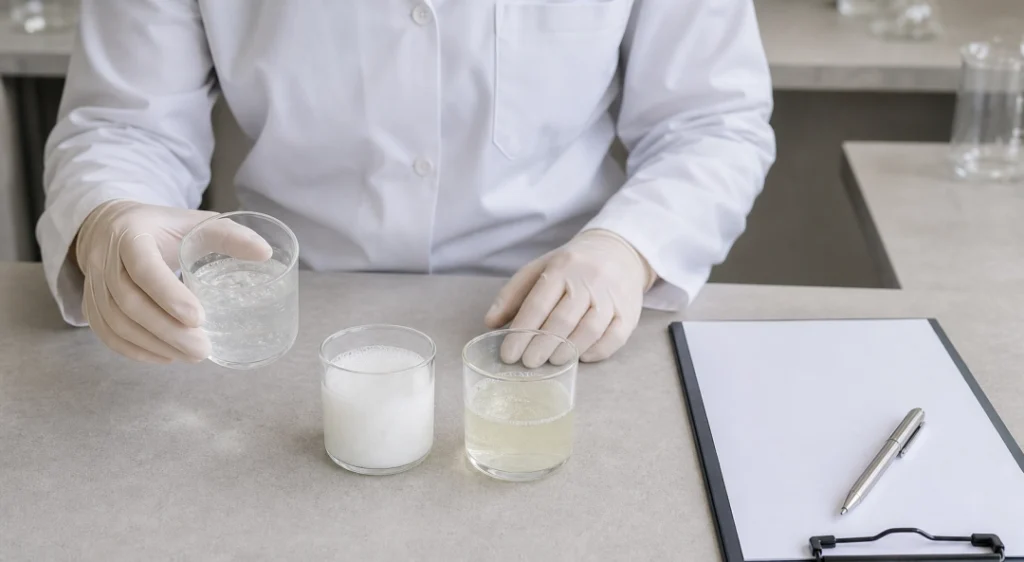
Concept illustration for prototype comparison. Use verified formulation and test records as performance evidence.
A clear brief makes the next sample round more useful
One page is usually enough to give R&D, purchasing, evaluation, and the supplier the same target. It also turns broad words such as “mild,” “creamy,” and “clean” into details that can guide a formula.
| Brief field | Useful detail | How it helps the project |
| Residue to remove | Light sebum, particulate soil, sunscreen, makeup residue, or another defined load | Keeps the cleansing test tied to the product’s job |
| Product format | Clear gel, opaque cream, pump foam, paste, or another format | Connects rheology and air delivery to the intended package |
| Lather target | Fast flash foam, fine creamy lather, dense cushion, or low-foam rinse | Gives the foam comparison a recognizable endpoint |
| Rinse target | Fast clean rinse, some slip, or a conditioned after-feel | Helps the team discuss the balance between cleansing and deposition |
| Process limits | Cold or heated process, mixing equipment, order of addition, and fill method | Keeps early samples relevant to the real plant process |
| Evidence needed | Appearance, viscosity, stability, use test, safety, claims, and target-market review | Shows what remains before the route can move forward |
The brief can also name an acceptable tradeoff. A cleanser designed for heavier residue may use a different lather target from a light daily wash. A fixed pump foamer places its own limits on viscosity and delivered dose. Capturing those choices early helps avoid sample rounds built around different assumptions.
A fair comparison of mild facial cleanser surfactants starts with active matter
The surfactant name is one part of the decision. Active matter, counterion, physical form, salt content, the rest of the blend, and the ingredients around it all influence the finished cleanser.
Active matter gives the samples a common basis
Two raw materials used at the same supplied percentage can deliver different amounts of active surfactant. Comparing them on active matter makes the dosage and cost discussion easier to follow.
For a raw material with a stated active content:
Delivered active matter (%) = raw material use level (%) x active content (%) / 100
Active matter is the comparison basis. Finished-formula testing still shows how the route behaves in cleansing, lather, rinse, and after-feel. The amino acid surfactants guide provides the wider chemistry and physical-form context.
A simple role map keeps the formula readable
It helps to give each material one clear reason for being in the first screening round. A secondary surfactant may support lather or rinse. A humectant or emollient may change after-feel. A polymer can move viscosity, deposition, and spreading. Fragrance and solubilizers can affect clarity and foam.
When two ingredients appear to solve the same problem, a simpler sample often gives a clearer answer. That clarity becomes valuable again during scale-up, when addition sequence and local concentration can change the way the system develops.
pH belongs on the same comparison sheet because it can affect the surfactant environment, preservation strategy, rheology, and finished-product specification. A pH value by itself is not evidence of mildness, so the product brief still needs an appropriate finished-product evaluation.
Three result lines make the tradeoff easier to see
One overall score can hide the reason a sample wins. Separate results for cleansing, lather, and after-feel make the tradeoff visible. A strong foam result may sit beside an ordinary rinse. Two samples may clean similarly and leave a very different feel after drying.
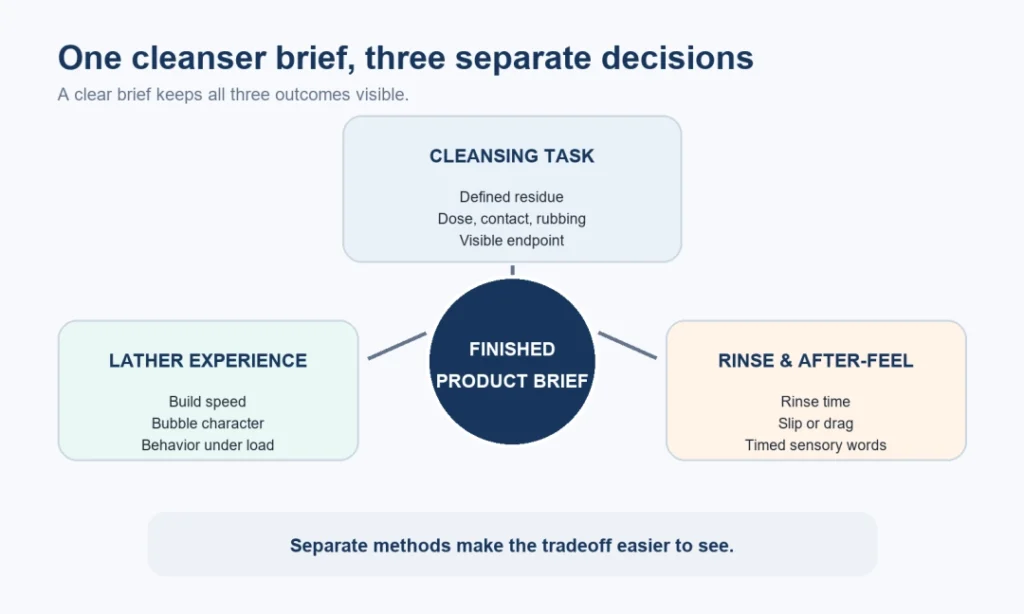
The product brief stays at the center while each outcome uses a method suited to that question.
Cleansing should reflect the residue the product will meet
A useful comparison uses a repeatable residue or soil that matches the intended use. Keeping dose, contact time, rubbing, water, and rinse sequence consistent makes it easier to see what remains at the chosen endpoint.
Claims work comes later, using evidence designed around the final wording, target market, and finished product. The Cosmetics Europe claim-substantiation guidance explains that relationship from a European industry perspective.
Lather is easier to improve when the failure is described
Foam height is only one part of the experience. Build speed, bubble character, behavior under the target residue, and foam life during the wash give a much clearer picture of what the user sees and feels.
When lather is holding back an otherwise promising formula, how to improve foam in mild surfactant formulations follows the problem from slow foam build to collapse during use. That makes it easier to choose the next formulation route without reopening the whole cleanser system.
Shared sensory words make after-feel easier to discuss
Terms such as “soft,” “clean,” “tight,” “slippery,” and “coated” become more useful when the team agrees on their meaning and the observation time. The same evaluator may describe the product differently during rubbing, during rinse, immediately after drying, and after a stated interval.
Published research describes how surfactants can interact with stratum corneum components and how cleanser solution structure can affect those interactions. This open-access review of cleanser and skin-barrier interactions is useful mechanism background. Product-specific decisions still come from an appropriate finished-formula method.
The package often explains the bench-to-use gap
Bench work gives the team a repeatable comparison. The intended package shows how much product reaches the hand and, in a foamer, how air enters the formula. Looking at both can explain why a sample changes character outside the beaker.
Delivered dose can change the experience
A pump, tube, or foamer may deliver a different dose from the weighed amount used at the bench. Flow, air intake, and viscosity also affect how easily the customer can spread and lather the product.
Testing the preferred samples through the intended package often reveals whether the formulation needs another change or whether the apparent problem starts with delivery.
One wash sequence makes internal feedback more useful
A short written sequence can cover dose, wetting, rubbing, added water, rinse, drying, and observation time. Applying the target residue in the same way gives everyone a comparable starting point.
A short video can capture lather build and rinse timing more clearly than a final foam photograph. It also gives purchasing, R&D, and the brand team something concrete to review together.
Instrumental and sensory results work best side by side. pH, viscosity, foam, and residue measurements track physical changes. Defined panel terms explain cushion, slip, tightness, and coated feel. Together they show why the team prefers one route.
The preferred route still has to fit production
A promising use-test sample becomes more useful when it also fits the project’s appearance, viscosity, pH, dispensing, stability, and packaging requirements.
Recording addition sequence, temperature, mixing, and the point at which viscosity develops can save time when the route moves beyond the bench. Surfactants, polymers, fragrance, acids, bases, and salts can create local conditions that the final pH reading does not show. If viscosity becomes the next obstacle, the amino acid surfactant thickening guide helps narrow the available thickening routes.
The preservation plan also belongs with the finished formula, process, packaging, target market, and required challenge test. Keeping these questions connected helps prevent a pleasant beaker sample from becoming an expensive late-stage rework.
Send INNO the brief and we can narrow the next step
The supplier conversation becomes much more useful when the enquiry contains the product task as well as the requested ingredient. The following details give us a practical starting point:
- intended format and package;
- target market and claims under consideration;
- residue or cleansing task;
- desired lather, rinse, and after-feel;
- current surfactant trade names, INCI names, use levels, and active matter;
- pH, viscosity method, water source, fragrance or oil load, and process limits;
- the current prototype’s main problem and any reference product being matched.
With this brief, INNO can keep the first discussion focused on current technical documents, raw-material form, active basis, and sample availability for your project. You receive a more relevant response, and the next sample can be tied to a clear evaluation question.
Send your facial-cleanser brief to INNO when you are ready. If the current result is difficult to describe, the formula basis, wash sequence, package, and point where the experience changes are enough to begin the discussion.