Your mild cleanser meets the cleansing brief, but the lather feels weak, disappears under soil, or never becomes dense enough during use. Adding more surfactant may raise foam in a quick bench check. It may also move viscosity, rinsing, cost, and the preservative environment without fixing the original cause.
To improve foam in a mild cleanser formulation, first identify where the foam is being lost. A formula that creates little foam needs a different response from one that builds quickly and then collapses. Water hardness, oil load, active matter, pH, viscosity, and the way the test introduces air can all change the result before you change the surfactant family.
This article gives you a practical order of work. It does not rank INCI names or promise that one additive will repair every system. The aim is simpler: make the next bench sample answer a useful question.
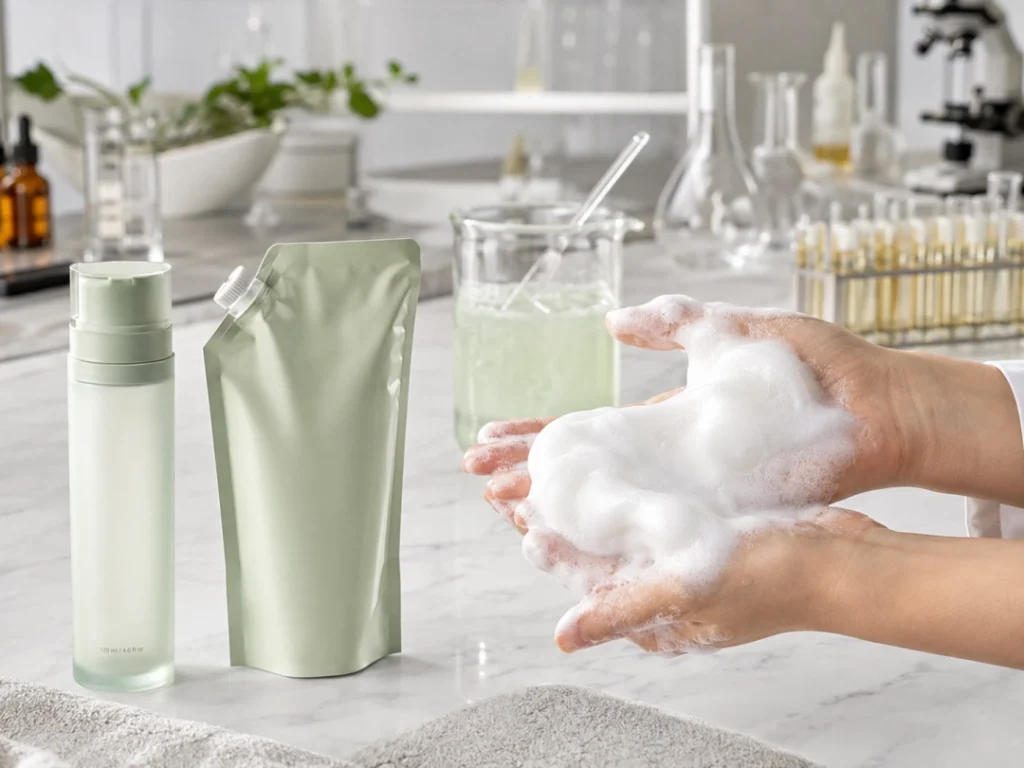
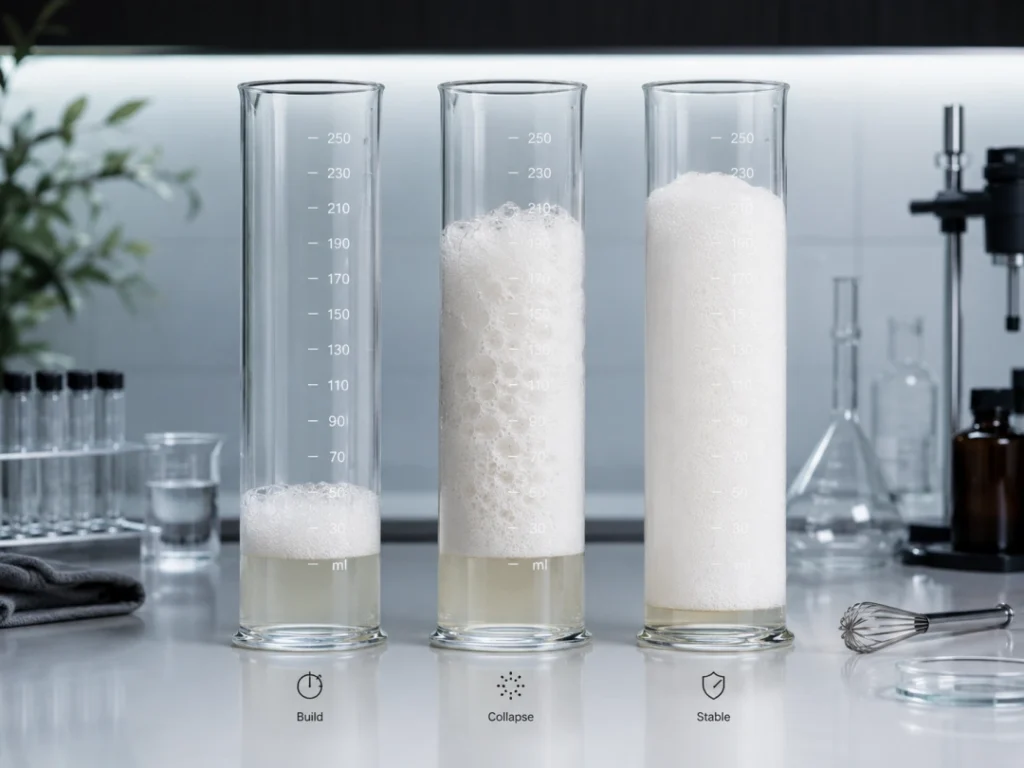
Illustrative foam-comparison scene. It is not an INNO test result or a performance comparison.
Find out which part of the foam is failing
“Low foam” is too broad to guide a formula change. Watch when the problem appears and how the bubbles behave. The timing usually points you toward a shorter list of causes.
| What you observe | What it may indicate | First useful check |
| Foam is slow to build from the first rub | Low delivered active matter, limited aeration, high viscosity, or a weak blend for the use condition | Match active matter and the foam method before changing ingredients |
| Foam rises quickly but falls within seconds | Film drainage, oil or fragrance load, electrolyte effects, or a blend that produces large, fragile bubbles | Compare the base with and without the hydrophobic load |
| Bench foam looks acceptable, but hand washing feels flat | The bench method may not reproduce dilution, rubbing, soil, or water quality during use | Repeat with the actual water and a use-relevant dilution |
| Foam changed after a water-source or pH change | Mineral ions or the pH adjustment may have changed the surfactant environment | Follow the hard-water or pH path before rebuilding the blend |
Foam never develops
Start with the calculation. Compare formulas on an active-matter basis, not simply at the same supplied percentage. Two raw materials dosed at 10% can deliver very different amounts of surfactant if their concentrations differ.
Then look at the method. A viscous sample may need more work to entrain air. A low-energy bench method can make a serviceable formula look weak, while a blender test can make almost any sample look impressive. Neither result is useful unless it resembles the way the cleanser will be dispensed and used.
Foam develops, then disappears
Fast collapse often deserves a paired sample before a new surfactant. Remove or reduce the most likely hydrophobic load in one small portion of the base, usually the fragrance, oil, or an emollient-rich additive. If the foam holds without it, the next task is compatibility and solubilization, not simply more surfactant.
Large bubbles can also drain faster than a finer lather. Record bubble appearance as well as height. A single number will not tell you why the user experiences the foam as thin.
The laboratory and the wash test disagree
That disagreement is useful. It tells you that the test is missing part of the product’s real job. Check dose, dilution, rubbing time, water temperature, water hardness, soil or oil load, and the point at which you record foam. Do not average unlike methods into one score.
Fix losses that are not caused by surfactant choice
Some foam problems disappear when the test basis is corrected. This is the cheapest place to start because it does not force a new raw material, a new specification, or another round of stability work.
Water, dilution, and sample age
Use the same water source for the reference and the modified sample. If plant water changed, compare it with the previous source or prepared water at the same formula dilution. The hard-water foam guide explains how to separate a water effect from a surfactant effect.
Give the samples the same rest period. Freshly made surfactant systems may contain different amounts of entrained air or may not have reached the same viscosity. A sample tested immediately and another tested the next day are not a fair pair.
Fragrance, oils, and other hydrophobic material
Hydrophobic ingredients can consume foam capacity or disturb the interfacial film. The effect depends on the ingredient, its dose, the solubilization route, and the surfactant blend. Do not assume every oil has the same effect.
A practical check is to compare the finished base with a version that omits only the suspected hydrophobic material. If the foam returns, work on that ingredient’s incorporation and compatibility. If it does not, move on.
pH and added electrolyte
A pH adjustment adds more than a new meter reading. The acid or base also brings water and ions into the formula, and it may change how some surfactants associate. If foam changed at the same time as clarity or viscosity, use the amino acid surfactant pH guide before treating the symptom as a foam-only problem.
Match the adjustment to the failure
Once the loss point is clear, choose an adjustment that can plausibly address it. Avoid changing the surfactant blend, active matter, fragrance route, thickener, and pH in the same sample. You may get better foam, but you will not know what produced it.
When the blend needs help building foam
Compare a small change in the primary-to-secondary surfactant balance while holding the total active matter steady. This tells you whether the blend composition matters without confusing it with a higher total surfactant dose.
Use the current TDS to calculate delivered active matter and note the raw-material form. A powder and an aqueous grade can represent the same broad chemistry while behaving differently during manufacture because they bring different amounts of water and salts.
When the foam needs to last longer
Look first at the ingredients that weaken the foam film and the way the formula drains. A co-surfactant, polymer, or rheology change may alter bubble stability, but it can also change clarity, rinse, and viscosity. Treat it as a formulation route, not as a universal “foam booster.”
If a candidate improves the cylinder result but creates stringy flow or a coated rinse, it has not met the product brief. Keep the use test beside the foam measurement.
When more active matter is the proposed answer
Raising active matter is a legitimate experiment, but it changes more than foam. It can affect cleansing, cost per batch, viscosity response, preservative demand, and rinse behavior. Make the increase visible in the formula sheet and compare it with a blend-ratio adjustment at the original active level.
That difference affects cost, too. If a formula needs a much higher use level, it may be the weaker route even when its first foam reading is higher.
Use a short adjustment ladder
Build the next round from one homogeneous base so every sample starts in the same place. Keep the current formula as the reference. Then choose the smallest set of changes that can separate your leading explanations.
For example, one sample can change the blend ratio at equal total active matter. Another can remove the suspected foam suppressant. A third can repeat the current formula in the target water. You do not need every possible combination. You need enough separation to decide which route deserves another day of work.
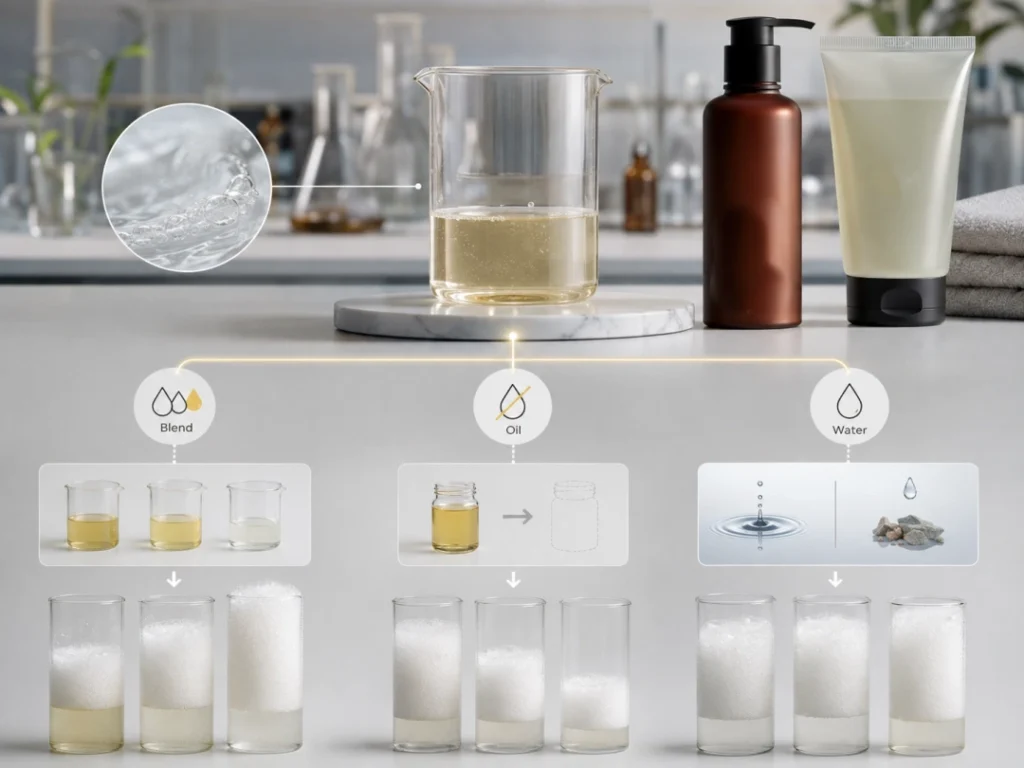
Record the formula dose and active basis, water, pH, temperature, sample age, foam method, initial foam, decay, and visual bubble character. If hand evaluation matters, use the same dose, wetting time, rubbing sequence, and rinse time. Describe what the evaluator felt instead of writing only “good” or “bad.”
ASTM D1173 covers foaming properties of surface-active agents and calls for reporting items such as concentration, temperature, water hardness, and foam height. Its scope also warns that the method does not necessarily predict a specific end use. That is a useful boundary: use a repeatable bench method to compare samples, then use a wash method that represents your product. See the ASTM D1173-23 method summary.
Do not trade a foam fix for a viscosity problem
Surfactant ratio, electrolyte, polymer, and active matter can all move foam and flow at the same time. Recheck viscosity only after the samples have reached the same temperature and rest time. Use the same spindle, speed, vessel, and sampling point.
If the foam route produces an acceptable lather but the viscosity no longer responds, move to the amino acid surfactant thickening guide. That page owns salt response and thickening-route development. This page only asks whether the foam adjustment has created a second problem.
Manufacturing can also hide a good formula. Excessive air during mixing may make the batch look thick, interfere with filling, or distort density and foam readings. Record where air enters and allow a consistent deaeration or rest period before comparing samples.
Send the foam profile, not just “low foam”
If the failure point is still unclear, send INNO the information that allows a useful first review:
- complete surfactant blend with trade names, INCI names, supplied concentration, and formula percentage;
- finished-product active matter calculation;
- water source or hardness information;
- pH before and after the foam change;
- fragrance, oils, solubilizers, polymers, and electrolyte levels;
- batch order, temperatures, mixing history, and sample age;
- foam method, dilution, photos, initial result, and decay observations;
- the reference batch or product behavior you are trying to match.
With that record, the discussion can focus on the most likely route: method correction, water, hydrophobic load, blend ratio, active matter, pH, or rheology. You can send the formula and foam observations for review or request current documents and sample availability for the INNO amino acid surfactant range.
Before you change the formula again
Check that the current sample and the reference use the same active-matter basis, water, temperature, age, and foam method. Decide whether the problem is foam build, foam life, or performance during washing. Then change one route that matches that failure.
More foam is not automatically more cleansing, and a taller cylinder result is not automatically a better user experience. The useful result is the one that helps you choose the next formulation step without creating a new problem elsewhere.