If your amino acid surfactant cleanser is too thin, the first step is usually not to add more salt or more thickener. First confirm what is actually in the surfactant base: active matter, surfactant ratio, pH, electrolyte load, and process conditions. Then change one variable at a time.
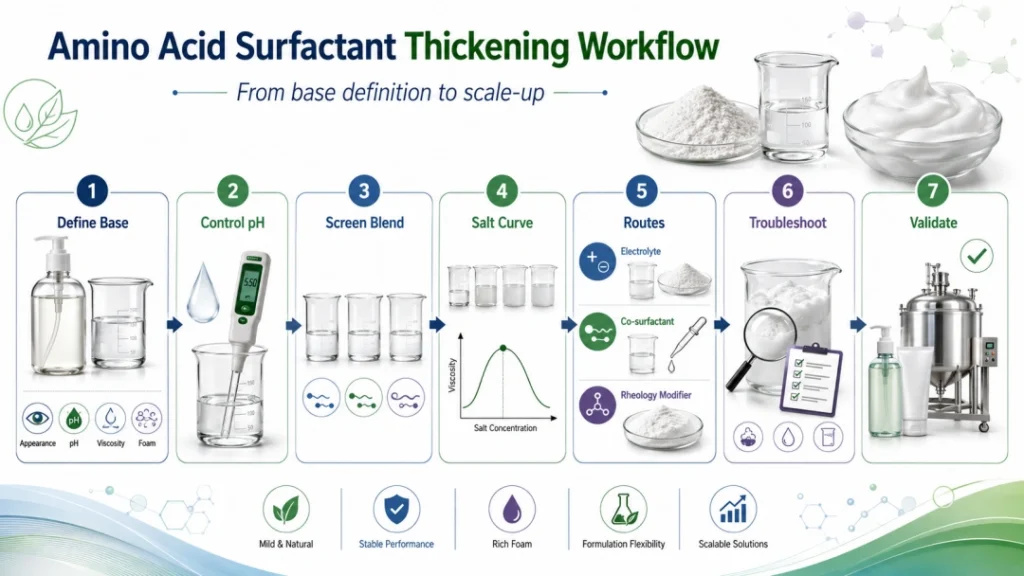
In our formulation work, we normally use this sequence:
Define the base → control pH → screen the surfactant blend → build a salt curve → compare thickening routes → troubleshoot → validate the final formula.
This matters because two formulas that look almost identical on paper can have very different viscosity responses. A change in raw-material active content, counterion, co-surfactant ratio, fragrance, preservative, pH, or addition order can move the system into a different rheological region.
Published work on amino-acid-derived surfactants supports this need for controlled testing. Sodium lauroyl sarcosinate systems, for example, can show substantial changes in micellar structure and rheology when pH or formulation composition is changed. That does not mean every glycinate, glutamate, sarcosinate, or alaninate behaves the same way. It means amino acid surfactant thickening has to be treated as a formulation problem, not as a fixed salt-dosage recipe.
The practical goal is not simply to reach the highest viscosity in one beaker. It is to find a viscosity window that your formula and manufacturing process can reproduce.
Define the System Before You Try to Thicken It
Before comparing thickeners, make sure you are comparing equivalent surfactant systems. We first identify the surfactant chemistry, supplied form, active content, counterion, co-surfactants, and target pH.
“20% amino acid surfactant” is not enough information.
A liquid sodium cocoyl glycinate, a concentrated sarcosinate, and a glutamate blend may differ substantially in supplied solids and formulation behavior. Even surfactants within the broader amino-acid-derived category can form different aggregate structures under comparable conditions. Experimental comparisons between N-acyl glycinate and N-acyl glutamate systems illustrate why chemistry should not be treated as interchangeable simply because both materials belong to the same broad surfactant family.
The first number we normalize is active matter:
Active surfactant (%) = Raw material dosage (%) × Active matter (%) ÷ 100
For example:
- 20% of a surfactant supplied at 30% active gives 6% active surfactant.
- 20% of a surfactant supplied at 50% active gives 10% active surfactant.
Those two formulas do not contain the same surfactant loading, even though the raw-material dosage is identical.
For each trial, we therefore record the surfactant composition, total active matter, pH, electrolyte concentration, co-surfactants, thickener, mixing sequence, temperature, viscosity measurement conditions, and appearance.
If two beakers behave differently, the first question is: what changed between them?
Use a Controlled Thickening Sequence
Amino acid surfactant thickening becomes much easier to diagnose when pH, surfactant ratio, salt, and rheology modifier are not changed simultaneously.
We normally start by fixing the pH range required by the finished product. pH should not be treated only as a final specification adjustment. In some amino-acid-derived surfactant systems, changing pH can alter micellar structure and rheological response. This has been demonstrated experimentally in research on pH-dependent micelle structure and rheology in a sodium lauroyl sarcosinate / cocamidopropyl hydroxysultaine system.
The correct question is therefore not:
What is the best pH for amino acid surfactants?
It is:
Can we build stable viscosity at the pH where this particular product actually needs to operate?
Once that pH is controlled, we compare the surfactant blend. An amino acid surfactant used alone may behave differently from a system containing an amphoteric or nonionic co-surfactant. Co-surfactants can change aggregate packing and rheological behavior, so they should be treated as structural formulation variables rather than only as foam boosters. Research on sodium cocoyl glycinate and sodium N-lauroyl sarcosinate mixed systems has demonstrated viscosity changes associated with surfactant composition and pH.
Only after that baseline is stable do we decide whether electrolyte thickening is worth screening.
Build a Salt Curve for Amino Acid Surfactant Thickening
A single successful NaCl addition does not prove that your formula has a practical salt-thickening system. You need a concentration-versus-viscosity curve.
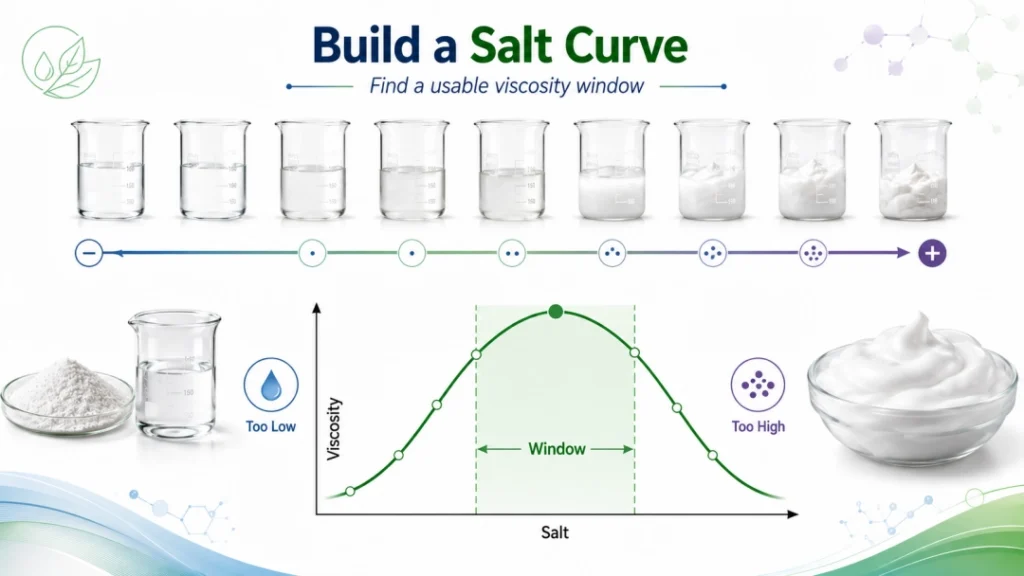
Prepare one uniform base batch and divide it into samples. Increase electrolyte in controlled increments while keeping the surfactant ratio, active matter, pH, processing conditions, sample temperature, and viscosity method unchanged.
Record cumulative electrolyte concentration rather than only the amount added at each step.
A useful test sheet looks like this:
| Electrolyte Level | pH | Viscosity | Appearance | Foam Observation | Notes |
|---|---|---|---|---|---|
| Baseline | |||||
| Trial 1 | |||||
| Trial 2 | |||||
| Trial 3 | |||||
| Trial 4 |
Do not choose the formula simply because one point produces the highest viscosity.
What we want to see is a usable region where normal variation in electrolyte level does not cause an unacceptable viscosity change. A very sharp viscosity peak may look impressive in the laboratory but can be difficult to control during manufacturing.
Recent experimental work on sodium N-acyl sarcosinates found distinct regions in their salt-response curves, with viscosity changing once critical electrolyte conditions were reached. The exact response depended on surfactant and electrolyte conditions, which is precisely why the curve should be measured rather than assumed.
If your curve rises and then falls sharply, the deeper physical explanation involves changes in surfactant aggregation and micellar structure. That mechanism is better treated separately from the practical thickening workflow; here, the important decision is whether the operating window is wide enough to manufacture reliably.
When Salt Is Not Enough, Compare Thickening Routes
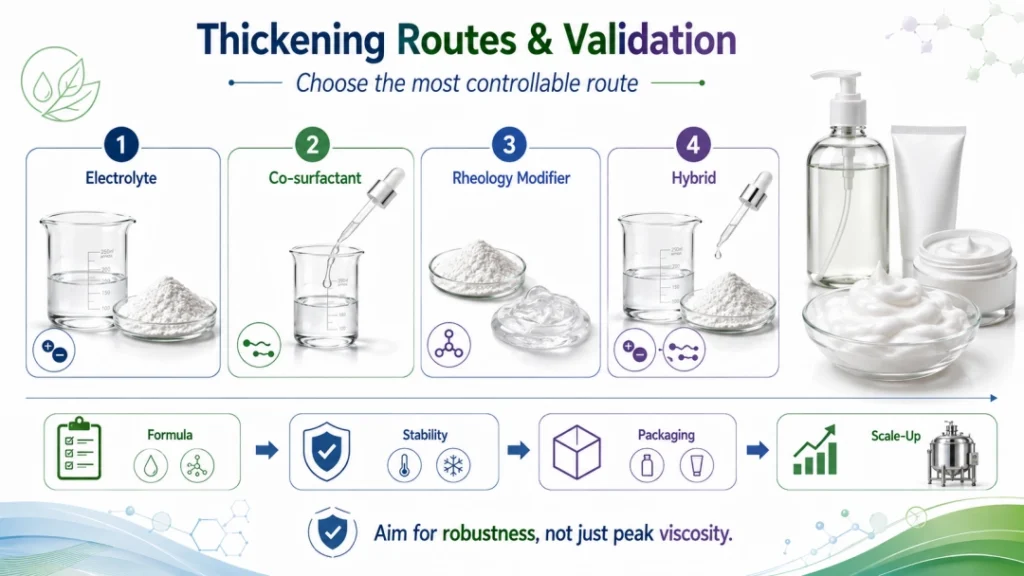
If electrolyte response is weak, narrow, or incompatible with the rest of the formula, stop trying to solve the problem by continuously increasing salt. Compare another thickening route.
There are three practical routes we normally screen.
Electrolyte-based thickening is attractive when the surfactant system already shows a broad, controllable salt response. But any significant change in ionic ingredients can shift that response, so the curve should be rechecked after the finished formula is assembled.
Co-surfactant structuring changes the surfactant blend itself. Amphoteric or compatible nonionic surfactants may alter aggregate behavior as well as foam and sensory properties. This is not a guarantee that adding one specific co-surfactant will increase viscosity; it is a formulation variable that should be screened at controlled ratios. Published work on sodium N-acyl sarcosinate systems also shows that electrolyte concentration can produce distinct regions in the viscosity response, reinforcing why electrolyte effects on sodium N-acyl sarcosinate rheology should be evaluated as a curve rather than at a single salt level.
Compatible rheology modifiers become useful when micellar thickening alone cannot provide the required viscosity window. Selection should be based on target pH, electrolyte tolerance, clarity, surfactant compatibility, processing requirements, foam impact, and the final flow profile.
| Thickening Route | Test When | Main Variable | Main Risk to Check |
|---|---|---|---|
| Electrolyte | The base shows useful salt response | Electrolyte level | Narrow viscosity window |
| Co-surfactant | Blend structure can still be optimized | Surfactant ratio | Foam, clarity and pH changes |
| Rheology modifier | Micellar thickening is insufficient | Chemistry and dosage | Compatibility and processing |
| Hybrid system | One route lacks robustness | Multiple controlled variables | Formulation complexity |
The best route is the one that remains controllable in the complete formula, not the one that produces the highest viscosity in a simplified surfactant-water model.
Control Addition Order, Mixing and Viscosity Measurement
If formula composition is unchanged but processing is not controlled, you cannot confidently attribute a viscosity difference to chemistry.
During screening, we use a fixed addition sequence and document it. Depending on the raw materials, that may involve preparing the water phase, adding surfactants and co-surfactants, adjusting pH, incorporating the rheology modifier, and then making controlled electrolyte adjustments.
That is not a universal manufacturing sequence. Some polymeric thickeners require specific hydration, neutralization, temperature, or shear conditions. The point is to use the same defined procedure when comparing trials.
We also standardize viscosity measurement. At minimum, record:
- instrument and measurement geometry or spindle;
- rotational speed or other shear condition;
- sample temperature;
- conditioning or equilibration time;
- time between production and measurement.
A viscosity value without measurement conditions is difficult to compare across laboratories or batches.
If the same formula gives different results on two production days, check process history before redesigning the formulation.
Troubleshoot by Failure Pattern
Different viscosity failures point to different first checks. Do not use “add more thickener” as the default response.
| Failure Pattern | Check First | Then Check |
|---|---|---|
| Viscosity remains low | Active matter, pH, surfactant composition | Whether the selected thickening route is suitable |
| Viscosity rises, then collapses | Electrolyte or modifier response curve | Whether the operating window is too narrow |
| Formula becomes hazy | pH, solubility, compatibility | Electrolyte and additive interactions |
| Viscosity drops after fragrance or preservative | Change introduced by the new ingredient | Rebuild the curve using the complete formula |
| Lab batch works but production batch does not | Active matter and raw-material variation | Addition order, mixing and measurement |
| Batch viscosity fluctuates | Active-matter normalization | pH, electrolyte and process variation |
For a low-viscosity batch, our diagnostic order is usually simple:
Active matter → pH and appearance → surfactant ratio → salt/thickener response → added ingredients → processing → measurement.
One mistake we see quite often is changing several variables in the same corrective trial. If you increase salt, change pH, raise the co-surfactant level, and add polymer at the same time, you may obtain the target viscosity—but you have learned almost nothing about why it worked.
Change one major variable at a time whenever practical.
Validate Robustness Before Scale-Up
A laboratory sample that reaches the target viscosity once is not yet a robust formulation. Before scale-up, test whether the formula tolerates realistic variation around the target condition.
We normally challenge the final system around variables such as pH, electrolyte level, active matter, surfactant ratio, raw-material lot, processing conditions, and measurement timing. The size of those variations should reflect your own raw-material specifications and manufacturing capability rather than an arbitrary universal percentage.
Most importantly, repeat the viscosity work in the complete formula.
A surfactant-water-salt model may behave well before you add fragrance, preservative, chelator, humectant, conditioning agents, functional actives, or other electrolytes. Once these materials are present, recheck pH, viscosity, appearance, and stability.
For scale-up, define a release window rather than a single ideal number:
- acceptable viscosity range;
- acceptable pH range;
- appearance criteria;
- active-matter control;
- electrolyte addition procedure;
- mixing and addition sequence;
- viscosity measurement method;
- defined recheck timing;
- applicable stability protocol.
The formulation we prefer is usually not the one with the highest laboratory viscosity. It is the one with the most controllable viscosity window.
Once you know which thickening route your system actually responds to, you can then compare the relevant amino acid surfactant types and individual product specifications instead of selecting raw materials by viscosity claims alone. If a formulation is still difficult to control after the variables above have been isolated, that is the right stage for a technical discussion, sample comparison, or targeted formulation trial.
FAQ
Why is my amino acid surfactant cleanser not thickening with salt?
Salt may not be the limiting variable. First verify active matter, surfactant composition, pH, existing electrolytes, and co-surfactants, then build a controlled salt curve. Some amino acid surfactant systems show useful electrolyte thickening, while others have weak or narrow response windows that require another thickening route.
How do you build a salt curve for an amino acid surfactant system?
Prepare one uniform base formula and increase electrolyte in controlled increments while keeping active matter, surfactant ratio, pH, temperature, processing, and viscosity measurement conditions constant. Record both viscosity and appearance at each cumulative electrolyte level so you can identify a usable operating window rather than a single peak.
Should pH be adjusted before or after thickening an amino acid surfactant cleanser?
There is no universal addition order for every amino acid surfactant system. Establish the product’s required pH and use a consistent process during screening because pH itself can change surfactant aggregation and viscosity. Final pH adjustment may require the thickening response to be checked again.
What thickener works best with amino acid surfactants?
There is no single best thickener for all amino acid surfactants. Selection depends on surfactant chemistry, active matter, pH, electrolyte load, co-surfactants, clarity, foam requirements, and manufacturing conditions. Compare electrolyte thickening, co-surfactant structuring, compatible rheology modifiers, or a controlled hybrid system.
Why does viscosity drop after adding fragrance or preservative?
Fragrance, preservative, and other additives can change solubilization, ionic conditions, pH, or interactions within the surfactant system. If viscosity drops after their addition, recheck the complete formula rather than simply increasing thickener. Rebuild the relevant viscosity curve with all final ingredients present.