A cleanser batch stays thin, so the first reaction is often to add more salt or change the rheology modifier. That may alter the batch, but it rarely explains what went wrong. Before changing the formula, confirm that the result is a genuine viscosity failure and locate the first difference between the last acceptable batch and the first failed one.
Why amino acid surfactants are difficult to thicken is often the wrong first question for a failed batch. The useful question is what changed: material identity, supplied active matter, water, formula version, process history, sample condition, or the measurement itself. Until that change is bounded, a thicker trial is only a new formula, not a diagnosis.
This fault-finding guide covers observation checks, batch reconstruction, cause classification, and controlled reproduction. It does not cover salt-curve design, thickener selection, or scale-up validation. Once you know which variable owns the failure, continue with the amino acid surfactant thickening guide. For wider context, use the amino acid surfactants guide.
Confirm that the viscosity failure is real
Treat the batch as failed only after the test sample and the reference have been compared under equivalent conditions. A single number is not enough if the two samples differ in temperature, age, air content, instrument setup, or sampling point.
Compare equivalent samples, not just two numbers
Record the instrument, geometry, speed or shear setting, sample preparation, measurement temperature, and time after sampling. Use the same method for the reference and failed batch. If one sample was tested immediately after hot processing and the other after cooling and rest, the difference cannot be assigned to the formula.
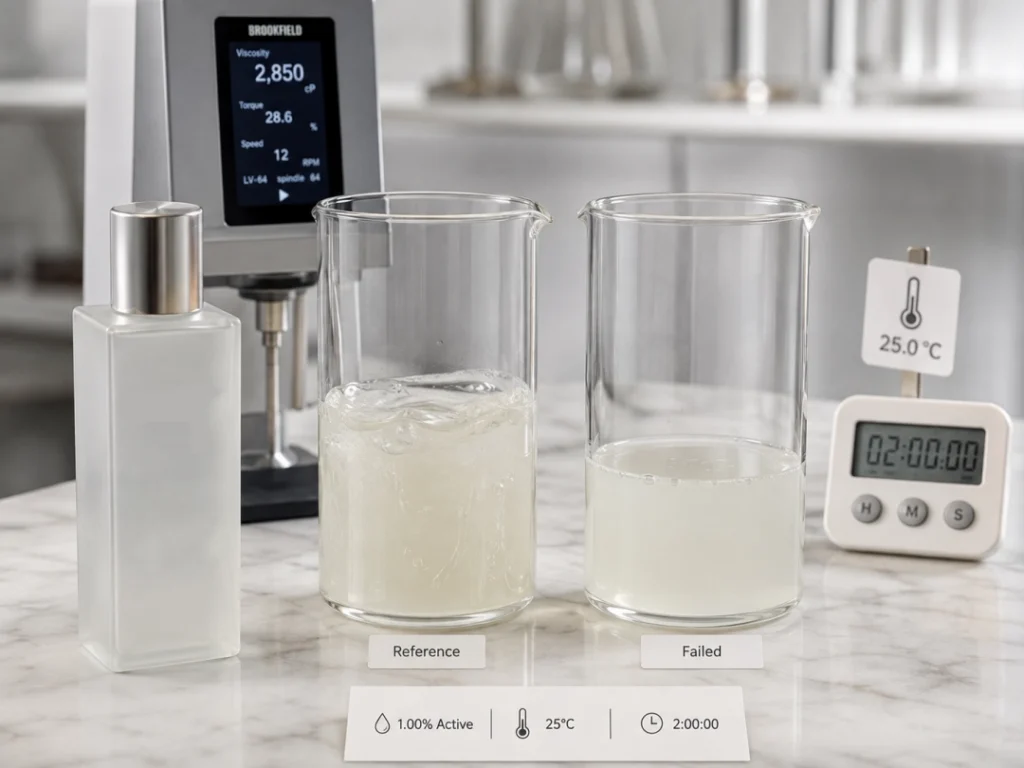
Repeat the reading on the retained sample before making a new batch. A large shift points first to sample handling or method control. A stable low result supports further investigation but does not identify the cause.
Describe the failure as an observable pattern
Replace “the batch is too thin” with a record another person can test. Note when the low reading appeared, whether the sample is clear or hazy, whether air or separation is visible, and whether the reading moves during storage. Photographs document appearance but do not prove the mechanism.
The pattern determines the next check. A batch that is thin from the first measurable stage needs a different investigation from one that loses viscosity after fragrance addition or after transfer to production.
Reconstruct the batch history before proposing a cause
The fastest route to a useful hypothesis is a side-by-side history of the last acceptable batch and the first failed batch. Memory is not a batch record, especially when several additions and adjustments happened close together.
Compare the last acceptable batch with the first failed batch
Put both batches on one timeline. Include formula revision, raw-material lots, actual weights, water source, batch size, addition times, pH adjustments, heating and cooling, mixing changes, sampling points, and viscosity readings. Keep planned values separate from actual values.
The comparison should show whether the failure is new, intermittent, or repeatable. Without an acceptable reference under the same formula and process, the work is development rather than batch troubleshooting.
Mark the first point where the two batches diverged
Start at the end of the process and move backward until the records match. The first documented difference is not automatically the root cause, but it is a testable lead. Later differences may simply be attempts to correct the already failing batch.

A late pH correction may be the first deviation, or it may have been added because viscosity was already low. The timestamp and earlier sample decide which interpretation is possible.
Keep evidence attached to the timeline
Link each observation to its source: batch sheet, weighing record, raw-material label, COA, instrument record, photograph, or retained sample. Do not fill gaps with an assumed value. Mark an unrecorded temperature, speed, or addition time as unknown and design the reproduction test around that limit.
Eliminate input errors before discussing surfactant chemistry
Verify what entered the vessel before explaining why the system behaved differently. Formula version, raw-material grade, supplied concentration, and weighing basis can change the effective surfactant level and ionic load before the intended viscosity-building step begins.
Verify raw-material identity, grade, lot, and document version
Match the container label and batch sheet to the approved trade name, INCI, physical form, and supplier document version. Similar product names do not prove that two grades have the same active matter, neutralization form, carrier, or inorganic content. The COA reports the tests listed for that lot; it does not replace the specification or formulation record.
If a substitution occurred, compare the supplier documents before more trials. If the required composition is not documented, request confirmation rather than estimating it.
Recalculate the active contribution on one basis
Use the actual weighed amount and the confirmed supplied active fraction:
Expected active contribution (%) = actual raw-material use level (%) x confirmed supplied active fraction
Apply the same basis to the good and failed batches. Keep active surfactant separate from carrier water, inorganic salts, neutralizing components, and other reported solids. This calculation is an audit step, not a formulation target. The amino acid surfactant thickening guide explains how active matter is used when designing a thickening study after the batch discrepancy has been resolved.
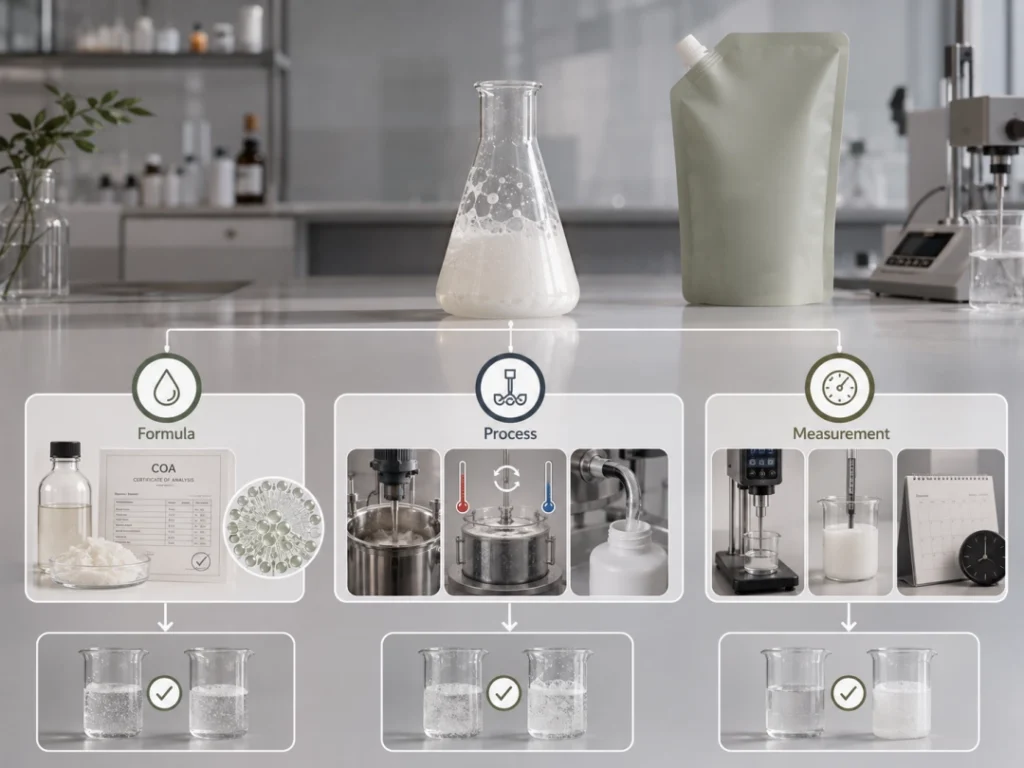
Why amino acid surfactants are difficult to thicken: separate formula, process, and measurement causes
A useful diagnosis assigns the observed failure to one of three working categories before testing a remedy. Formula causes travel with the material combination, process causes appear with how the batch was made, and measurement causes change when the same sample is tested correctly.
Formulation clues point to a changed input
Suspect an input change when the baseline remains thin across careful repeats made with the same process. Check formula revision, active matter, water, raw-material grade, pH reading method, and any additive introduced before the change appeared. pH and electrolyte are diagnostic variables here because they can alter ionization and aggregate interactions, not because one value or salt level is universally correct.
Model studies on sodium lauroyl sarcosinate show that composition and pH can shift rheology. They do not set limits for every commercial amino acid surfactant, so test the hypothesis with your actual materials and method.
Process clues appear after a defined manufacturing event
Suspect the process when the laboratory reference is repeatable but production is not, or when viscosity changes after an addition, heating, cooling, transfer, or hold. Compare the addition point, local mixing, temperature history, batch size, and sampling times. Reproduce the documented process instead of assuming that extra mixing will repair it.
If a process deviation is confirmed, repeat it at a controlled scale without changing the formula. Otherwise, the result cannot show whether the process was responsible.
Measurement clues disappear under a fixed method
Suspect measurement when duplicate readings on the same sample disagree, when air or temperature is uncontrolled, or when the reference and failed samples were prepared differently. Repeat the method with a retained sample before remaking the batch. If the difference disappears, correct the method and review earlier conclusions based on the inconsistent data.
| Observed pattern | First check | Confirmation test | Next route after confirmation |
| Baseline stays thin in careful repeats | Formula revision, material identity, active contribution | Repeat with verified inputs on the same basis | Move to route development only after the discrepancy is bounded |
| Lab sample is acceptable but production is thin | Addition, mixing, temperature, sampling history | Reproduce the suspected process difference without changing the formula | Review process control and scale-up |
| The same sample gives inconsistent readings | Method, temperature, sample age, air | Retest the retained sample under one fixed method | Correct the measurement protocol |
| Viscosity changes after one additive | Addition point, grade, lot, matched base | Compare the same base with and without that additive | Investigate the additive interaction as a separate problem |
Run the smallest experiment that can reproduce the fault
The first experimental goal is to reproduce the failure, not to produce a thick sample. If the failed condition cannot be repeated, changing several formulation variables will add noise and may hide the original cause.
Repeat the failed condition before changing the formula
Make a fresh baseline from the recorded formula and process. Use confirmed raw materials, the same water specification, the same batch basis, and a fixed measurement protocol. Keep the retained failed sample and an acceptable reference beside it when available.
If the baseline reproduces the low result, the failure is suitable for a controlled comparison. If it does not, return to the batch timeline and measurement method. Do not interpret a modified trial against a baseline that behaved differently from the failed batch.
Change one suspect variable and retain the baseline
Select the variable supported by the strongest documented difference. Change only that variable while holding formula basis, materials, batch size, temperature path, mixing, sampling time, and test method constant. Record what the result can prove and what it cannot.
A one-variable result applies only to the tested formula and conditions. Repeat the comparison before using it to change production control or materials.
Stop when the experiment no longer answers the diagnosis
Stop if the material identity is unresolved, the baseline does not reproduce, the method is unstable, or the next trial would change several variables at once. Write a new experimental question before mixing again. A series of improvised corrections may create an acceptable sample, but it cannot support a defensible root-cause conclusion.
Close the investigation with a cause, a limit, and a handoff
A troubleshooting report is complete when it states what caused the failure, under which recorded conditions, how the cause was confirmed, and what remains unknown. “The viscosity was fixed” is an outcome, not a diagnosis.
Write the conclusion at the right level of certainty
Use “confirmed” only when the failure was reproduced and the suspected variable changed the result in a controlled comparison. Use “supported” for consistent but incomplete evidence, and “not determined” when records or measurements prevent a conclusion.
After the cause is bounded, hand the work to the correct page or team. Use the controlled amino acid surfactant thickening workflow for salt curves, rheology-route comparison, and scale-up validation. Use the amino acid surfactants formulation guide when the team needs broader chemistry and application context.
Send the minimum useful data set for technical review
Provide the full formula on an as-supplied basis, the active-matter calculation, trade names and lots, relevant TDS or specification versions, water source, batch size, actual addition order, mixing and temperature history, pH method and result, viscosity method, sampling time, appearance, photographs, and retained samples when available. Include the last acceptable batch and the first failed batch in the same format.
That package lets a technical reviewer test a specific hypothesis. Without it, possible causes cannot be ranked.
FAQ
Why are amino acid surfactants difficult to thicken?
Amino acid surfactant systems may stay thin when their actual composition, ionization state, ionic environment, or process history does not support the required structure. In a failed batch, first identify what changed from the acceptable reference before choosing a new thickening route.
How can I tell whether low viscosity comes from the formula or the process?
Repeat the same verified formula under a controlled process, then compare it with the failed batch history. If the low result follows the material combination across repeats, investigate the formula. If it appears only after a manufacturing difference, investigate the process.
What should I compare between a good batch and a thin batch?
Compare formula revision, raw-material grade and lot, supplied active matter, actual weights, water, batch size, addition order, mixing, temperature history, sampling time, pH method, and viscosity method. Mark the first confirmed difference and test that variable without changing the others.
When should I use the amino acid surfactant thickening guide?
Use the thickening guide after the failed batch has been verified and the cause has been bounded. That page covers how to build viscosity through controlled route evaluation; this page covers how to identify why a reference batch changed or failed.