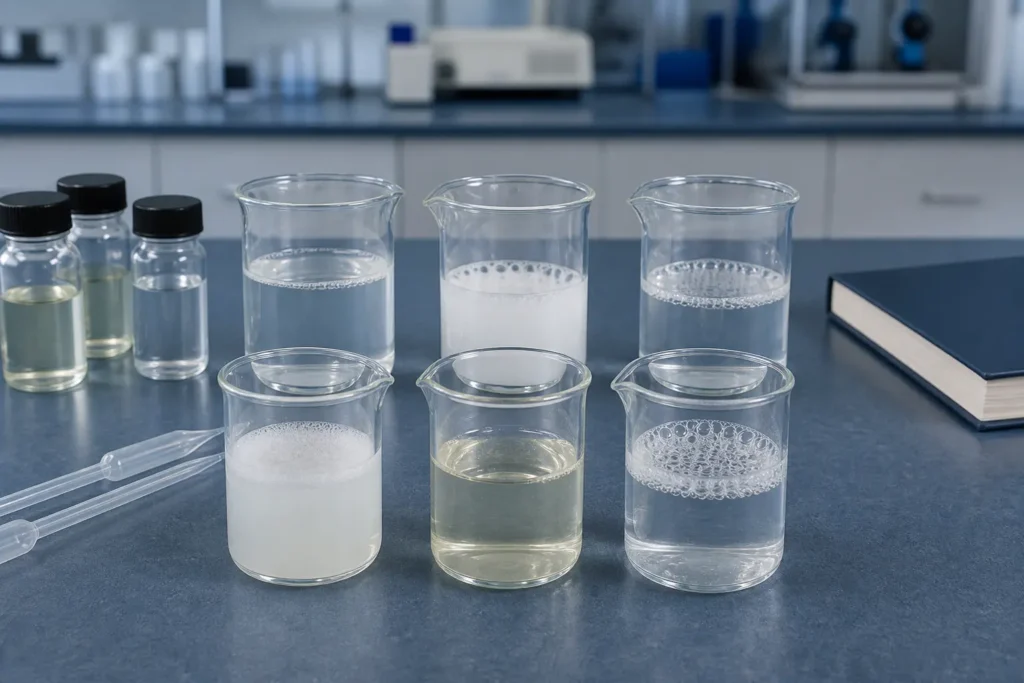
By sample six, the bench can become a crime scene. One beaker has extra salt, another has a different pH, a third has a new fragrance, and nobody remembers whether the co-surfactant level moved too. There are plenty of samples and very little evidence.
A useful sodium lauroyl glutamate surfactant system formulation follows a sequence. First choose what job the co-surfactant must do. Compare candidates on equal active matter. Set the useful pH region before drawing a salt-response curve. Add fragrance only after the base can be read, then confirm the chosen combination as a complete formula.
The result is a useful development decision: which blend is worth another week of work.
Begin with a one-sentence product brief
The brief decides which result matters most. “Make a mild cleanser” is too loose because mildness, foam, clarity, viscosity, rinse, cost, package, and process can pull the formula in different directions.
Write one sentence that names the product format, consumer-use condition, and the result that must improve without sacrificing the current strength. For example: “Develop a pump facial cleanser with quicker foam build while keeping the present clarity and after-feel.” That sentence makes a weak result easy to reject.
Then fix the practical boundaries before the first batch:
- finished format and package;
- target active matter and planned pH region;
- water source, fragrance status, and preservation route;
- manufacturing limits such as powder handling, heat, and mixing.
The Sodium Lauroyl Glutamate ingredient guide covers what the ingredient is and how powder and liquid grades differ. This page starts after that choice, when you need to make the blend work.
Choose the co-surfactant by the job it must perform
Compatibility is more useful when it has a purpose. A candidate added for faster foam should be judged differently from one added for viscosity, clarity, or rinse feel.
| Development need | What to watch in the first screen | What can quietly get worse |
| Faster foam build | Time to generate foam at the intended dilution | Viscosity, air entrainment, rinse feel |
| Longer foam life | Foam decay and drainage over a fixed time | Dense residue or slower rinse |
| Easier thickening | Viscosity response after pH is set | Cloudiness or a narrow salt window |
| Fragrance clarity | Appearance immediately and after the normal hold | Foam and viscosity after solubilization |
| Softer after-feel | Side-by-side wash assessment with a shared vocabulary | Cleansing power, package dose, cost |
Use a published blend as a starting clue
A study of an SLG and lauramidopropyl hydroxysultaine system reported pH- and concentration-dependent changes in micelles and viscoelastic behavior under its test conditions. The useful lesson is that the interaction can be strong. Rebuild the idea with your fragrance, preservative, grade, water, and process before carrying it forward.
Start with a short list of candidates whose role matches the brief. One credible candidate tested cleanly is worth more than five blends carrying unrelated changes.
Keep commercial reality in the same notebook
Record supplied active matter, water, inorganic salt, form, lead time, and cost per delivered active matter. A liquid may save batching time. A powder may reduce shipped water and free more room in a concentrated formula. Delivered active cost makes the two routes easier to compare fairly.
Make every blend comparison on equal active matter
When grades have different supplied actives, compare their active contributions rather than equal raw-material percentages:
*Active contribution (%) = raw material in formula (%) x supplied active matter (%) / 100*
If a bench design calls for a 3.00% active contribution from KWLG-95 at 98.5% active matter, the corresponding raw-material input is:
*3.00 / 0.985 = 3.05% KWLG-95*
The 3.00% target is only an arithmetic example. Choose the actual active matter from your product brief and safety assessment.
When you change the co-surfactant ratio, hold total surfactant active matter steady unless total actives are the variable you intend to test. Also rebalance water. Otherwise a thicker sample may simply contain more surfactant solids.
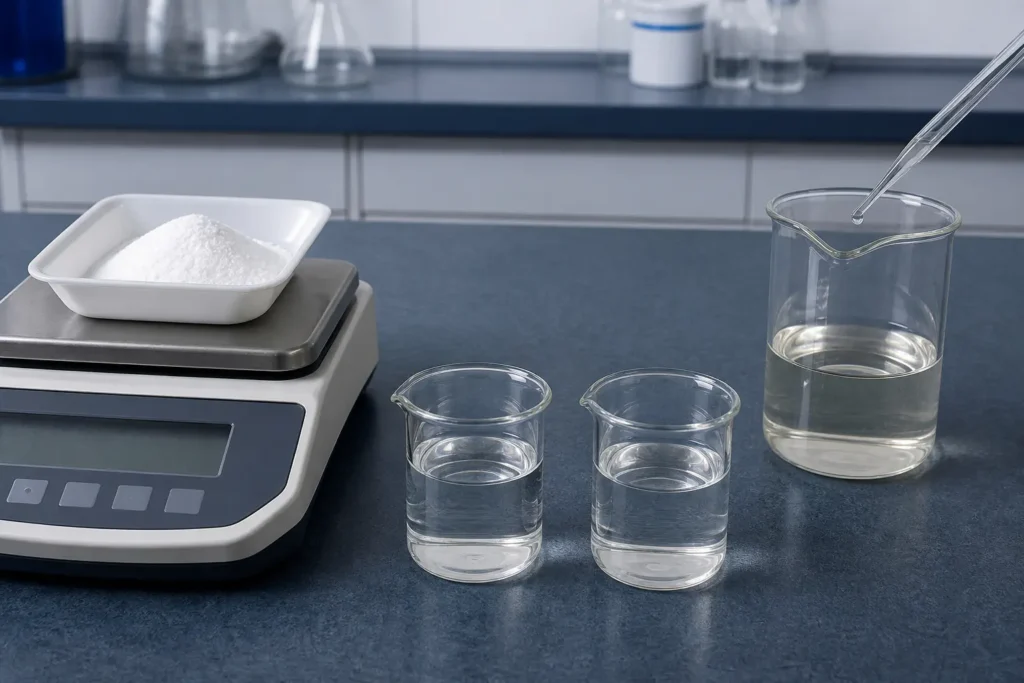
Conceptual equal-active comparison. Use the controlled specification or current COA for each raw material.
Three short rounds keep the experiment readable
The smallest useful experimental matrix is usually sequential. Each round removes weak options before the next variable arrives, so you spend detailed work on fewer samples.
| Round | Change | Keep fixed | Decision at the end |
| 1. Blend | Co-surfactant identity or ratio | Total active matter, water, pH method, no fragrance, minimum unavoidable electrolyte | Which blends meet the foam and appearance brief? |
| 2. pH | A small set of pH conditions inside the product’s intended region | Chosen blends, active matter, water, process, no fragrance | Which pH region keeps the useful balance? |
| 3. Salt and fragrance | Salt additions and fragrance challenges, first separately and then together | Chosen blend and pH route | Does the complete system retain clarity, viscosity, and foam? |
Round 1 should feel almost boring
Prepare a plain base with the minimum number of ingredients needed to compare the surfactant blend. Use the same water, batch size, mixing, temperature history, and sample age. A colorful, fully dressed prototype may look more exciting, but it makes a poor starting witness.
Reject blends that miss the central brief. If a candidate produces attractive foam but immediately destroys the required clarity, decide whether that trade-off is acceptable before optimizing it further.
Round 2 sets the pH route
Choose pH conditions that make sense for the intended product, preservation route, and ingredient set. The useful region is the one that balances clarity, viscosity, and foam in that complete blend.
Add titrant through the same route each time and observe the sample after the same hold. The article on how pH changes amino acid surfactant system behavior explains why the addition history matters as well as the endpoint.
Round 3 brings in salt and fragrance
Run salt additions on the selected pH condition, then challenge a separate portion with fragrance. Combining both changes in the first sample leaves you unable to tell which one shifted the result.
Once the separate behavior is clear, prepare the intended combination. This last sample is where a promising base becomes a realistic formula candidate.
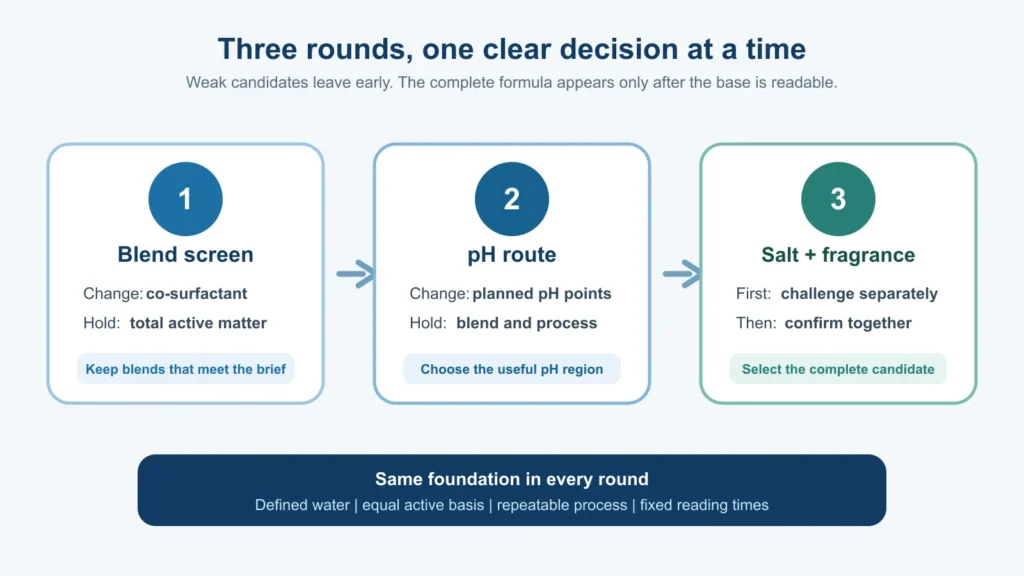
A lean development route. Choose actual levels from the product brief and current raw-material documents.
Read clarity, viscosity, foam, and use experience together
One attractive number can hide a weak formula. A high viscosity reading says little about pour, pump delivery, recovery after shear, or what happens after a temperature change. Strong initial foam may collapse quickly or disappear when the product meets oil and hard water.
Give each output a defined observation:
- Clarity: appearance against the same background, at the same temperature and sample age.
- Viscosity: instrument, geometry or spindle, speed, temperature, preconditioning, and time after manufacture.
- Foam: dilution, water, generation method, initial amount, and decay time.
- Use experience: dose, soil or oil condition, wash sequence, rinse, and shared sensory terms.
ASTM D2196 notes that apparent viscosity depends on rotational speed and that measurements at more than one speed better characterize a non-Newtonian material. An internal screening method becomes more useful when it records the same details.
For facial cleansers, the article on balancing cleansing, foam, and skin feel helps turn these measurements into a product decision rather than a beauty contest between beakers.
Take one complete formula to the pilot vessel
Use the pilot batch to confirm the route you chose. Carry forward the exact raw-material grades, active calculations, order of addition, pH-adjustment method, temperature history, mixing condition, hold time, and final test methods.
If the plant result differs from the bench, compare what the ingredients experienced. Feed location, surface turnover, air intake, heat-up rate, and local titrant concentration can all change with scale even when the formula percentages stay the same.
INNO KWLG-95 offers 98.5% active matter in a powder format. That makes equal-active calculations straightforward and limits supplied water in concentrated bases. When price matters, compare our quote on delivered active matter and include freight, handling, energy, cleaning, and yield. This is where the commercial value of a high-active grade becomes visible without pretending that price per kilogram tells the whole story.
You can request KWLG-95 documents, a sample, or a quote when your brief is ready. Send the target format, total active matter, proposed co-surfactants, pH route, water source, fragrance status, process limits, and the result you need to improve. We can help narrow the first practical screen.
FAQ:
Which co-surfactant is most compatible with Sodium Lauroyl Glutamate?
The best co-surfactant is the one that performs its assigned job in your complete Sodium Lauroyl Glutamate formula. Compare candidates at equal total active matter in the intended pH, water, fragrance, and process conditions.
Should I optimize pH or salt first?
Set the useful pH region first, then study salt response. pH changes the ionization and aggregation behavior of Sodium Lauroyl Glutamate, so a salt curve made at the wrong pH may not transfer to the final formula.
How many samples are needed for a useful first screen?
Use one plain baseline and only enough candidate blends to answer the first decision. Move the strongest options into separate pH, salt, and fragrance rounds so each sample answers a clear question.
Should fragrance be added during the first surfactant comparison?
Keep fragrance out of the first blend comparison unless fragrance compatibility is the main question. Add it after the base blend and pH route are readable, then include it in the final combined confirmation.
How do I compare KWLG-95 powder with a liquid Sodium Lauroyl Glutamate grade?
Compare equal active matter, then add supplied water, inorganic salt, batch time, heating, powder handling, freight, cleaning, and yield to the cost picture.