
A late delivery is frustrating. A late delivery with the wrong specification or an unexplained lot change can stop production. Before approving a personal care ingredient supplier, you need evidence that the grade, batch release, documents, packaging, and shipment stay connected from sample to routine orders. This 12-point checklist shows what to request and what each answer should help you decide.
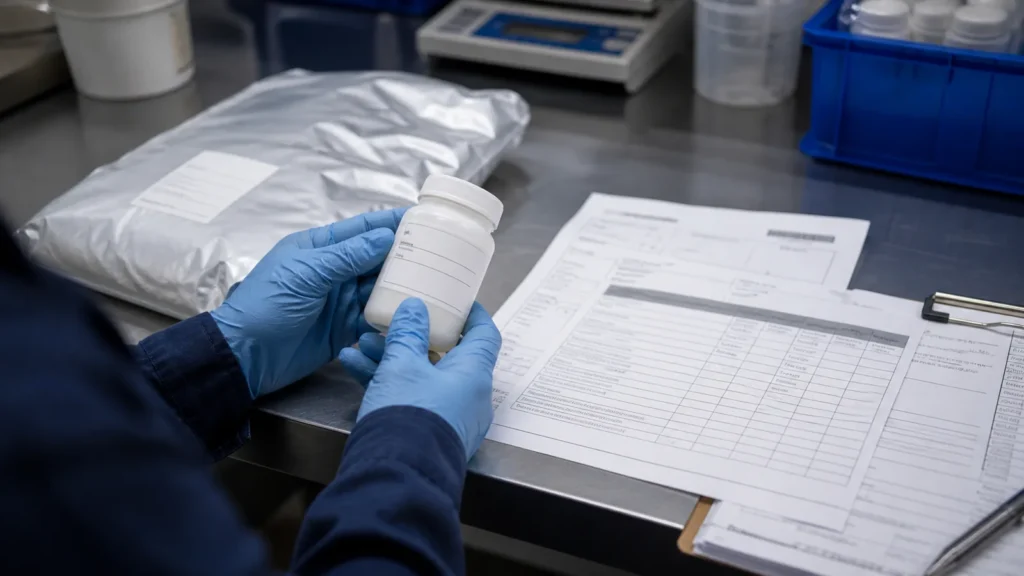
Conceptual illustration: supplier qualification begins by matching the material sample to the documents and delivery information.
Define the purchase before you audit the supplier
The most useful starting point is a demand brief that names the exact grade or required function, estimated annual volume, order pattern, pack size, destination, intended use, and documents your teams expect. A request that says only “please quote one container” leaves too much uncertainty for a meaningful capacity or lead-time answer.
ISO’s guidance on ISO 9001 in the supply chain makes the same practical point: the buyer must state the intended use, requirements, approvals, and monitoring needed. It also warns that an ISO 9001 certificate is not a product conformity statement. Your material specification and approval work still matter.
One realistic demand scenario gives every capacity and logistics answer a common basis. It may cover:
- one named grade for a rinse-off formulation;
- the normal order quantity and largest forecasted call-off;
- required pack format and shipping destination;
- target first-order date and acceptable replenishment window;
- current TDS, SDS, representative COA, and any market-specific documents needed for review.
With those details in view, quality, capacity, and shipping answers can be compared against the same purchase rather than against a hypothetical order.
The 12-point cosmetic ingredient supplier audit checklist
| No. | Delivery check | Evidence to request | What the answer should let you decide |
| 1 | Legal and operating identity | Business entity, manufacturing site, seller, certificate holder, and invoice entity | Whether the organizations named across contracts and technical documents form a clear supply chain |
| 2 | Product identity and controlled specification | Trade name, INCI, supplied form, controlled specification, TDS, and current SDS | Whether everyone is discussing the same grade on the same basis |
| 3 | Sample origin | Sample label, lot or reference number, production or development status, and supporting document version | Whether the approved sample can be related to future bulk supply |
| 4 | Grade-specific capacity | Normal output for the relevant line or grade family, available campaign windows, and current allocation | Whether a company-level annual capacity figure applies to your material and order pattern |
| 5 | Supply continuity | Critical raw-material controls, backup arrangements, maintenance planning, and forecast process | Which upstream or plant constraints could interrupt supply |
| 6 | MOQ, packaging, and lead time | Standard MOQ, pack options, make-to-stock or make-to-order status, normal lead time, and forecast cut-off | Whether the commercial format fits your factory and inventory model |
| 7 | Batch release | Approved specification, test methods, release responsibility, and representative COA | Whether a batch is released against agreed requirements rather than a generic sales description |
| 8 | Traceability and retained samples | Batch numbering logic, manufacturing and test records, retained-sample practice, and shipment link | Whether a complaint can be traced to the material, batch, test, and delivery |
| 9 | Change control | Changes covered, notification route, customer approval needs, and transition handling | Whether a change in site, process, specification, method, or packaging could arrive without review |
| 10 | Technical and export documents | Available TDS, SDS, COA, INCI information, transport or export documents, language, and revision control | Whether regulatory, safety, logistics, and incoming-QC teams will receive the correct documents |
| 11 | Shipment execution | Packaging protection, labels, lot visibility, route, forwarder handoff, and exception updates | Whether the right released lot can arrive in usable condition with usable records |
| 12 | Complaint and corrective-action process | Complaint contact, evidence requested, investigation steps, containment, and corrective-action follow-up | Whether the supplier can control a problem instead of simply replacing one shipment |
The checklist works best as an evidence review. A yes or no questionnaire is fast, but it often rewards polished language. For each high-risk point, a useful response includes an example document, a realistic order scenario, and a named owner.
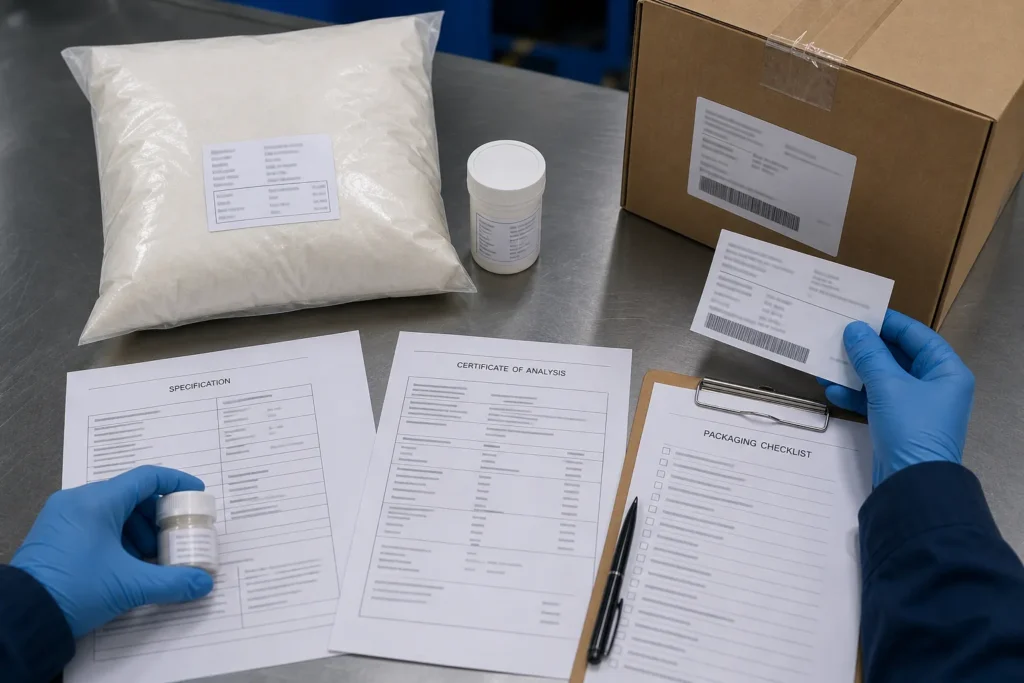
Conceptual illustration: packaging, batch identity, technical documents, and shipment information belong in the same review.
Check identity before you compare capacity
The brand on a website may differ from the manufacturer, seller, certificate holder, or exporting entity. That is not automatically a problem. It becomes a problem when nobody can explain the relationship or match the product across the quotation, specification, SDS, COA, label, and shipment.
Product identity comes first. Similar trade names can refer to different concentrations, neutralization forms, carriers, or physical forms. The controlled specification should define what the supplier agrees to deliver over time. A batch COA reports the tests listed for one lot. The SDS serves a different safety and handling purpose. The TDS, SDS and COA guide explains how to keep those roles separate.
Sample origin is the next link. A development sample can be useful, but its status must be clear. If it came from a different route than routine production, the qualification plan needs to state what will be reconfirmed before approval.
Make capacity specific to the grade and buying pattern
Annual production capacity is a starting point. Your order is supplied by a particular line, campaign, raw-material plan, release queue, pack format, and shipping window.
A capacity answer becomes more useful when it covers three situations:
- Your normal order arrives on the forecasted date.
- Your largest expected call-off arrives during a busy period.
- A released batch is delayed and the next acceptable lot must be identified.
A credible answer may acknowledge limits. A campaign schedule, forecast cut-off, or packaging constraint gives the buyer something concrete to plan around. “No problem” provides no such basis.
INNO has confirmed approximate annual production of 10,000 metric tonnes across its operation. For an INNO inquiry, the grade, annual demand, call-off pattern, package, destination, and required date provide the basis for a project-specific supply discussion.
Follow one batch from release to complaint
A representative COA can anchor the traceability review. The batch behind it should connect the material identity, production record, test results, release status, retained sample, packaging, and shipment.
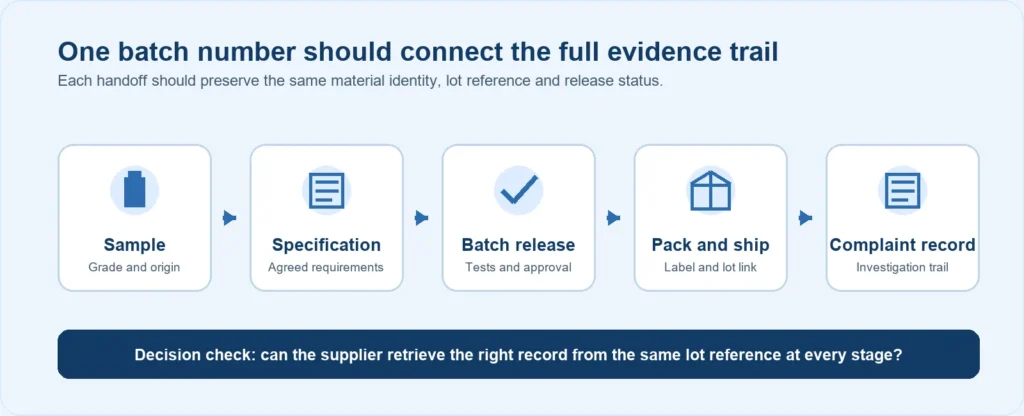
A useful traceability path keeps the same material and lot reference connected through release, shipment, and any later investigation.
INNO’s equipment record dated 19 August 2026 lists a drying oven, titration setup with an electronic balance, pH meter, Agilent gas chromatograph, and Agilent high-performance liquid chromatograph for the test items named in that record. For qualification, ask for the current test method, specification, and COA that apply to the exact grade.
The exact records vary by company and material. The principle does not: a batch number should lead somewhere. The US FDA’s cosmetic GMP inspection checklist asks finished-cosmetic manufacturers to control material identity and lot status, maintain production and laboratory records, retain samples, and keep complaint information. Raw-material buyers can use those downstream expectations to shape supplier questions, while still applying the rules of their own market and quality system.
A short complaint scenario reveals how the process works before a real batch is at risk:
A production batch shows an unexpected color or viscosity shift. What information do you need from us, what records will you check, how will you contain related stock, and who will report the investigation?
The supplier does not need to reveal confidential process details. It should be able to explain the investigation path, evidence needs, ownership, and communication route.
Score critical evidence separately from commercial convenience
Equal scoring can hide a serious gap. A supplier can collect points for a helpful sales team, attractive packaging, and short replies while still lacking a controlled specification or usable traceability.
Three decision levels help keep a convenient commercial answer from masking a critical evidence gap:
| Decision level | Typical examples | Suggested response |
| Critical | Unclear product identity, no agreed specification, batch cannot be traced, or material is shipped before release | Stop approval until the gap is resolved |
| Major | Capacity is not grade specific, change control is unclear, or required documents cannot be matched to the grade | Add evidence, conditions, or a limited qualification plan |
| Standard | Preferred pack size, document language, forecast format, or routine contact details need adjustment | Close through normal commercial coordination |
Your risk level should reflect the material’s role in the formula, the cost of a failed batch, availability of qualified alternatives, replenishment time, and market requirements. A critical preservative component and a low-impact processing aid may justify different audit depth.
Ask INNO for a project-specific qualification pack
INNO’s manufacturing and R&D overview and ingredient support process provide the company-level background. Grade-level information then gives the qualification discussion a practical basis.
Share the product or function you need, target application, estimated volume, order pattern, pack preference, destination, and document list. INNO can then confirm the current material documents available for review, discuss sampling and testing needs, and coordinate the next commercial step.
What INNO Can Provide for Supplier Qualification
| Buyer checks | INNO evidence |
|---|---|
| Product identity | Grade-specific TDS / SDS / specification |
| Batch release | Representative or batch-specific COA |
| Traceability | Batch / test / shipment records where applicable |
| Laboratory capability | GC, HPLC, pH, titration and other test equipment |
| Application verification | Formulation and application test reports |
| Sampling | Grade samples for laboratory evaluation |
| Supply discussion | Grade, volume, packaging, destination and lead-time review |

FAQ
Is an ISO 9001 certificate enough to approve a cosmetic ingredient supplier?
No. It supports confidence in the supplier’s quality management system, but it does not prove that a specific ingredient or batch meets your specification.
Should every ingredient supplier receive an on-site factory audit?
Not always. Choose audit depth from material risk, supply impact, prior evidence, certification scope, complaint history, and the confidence your own quality system requires.
How many COAs should I review during qualification?
Review enough representative lots to understand the reported specification and variation. The right number depends on risk, production frequency, available history, and your approval procedure.
What information should I send before requesting lead time?
Send the exact grade, quantity, pack size, destination, required date, forecast pattern, and document needs. Lead time without those details is only a rough estimate.