The pilot batch looked fine when it left the mixer. The next morning it was slightly hazy, noticeably thinner, and the foam fell away faster. Three symptoms arrived together, so the first reaction was to search for three fixes.
That usually makes the batch harder to read. Cloudiness, low viscosity, and foam instability can all begin with the same change in pH, electrolyte load, water quality, fragrance, co-surfactant balance, or hydration history. The useful question is: what changed first?
Our six-step Sodium Lauroyl Glutamate troubleshooting sequence starts with active matter, then follows pH, electrolytes and water, fragrance and co-surfactants, hydration, and finally the test method. It is designed to help you find the next useful bench check without rebuilding the formula on a hunch.
The timing often narrows the cause faster than the appearance. A batch that turns hazy during acid addition tells a different story from one that is clear at filling and hazy after an overnight hold.
Write down the first moment the change became visible. Include the last ingredient added, batch temperature, pH at that point, mixing condition, and the time since manufacture. If two symptoms appeared at different times, keep them separate. Viscosity may drop during fragrance addition while foam changes only after dilution with hard water.
Use the quick map below to decide where to look first. The split sample then tells you whether that route is worth pursuing.
| What you observe | First place to look | Useful split sample |
| Haze begins during pH adjustment | Titrant concentration, addition point, local pH, final pH | Same base, adjusted more gradually |
| Viscosity drops after salt | Electrolyte level and salt-response curve | Same base with no added salt |
| Foam changes only in use water | Calcium, magnesium, dilution, temperature | Deionized water versus site water |
| Haze follows fragrance | Fragrance load and solubilization in the full blend | Fragrance-free half-batch |
| Grit or flakes remain from the start | Powder wetting and hydration | Fully dispersed water-phase base |
Step 1: put the surfactants on one active-matter basis
A formula can look unchanged on paper while its surfactant solids have moved. This happens when a powder grade is replaced by a liquid grade, a supplier changes, or the percentage of one blend is adjusted without recalculating active matter.
For each surfactant, multiply its formula percentage by the supplied active-matter fraction. A 10% addition of a 30% active grade, for example, contributes 3% active surfactant to the batch.
Add the active contributions to obtain the total surfactant active matter. Also note the water and inorganic salt carried in by each grade. These are different inputs, and both can affect the finished system.
If the failed batch and the good batch contain different active contributions, correct that difference before blaming pH or fragrance. Extra raw material may also bring extra water or electrolyte, so the micellar structure can move in an unexpected direction.
Step 2: rebuild the pH event from addition to final reading
Sodium Lauroyl Glutamate changes its ionization and aggregation behavior with pH. Published work on its pH-dependent aggregation and foam behavior shows why the same surfactant can behave differently as its protonation state changes. In a finished cleanser, the rest of the formula adds another layer.
The final pH hides what happened while concentrated acid or alkali entered the batch. Record the titrant, concentration, addition point, temperature, mixing, and the time between adjustment and measurement. Then split the base and approach the target through smaller additions while watching clarity and flow.
Our guide to how pH changes amino acid surfactant system behavior goes deeper into this part of the investigation. For LG-09, the decision is simpler: if the symptom follows the pH step, reproduce that step before changing anything else.
Step 3: count every source of electrolyte and water hardness
Added sodium chloride is only the electrolyte you can see. Sodium salts may also arrive with surfactants, pH adjusters, preservatives, or other raw materials. Process water can add calcium and magnesium. Together they alter charge screening, solubility, micelle packing, and sometimes the visual appearance of the batch.
Start with a formula-level salt inventory. Raw-material grades and lots matter because one INCI name can cover different supplied compositions. Then prepare the same formula with a defined low-mineral water source and with the water used at the site. If the difference appears only after dilution, test the actual use-water condition too.
The separate article on water hardness and amino acid surfactant foam covers water testing in detail. Here, water is one branch of the six-step sequence. Let the split sample decide whether it deserves more attention.
Step 4: give fragrance and co-surfactants their own split samples
Fragrance is a small line on the formula and a large variable at the interface. It can change clarity, foam, or viscosity after the surfactant base appeared complete. A co-surfactant can improve one result and weaken another because the mixed aggregate is different from either ingredient alone.
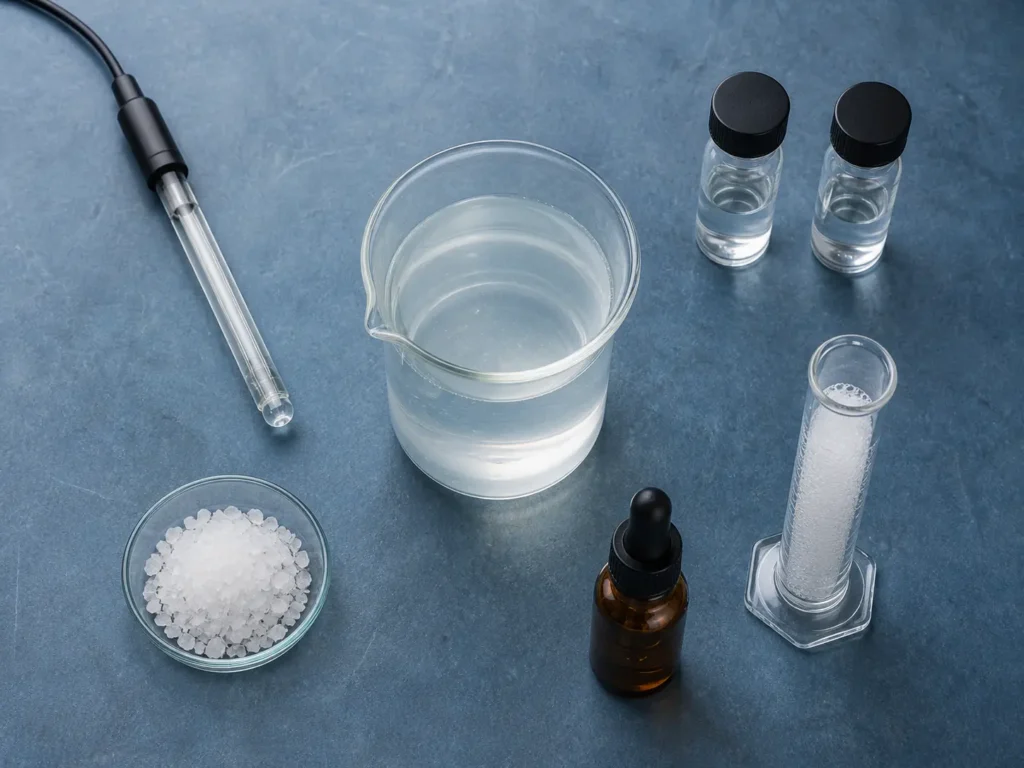
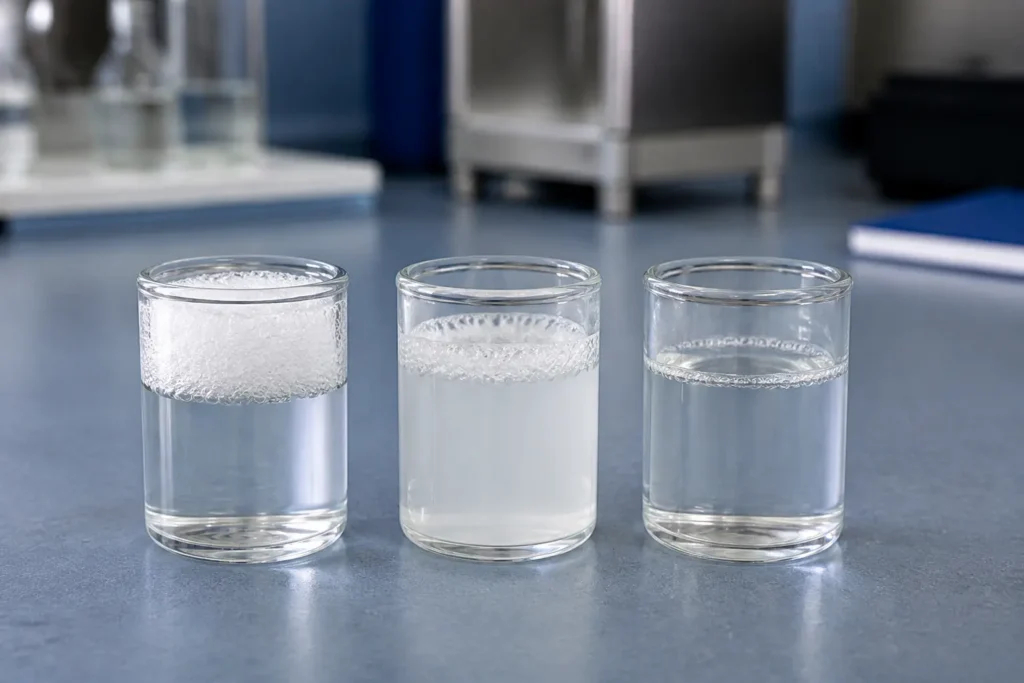
Conceptual diagnostic scene. Actual instruments and methods should follow your laboratory procedure.
Keep one sample fragrance-free. In a second sample, add the intended fragrance at the intended stage. If the formula contains a new co-surfactant or solubilizer, compare the old and new grades on equal active matter. Observe immediately and again after the normal hold.
This small split tells you whether the failure belongs to the surfactant base or to the finished blend. It also prevents a common waste of time: adding more salt to recover viscosity when the real change began with fragrance.
Step 5: make sure hydration is finished before judging the system
Partly wetted Sodium Lauroyl Glutamate powder can masquerade as poor solubility, haze, sediment, or unstable viscosity. The raw material has to enter the water phase before the rest of the formula can be interpreted cleanly.
For KWLG-95, the current TDS calls for cold-water addition under stirring, dispersion, and then heating. If the powder was charged into hot water, fed faster than the surface could wet it, or left on the wall, return to a clean water-phase preparation. A longer hold may soften the symptom while dry cores or residue remain.
The key handoff is visual and repeatable: no dry islands, no wall ring, no gritty cores in a spread sample, and no reappearance of visible solids during the defined hold. Once that base is sound, continue with pH, fragrance, and final viscosity adjustment.
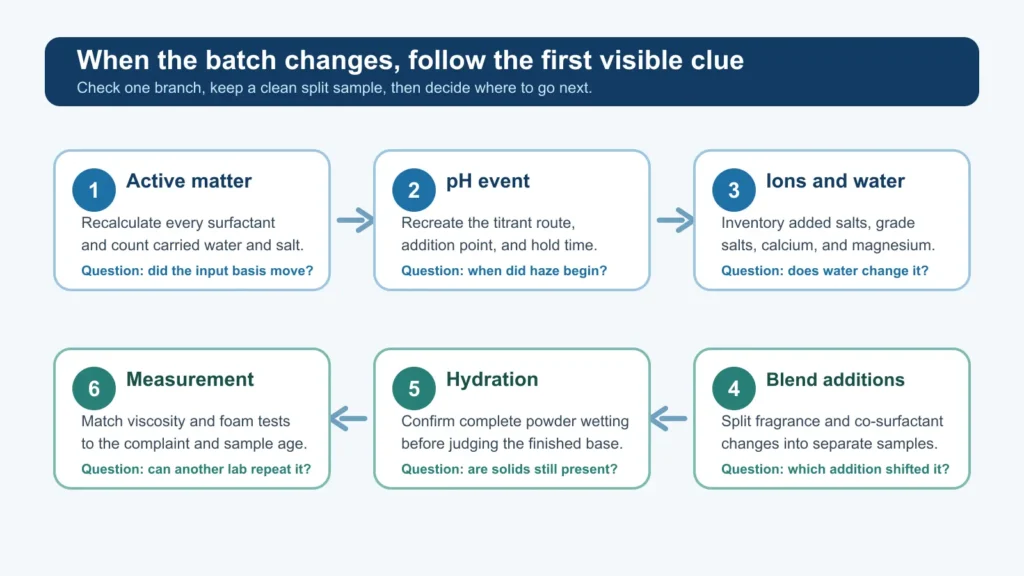
Use the path to choose the next bench check. A single symptom may need more than one branch.
Step 6: make the test reproduce the complaint
A viscosity result needs the instrument, spindle or geometry, speed or shear condition, temperature, sample age, and any preconditioning. Otherwise two laboratories can measure different numbers from the same non-Newtonian sample and both instruments may be working correctly.
Foam also needs a defined method. ASTM D1173 records concentration, temperature, water hardness, and foam height under its specified conditions, while noting that the method does not necessarily predict a specific end use. Your internal shake test or hand-wash panel can still be valuable when it is described well enough to repeat.
If low viscosity is the main complaint, the amino acid surfactant thickening guide can take over after the first-pass checks here. If foam is the complaint, record both foam build and decay. “Low foam” is too broad to tell you which one failed.
When the trail points back to the raw material
After the process and formula splits are clean, compare the incoming lot with the last accepted lot under the same preparation and test conditions. Check identity, supplied form, active matter, water, inorganic salt, appearance, and the current controlled documents. A COA describes a batch. The TDS describes the supplier’s current product position. You need both for a useful discussion.
INNO KWLG-95 is a white powder grade with a current declared active matter of 98.5%. Its high-active format makes the surfactant calculation clear and limits the water carried in with the ingredient. The complete blend still needs testing, but purchasing and R&D begin from a cleaner basis.
If you want us to review a failed sample, send the full formula on an active basis, raw-material trade names and lots, water source, order of addition, temperature history, pH adjustment details, viscosity method, foam method, and timed photos. You can request current KWLG-95 documents or a sample from the product page.
FAQ:
Why did my Sodium Lauroyl Glutamate cleanser turn cloudy after pH adjustment?
The pH adjustment may have changed surfactant ionization, solubility, or aggregate structure, especially where concentrated titrant entered the batch. Reproduce the same base in a split sample and approach the target more gradually while recording clarity at each addition.
Why did viscosity fall after fragrance was added?
Fragrance can change solubilization and micelle packing in the complete surfactant blend. Compare a fragrance-free portion with the intended fragrance addition before adding more salt or thickener.
Can hard water cause both haze and weak foam?
Yes. Calcium and magnesium can change ionic interactions and may affect solubility, foam, or appearance, but the result depends on the full formula and dilution condition. Compare defined low-mineral water with the actual site or use water.
Can I recover low viscosity by adding more salt?
Only after you know where the formula sits on its salt-response curve. Extra salt may raise viscosity, do little, or reduce it after the system passes its useful region. Test small additions in split samples first.
What information helps INNO troubleshoot the batch?
Send the complete formula on an active-matter basis, product grades and lots, process order, time and temperature history, water source, pH-adjustment record, test methods, and photos from the moment the symptom first appeared.