The formula has passed. The next problem is the clock. Powder charging occupies the mixer, two operators follow the wetting step closely, and a short production run spends more time getting ready than filling bottles. This is the point at which a liquid surfactant starts to look interesting.
Liquid Sodium Lauroyl Glutamate is worth considering when direct liquid charging can remove a real production bottleneck and the formula has room for the water supplied with the grade. INNO KWLG-25 contains 24-26% Sodium Lauroyl Glutamate in an aqueous liquid. It can simplify the route into the vessel, but the gain only counts after dosing accuracy, line recovery, cleaning and formula space have all been checked on your equipment.
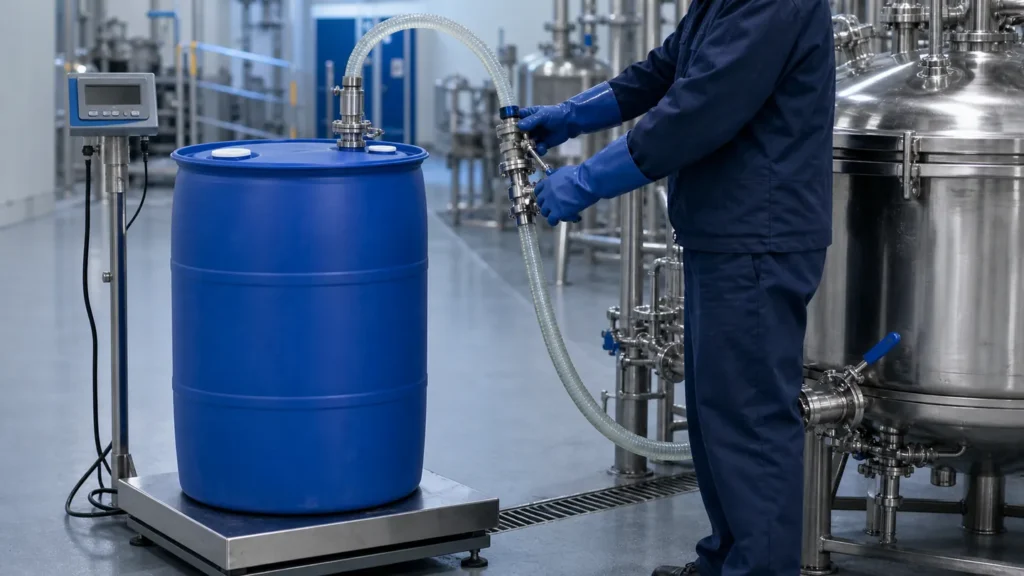
A liquid route earns its place when the whole transfer is repeatable, from drum to recorded vessel charge.
Start with the bottleneck you can measure
A liquid grade is a strong candidate when powder charging or hydration holds up the same vessel repeatedly. Look at recent batches and find the minutes that production actually loses: preparation, charging, waiting for a uniform phase, cleaning the charging area, or correcting an inconsistent addition.
The decision becomes clearer when the line runs the same cleanser often. A saved handling step can matter across several batches each week. For a campaign made once every few months, a new pump, hose set and storage routine may cost more attention than they save.
| Production situation | What it suggests |
| The powder addition stage regularly controls batch cycle time | A liquid trial has a clear operational question to answer |
| Operators obtain different addition times or endpoints | Direct transfer may improve repeatability if the charge can be measured accurately |
| The formula has ample aqueous phase and a moderate surfactant target | KWLG-25 is easier to accommodate on a supplied-mass basis |
| The product is highly concentrated or has little free water | Check formula space before discussing equipment |
| The plant lacks a suitable transfer and cleaning route | Treat the liquid option as a plant project, not a quick raw-material swap |
Count the result at the bottleneck. A shorter surfactant addition has limited value if the new line takes longer to clean or leaves an uncertain quantity between the drum and vessel.
Check the supplied composition against the formula
The current KWLG-25 product record describes a colorless to light-yellow liquid supplied in 200 kg drums. Its composition listing is:
| Declared component | Current listed range |
| Aqua | 73-76% |
| Sodium Lauroyl Glutamate | 24-26% |
| Phenoxyethanol | 0.2-0.6% |
| Caprylyl Glycol | 0.1-0.3% |
| Sodium Chloride | 0-0.5% |
Those numbers answer two early questions. First, can the formula accept the supplied water at the Sodium Lauroyl Glutamate contribution you need? Second, have the preservation and electrolyte teams counted the other declared components in the finished formula review?
If formula water is already tight, settle that calculation before arranging a plant trial. The Sodium Lauroyl Glutamate ingredient guide explains how physical form and supplied content change grade selection. For a direct conversion from powder, use a separate equal-active calculation and rebalance the complete formula rather than changing one line on the batch sheet.
Qualify the route from drum to vessel
The production question is simple: how much material left the drum, and how much reached the batch? The answer may come from a floor scale, a vessel load cell, a calibrated meter, or a documented combination used by your site. The method matters less than a clean mass reconciliation.
Record the drum or source weight before and after transfer, the vessel gain, any planned line rinse, and the material collected during disconnection. This exposes line hold-up before it becomes an unexplained active-matter difference. It also shows whether a nominally convenient liquid creates a yield or housekeeping problem at the end of the hose.
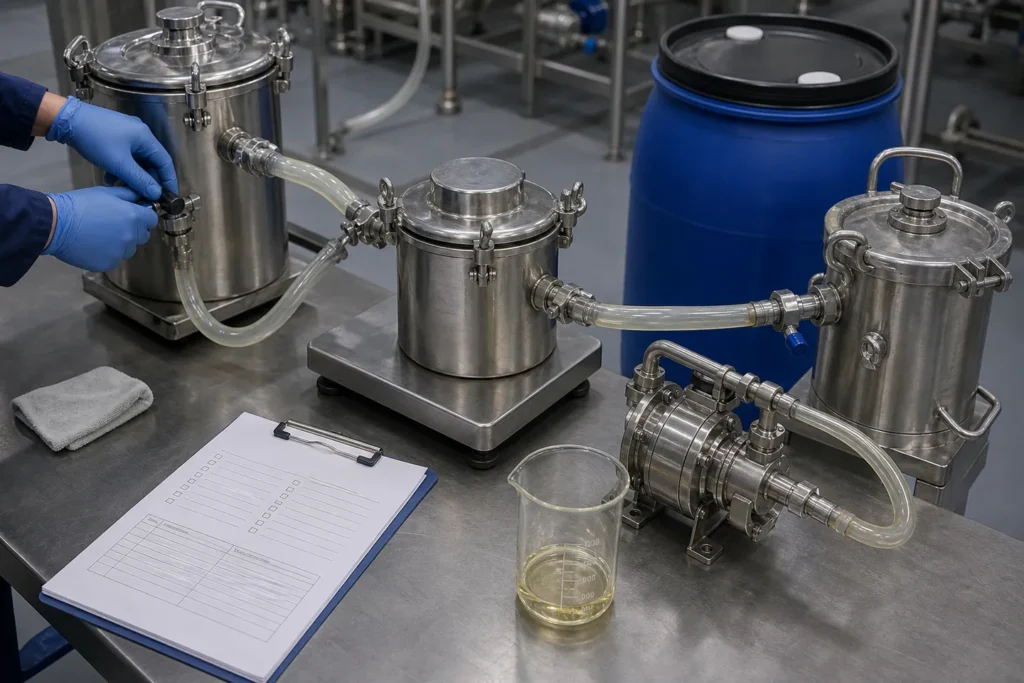
A short transfer rehearsal can reveal more than a polished equipment brochure: actual charge, residue, rinse volume and clean-down time.
Use the intended pump, hose length, fittings and plant temperature during the rehearsal. Confirm that the transfer remains steady and that the material can be recovered and cleaned by the site procedure. Storage, handling and personal-protection requirements must come from the current controlled documents. The TDS, SDS and COA guide helps purchasing and production request the right document for each decision.
ISO 22716 covers quality aspects of cosmetic production, control, storage and shipment. The transfer route therefore belongs inside the controlled manufacturing system, with the same discipline as the rest of the batch.
Run one production rehearsal before changing the master process
Use the real batch size or a scale that reproduces the same transfer route. A useful rehearsal records five items: required charge, recovered charge, transfer time, line-cleaning time and the amount of rinse or retained material. Continue the batch far enough to check whether the new addition route changes appearance, final pH, viscosity or another release-relevant property under your usual method.
Set acceptance limits from your plant procedure and product specification before the first commercial campaign. Charge deviation, cleaning time and appearance change all need an owner and a release decision.
For the rehearsal, keep the formula basis, downstream process and test schedule stable while the transfer route is being assessed. Once the line is understood, any formulation adjustment has a cleaner explanation.
Let the total operating result decide
KWLG-25 has earned its place when the line can deliver the intended charge, the formula can carry its supplied composition, and the saved handling time survives cleaning and changeover. Purchasing can then compare the current quote with the real operating picture: raw-material mass, freight, labor, energy, handling, residual loss and storage.
This is also where INNO can shorten the discussion. The KWLG-25 product page is the place to request the latest product documents, sample and packing information. Send us your batch size and frequency, intended Sodium Lauroyl Glutamate contribution, available formula water, transfer setup and delivery destination. We can prepare the relevant commercial and technical information for your trial without asking you to redesign the whole line in an email.
Discuss a KWLG-25 production trial with INNO
Questions production and procurement usually ask first
Can KWLG-25 be pumped directly from a 200 kg drum?
It can be evaluated for direct drum transfer, but your pump, hose, fittings, temperature and charge-accuracy method decide whether the setup is suitable. Run a short transfer and recovery check before approving the route.
Does a liquid grade always shorten batch time?
Only when it removes the step that is holding up production. Measure transfer and cleaning time together; a faster charge can lose its advantage during line recovery or changeover.
Does the formula water need to change when KWLG-25 is introduced?
Yes. KWLG-25 is an aqueous grade, so its supplied water and other declared components must be included in the complete formula balance. If the water budget cannot accommodate the required dose, the liquid route may not fit.
What should we send INNO before requesting a trial sample?
Send the product format, batch size and frequency, target surfactant contribution, available formula water, dosing equipment, destination market and the documents your quality team needs. That is enough to prepare a focused sample and quotation discussion.