The first beaker is beautifully clear. Then the fragrance goes in, the pH is adjusted, and the gel develops a faint haze that nobody remembers seeing yesterday. One colleague reaches for more solubilizer. Another wants to change the surfactant. By lunch, the formula has three new variables and no clear explanation.
A clear facial cleanser built with liquid Sodium Lauroyl Glutamate is easiest to develop in visible stages. Establish a clear surfactant base, follow the pH route, bring in the ingredients most likely to disturb clarity, then set the final rheology and judge the product after it has settled. Keep a small sample before each important change so the first cloudy point remains visible.
INNO KWLG-25 is a 24-26% Sodium Lauroyl Glutamate aqueous liquid listed for facial-cleanser use. It gives you a practical liquid starting form. The finished gel still has to prove its own clarity, flow, foam and storage behavior.
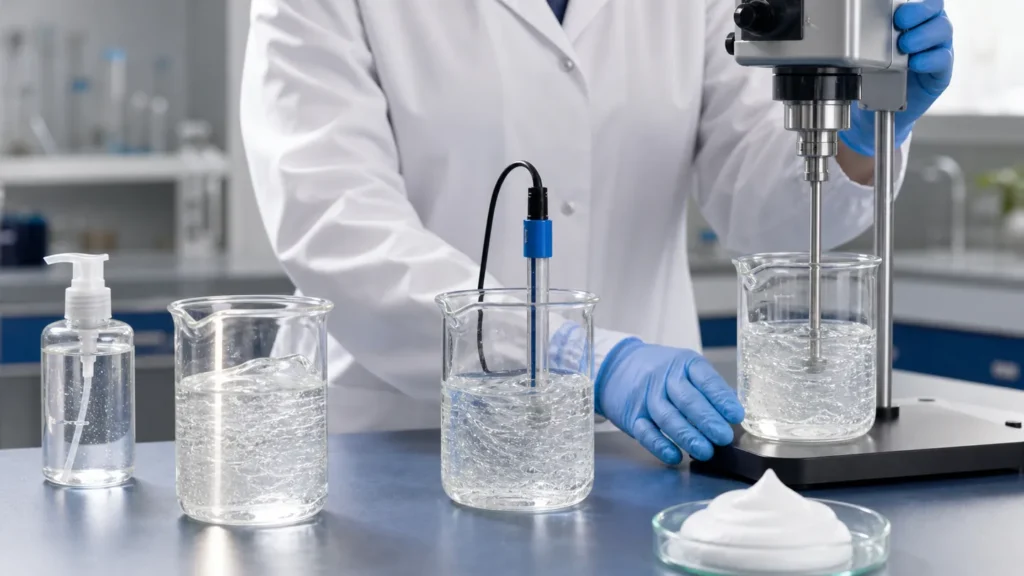
A clear gel is a finished-system result. Read appearance, pH, flow and use performance from the same batch history.
Decide what “clear” means for this product
A practical clarity check uses the same clean container, fill height, background, lighting and observation time. A black-and-white stripe card behind the sample quickly separates true haze from color and trapped air. Keep one approved reference beside new samples if the product brief calls for a tight appearance match.
A freshly mixed gel full of microbubbles is not ready for a clarity review. Give it the normal settling or deaeration step first. Persistent haze has a formulation story; air has a process story. They can look similar under office lighting and lead to very different fixes.
Instrumental turbidity can be useful when appearance limits are narrow, but the method and sample preparation must stay the same. There is no universal turbidity value that makes every facial cleanser commercially “clear.” Your brief, package and quality procedure define the acceptable result.
Keep a sample before each high-risk addition
Start with the intended production water, the complete surfactant blend and the planned active-matter basis. Once that base is uniform, retain a small labeled sample. Continue through the real process and retain another sample before and after the ingredient most likely to challenge clarity, often fragrance, an oil-soluble active, a solubilizer, a polymer or an electrolyte-bearing addition.
The retained pair gives you a useful sentence: “The base was clear before fragrance and hazy after the fragrance premix.” That is far more actionable than “the cleanser is cloudy.” It points the next trial toward the hydrophobic load and its solubilization route instead of sending the whole surfactant system back to zero.
Treat the pH step as part of the formula history
pH can change Sodium Lauroyl Glutamate association and solubility. The adjustment also brings acid or base, counterions and extra water into the batch. Record the adjustment solution, dose, addition point, batch temperature and the pH after the normal hold. That short history is often enough to distinguish a chemistry change from a poorly mixed local event.
If haze appears during adjustment, return to the last clear retained sample and repeat the intended pH move at small scale. Keep the same adjustment solution and mixing approach. A repeatable transition deserves a focused pH and compatibility review. A symptom that disappears under a gentler addition route points back toward process.
The deeper chemistry and troubleshooting path belong in how pH changes amino acid surfactant system behavior. For this project, the useful output is a pH route that can be repeated in the plant.
Set viscosity after the difficult ingredients are present
A clear base can look ready and still collapse after fragrance, preservative, electrolyte or final pH adjustment. Bring those ingredients into the intended process before committing to the thickener level. Then let the batch reach the temperature and hold time used by your laboratory method.
Record the viscometer, spindle or geometry, speed, sample temperature and reading time. ASTM D2196 describes rotational viscometer methods for non-Newtonian materials and reinforces a practical point: a viscosity result only travels with its test conditions.
The package also gets a vote. A number that looks acceptable on the report may still pour too quickly, string from a pump or trap air during filling. Check the intended package after the laboratory reading. If the surfactant base resists the expected salt or polymer route, move to the amino acid surfactant thickening guide rather than pushing pH around solely to chase body.
Read the first failure before changing the formula
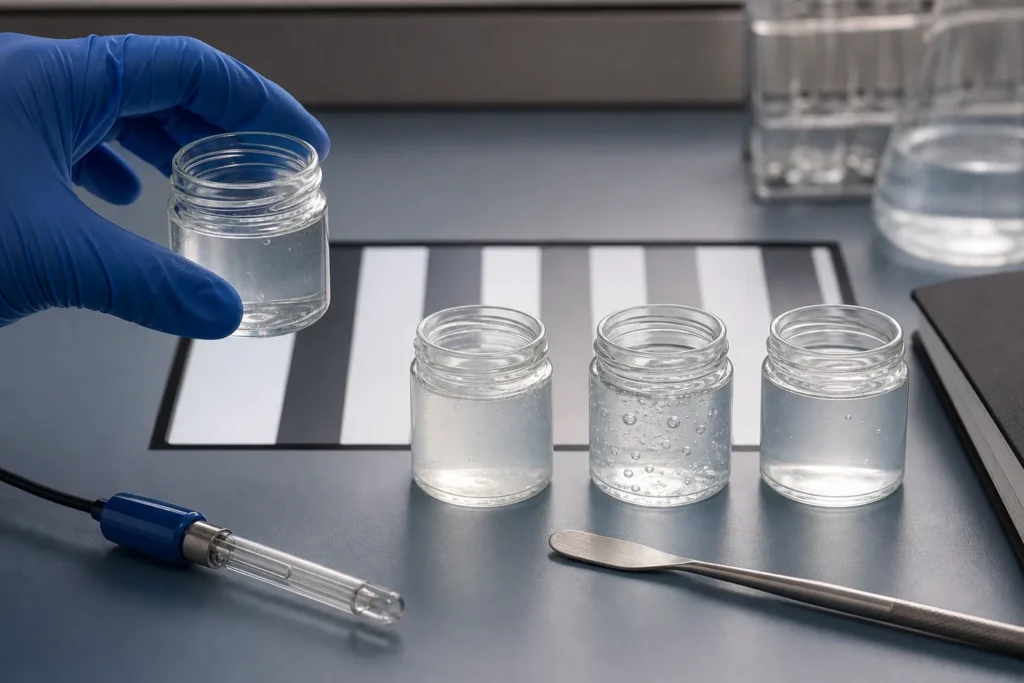
Retained samples turn a vague complaint into a timestamp: clear here, changed after this step.
| What you observe | The most informative next comparison |
| Haze is present before fragrance | Recheck water, surfactant ratios, pH history and deaeration in the simplified base |
| The base is clear and the fragranced sample is hazy | Compare the retained base with the exact fragrance and solubilizer route used in production |
| Viscosity is high when fresh and lower after the hold | Repeat the reading at the same temperature and method, then review pH and electrolyte additions |
| The gel is clear but too thin for the package | Screen the rheology route in the completed base; clarity confirms appearance, not completed structure |
| The gel is clear at room temperature and hazy under one storage condition | Keep the formula and package together in the project stability program and follow the change over time |
Foam belongs in the same development record, but it answers a different question. Use the intended product dose, water and test routine after the formula has reached its near-final pH and viscosity. A crystal-clear gel with slow lather or an unsuitable rinse still misses the commercial brief.
Cosmetics Europe stability guidance recommends a program adapted to the product, including relevant aesthetic, functional and package considerations. Choose conditions and acceptance criteria from your product, market and internal experience rather than borrowing a universal time and temperature from another formula.
Where KWLG-25 fits into the trial
The current KWLG-25 composition listing contains 24-26% Sodium Lauroyl Glutamate, 73-76% water, 0.2-0.6% Phenoxyethanol, 0.1-0.3% Caprylyl Glycol and 0-0.5% Sodium Chloride. Count the full supplied composition when you set the preservation, water and electrolyte plan. The material is described as colorless to light yellow, so finished-product color remains a separate acceptance question.
The KWLG-25 product page provides the current product route for documents and samples. If your clear gel is close but still misses appearance or flow, send us the formula stage at which it changes. Include the surfactant blend, target active matter, water source, pH adjustment route, fragrance and solubilizer, thickener, viscosity method, package and storage observations. We can then discuss the next useful sample instead of handing you a generic cleanser formula.
Ask INNO to review a KWLG-25 clear cleanser trial
Questions that usually follow a clear-gel trial
Can KWLG-25 produce a crystal-clear facial cleanser?
KWLG-25 can be evaluated in clear facial-cleanser systems, but the finished clarity depends on the complete surfactant blend, pH, water, fragrance, solubilizer, rheology system and process. Approve clarity on the complete formula.
Why did a clear base turn cloudy after fragrance was added?
The fragrance or its premix may have exceeded the solubilization capacity of the finished surfactant environment. Compare the retained clear base with the exact fragrance and solubilizer route before changing the primary surfactant.
Should final viscosity be set before or after pH adjustment?
Establish the intended pH route first. Set the final thickener level only after fragrance, preservative and the other finishing ingredients are present and the sample has reached the laboratory’s specified temperature and hold time.
Do trapped bubbles count as a clarity failure?
Trapped bubbles can imitate haze and distort viscosity readings. Apply the normal deaeration or settling step, then inspect the sample again under the same lighting before changing the formula.
What information helps INNO review a cloudy or thin sample?
Send the complete ingredient list and use levels, water source, batch order, pH history, fragrance premix, thickening route, viscosity method, package and photographs of retained samples. The point where the change first appears is especially useful.