A buyer sends two sodium lauroyl glutamate quotations across the desk. One uses 99% for AMISOFT LS-11. The other lists INNO KWLG-95 at 98.5%. The first reaction is predictable: the 99% grade must deliver more.
It does, but only slightly. To put 4.00 kg of declared material into a 100 kg batch, the 99% basis needs 4.04 kg of powder; the 98.5% basis needs 4.06 kg. The difference is about 20 g. Price, moisture, salts and impurity profile can matter far more.
A useful sodium lauroyl glutamate active matter comparison separates five lines: active matter, content, purity, moisture and inorganic salts. Read them separately, then bring them back together in one equal-active calculation.
The useful number is the one that survives the trip from the specification to the batch sheet.
Five numbers behind sodium lauroyl glutamate active matter
Read a sodium lauroyl glutamate grade by asking what each result measures. A high number is useful only inside its own definition.
| Term | What it means in practice | What a favorable result can bring | What still needs checking |
| Active matter | Surfactant counted by a stated active-matter method | A reliable basis for dosage and cost per active kilogram | Method, applicability and whether both suppliers use the same basis |
| Content or assay | Target material calculated or measured by the supplier’s stated procedure | More declared material per kilogram as sold | Calculation route, sample basis and comparability with another supplier’s result |
| Chemical purity | Proportion of the target chemical relative to defined related substances or impurities | Fewer unwanted organic residues and a clearer incoming-quality profile | Analytical method, named impurities and reporting basis |
| Moisture or loss on drying | Water, or mass lost under specified drying conditions | Less supplied water and more room in concentrated formats | Moisture method; loss on drying may include more than water |
| Inorganic salts | Sodium chloride or other mineral residue carried by the grade | Lower uncontrolled electrolyte input when the value is low | Which salts are measured and how the finished formula responds |
Active matter is the best starting point when the method genuinely measures the surfactant in question. ISO 2271, for example, describes a two-phase titration method for anionic-active matter within a stated field of application. It shows why the method name belongs beside the result.
Content or assay may reach the number differently. Ajinomoto’s public AMISOFT LS-11 specification lists 93-100% content calculated from nitrogen content. A fair comparison uses a compatible definition and method.
Purity needs the most discipline. Chromatographic purity is a separate result from KWLG-95’s 98.5% declared content. It needs a defined target, related substances and analytical basis. Moisture, salts and organic impurities also require their own lines.
The TDS, SDS and COA guide helps keep these document roles straight. The TDS or controlled specification sets the commercial target, the COA reports a released batch, and the SDS communicates composition for safety purposes. None should be asked to do all three jobs.
What higher content and higher purity can actually do for you
Higher content puts more target material into each kilogram purchased. Higher purity, when supported by a suitable impurity method, tells you more about what accompanies it. The two ideas travel together but measure different things.
Higher content creates room in the formula and the warehouse
A concentrated powder needs a lower use level to deliver the same target amount. That leaves more formula room and reduces the kilograms stored and shipped per kilogram of declared material.
The customer benefit is practical: less freight allocated to supplied water and a cleaner cost comparison. High content also suits dry or compact formats where supplied water works against the design.
A defined purity profile reduces avoidable questions
Related organic material, free fatty acid, moisture and salts can each affect a different part of the formula. A well-characterized grade gives R&D and incoming QC fewer unknowns when samples behave differently.
A purity profile improves raw-material control; the finished formula still decides foam and mildness. If free lauric acid matters to your specification, ask for that result or the relevant chromatographic profile.
Fine powder still needs suitable dust control, wetting and dispersion. Low salt gives you more control over electrolyte, while the complete formula determines viscosity.
Equal-active dosage takes one formula
Once the percentage definitions are comparable, equal-active conversion is short:
New raw-material use level = Current use level x Current content basis / New content basis
If you are building from a target rather than replacing a grade:
Raw-material use level = Target contribution / Content basis as a decimal
From a 95% grade to 98.5%
Suppose the current formula uses 4.00% of a 95% grade. It delivers:
4.00 x 0.95 = 3.80% declared material
To deliver the same 3.80% with a 98.5% grade:
3.80 / 0.985 = 3.86%
The replacement starts at 3.86%, not 4.00%. In a 1,000 kg batch, that is 1.4 kg less powder entering the vessel. Close that gap somewhere in the batch sheet, usually in formula water unless the composition data points elsewhere.
From a 99% benchmark to 98.5%
If your AMISOFT LS-11 quotation or COA uses 99% as the working basis, a 4.00% target needs:
4.00 / 0.99 = 4.04% of the 99% grade
4.00 / 0.985 = 4.06% of KWLG-95
The use-level difference is about 0.02 percentage points, or roughly 20 g in a 100 kg batch. That is worth correcting. It is not large enough to settle the purchasing decision on its own.
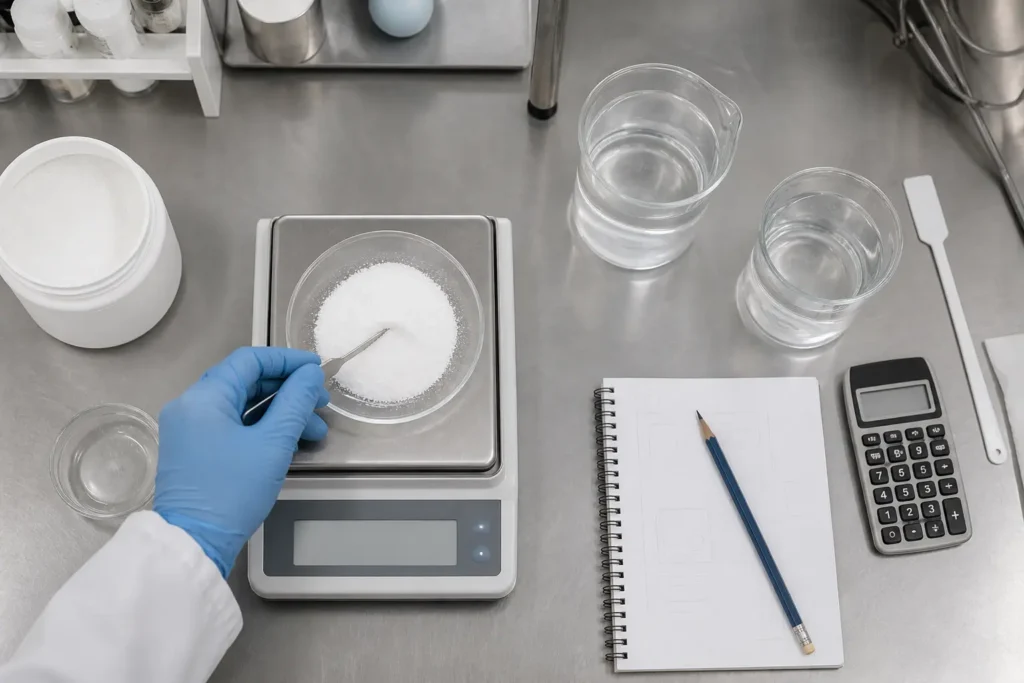
Equal-active dosing removes one easy source of noise before the formula tells you what really changed.
Compare price after you compare delivered material
Bag price is quick to read and easy to misuse. The fair first line is:
Cost per kg of declared material = Delivered price per kg / Content basis as a decimal
For a 99% grade, divide the matched delivered price by 0.99. For KWLG-95 at 98.5%, divide by 0.985. Keep the currency, quantity, packaging, destination and Incoterm the same.
The 0.5-point content gap has a simple commercial implication. On comparable definitions, a 98.5% grade needs to be only about 0.51% lower in delivered price than a 99% grade to offset the difference in cost per kilogram of declared material. That is arithmetic, not a promised saving. It does show why a meaningful price advantage can outweigh such a small content gap.
Then add freight, storage, dust handling, dispersion time, heating and cleaning. A low active-cost grade that adds half a shift to every batch is not inexpensive.
Moisture and salts belong in the batch sheet too
The unused part of a content percentage has no automatic identity. At 98.5% declared content, the remaining 1.5% may include water, salts or other specified material. Leave it unassigned until the documents support the split.
Moisture mainly changes mass balance, supplied-water freight and the room available in concentrated formats. Inorganic salts change the electrolyte load. That may affect clarity or rheology in a sensitive surfactant blend, although the direction and size of the change depend on the full formula.
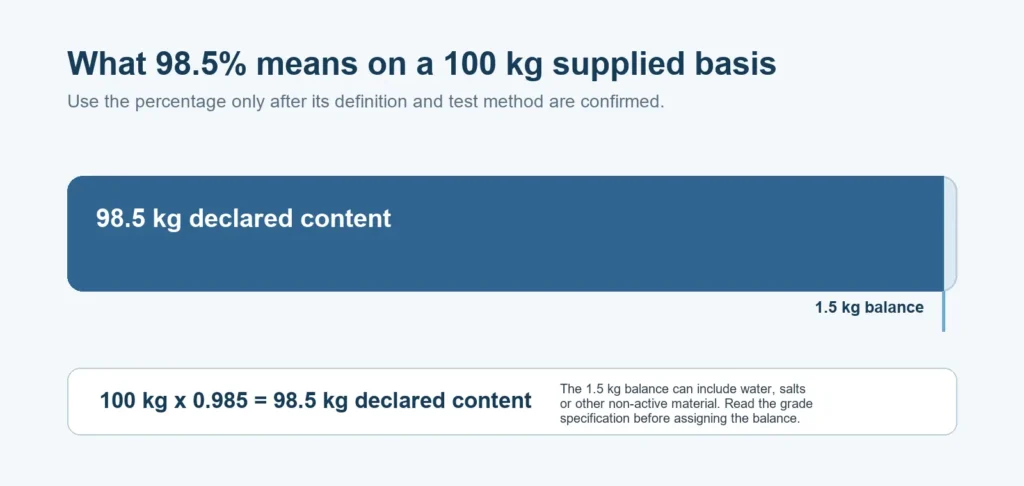
A 98.5% content result leaves a 1.5% balance. Good specifications explain that balance instead of asking you to guess.
When two powders reach the lab, first match their delivered material contribution and correct the batch water. Record the supplied salt information separately. If clarity or viscosity moves, you now have a useful lead instead of a mystery caused by two different dosage bases.
A supplier comparison that purchasing and R&D can share
You do not need a heroic spreadsheet. One page is enough if it carries the right lines:
- Confirm the same INCI, physical form and intended application.
- Write the exact label used for the percentage: active matter, content or assay.
- Record the method or calculation basis and whether the result is as-is or dry basis.
- Convert both offers to equal active and cost per kilogram of declared material.
- Compare moisture, inorganic salts and any impurity that matters to your formula.
- Check the current TDS, SDS, specification, COA and relevant company certificates.
- Run the intended formula with matched dosage, water, process and observation time.
Purchasing gets a defensible cost number, R&D gets a fair starting batch, and supplier discussions move faster.
Where INNO KWLG-95 fits in this comparison
KWLG-95 is positioned for teams that want a high-content sodium lauroyl glutamate powder without carrying the full price of the head-brand reference. Its current declared content is 98.5%, only 0.5 percentage points below a 99% AMISOFT LS-11 buying basis. On matched quantity, packaging, destination and Incoterm, INNO also holds a favorable price position.
Our current comparative chromatographic work supports KWLG-95 as a high-purity grade with a controlled free-lauric-acid profile. If that distinction matters to your project, we can review the current method and sample data with your team alongside the 98.5% declared-content figure.
INNO can supply the current TDS, SDS and COA, plus company certificates covering ISO 9001, ISO 14001, ISO 45001 and ISO 22716 GMP for their certified scope. Request the documents and a sample from the KWLG-95 product page.
Send us your current grade, percentage basis, use level, quantity, destination and Incoterm. We will return the equal-active KWLG-95 dosage and a matched quotation. Add the target pH and the result you need to preserve. Send the comparison to INNO.
Questions buyers ask before changing grade
Is 98.5% content the same as 98.5% chemical purity?
No. The 98.5% figure is KWLG-95’s declared content basis. Chemical purity requires a defined analytical method and impurity profile, so request the relevant method and results when purity is part of your buying specification.
How do I convert sodium lauroyl glutamate active matter from 99% to 98.5%?
Multiply the current use level by 0.99 and divide by 0.985. For example, 4.00% of a 99% grade corresponds to about 4.02% of a 98.5% grade when replacing at equal declared material contribution.
Does a higher-purity sodium lauroyl glutamate always foam or thicken better?
No. A better-defined impurity profile reduces raw-material uncertainty, but foam and viscosity still depend on dosage, pH, water, salts, co-surfactants, oils, polymers and process. Compare the grades at equal active in the intended formula.
What should I request before approving a new sodium lauroyl glutamate supplier?
Request the current specification or TDS, SDS, recent COA, percentage definition, test method, moisture and salt data, relevant impurity information and applicable company certificates. Then compare delivered cost on an equal-active basis and run the target formula.