A dry cleanser has a rather public way of reporting a packaging mistake. The first few doses pour cleanly. A week later, the powder arrives in one stubborn piece, or the tablet survives the box but takes too long to break apart in wet hands.
A Sodium Lauroyl Glutamate powder cleanser and a compressed cleansing tablet can start from the same solid surfactant. The ingredient brings a concentrated surfactant into a format designed to carry little water. The format still has to survive blending, filling, storage and bathroom use before that surfactant can do its job. A practical development plan follows the product through those stages and checks five things: dose uniformity, powder flow, moisture response, release into water and final lather.
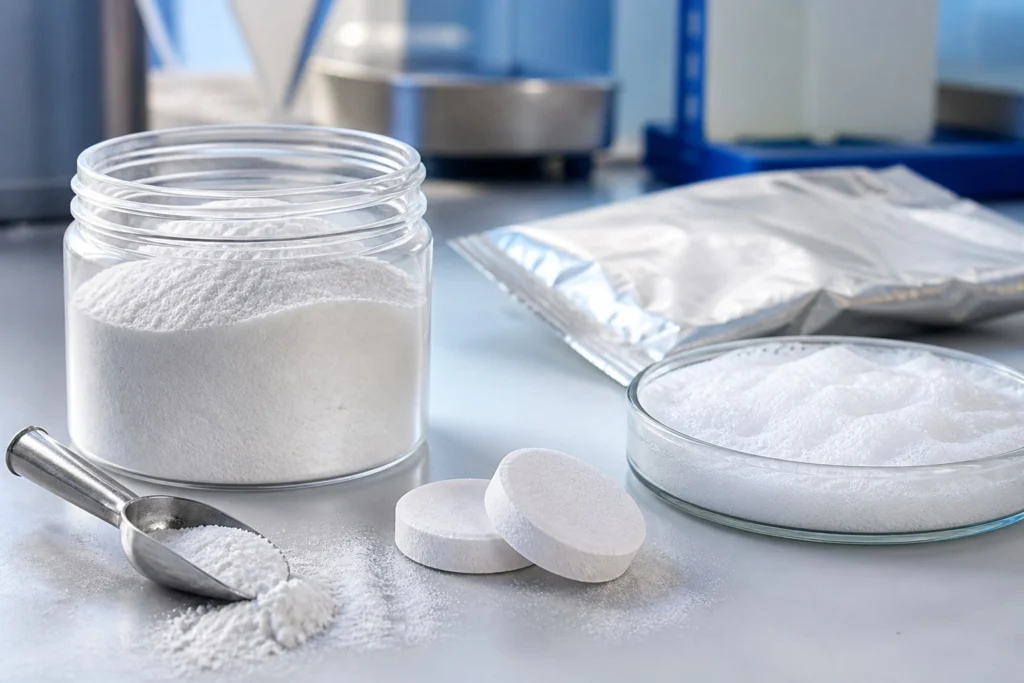
Conceptual illustration.
The formula begins at the filler, not at the sink
For a liquid cleanser, a poorly dispersed surfactant often appears during batching. In a dry format, the same problem can stay hidden until filling or even until the customer opens the pack.
The product has to pass through a chain:
- The raw materials must flow and blend without creating persistent pockets.
- The mixed powder must deliver a consistent dose to each sachet, jar scoop or tablet die.
- The pack must limit moisture exposure through storage and repeated opening.
- The powder or tablet must wet and break apart with the water the customer actually uses.
- The released surfactant must build enough lather and rinse as intended.
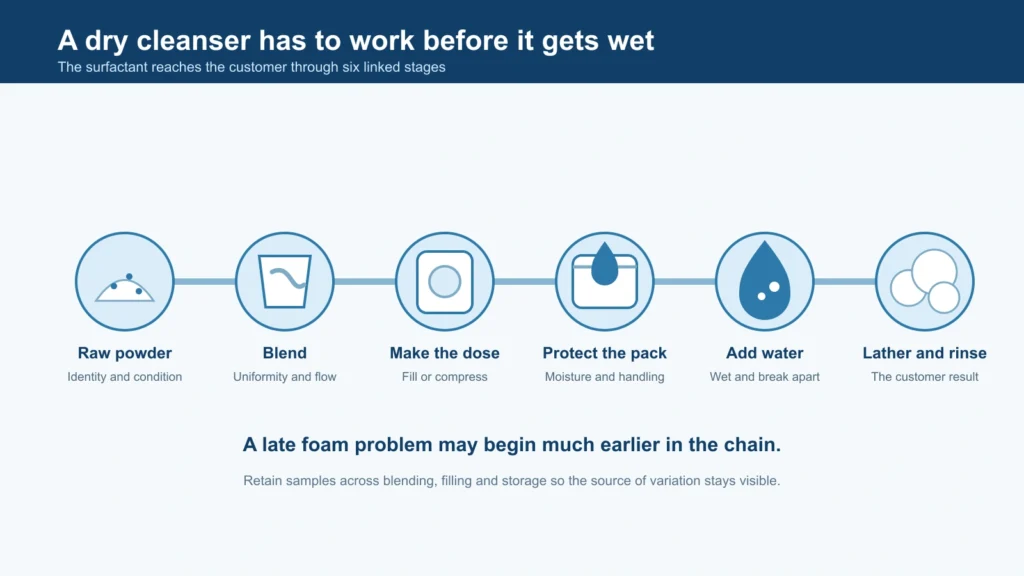
This sequence changes how you read a failure. A weak foam result may begin with poor dispersion at the sink, but it may also begin several steps earlier with segregation in the hopper or a tablet that releases the surfactant unevenly.
Blend uniformity protects the dose
A cleansing powder is a mixture of particles that may differ in size, shape and bulk behavior. During transfer and vibration, those differences can encourage segregation. The top of a hopper and the bottom of the same hopper may then stop being equivalent samples.
Sodium Lauroyl Glutamate deserves particular attention because it carries a large share of the cleansing function. A high-content powder may occupy less formulation mass than a diluted liquid route would, but each delivered dose still needs the intended amount of surfactant.
For a loose powder, sample the blend where the process can change it: after blending, near the beginning and end of filling, and after any transfer that adds vibration or a long drop. The aim is simple. A customer should not receive a gentle first scoop and a surfactant-heavy last one.
A tablet adds another layer. Flow into the die, fill weight and compression all influence unit consistency. Good tablet mass is useful, but it does not prove that every component remained evenly distributed before compression. If your formula contains ingredients used at small levels, the preblend route may matter more than another minute of main blending.
Moisture changes flow before the powder looks wet
Dry products do not need visible droplets to develop a moisture problem. Water absorbed from humid air can increase particle cohesion and create a crust or cake at the exposed surface. Research on moisture-induced powder caking also shows that caking may be uneven through a powder bed, which explains why a quick look at the top of one sample can miss what is happening deeper in the pack.
The practical variables are familiar: the moisture sensitivity of every ingredient, room humidity during filling, exposure time, package barrier, closure design and the number of times the customer opens the pack. A jar in a bathroom experiences a different life from a single-dose sachet.
That difference deserves its own storage trial. Keep an unopened control beside a package that is opened and closed on the intended use schedule. Follow appearance, flow, dose delivery and activation. If the pack includes a desiccant or special liner, evaluate the complete pack as sold rather than treating the packaging material as a footnote.
INNO’s current KWLG-95 TDS instructs users to keep the product sealed in a dark, cool and dry place. The finished cleanser needs its own packaging study because other powders may absorb moisture more readily than the surfactant grade.
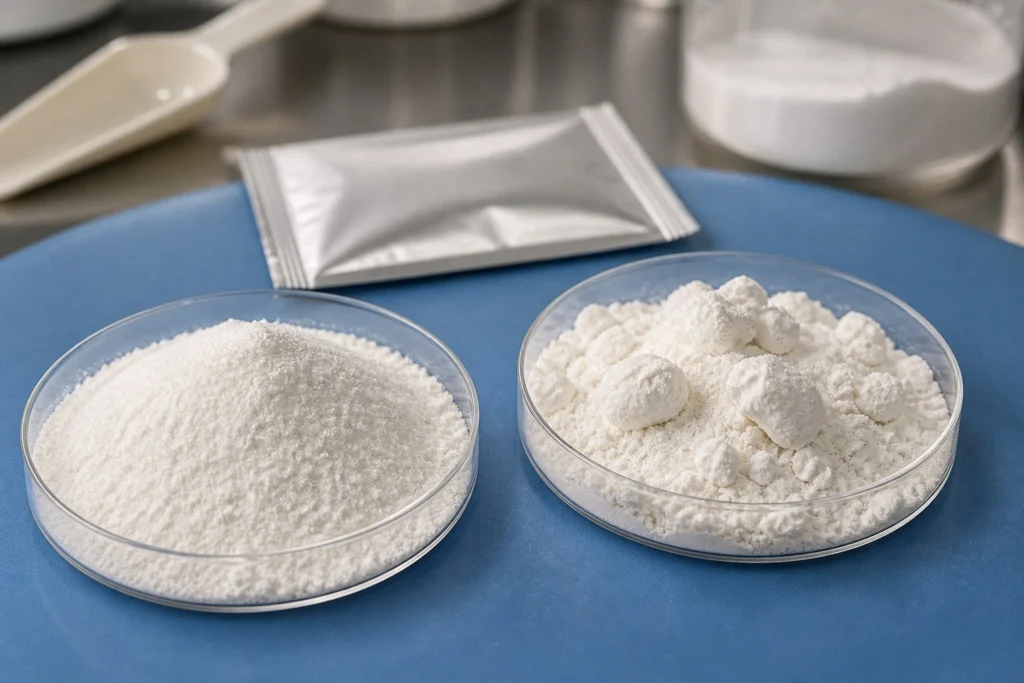
Conceptual illustration of a packaging question, not measured KWLG-95 caking data.
Loose powder and tablets meet water differently
Both formats may use the same surfactant, but the customer does not activate them in the same way.
A cleansing powder needs fast, even wetting
Fine powder can float on the water film or form small wet shells around dry centres. Coarser particles may feel gritty or take longer to disappear. The useful test therefore begins with the intended dose and use motion, not a large beaker with generous stirring.
Observe how much powder remains on the hand or vessel, whether lumps survive rubbing, how quickly lather appears, and whether the rinse carries away visible particles. If the product is dispensed through a sifter or narrow opening, include that package in the trial. A formula that performs after weighing on an analytical balance may still annoy a customer at 7 a.m.
A tablet must balance strength and release
A cleansing tablet needs enough mechanical strength for filling, shipment and handling. Too much resistance to break-up can slow wetting and surfactant release. Too little can create chips, dust and variable doses before use.
Published research on effervescent cleansing tablets evaluated flow, tablet properties, disintegration, cleansing performance and stability as separate outcomes. The formulation in that paper is not a recipe for Sodium Lauroyl Glutamate, but the test categories are a useful reminder: a tablet can look intact and still miss the use-time target.
Test the product in the order the customer experiences it
Dry-format development becomes clearer when the evaluation follows the product’s life rather than the layout of a standard lab form.
| Stage | A useful observation | What the result helps you decide |
| Incoming powder | Appearance, sealed-pack condition and any caking | Whether the raw material is fit to enter the trial |
| Blending and transfer | Flow, visible uniformity and samples from process-sensitive points | Whether the chosen blending and transfer route protects dose consistency |
| Filling or compression | Fill variation, dust, tablet integrity or powder bridging | Whether the process can make repeatable units |
| Pack storage | Flow or tablet condition after unopened and use-cycle exposure | Whether the package controls the real moisture risk |
| Water activation | Wetting, break-up, residue and time to useful lather | Whether the format releases the surfactant under realistic use |
| Rinse | Foam character, visible particles and after-feel | Whether the complete product meets the cleansing brief |
Use one retained sample to connect the stages. If a late complaint appears, you can compare it with the same batch before filling and after storage. That is much more informative than remaking the formula from memory.
Where INNO KWLG-95 fits
INNO KWLG-95 is a white solid powder grade of Sodium Lauroyl Glutamate with a current declared content of 98.5%. Its TDS lists cleansing powder and cleansing tablets among the intended application directions, and the 15 kg drum format is documented for supply.
The high supplied content gives a dry-format developer a concentrated surfactant option without choosing a liquid grade that brings a large water phase. It does not establish particle-size distribution, flow index or direct-compression performance. Those properties and the full powder blend still need to be assessed for the intended equipment and pack.
You can review the KWLG-95 Sodium Lauroyl Glutamate powder page for current document and sample access. The broader Sodium Lauroyl Glutamate guide explains how content, water and salts differ from one commercial grade to another.
For a useful first discussion, send the intended format, dose, other powder components, blending route, filling or compression process, package type and activation routine. We can provide the current KWLG-95 documents and help you decide whether a concentrated powder grade belongs in the first screen.
Discuss a powder cleanser or cleansing tablet project with INNO
Questions that matter before scale-up
Can KWLG-95 be used for direct compression?
The current TDS lists cleansing tablets as an application, but it does not document direct-compression performance. Check the complete blend for flow, die filling, tablet strength, friability and disintegration on the intended equipment before choosing the manufacturing route.
Does a dry cleanser need a preservative system?
The answer depends on the finished product’s water activity, ingredients, manufacturing hygiene, package, use pattern and target-market requirements. A product that is dry at filling can still face water during repeated bathroom use. Set the preservation decision from the complete product risk assessment rather than the word “powder.”
What should incoming QC check for a surfactant used in a dry format?
Match the product and lot to the approved documents, inspect the sealed pack, and compare appearance and any caking with the agreed incoming criteria. Use the site’s approved test methods for content or moisture-related checks. Hold material that shows a meaningful change in flow or condition before it reaches the main blend.
Why can two tablets with the same weight produce different foam?
Equal mass does not guarantee equal release. Blend segregation, compression differences, moisture exposure, break-up behavior and the customer’s water dose can change how much surfactant becomes available during use. Compare disintegration and lather from units sampled across the same production run.