Match the surfactant basis first. Then repair the water and total batch balance as separate calculations.
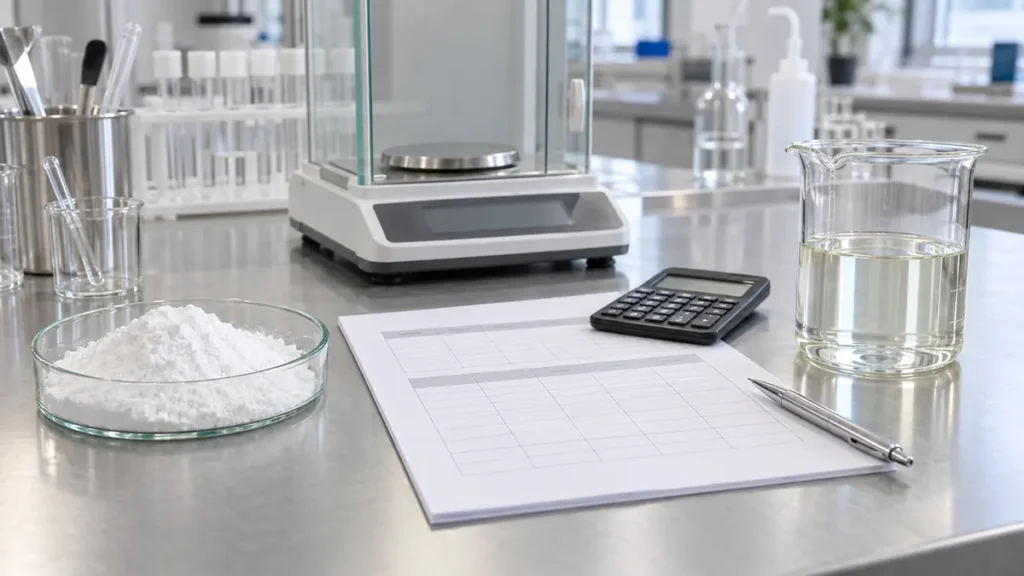
Replacing 10 kg of a liquid surfactant with 10 kg of powder is simple arithmetic and usually the wrong formulation move. The two materials can deliver very different amounts of surfactant. The liquid may also supply most of its mass as water, while the powder leaves that water out of the batch.
A reliable conversion uses two ledgers. The first keeps the chosen surfactant contribution constant. The second restores the water or total batch mass according to the purpose of the trial. If those steps are combined into one shortcut, a change in foam, viscosity, clarity, or processability cannot be assigned to the grade alone.
Use one declared basis for both materials
The calculation needs a percentage for the old material and a percentage for the replacement. Both percentages must mean the same thing and come from documents that use a comparable test or definition. A product’s assay, purity, solids, total listed ingredients, and active matter are not automatically interchangeable terms.
Write the basis on the calculation sheet. If the supplier document states active matter under a named method, use that field. If only composition or content is available, call the result a listed-content comparison rather than silently relabeling it as active matter. This naming discipline matters when QA, purchasing, and R&D later try to reproduce the conversion.
Surfactant contribution = supplied product mass × declared basis fraction
Replacement mass = target surfactant contribution ÷ replacement basis fraction
Enter percentages as fractions in a manual calculation. For example, 25% becomes 0.25. A spreadsheet or the calculator below can accept percentage values directly.
Water correction and batch-mass correction answer different questions
After the replacement mass is known, decide what must stay fixed. Keeping the final batch at the same total weight requires a mass make-up. Keeping the same water content requires a water balance based on the documented water in both supplied materials. Those answers can differ when a material contains non-surfactant matter that is not water.
Batch-mass make-up = old product mass − replacement product mass
Water make-up = water from old product − water from replacement product
Do not assume that everything outside the stated surfactant percentage is water. Use a documented water value when exact water balance matters. ISO 4317:2011 describes Karl Fischer methods for determining water in surface-active agents and detergents, but the correct supplier method and acceptance basis still need to match the material. See the ISO 4317 overview.

Try the conversion calculator
This calculator separates surfactant contribution, replacement mass, total batch make-up, and documented water correction. Use percentages from current supplier documents. The optional water fields should remain blank when the water value is not known.
Powder-to-liquid surfactant conversion
Old product mass (kg)Old declared basis (%)Replacement declared basis (%)Old product water (%) optionalReplacement product water (%) optionalCalculate Load KWCG listed-content example
Enter the known values and select Calculate.
A KWCG-25 to KWCG-95 example shows the two balances
INNO currently lists KWCG-25 as a liquid containing 75% Water, 20% Disodium Cocoyl Glutamate, and 5% Sodium Cocoyl Glutamate. For a transparent listed-content example, 100 kg of KWCG-25 therefore contains 25 kg of the two listed cocoyl glutamate salts and 75 kg of listed water.
KWCG-95 is listed as Sodium Cocoyl Glutamate powder with 93.5% to 100% content. Using the lower listed-content value of 93.5% gives a conservative composition-basis calculation:
25 kg ÷ 0.935 = 26.74 kg KWCG-95
Replacing 100 kg of KWCG-25 with 26.74 kg of KWCG-95 leaves 73.26 kg to restore if the total batch weight must remain unchanged. That number is a batch-mass make-up. It is not automatically an exact water correction because the current KWCG-95 source does not state that every remaining percentage point is water.
This example compares listed composition and content, not active matter established under one shared analytical method. For a release formula, use the agreed document fields and lot-specific values required by your quality system.
The INNO grades do not become chemically identical after the math
INNO currently offers KWCG-95 as a white Sodium Cocoyl Glutamate powder with 93.5% to 100% listed content and a standard 15 kg pack. INNO also offers KWCG-25 as a pale-yellow or colorless transparent liquid with the listed 75/20/5 composition and a standard 200 kg pack.
The calculation only matches the chosen mass basis. KWCG-25 contains both disodium and sodium salts, while KWCG-95 is listed as the sodium salt. The supplied water, dissolution route, pH response, ionic environment, and process handling also change. Equal mass contribution is the starting condition for a fair trial, not proof that the finished products will behave the same.
Carry the new numbers into a controlled bench trial
Make the calculation before mixing, then prepare a control and a replacement sample from the same base formula. Keep batch size, target surfactant contribution, final pH, temperature history, shear, addition order, water source, and sample age as close as practical. Record any intentional water or mass correction.
| Question | Calculation or test | Useful record |
|---|---|---|
| Was the surfactant basis matched? | Mass × documented percentage | Document version, field name, value, lot basis |
| Was batch mass restored? | Old mass minus replacement mass | Actual weighed make-up and final batch mass |
| Was water truly matched? | Documented water in minus documented water out | Water values, sources, and any unknown remainder |
| Did the formula remain equivalent? | Controlled finished-product comparison | pH, appearance, viscosity, foam, rinse, stability |
If the converted sample fails, resist the urge to change several ingredients at once. First verify the actual weights and percentages. Then separate incomplete powder dispersion, salt-form effects, final pH, and the changed water path. One clean comparison is more useful than a corrected batch whose cause can no longer be identified.
Frequently asked questions
What is the basic surfactant active matter formula?
Multiply supplied product mass by its documented active-matter fraction. Divide the target active mass by the replacement product’s documented fraction to obtain the new dosage.
Can I use product purity instead of active matter?
Only when the supplier confirms that both values share the same definition and method. Otherwise, purity, assay, solids, content, and active matter should remain separate fields.
How much water should I add when changing from liquid to powder?
For exact water balance, subtract documented water supplied by the powder from documented water supplied by the liquid. Do not treat every unspecified percentage as water.
Does equal active matter guarantee the same foam and viscosity?
No. Equal active matter controls one comparison variable, while salt form, pH, co-surfactants, electrolytes, process, and measurement conditions can still change finished-product behavior.
Send INNO the basis behind your conversion
Share the current grade and document, old dosage, percentage field used, target batch size, intended replacement direction, final pH, process limits, and whether you need equal surfactant contribution, equal water, or equal total batch mass. INNO can prepare a focused KWCG-95 or KWCG-25 sample discussion around those numbers.