The formula must remain uniform and usable from the mixer to the last consumer dose.
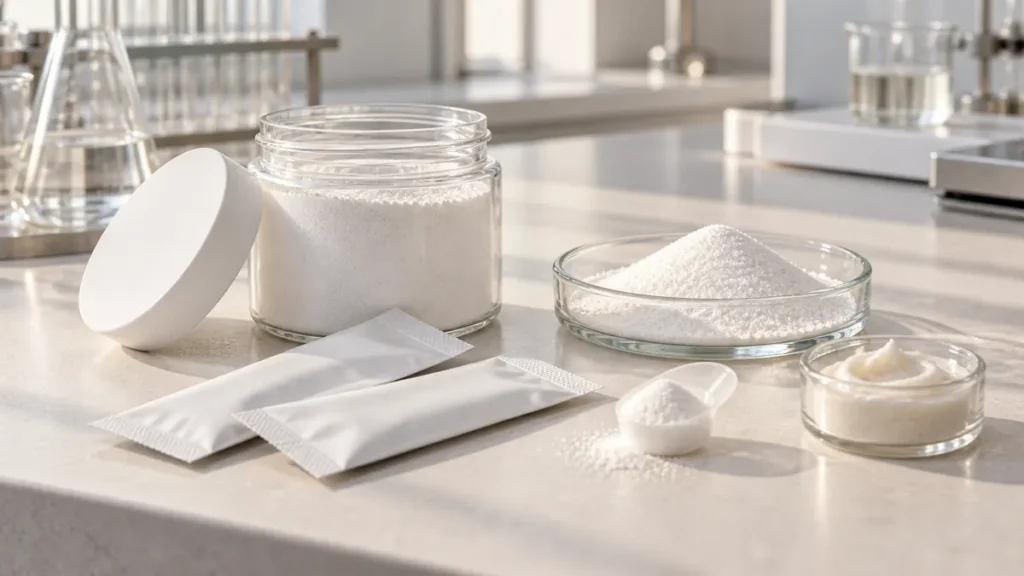
A powder cleanser can leave the filling line as a free-flowing blend and reach the user as a hard mass. The same formula may disperse well from a fresh sachet but float, clump, or leave concentrated grains when it is scooped from a bathroom jar. These are different failures, and they begin at different points in the product’s life.
Concentrated sodium cocoyl glutamate powder reduces the water brought in with the surfactant. It does not remove moisture risk from the rest of the formula, the factory, the package, or consumer use. A workable development plan follows the powder through four moments: blending, filling, storage after sealing, and contact with water during use.
Uniformity has to survive more than the mixer
A dry cleanser often combines powders with different particle sizes, shapes, densities, and surface properties. A blend may look even in a laboratory cup yet segregate during transfer, vibration, hopper discharge, or filling. If a low-water paste is the target, the same concern appears as incomplete wetting or pockets of dry powder.
Choose a marker that can be measured in samples from different parts of the batch. Sampling only from the top of a vessel cannot establish uniformity. Define the number and location of samples, the acceptable variation, and the analytical method before the trial. The marker should represent the component whose uneven distribution creates the greatest quality or safety concern.
Particle engineering can help, but the solution is formula specific. Milling everything finer may increase dust and surface area. Granulation may improve flow or reduce visible segregation, yet it can change how quickly the product breaks apart in water. A carrier or binder may support uniformity while taking up formula space and changing foam. Screen the manufacturing benefit against the use experience.
Moisture reaches the powder in short events
Humidity exposure is rarely one constant condition. Powder meets room air during weighing and filling. The sealed package then faces transport and storage. After opening, humid air enters the headspace, and a wet hand or damp scoop can create a local moisture spot. Short exposures may repeat many times.
Powder-caking literature describes several routes by which moisture and environmental conditions can strengthen contacts between particles. A broad review in Powder Technology discusses capillary condensation, liquid and solid bridges, temperature, humidity, pressure, and storage time as caking variables. This research covers bulk powders generally, not KWCG-95 or a finished cosmetic formula, but it explains why one fresh-flow test cannot establish shelf performance. See the powder-caking review.
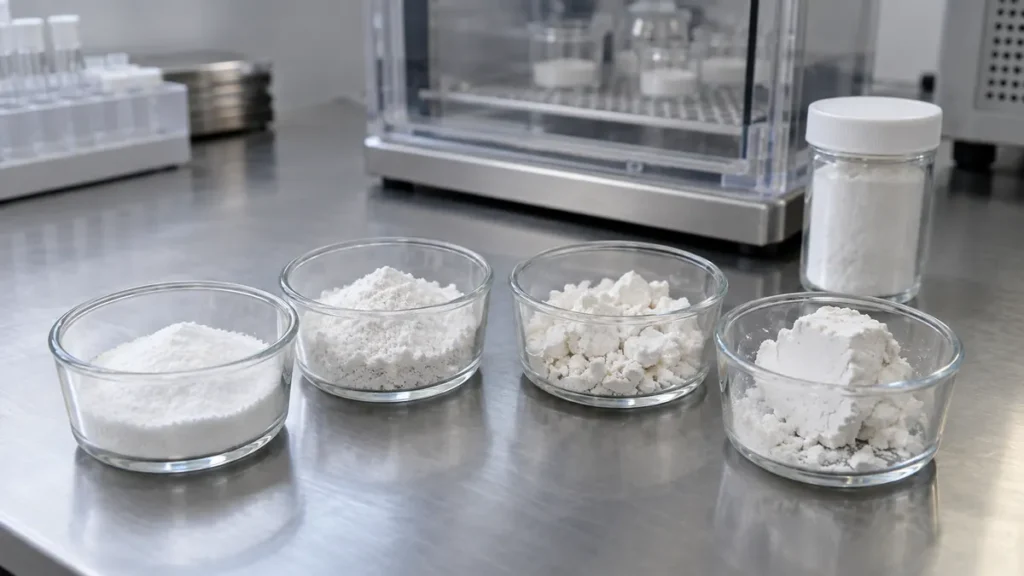
Do not assume every clump has the same cause. A soft clump that breaks with light pressure is different from a hard cake, a partially dissolved mass, or a package contaminated by wet use. Record when the change first appears, how much force breaks it, whether the dose remains uniform, and whether the powder still disperses as intended.
The package is part of the formulation decision
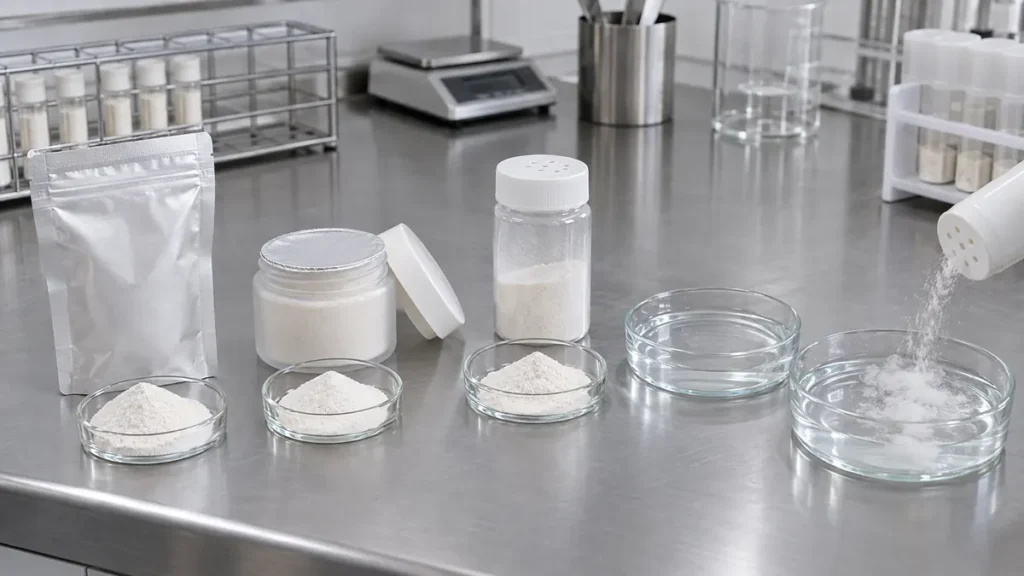
A sachet, screw-cap jar, shaker, or water-activated pump exposes the powder differently. Single-dose packaging limits repeated opening but creates more package units. A jar is simple to fill and use, though its headspace changes after each opening and the opening may admit damp fingers or tools. A shaker can control the dose while its holes and closure become part of the moisture path.
Compare barrier materials using measured properties under stated conditions. Water vapor transmission rate is one useful packaging input, but it does not describe the complete pack. ASTM F1249-25 covers measurement of water vapor transmission through flexible barrier materials and notes its relationship to packaged-product stability. The ASTM method page also stresses agreement on sampling, test conditions, and acceptance criteria.
The closure, seal area, wall thickness, package geometry, filling environment, and consumer opening pattern still need finished-pack testing. A low transmission value for a flat film cannot prove that a filled sachet has sound seals. Likewise, choosing a jar resin by name does not establish the performance of the cap, liner, or complete package.
Dispersion is a use test, not a solubility assumption
The user does not normally dissolve a cosmetic powder under ideal laboratory stirring. They may sprinkle it into a wet palm, add a few drops of water, or dispense it onto a damp tool. The local powder-to-water ratio can be high, and surface wetting may create lumps before the rest of the dose hydrates.
Design a use test around the intended instructions. Fix the dose, water amount, water temperature, contact time, and motion. Record the time to a uniform slurry or foam, visible grains, residue, dust during dispensing, and dose consistency. Test fresh product and product aged in its final package.
Run at least one reasonable misuse condition if it reflects the package. A wet scoop or an incompletely closed lid may not be part of the official directions, but it can reveal whether one event ruins the remaining product. Treat this as a risk screen, not as permission to omit clear use instructions.
KWCG-95 is the concentrated INNO route
INNO currently offers KWCG-95 as Sodium Cocoyl Glutamate. Its current listed details describe a white solid powder with 93.5% to 100% content. The standard listed pack is 15 kg.
This composition and physical form make KWCG-95 a candidate when a formulator wants to avoid the large carrier-water contribution of a liquid surfactant grade. They do not establish that a finished powder cleanser will remain free flowing, resist humidity, disperse quickly, or perform in a particular package.
Before pilot work, request the current technical and safety documents for the intended lot. Confirm the plant’s powder-handling route and the customer’s target water content. Use the finished blend to determine dust behavior, uniformity, flow, caking, dispersion, foam, rinsing, and stability under defined conditions.
A shelf-life screen should imitate opening and closing
Traditional sealed stability samples answer only part of the question. Keep a sealed control, then add in-use simulations that match the planned package. A jar might be opened on a set schedule in a controlled environment. A sachet program should examine seal integrity and units removed from different points in a shipping pack. A shaker needs repeated dispensing and closure checks.
| Sample history | What it represents | Useful observations |
|---|---|---|
| Sealed control | Unopened storage in the final package | Appearance, mass change, flow, caking, package integrity |
| Repeated opening | Headspace exchange and normal dispensing | Dose consistency, closure condition, clumps, dispersion |
| Defined wet-contact event | A foreseeable damp-hand or damp-tool challenge | Local caking, spread of the defect, remaining usability |
Low water does not automatically place a finished cosmetic product in a microbiologically low-risk category. ISO 29621 provides guidance for identifying low-risk products through risk assessment. Apply that assessment to the finished formulation, manufacturing process, package, and intended use instead of inferring the outcome from format alone. See the current ISO 29621 overview.
The wider stability program should also consider physical integrity, chemical and microbiological stability, and compatibility between the product and its container. Cosmetics Europe’s cosmetic stability guideline explains why the exact tests and acceptance criteria must be chosen for the formula type.
Frequently asked questions
Is KWCG-95 suitable for a waterless powder cleanser?
KWCG-95 is a high-content powder candidate, but finished-product suitability depends on blend uniformity, moisture control, package performance, dispensing, and use dispersion.
A sample trial should include the complete powder blend and the intended pack. Raw-material appearance alone cannot answer the shelf-life question.
Why did my powder cleanser cake after the jar was opened?
Repeated humidity entry, a damp hand or scoop, weak closure performance, or moisture migration between ingredients may have changed particle contacts.
Compare an unopened control with the used package and reconstruct the opening, humidity, and wet-contact history before changing the formula.
Does a waterless cleanser automatically need no preservative?
No. The microbiological decision requires a finished-product risk assessment that includes composition, manufacturing, packaging, and how water may enter during use.
Do not publish a preservative-free claim or omit the relevant testing solely because no water is deliberately added during manufacture.
Which package gives the best moisture protection?
No package format wins by name alone; compare the complete pack’s barrier, seals, closure, dispensing route, and repeated-use performance.
A measured film-barrier value is useful for screening, but the filled package needs its own integrity and stability work.
How should powder-cleanser dispersion be tested?
Use the intended consumer dose and instructions, then fix water amount, temperature, contact time, and motion so aged packages can be compared fairly.
Record clumps, visible grains, time to uniformity or foam, residue, and whether the dispenser still provides a consistent dose.
Define the format before requesting a KWCG-95 sample
Send INNO the target dosage form, intended water content, full powder or low-water formula skeleton, batch size, blending and filling equipment, expected storage climate, package concept, use instructions, and dispersion target. We can prepare a KWCG-95 sample and focus the first discussion on the risks created by your actual format.