The final pH number matters, but the route used to reach it may also change what you see in the vessel.
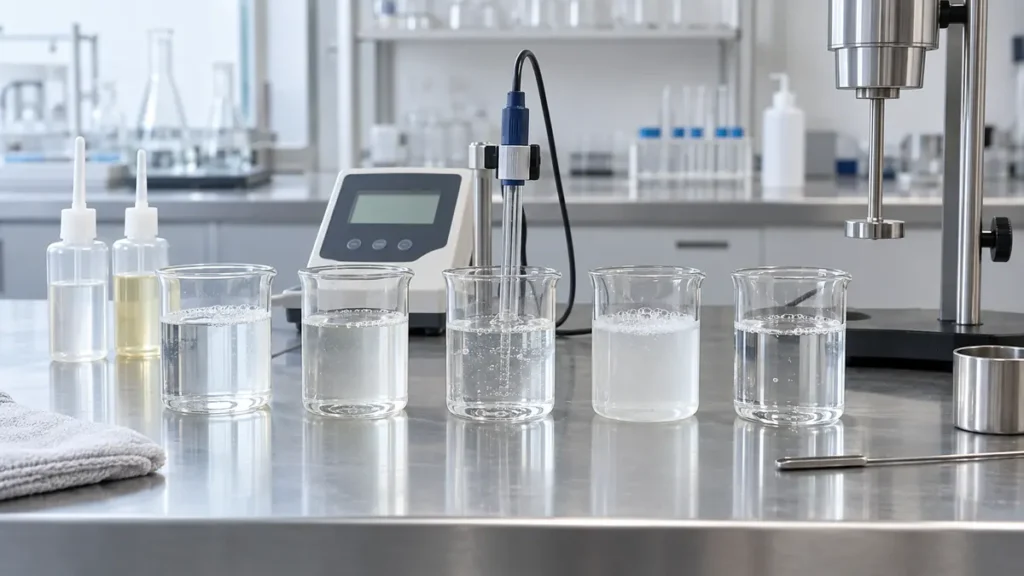
A cocoyl glutamate batch can reach its target pH and still differ from the last trial. One sample may be clear immediately and hazy the next morning. Another may thicken during adjustment, then lose body after fragrance or electrolyte enters. Foam can move in a different direction from viscosity.
These observations do not mean that pH is unimportant. They mean that one pH reading cannot describe salt balance, local neutralization history, aggregate structure, temperature history, or interactions with the rest of the formula. Treat pH as a controlled process variable, then give the system time and test each performance attribute separately.
The INCI salt name is a starting state, not the whole finished system
N-acyl glutamates contain two carboxyl groups. Their degree of protonation changes with the acid-base environment. In practical terms, adding acid or base can alter the balance among more protonated material, monosodium species, and disodium species in the aqueous system. Counterions and other ingredients also contribute to the ionic environment.
This is why Sodium Cocoyl Glutamate and Disodium Cocoyl Glutamate should not be treated as labels that make the finished formula immune to pH. The supplied INCI identifies the ingredient as sold. Once it is diluted and adjusted with the rest of the batch, the equilibrium belongs to the complete formulation.
Published work on purified sodium N-lauroyl glutamate provides a useful model. A 2022 study reported pH-dependent protonation, aggregate changes, and different surface and foam behavior across its experimental conditions. The fatty-acid distribution in cocoyl material and the rest of a commercial formula are different, so the paper explains a mechanism rather than proving an exact KWCG result. See the N-acyl glutamate pH study.
Clarity can change when association and solubility change
Reducing pH increases protonation. In some N-acyl glutamate systems, that can reduce aqueous solubility or encourage more associated structures. A clear batch may become opalescent, form a soft deposit, or show temperature-sensitive haze. The threshold is not universal because chain distribution, concentration, co-surfactants, neutralizer, electrolyte, fragrance, and temperature all influence the result.
Cloudiness after acid addition therefore has several plausible explanations. The acid may have created a low-pH zone before it dispersed. The batch may have crossed a solubility boundary. Fragrance or preservative may have entered near the same time. A cold sample may also reveal a phase condition that was not visible while the batch was warm.
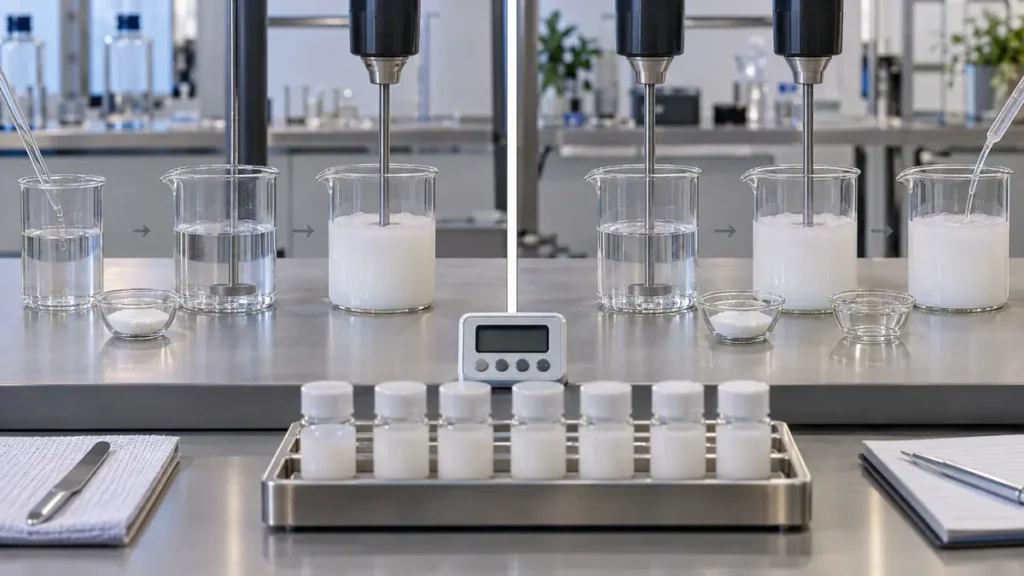
Confirm the sequence before changing the formula. Reproduce the base without the final additive, dilute the acid or base consistently, control mixing, and compare immediate and rested appearance at defined temperatures. If a slow pH shift accompanies the haze, record both rather than treating the first meter reading as final.
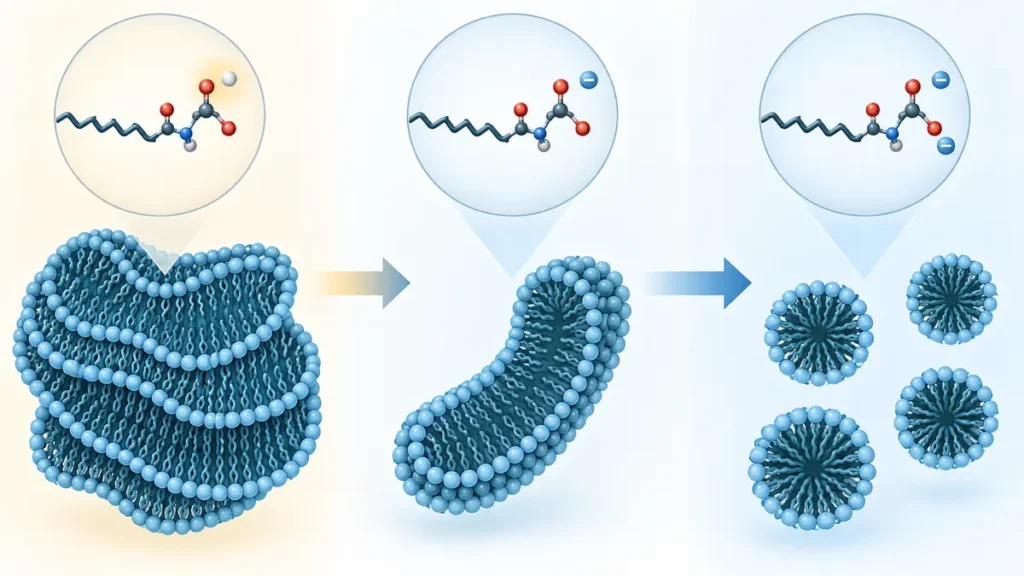
Foam and viscosity do not share one guaranteed optimum
Changing headgroup ionization can alter adsorption and self-assembly, but foam volume, foam stability, and rheology measure different outcomes. A pH that gives acceptable initial foam may not produce the desired drainage rate or viscosity. A thick sample can also owe its structure to a narrow association window that moves when salt, betaine, polymer, or fragrance is added.
A 2016 sodium lauroyl glutamate study combined acid-base titration, spectroscopy, interfacial measurements, foam testing, and microscopy. It found that pH and temperature changed bulk association and foam-film structure under the study conditions. Again, lauroyl glutamate is a model for the response, not a performance claim for Sodium Cocoyl Glutamate or an INNO grade. See the environmental-response and foam study.
More recent research also reports that N-acyl glutamate critical micelle temperature can depend on instantaneous composition, pH, and thermal path. That finding supports a practical precaution: compare samples after the same heating, cooling, and rest history. It does not supply a universal manufacturing temperature. See the 2025 N-acyl glutamate aggregation study.
For development work, give each observation its own column. Record clarity or turbidity, viscosity with method and temperature, foam generation, foam decay, and any deposit. An overall score can hide the fact that one property improved while another moved outside the target.
Adjustment order can create different local conditions
A beaker with a final pH of 5.8 can have more than one process history. Concentrated acid added onto incompletely dispersed powder creates a different local environment from dilute acid added after hydration. Acid placed in the water before surfactant charging may affect wetting and dissolution from the start. A late correction after thickener addition can expose a structured batch to a concentrated pH gradient.
No single sequence can be recommended for every cocoyl glutamate formula from the current evidence. The useful answer is a small order-of-addition screen that changes one route at a time.
| Lane | Adjustment route | Question it isolates | Keep fixed |
|---|---|---|---|
| A | Disperse or dilute surfactant, then add diluted acid or base | Response after a uniform surfactant phase forms | Final pH, temperature, concentration, mixing |
| B | Pre-adjust part of the water before surfactant addition | Effect of the initial water environment on incorporation | Neutralizer amount basis and final batch composition |
| C | Adjust after the full surfactant blend but before thickening | Whether the co-surfactant system buffers the change | Blend ratio, rest time, and shear |
| D | Make a small final correction after all additives | Sensitivity of the complete structured formula | Correction size, dilution, dosing rate, measurement time |
Use the same acid or base solution strength in every relevant lane and record the actual amount added. Large differences between calculated and measured additions may point to buffering by other ingredients, measurement timing, or an incorrect starting pH assumption. They do not prove a change in one surfactant species by themselves.
INNO’s two cocoyl glutamate routes start from different supplied compositions
INNO currently offers KWCG-95 as Sodium Cocoyl Glutamate. Its listed physical form is a white solid powder, the listed content range is 93.5% to 100%, and the standard pack is 15 kg. Powder incorporation and the initial neutralization environment therefore belong in the process trial.
INNO also offers KWCG-25 as a pale-yellow or colorless transparent liquid. Its listed composition is 75% Water, 20% Disodium Cocoyl Glutamate, and 5% Sodium Cocoyl Glutamate. The standard pack is 200 kg. The carrier water and mixed listed salt composition need to enter the formula balance.
These fields identify two development routes. They do not establish a shared best pH, identical clarity window, or equivalent foam and viscosity. Request current technical documents, calculate each material on an agreed basis, and test the selected grade inside the intended formula.
Measure pH with a method that another person can repeat
A pH value without a sample method is difficult to compare. Record whether the meter measured the finished product directly or a defined aqueous dilution, the dilution ratio, water quality, sample temperature, calibration range, mixing, rest time, and reading endpoint. High-viscosity or structured samples may need a laboratory procedure suited to the instrument and product.
ISO 4316 describes potentiometric pH measurement for aqueous solutions of surface-active agents and states that the method applies when indicated by the specific product standard. It is useful evidence that preparation and measurement conditions belong with the number. It should not be cited as automatic approval of one method for every finished cosmetic. See the ISO 4316 method overview.
Do not rush the endpoint. Record pH after adjustment and again after the planned rest period. Recheck after the sample returns to the defined test temperature. If the formula contains a thickener or other slow-hydrating material, use a sampling schedule that separates meter stabilization from continued batch development.
Read a pH-related failure by its timing
| Observation | Possible variables | First controlled check |
|---|---|---|
| Haze appears at the acid contact point | Local pH, acid concentration, dispersion, temperature | Repeat with the same acid amount more dilute and slower |
| Clear when warm, hazy after cooling | Solubility, aggregate or phase change, thermal history | Run matched cooling and rest profiles at defined temperatures |
| Viscosity rises, then falls | Narrow pH window, electrolyte, additive interaction | Build a fine pH series before changing thickener level |
| pH moves after overnight rest | Equilibration, hydration, temperature, sampling method | Repeat readings on the same sample under one method |
| Foam changes but appearance does not | Interfacial behavior, co-surfactant ratio, measurement conditions | Repeat the foam method at matched active basis and pH |
A fine pH series is often more useful than one large correction. Split one uniform base into small samples, adjust in narrow steps chosen for the product target, and measure after the same time and temperature. Once a workable zone appears, repeat it with the complete formula and under the intended process order.
Frequently asked questions
Does lower pH always make cocoyl glutamate cloudy?
No. The response depends on salt balance, concentration, chain distribution, co-surfactants, electrolytes, temperature, additives, and process history, so the finished formula needs a controlled screen.
Can finished-product pH reveal the exact sodium-to-disodium ratio?
No. One pH reading cannot uniquely calculate species distribution in a multicomponent formula without the relevant equilibrium, composition, temperature, and ionic-condition data.
Why does pH change after the batch rests overnight?
Continued dissolution, hydration, equilibration, temperature change, or inconsistent sampling can move the reading. Repeat the measurement under the same documented conditions before correcting again.
Should pH be adjusted before or after adding thickener?
There is no universal order. Compare defined routes because pH can affect surfactant association while the thickener and final additives can alter the measured response.
Can I use published lauroyl glutamate pH ranges for cocoyl glutamate?
Use them to understand possible mechanisms, not as product specifications. Cocoyl chain distribution, grade composition, formula ingredients, and test conditions require separate validation.
Give INNO the adjustment history, not only the final pH
Send the target pH, starting pH, acid or base and its dilution, addition order, dosing temperature, mixing time, surfactant blend, active basis, water source, thickener, electrolyte, fragrance, appearance target, viscosity method, and the time when the change first appears. INNO can use that process record to frame a focused KWCG-95 or KWCG-25 sample discussion.