A useful preservative screen should leave you with a cleanser that passes its microbiological evaluation and still pours, foams and looks the way you intended. Test those requirements together. Waiting until the shampoo’s viscosity is perfect before considering the complete preservative system can send the formula straight back to the bench.
Start with the exact surfactant blend, target pH and thickening method. Keep them documented while comparing phenoxyethanol-based candidates, then verify the finished version. “Amino acid cleanser” describes a product direction; it is not enough information to choose a preservation dose.

Does a rinse-off cleanser still need a preservation assessment?
Yes. Short contact with skin or hair does not resolve the product’s contamination risk during manufacture, storage and use. Assess the formula and its package rather than using “rinse-off” as a reason to skip the question.
Consider the bottle between washes
The FDA identifies contaminated raw materials and water, inadequate packaging and consumer handling among routes by which cosmetics can become contaminated. Those considerations remain relevant to a cleanser that eventually goes down the drain.
Describe the intended closure and use pattern when discussing the testing plan. A flip-top shampoo bottle, a foaming cleanser pump and a refill format present different handling questions. No package format, on its own, establishes that a particular formula needs less preservation.
Separate preservation from cleansing performance
Foam volume and rinse feel are useful product-development observations. They are not preservation test results. Likewise, a claim about mild cleansing does not demonstrate antimicrobial protection during storage.
Keep raw-material quality and manufacturing hygiene within the wider assessment. A preservative trial should not become an attempt to compensate for an unexplained contamination problem in process water or equipment. If an unexpected microbiological result appears, investigate the process as well as the formula.
What must you know about the surfactant base before screening?
Record the full composition, including surfactant grades and active content, pH, fragrance and the method used to obtain viscosity. Two products carrying the same amino acid marketing description can be quite different development samples.
Identify the blend behind the product description
Name the actual glutamate or glycinate ingredient and any co-surfactants. Record their supplied concentrations and addition levels separately. If you exchange a diluted raw material for a more concentrated grade, account for both the active material and the water brought into the formula.
Preservative behavior cannot be predicted from the label alone. In research on emulsions with high nonionic surfactant content, different preservative combinations gave different compatibility and efficacy results. These were not amino acid shampoo trials. They illustrate the need to test a defined system, not a rule that all surfactants deactivate phenoxyethanol.
Keep one screening record per formula version
The suggested record below captures the details needed to compare candidates. Fill it in before preparing samples, then update the measured fields after the agreed conditioning period. Do not rely on the recipe name to distinguish versions.
| Record field | What to enter |
|---|---|
| Surfactant base | Exact grades, supplied concentrations, addition levels and calculated active matter |
| pH | Target, adjustment material, measured result, sample temperature and measurement method |
| Viscosity system | Polymer or electrolyte inputs, addition sequence and measurement conditions |
| Preservative candidate | Full composition, grade, lot, dose and total phenoxyethanol from all known sources |
| Other variables | Fragrance, solubilizer, conditioning ingredients, extracts and their carriers |
| Evaluation | Sample age, storage conditions, appearance, viscosity, foam observations and microbiology report reference |
How should pH influence the phenoxyethanol system you choose?
Check the pH guidance for every component of the preservation system and measure the finished cleanser consistently. A statement about phenoxyethanol alone does not describe every blend that contains it.
Read the complete system’s requirements
Commercial blends can include other antimicrobial ingredients, boosters and carriers. Ashland’s preservative portfolio, for example, gives different pH guidance for different phenoxyethanol-containing systems, including combinations with organic acids. Use the documentation for the exact candidate rather than transferring a range from a neighboring product.
Define the cleanser’s acceptable pH range with the responsible formulation and safety teams. Screen the preservative within that product requirement. Moving the entire formula to a new pH simply to accommodate a candidate may create another development task for the surfactant and thickening system.
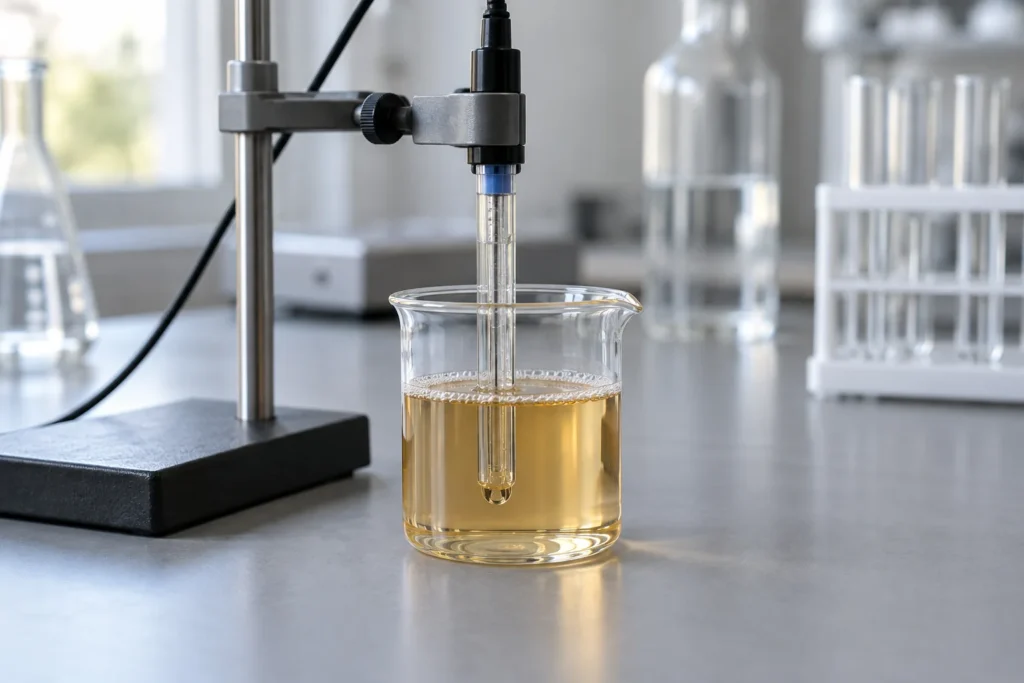
Measure the formula you intend to test
Use a suitable, calibrated electrode and a documented procedure. State whether you measure the product directly or at a specified dilution, and record the temperature. Results obtained on different preparation bases should not be treated as interchangeable.
Check pH after all relevant ingredients are incorporated and after the defined conditioning period. If you adjust the formula following an initial result, attach the updated composition and pH to the sample submitted for preservation testing. The laboratory should not have to guess which version is in the bottle.
What if the preservative changes clarity, foam or viscosity?
First confirm what actually changed: composition, final pH, processing or measurement conditions. Then use a matched comparison to distinguish the candidate’s effect from adjustments made elsewhere in the formula.
Keep a useful baseline
Prepare a reference using the existing system, if one is available, and compare it with the proposed candidate in the same base. Keep final mass constant and account for the candidate’s carrier. A base without the trial preservative can serve as a short-term laboratory control, but not as a finished product for use.
For the first comparison, avoid correcting each sample with a different amount of salt or polymer before recording the initial result. You would then be comparing different thickening systems as well as different preservatives. Make any justified optimization a separate, documented round.
Judge conditioned samples by the same method
Record appearance and viscosity at matched sample age and temperature, using the same measurement settings. Consider trapped air before attributing a visual or reading difference to incompatibility. For foam comparisons, keep dilution, water conditions and agitation method consistent.
If one candidate produces a thinner cleanser, investigate the observation before increasing the thickener. The formulation does not become easier to understand just because the next addition hides the symptom. Confirm the final optimized version again, including its preservation performance.
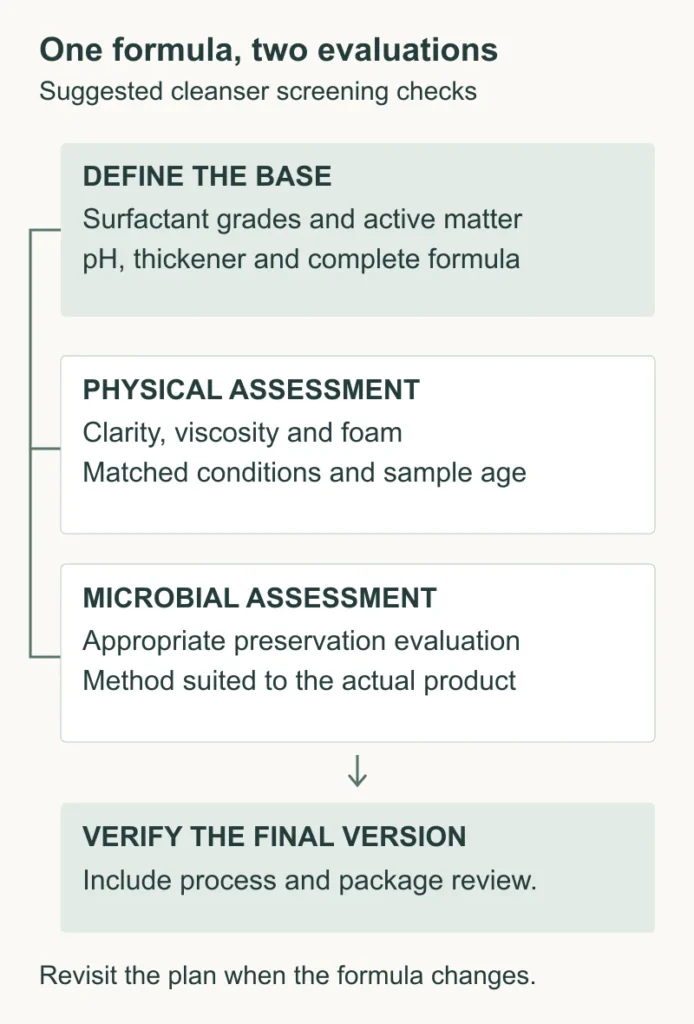
When is a candidate ready for finished-product verification?
Move forward when the full formula and process are defined, the physical screen is acceptable and the microbiology laboratory has the information needed to evaluate that version. Include the intended package and relevant storage conditions in the wider assessment.
Agree the test question before sending samples
ISO 11930 provides a framework for evaluating antimicrobial protection in cosmetics. Ask the laboratory which approach is applicable and how it will establish that its recovery and test procedures are suitable for your surfactant-rich sample.
Keep physical observations separate from the microbiological outcome. If a candidate looks acceptable but falls short against a test organism, discuss that specific result. If it meets the microbiological criteria but separates or loses the required dispensing behavior, it still has development work left.
For a shortlisted candidate, repeat preparation using the intended process. Decide with the responsible team which formula or manufacturing changes require further verification. This makes the approval traceable to a reproducible product, rather than to one unusually cooperative laboratory sample.
Define the INNO material enquiry
INNO’s technical guidance for Proextend phenoxyethanol includes rinse-off and shampoo applications and calls for formulation-specific compatibility and preservation testing. Those application directions make it a candidate to evaluate, not a guarantee for every amino acid blend.
Request the current TDS, SDS and relevant batch documentation. Share the surfactant grades, target pH, thickening method and intended product format when discussing samples. If you already have a failing or physically unstable version, include its exact preservation composition and the observations that need explaining.
FAQ
Can a rinse-off shampoo skip preservation evaluation because contact is brief?
No. Brief contact during washing does not establish low contamination risk during manufacture, storage or use. Assess the complete product and its packaging through an appropriate microbiological evaluation.
Can I copy a cream’s phenoxyethanol dose into an amino acid cleanser?
Treat it only as a proposed starting point requiring review. The surfactants, pH and other ingredients create a different formulation, so the cream’s preservation result does not validate the cleanser.
What should I check first if viscosity changes after adding the preservative?
Confirm the actual dose, complete composition, final pH and addition sequence. Compare conditioned samples with matched measurement settings before changing the thickener or assigning the cause to phenoxyethanol.
Does a clear, well-foaming cleanser prove the preservative is compatible?
It supports only part of the physical assessment under the observed conditions. Check stability over the relevant conditions and evaluate antimicrobial protection in the final formula separately.
For your next cleanser or shampoo trial, send INNO the surfactant types, target pH and product format to discuss phenoxyethanol samples and the applicable technical documents.