The toner is transparent until the preservative goes in. A pale swirl appears, the stirrer runs a little longer, and the batch still looks like someone breathed on the glass. Phenoxyethanol gets the blame because it arrived last. Fair enough as a starting suspicion; rather thin evidence for a verdict.
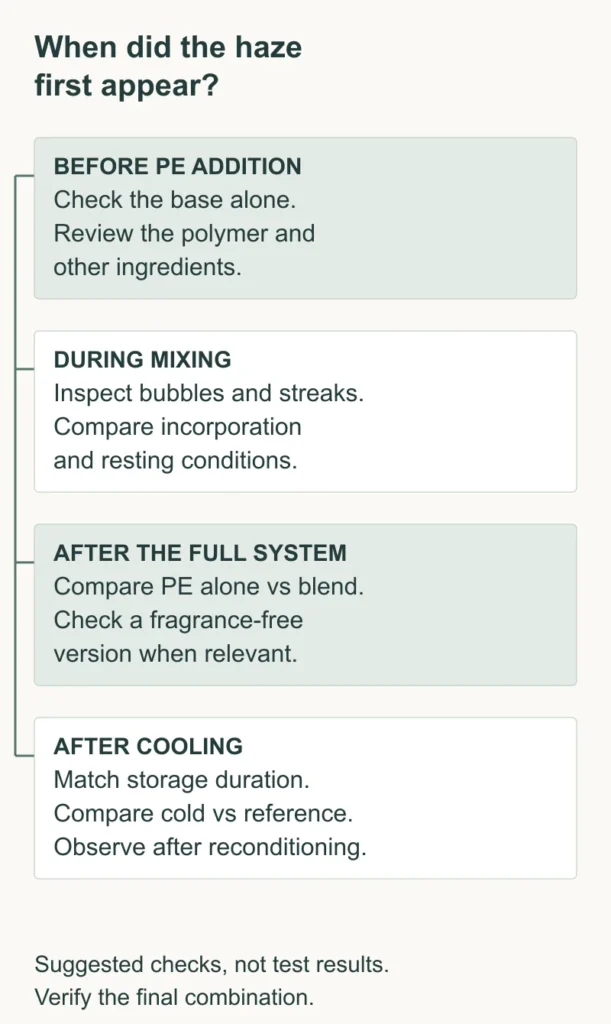
First establish when the haze appears and exactly what you added. Then compare the base with phenoxyethanol alone, the complete preservative system and, where relevant, a fragrance-free version. This separates a mixing problem from a compatibility problem before you spend another afternoon adjusting the wrong ingredient.
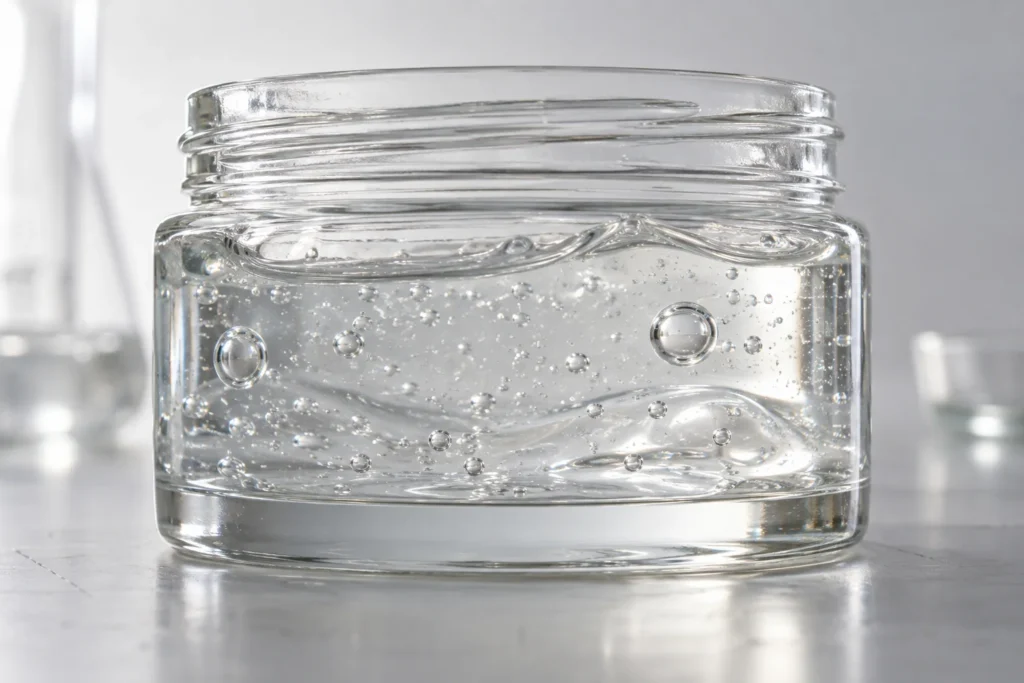
Look closely before changing the formula. Discrete bubbles, suspended particles and uniform haze call for different follow-up checks.
What should you record before trying to clear the batch?
Record the first visible change, the addition immediately before it, and the sample’s temperature and pH. Preserve an untouched sample so that troubleshooting does not erase the original symptom.
Give the haze a timeline
Did it appear at the point of addition, after pH adjustment, during cooling, or only after storage? These observations suggest different tests. A temporary streak near the addition point suggests checking distribution first. A whole sample that clouds after cooling warrants a temperature comparison. Neither observation identifies a chemical cause on its own.
Write down the full preservative trade name and lot, not just “PE.” Include the dose, any premix, mixing conditions and the order of fragrance and polymer additions. A phenoxyethanol-containing blend can introduce several ingredients at once.
Check whether you are seeing bubbles or material
Inspect matched samples against light and dark backgrounds in identical containers. Look for discrete round bubbles, particles, an oily surface ring or evenly distributed haze. Magnification can help distinguish these appearances without guessing their composition.
Let a small retained sample rest under defined conditions, or use the formula’s established deaeration procedure. If visible bubbles diminish, investigate air incorporation. If turbidity remains, continue the compatibility checks. Persistent bubbles in a viscous gel can take time to escape, so a short rest is not a definitive exclusion test.
Does phenoxyethanol’s water solubility rule out a problem?
No. A water-solubility value describes a particular material and test condition. It does not establish the clarity limit of a finished toner containing fragrance, a booster, dissolved salts or a gelling polymer.
Read the solvent and temperature behind the number
For example, Clariant’s Phenoxetol SG information gives a finite water-solubility figure for that grade. Such information is useful for initial screening. It is not an INNO specification or a guarantee that a complex formula will remain clear.
Distinguish the final concentration from the conditions at the addition point. A concentrated premix entering a small portion of water experiences a different composition from the finished batch. Check whether your incorporation method gives the ingredients enough opportunity to distribute before judging the final appearance.
Read the whole preservative composition
INNO’s ethylhexylglycerin technical guidance describes that ingredient as insoluble in water and soluble in certain other media. Its presence therefore adds a compatibility question that testing phenoxyethanol alone will not answer. This does not mean every EHG-containing formula will cloud.
For a caprylyl glycol system or another commercial blend, use its own technical documentation. Do not borrow a solubility statement from a different blend with a similar trade name. The carrier and additional ingredients belong in the investigation too.
Which control samples help locate the source of haze?
Use matched samples that remove or isolate one suspected contribution at a time. Keep final mass, pH and processing conditions as consistent as the comparison allows, and document every unavoidable difference.
Build a small set around the actual symptom
The following is a suggested diagnostic sequence, not a validated production formula. Choose the comparisons relevant to the batch. If no fragrance is present, there is little value in building a fragrance experiment.
| Comparison | What it tests | Interpretation boundary |
|---|---|---|
| Base without added trial preservative | Whether the base clouds independently | Diagnostic control only; not a preserved finished product |
| Base with phenoxyethanol alone | Behavior at the same total PE level | Does not predict the complete blend’s behavior |
| Base with the complete system | Additional effect of the actual blend | A difference implicates the combination, not one proven culprit |
| Full formula without fragrance | Whether fragrance participates in the haze | A clear result does not identify the mechanism |
Replace omitted material with the designated make-up ingredient to maintain batch mass. When a trial changes a carrier or solubilizer, record it explicitly. Adjusting the fragrance, booster and solubilizer together may produce a clear sample, but it leaves you with very little explanation.
Add a gel-specific branch when needed
If a simplified liquid stays clear while the gel clouds, examine the polymer grade, hydration procedure, neutralization and electrolyte inputs. These are candidate variables, not proof of a polymer-preservative reaction.
Polymer selection matters: Lubrizol describes Carbopol 1342 specifically for applications including clear gels and electrolyte-containing systems. That grade-specific guidance illustrates why “carbomer” alone is not enough information for a diagnosis. Consult the documentation for the polymer you actually use.
Reproduce the suspected difference with a fresh preparation. A single clear beaker is encouraging; a repeatable result is much more useful when production asks what, precisely, needs to change.
What does haze after cooling tell you?
It points toward a temperature-dependent change worth investigating. Compare matched retained samples at defined conditions, then observe whether the change reverses on return to the original temperature.
Separate cooling effects from the passage of time
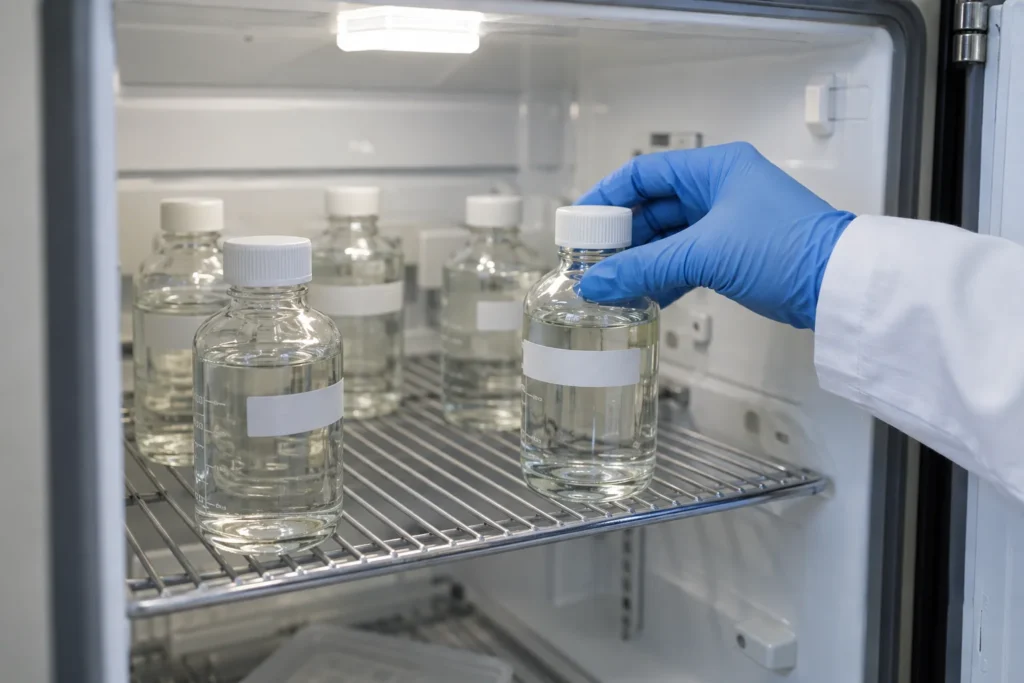
Store one sample at the selected low temperature and a matched sample at the reference temperature for the same duration. Record the actual temperature, storage time and appearance before moving either sample. Choose conditions appropriate to the product’s intended stability program rather than treating a household refrigerator as a universal standard.
If only the cooled sample clouds, temperature becomes a stronger lead. If both change, time-dependent instability or another shared variable remains possible. Photograph them under the same lighting, container geometry and background so that an exposure change does not masquerade as chemistry.
Use warming as a diagnostic observation
If the cloudy sample clears after returning to the reference temperature, record the time needed and any residue. Reversible haze is consistent with a temperature-sensitive physical change, but does not identify the affected ingredient or establish acceptable shelf life.
Warming can also help an incorporation trial, provided it stays within the relevant ingredient guidance. INNO’s phenoxyethanol TDS notes that warming can speed dissolution and cautions against prolonged heating. A sample that looks good only while warm has not solved a cold-storage problem.
When is a clearer formula ready for the next test?
Move forward when a fresh preparation reproduces the improvement under the intended conditions. Then evaluate the revised formula’s stability and antimicrobial protection; clarity alone answers neither question completely.
Verify the change you intend to keep
A different premix, solubilizer level or booster may solve the appearance problem while changing the formula. Record the final composition and process instead of submitting an earlier version for preservation testing. ISO 11930 provides a framework for evaluating antimicrobial protection, distinct from an appearance assessment.
Do not dilute or filter a production batch merely because a small experiment became clear. Either action can change composition or remove material that has not been identified. Any production rework needs its own approved assessment and verification.
Bring the formulation history to the ingredient discussion
When evaluating INNO Proextend phenoxyethanol, use its current grade documentation and keep the trial input traceable. Ask for the relevant TDS, SDS and batch information rather than selecting a replacement solely because another sample looks clearer.
The most useful enquiry includes the complete preservative grade, dose, base pH, polymer and fragrance details, plus the addition order and the time and temperature at which haze appeared. Those details let the next trial address a specific hypothesis.
FAQ
If the formula becomes clear, has the preservative worked?
No. Clarity is an appearance result. Evaluate antimicrobial protection in the final formula using an appropriate method, and assess stability separately under the intended storage conditions.
Why is my toner clear when fresh but cloudy after refrigeration?
A temperature-dependent solubility or compatibility change is one possibility. Compare it with a reference-temperature control for the same duration, then record whether the haze reverses after reconditioning.
Is phenoxyethanol necessarily responsible when a booster blend clouds?
No. The booster, carrier, fragrance or their combination may contribute. Compare phenoxyethanol alone with the complete system at matched phenoxyethanol levels before assigning the cause.
Should I keep adding solubilizer until the gel is transparent?
Avoid open-ended additions. Test defined levels in fresh, matched samples and reassess viscosity, stability and preservation. A clearer appearance does not establish that the revised formula meets all product requirements.
Have a clear-formula problem to investigate? Send the haze timeline and exact preservative composition with your enquiry. Contact INNO to discuss the relevant grade information and a focused next trial.