You replace an emollient to improve a lotion’s after-feel. The new batch looks good, the viscosity is on target, and the phenoxyethanol line on the formula sheet has not changed. Can the old preservation result come along for the ride?
Treat it as useful background, not automatic approval. In an oil-in-water emulsion, phenoxyethanol’s distribution depends on the surrounding formula. Review the change, compare the revised and reference batches under matched conditions, and decide what preservation work needs repeating. That approach keeps a seemingly small texture adjustment from becoming an undocumented microbiological assumption.

Why can the same phenoxyethanol level perform differently in two lotions?
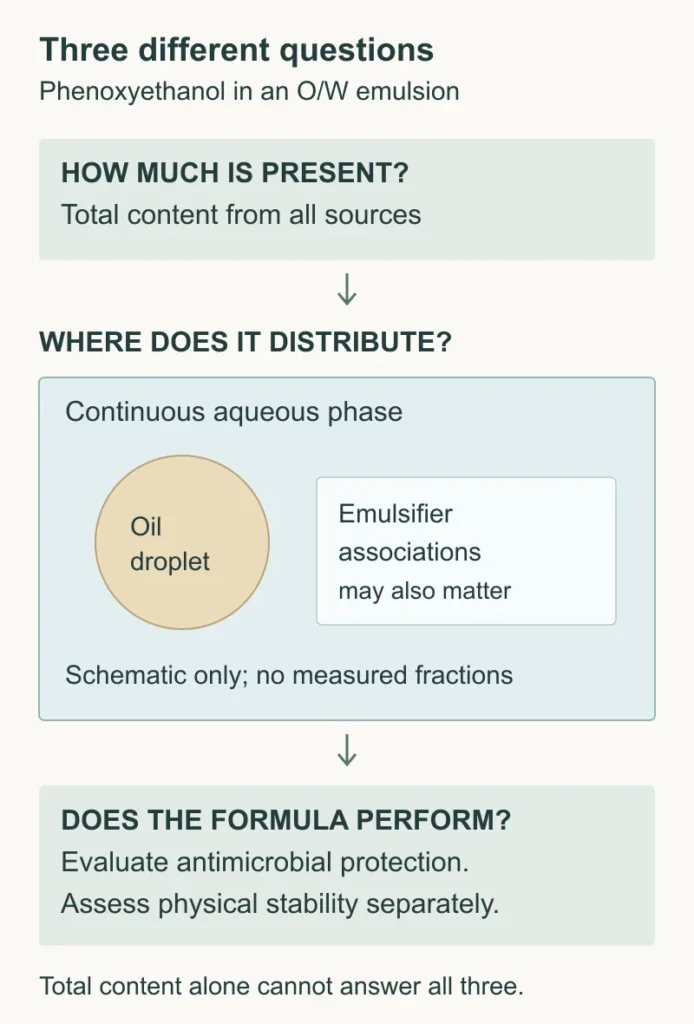
Total concentration tells you how much phenoxyethanol the formula contains. It does not tell you how much is freely present in the aqueous phase, or establish the antimicrobial performance of the complete product.
Follow the ingredient beyond the weighing sheet
In an oil-in-water, or O/W, emulsion, oil droplets sit within a continuous aqueous phase. Phenoxyethanol can distribute between these environments and associate with emulsifier structures. The oil composition and emulsifier system can therefore affect its free aqueous concentration.
Puschmann and colleagues studied this relationship in O/W emulsion gels. They measured free aqueous phenoxyethanol by equilibrium dialysis and compared it with antimicrobial test results. Within their model systems, the free concentration was more informative than the overall amount; oil selection and emulsifier concentration influenced distribution.
These were controlled pharmaceutical formulation experiments, not INNO lotion tests. They support investigating the finished formulation, not assigning a universal correction factor to every cosmetic oil or emulsifier.
Keep total-content and availability questions separate
A calculation of total phenoxyethanol remains necessary for composition control. Include material added directly and any documented contribution from blends or other ingredients. Then label that result accurately: total phenoxyethanol in the formula.
Dividing it by the water percentage does not measure the free aqueous fraction. Similarly, a total-content assay cannot by itself establish preservation efficacy. Ask the laboratory what a proposed analytical method actually measures before using its result to answer a different question.
Which emulsion changes deserve a preservation review?
Review changes to the oil phase, emulsifier system, aqueous ingredients and processing history. Use the actual difference between versions to choose the next checks, rather than repeating a standard test list without a question.
Describe what changed in practical terms
“New oil” is an incomplete change record. Identify the removed and replacement grades, their quantities and any other adjustment needed to keep the lotion stable. If changing an oil also required more emulsifier and a different cooling procedure, you now have several variables to consider.
| Change | Record first | Next verification question |
|---|---|---|
| Oil or emollient | Identity, amount and resulting formula adjustments | Does the revised formula retain physical and microbial performance? |
| Emulsifier | Exact grade, composition and dose | Does the old preservation conclusion remain applicable? |
| Aqueous ingredient | Carrier, pH contribution and carried-in preservative | Did total composition or the evaluation basis change? |
| Processing | Addition point, temperature, mixing and cooling | Can the intended process reproduce the evaluated sample? |
Give the reference batch a fair comparison
Where practical, prepare the reference and revised versions together using matched raw-material lots and equipment. Record final pH, batch mass and the time between manufacture and testing. Keep retained samples so that an unexpected result has something meaningful beside it.
A previous passing report still helps define the reference. However, comparing a fresh laboratory batch with an old result obtained under a different method can leave the cause of a difference unresolved. Agree in advance which historical data are comparable and which questions require fresh controls.
Should phenoxyethanol go into the water phase, oil phase or cool-down?
Choose an addition route that suits the exact raw material and produces a reproducible, adequately distributed system. There is no single phase assignment that proves preservation in every cream or lotion.
Check the complete material being added
Read the instructions for the supplied grade. Phenoxyethanol alone and a multicomponent preservative blend may have different incorporation requirements. A convenient premix is useful only if its components remain suitable for the formula and the chosen process.
INNO’s phenoxyethanol technical guidance notes that warming can accelerate dissolution and cautions against prolonged heating. That is not a reason to invent a universal addition temperature. Consider the restrictions of the full ingredient system and record both temperature and exposure time during the trial.
Verify the batch after incorporation
Keep the first process comparison focused. If you want to evaluate an addition point, hold the composition fixed and define the alternative procedure precisely. Changing dose, phase and mixing time together makes a favorable result difficult to reproduce.
For scale-up, ask whether the production vessel can achieve the intended distribution within the available mixing time. Where an analytical check is justified, agree a sampling plan that can reveal differences within the batch. One conveniently collected sample may be a poor description of the whole vessel.
What should a useful lotion verification plan include?
Assess physical stability and antimicrobial protection as separate requirements, then relate both to the final formula, manufacturing process and package. Neither an attractive texture nor a satisfactory ingredient certificate substitutes for a finished-product evaluation.
Define what the laboratory needs to answer
ISO 11930 addresses the evaluation of antimicrobial protection in cosmetic products. Discuss the applicable test approach, sample preparation and interpretation with the laboratory. Send the actual formula version, including its complete preservative system, rather than a shortened ingredient list.
Agree whether freshly prepared samples are sufficient for the development question or whether samples from defined storage conditions are also needed. Record those conditions on the submission. If a report identifies a weakness against a particular test organism, ask how that finding changes the next experiment.
Keep analytical investigations proportionate. A specialist free-concentration study may help explain a stubborn difference, but a development team does not need to commission one automatically for every lotion. Start with a clear comparison and a question the available test can answer.
Include the way the product will be used
The FDA’s microbiological safety information identifies raw materials, water, packaging and consumer handling among possible routes of contamination. A cream in a jar and a lotion in a pump deserve consideration in their intended use settings, even when their ingredient lists are similar.
Changing the package does not automatically establish a lower preservative requirement. Describe the closure, dispensing method and anticipated handling to the team assessing product risk. Review the final package as part of the development plan instead of adding it after all formulation decisions are closed.
What information makes an ingredient enquiry more useful?
Send the emulsion type, oil and emulsifier composition, current preservation system and the change you are investigating. These details turn a general request for a preservative into a defined material-selection task.
Use a documented phenoxyethanol input
INNO Proextend phenoxyethanol is an ingredient option for a formulation-specific preservation system. INNO’s technical guidance includes creams and lotions as application directions and calls for compatibility and preservation challenge testing before use.
Request the current TDS, SDS and relevant batch documentation. Keep the phenoxyethanol grade traceable through the trial, especially if the project also involves a supplier change. Otherwise, a formulation comparison can quietly become a raw-material comparison as well.
Ask for support around the unresolved variable
State whether the problem followed an oil substitution, an emulsifier adjustment, an incorporation change or a preservation result. Include the observation that prompted the enquiry and the test conditions already used. Avoid sending only a target dosage and asking whether it will pass.
For the next round, choose the smallest controlled comparison that resolves the uncertainty. Once it succeeds, verify the final version and retain its supporting records. That is a more useful handover to production than a formula sheet with an unexplained “same as before” beside the preservative.
FAQ
Will the same phenoxyethanol dose work equally in different lotions?
Not necessarily. Different oils, emulsifiers and aqueous ingredients can change the formulation environment. Evaluate preservation in the actual lotion rather than transferring a result solely because the total dose matches.
Must phenoxyethanol always be added to the water phase?
No universal phase rule applies. Follow the exact grade’s guidance and verify an incorporation process that gives suitable distribution, compatibility and preservation performance in your formula.
Can I keep the old preservation result after changing the emulsifier?
Use it as reference data, then review the change with the responsible technical team. Determine which compatibility and preservation checks are needed before relying on the conclusion for the revised formula.
Does a total phenoxyethanol assay show the free water-phase concentration?
No. A total-content assay and a free-concentration measurement answer different analytical questions. Ask the laboratory to define the measured fraction and method before interpreting the result.
Planning an O/W lotion or cream trial? Send INNO the emulsion type, oil-phase composition and current test status to discuss phenoxyethanol documentation and sample options.