Two lotion samples can look identical on Monday and give you quite different reasons to worry by Friday. One might lose viscosity. The other might look beautiful but disappoint in a preservation test. Choosing a phenoxyethanol booster by appearance alone gives the prettiest jar rather too much authority.
To compare ethylhexylglycerin with caprylyl glycol, keep the base formula and total phenoxyethanol concentration fixed first. Then evaluate each candidate’s compatibility and preservation performance under matched conditions. The useful outcome is a combination that meets your formula’s requirements, not a universal winner between two ingredient names.
Do ethylhexylglycerin and caprylyl glycol do the same job?
Both can contribute to preservative systems, but that shared role does not make them interchangeable. Their behavior in the complete formula, including how you incorporate them, determines whether a particular combination is useful.
What the ethylhexylglycerin evidence supports
Ethylhexylglycerin, often shortened to EHG, is a multifunctional cosmetic ingredient. In a study by Langsrud and colleagues, EHG damaged bacterial membrane integrity and strengthened phenoxyethanol’s lethal effect on E. coli under the experimental conditions. This gives formulators a reason to investigate the combination.
It does not establish the best ratio in a scented gel, prove control of every challenge organism, or authorize reducing phenoxyethanol in an existing formula. Those are separate questions. A mechanism explains why a combination deserves testing; a finished-product result tells you whether it worked in that product.
Why caprylyl glycol needs its own trial
Caprylyl glycol also appears alongside phenoxyethanol in commercial systems. For example, Ashland’s preservative portfolio lists Optiphen grades containing both ingredients. That establishes an available formulation route, not equivalence to EHG or proof that a separately assembled blend will behave like a named commercial product.
Request the exact candidate’s composition, physical form and incorporation instructions. A neat ingredient, a diluted preparation and a multicomponent blend are different trial inputs. Do not assume that the same weight of each delivers the same amount of booster or phenoxyethanol.
How do you build a comparison that answers one question?
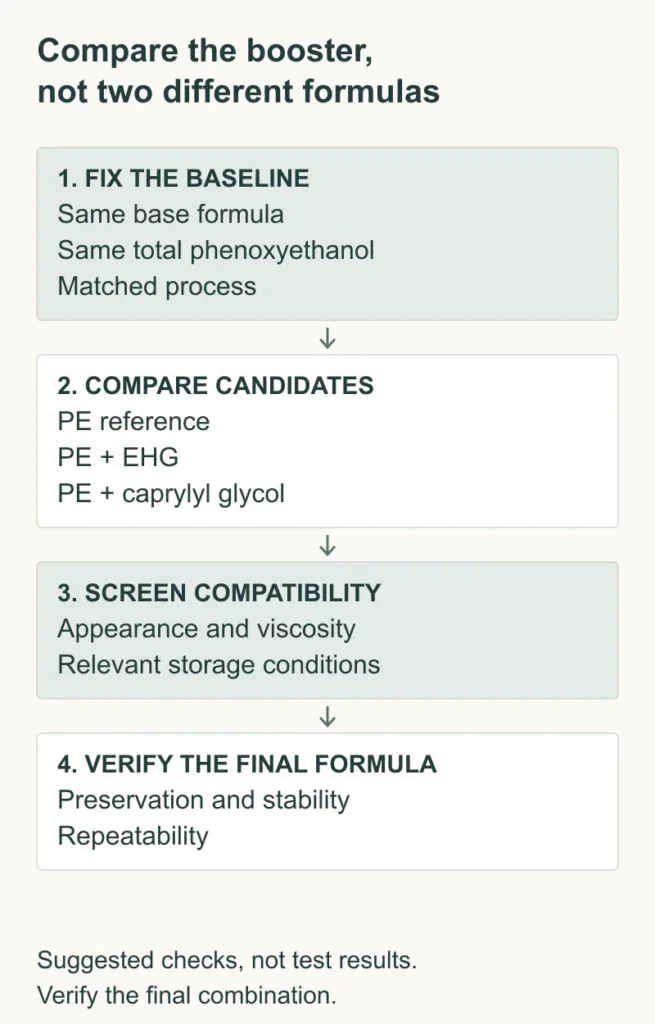
Start with one base and one phenoxyethanol level, then compare a phenoxyethanol-only reference with EHG and caprylyl glycol variants. Treat this as a suggested development screen, with candidate levels selected from relevant supplier guidance and your product’s safety and market requirements.
Keep the first comparison deliberately small
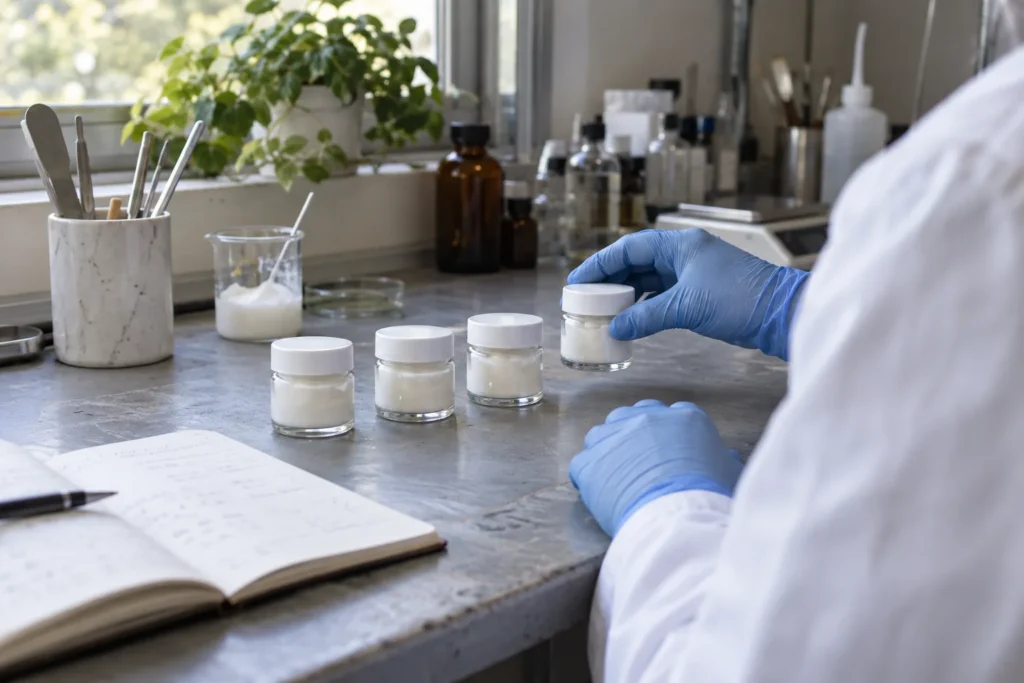
The matrix below separates the contribution of each candidate from the baseline. A base-only sample can help identify appearance changes already present without the added system. It is a laboratory control, not a product for use or distribution. Arrange microbiological controls with the testing laboratory.
| Sample | What changes | Question answered |
|---|---|---|
| Base control | No added trial preservative system | Does the base already have an appearance or stability problem? |
| PE reference | Phenoxyethanol at the selected fixed level | How does the base behave with PE alone? |
| PE + EHG | EHG at its selected screening level | What changes relative to the PE reference? |
| PE + caprylyl glycol | Caprylyl glycol at its selected screening level | What changes relative to the same reference? |
Keep final batch mass constant by adjusting the designated make-up ingredient. Document any preservative already carried in by extracts or other raw materials. Count phenoxyethanol from every source, especially when one candidate arrives as a blend.
Separate equal-dose screening from practical optimization
An equal-mass comparison can answer a narrow question about two selected doses. It cannot establish equal antimicrobial potency. A practical comparison may instead use different candidate levels within their documented ranges. State which question you are testing before interpreting the result.
Hold pH, fragrance, water source, polymer grade and the other formula inputs constant. Use matched mixing and cooling histories where both candidates’ instructions allow it. If one needs a carrier or a different addition procedure, record that difference and consider a carrier-only control. Otherwise, the apparent booster effect may belong to the carrier.
After the first screen, investigate promising levels in a separate round. Reducing phenoxyethanol while increasing a booster at the same time can be useful optimization, but it answers a different question from the original comparison.
Which results should decide whether a booster stays?
Use separate acceptance criteria for preservation, physical stability and the intended product experience. A strong result in one category cannot compensate for failure in another.
Inspect the formula after it has had time to settle
Compare clarity, color, odor and viscosity at agreed times and temperatures, using the same containers and measurement method. For a transparent product, include the relevant low-temperature condition. For a lotion, record separation and texture changes as well as the viscosity number.
Freshly mixed samples can mislead. Different sample temperatures or trapped air can complicate visual and viscosity comparisons. Allow consistent conditioning before measurement, and use your established test procedure rather than judging whichever sample happens to be nearest the light.
Read the preservation result beyond the pass label
Agree the test method and interpretation with the microbiology laboratory before submitting samples. ISO 11930 addresses evaluation of a cosmetic product’s antimicrobial protection through preservation efficacy testing and microbiological risk assessment. Select the applicable approach for the actual product.
Ask which organism, time point or recovery result distinguishes the candidates. If the laboratory identifies a fungal weakness, a favorable bacterial result does not remove it. Keep the tested formula version attached to the report, including the final pH and complete preservative composition.
Repeat promising preparations independently before drawing a firm conclusion. Several readings from one jar describe that jar; independently prepared batches also help reveal whether the process is reproducible.
How do you choose a combination without overreading the trial?
Select the combination that meets your defined requirements with a repeatable process. Keep the conclusion specific to the tested base, doses and conditions; a useful result in one lotion is not a purchasing specification for every product.
Investigate the reason for a rejection
If one candidate develops haze, check its incorporation and compatibility before calling it an ineffective preservative. If both look acceptable but one fails the agreed microbiological criteria, appearance has already answered all it can. Increasing the dose without a new hypothesis may simply create a more expensive failed sample.
Where both candidates pass, compare the documented process requirements and the cost of the complete system at its validated dose. Include any carrier and extra processing step. A lower price per kilogram does not necessarily mean a lower cost per finished batch.
Use the INNO grade as a defined trial input
INNO Proextend phenoxyethanol provides the phenoxyethanol ingredient for a separately designed system. Obtain the current TDS, SDS and relevant batch documentation, then keep the same grade and lot across the first comparison where possible.
INNO’s ethylhexylglycerin technical guidance calls for renewed microbial efficacy evaluation when it is added to an existing preservative system. Follow that same discipline when moving a shortlisted formula toward production. A successful screen is a reason to verify the final combination, not to stop testing.
FAQ
Can I replace ethylhexylglycerin with the same amount of caprylyl glycol?
Do not assume a direct substitution. Check the supplied composition and incorporation method, then reassess clarity, viscosity, product feel and preservation performance in the complete formula.
Should I lower phenoxyethanol when I first add a booster?
Keep phenoxyethanol fixed during the first comparison if your aim is to isolate the booster effect. Investigate any reduction in a separate optimization round, followed by evaluation of the final system.
Does a higher booster dose mean better preservation?
Not necessarily. The formula must still meet compatibility, safety and product requirements. Compare justified dose levels experimentally rather than assuming that more booster will solve every preservation weakness.
What if both combinations pass the challenge test?
Compare reproducibility, stability, processing needs and the cost of each complete system at its tested dose. Keep the decision tied to that formula instead of declaring one ingredient universally superior.
For an INNO enquiry, share the product type, base pH, current preservative composition and the problem the booster must solve. Ask which grade documents and sample options can support your comparison.