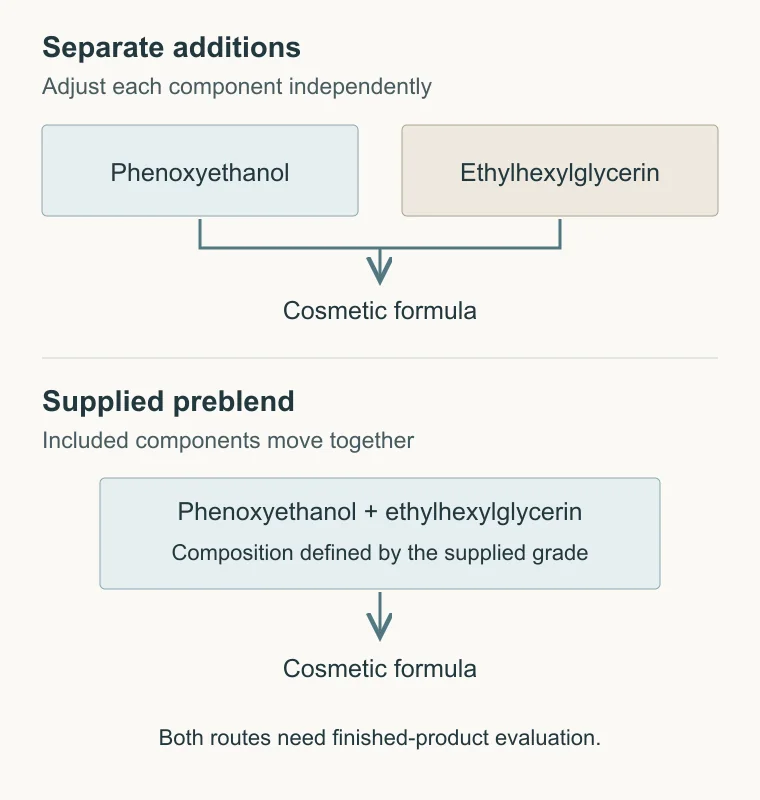
Imagine that your lotion prototype needs another round of preservative trials. You want to change the ethylhexylglycerin level while keeping phenoxyethanol steady. With separately supplied ingredients, that is a change to one formula line. With a fixed blend, turning up one component turns up the other. The bottle has already made that particular decision for you.
Separate dosing is worth considering when you need independent control over the components. A PE 9010 preblend is worth considering when its supplied combination fits the formula and your manufacturing process. Neither route wins on its name alone. The useful comparison is between documented compositions, practical incorporation requirements and results in your finished product.
What changes when phenoxyethanol comes in a PE 9010 blend?
You receive a combination of ingredients rather than a single phenoxyethanol grade. For Euxyl PE 9010 and Nipaguard PE 9010, the named companion is ethylhexylglycerin. It belongs in the formulation assessment, not in the small print.
One purchased material can contain several formulation inputs
A single-ingredient phenoxyethanol grade supplies phenoxyethanol to its stated specification. A preservative preblend supplies several ingredients together at the composition specified for that grade. In either case, the material enters a larger cosmetic formula; buying a single ingredient does not mean it must be the formula’s only preservation-related component.
Nor does “single ingredient” mean an assay of exactly 100%. The supplier’s composition and specification determine the appropriate input for your calculations. For a blend, the complete composition matters even if the purchasing system gives the material just one stock code.
Ethylhexylglycerin has a technical role
In its description of Euxyl PE 9010, Ashland identifies phenoxyethanol and ethylhexylglycerin and describes the latter’s effect on microbial membrane surface tension as part of the preservative-boosting mechanism. That explains why removing it is a formulation change, not merely a different way of ordering phenoxyethanol.
The practical question is how that combination behaves in your base. A boosting mechanism does not supply a universal reduction in preservative dose. Any proposed reduction needs evidence from the resulting formula.
When is separate dosing more useful than a fixed blend?
Separate dosing is useful when the development question requires changing one component independently. A preblend suits evaluation when its fixed composition already matches your intended inputs. The trade-off is control over the ratio versus managing a supplied combination as one raw material.
Independent adjustments suit an open development question
Suppose you are investigating whether a change in the companion ingredient improves an otherwise promising formulation. Separate dosing lets you hold phenoxyethanol constant while changing that input. You can describe what changed and interpret the trial accordingly.
That freedom comes with practical work. Each material needs a matching specification, a defined addition step and an accurate weighing record. At a small trial scale, check that the balance and dosing method suit the amount you intend to add. Flexibility is useful only when the intended composition reaches the beaker.
A preblend keeps the supplied components together
With a preblend, the included components enter through one raw-material addition. This can suit a formula whose chosen combination is already fixed. It does not remove the need to follow the grade’s handling instructions or confirm uniform incorporation.
Increasing the blend dose also increases its included components together. If you later add extra phenoxyethanol or ethylhexylglycerin separately, you have created a modified combination. Its composition and evaluation should reflect that change.
| Decision | Separate ingredients | PE 9010 preblend |
|---|---|---|
| Adjust the component ratio | Change individual additions. | The supplied ratio stays fixed when the blend dose changes. |
| Define the input | Check each grade and its documented composition. | Check the complete composition of the specified blend. |
| Write the batch instructions | Record separate quantities and addition steps. | Record the blend quantity and its incorporation conditions. |
| Compare purchasing cost | Include all separately added components. | Use the dose of the supplied blend in the evaluated formula. |
| Accept the formula | Use the project’s finished-product evaluation. | Use the project’s finished-product evaluation. |
A price per kilogram comparison stops too early. The relevant material cost depends on the amounts of every component in the formula you can accept. Separate ingredients are not automatically cheaper, and a shorter ingredient-handling list does not establish a saving by itself.
Are Euxyl PE 9010 and Nipaguard PE 9010 interchangeable?
The two suppliers name the same component pair, but that alone does not establish interchangeable grades. A substitution decision needs the applicable composition, specification and formulation evaluation for the actual materials being purchased.
Shared component names establish a starting point
Ashland describes Euxyl PE 9010 as a phenoxyethanol and ethylhexylglycerin blend. Clariant also lists that combination for Nipaguard PE 9010. Those descriptions put both products in the comparison; they do not settle every field on a qualification sheet.
Use the supplier’s composition document for the component fractions. The digits in a trade name are not an analytical certificate. The same rule applies when someone offers a material described simply as “PE 9010 equivalent”.
Compare the documents that belong to the supplied grades
The useful document set identifies the full trade name, supplier and applicable version, then gives the composition, specification and relevant incorporation guidance. Where a parameter matters to your project, compare its test method as well as its stated limit.
A missing field is a question for the supplier, not an invitation to borrow a value from a similarly named product. This matters especially when a proposed substitute is being justified by a brochure rather than by the documents accompanying the material.
How can you compare the routes without confusing the results?
Decide whether you are comparing matched ingredient inputs or two independently optimized formulas. The first helps investigate a controlled change. The second helps select a workable commercial option, but it cannot isolate the effect of purchasing the ingredients separately.
Match the contribution, not just the bottle dose
For each material, its phenoxyethanol contribution equals its addition level multiplied by its documented phenoxyethanol mass fraction. When the addition level is a percentage by mass of the finished formula, express the fraction as a decimal; the result is the contributed phenoxyethanol percentage.
Then account for the companion ingredients. Matching phenoxyethanol while omitting ethylhexylglycerin still leaves a different formula. Record that difference rather than calling the samples compositionally matched.
Make the preparation differences visible
A useful initial comparison keeps the base and preparation conditions as consistent as the question allows. Record the actual addition sequence, mixing conditions and final pH. If one route needs a different incorporation step, include it in the comparison rather than hiding it behind the same formula number.
Check appearance and physical stability alongside the preservation evaluation. A smooth lotion is encouraging, but microorganisms are not judging the finish. Physical compatibility and antimicrobial protection need their own evidence.

Agree on the evaluation before choosing a winner
ISO 11930 addresses the evaluation of antimicrobial protection in cosmetic products. The laboratory should select the applicable method and interpretation for the product, including the relevant risk assessment. A raw-material description cannot stand in for that finished-product decision.
- State the comparison question and the acceptance criteria.
- Confirm the candidate grades, composition documents and sample identities.
- Record which component inputs and preparation conditions stay fixed, and which change.
- Link compatibility observations and preservation results to the exact formula version.
This suggested sequence keeps an unsuccessful trial useful: you can see what it tested and decide what to investigate next.
Where does Proextend Phenoxyethanol fit into the choice?
INNO’s Proextend Phenoxyethanol is a candidate for the single-ingredient route when you want to select and dose companion ingredients separately. Its role is to supply the phenoxyethanol input, not to stand in for every component of a PE 9010 blend.
Start with the grade that matches the trial
Proextend Phenoxyethanol has the INCI name Phenoxyethanol. INNO’s technical guidance covers use in personal-care formulations and calls for preservation challenge and compatibility testing of the resulting product.
For a comparison, the useful starting documents are those that identify the supplied material and establish the composition needed for dose accounting. Any separately selected booster brings its own documentation and evaluation needs.
Make the enquiry about the change you want to make
A useful brief names the current preservative grade, the type of cosmetic and the reason for considering separate dosing. Include the target market and any process restriction that affects incorporation. You can begin with those details without sending a confidential full formula.
If the only proposed change is replacing a blend with phenoxyethanol at the same percentage, revisit the component accounting first. Otherwise, the trial may answer a different question from the one you intended.
FAQ
Can I replace a PE 9010 blend with phenoxyethanol at the same percentage?
Not as a direct equivalent. The blend supplies companion ingredients as well as phenoxyethanol. Calculate each component’s contribution, define the intended replacement composition, and evaluate the resulting formula before accepting the change.
Can I recreate a branded blend by mixing the same named ingredients?
Matching ingredient names does not establish a branded-grade equivalent. You would need the appropriate composition, raw-material specifications and preparation controls, followed by evaluation in your formula. Do not infer those details from the trade name.
Does a PE 9010 preblend remove the need for a challenge test?
No. A supplied blend does not by itself establish adequate protection of the finished product. Determine the appropriate preservation evaluation with the laboratory, taking account of the product and its microbiological risk assessment.
Which documents should I request before comparing the two routes?
Request the applicable composition information, technical data, specification and relevant batch documentation for each candidate. Include incorporation guidance so the trial compares known materials prepared under recorded conditions.
Considering separate dosing for your next trial? Send INNO the current grade, application and intended adjustment to discuss the relevant Proextend Phenoxyethanol documents and sample arrangements.