A salt addition that works in one cleanser can leave another almost unchanged, or push it past a narrow viscosity peak. The useful question is not how much salt to add. It is how quickly to learn whether salt is the right route at all.

Consider a familiar bench result. A thin cocoyl glutamate base receives one salt addition, then another. The beaker looks slightly better, so the formulator keeps going. After the fragrance and preservative are added, the batch becomes thin again. More salt no longer helps. Several trials have been spent optimizing a mechanism that the finished formula may not support.
Cocoyl glutamate systems are not governed by salt concentration alone. Surfactant concentration, counterion, pH, cosurfactants, temperature and other dissolved materials can change the structures responsible for flow. Published model work reinforces that point. In a disodium N-dodecanoylglutamate system with long-chain alcohol, changing sodium chloride altered lamellar spacing and rheology rather than producing a simple universal rise in viscosity. That is useful mechanistic evidence, but it is not a performance result for a commercial cocoyl glutamate grade. See the study abstract on PubMed.
The practical response is a short route screen with a defined stop rule. Give salt a fair, controlled test. If it cannot produce a usable region, move deliberately to a cosurfactant or polymer route instead of extending the salt series indefinitely.
Start with a decision, not a target number
Before making samples, write down what would make salt worth keeping. A promising route should do more than create one thick beaker. It should show a measurable rise across adjacent additions, remain workable after the intended pH adjustment, and retain enough structure when key final ingredients are introduced.
Salt-route gate: Continue only when the series reveals a controllable viscosity region, not a single isolated peak. Stop when repeated additions give little response, clarity becomes unacceptable, or the response disappears after a required formulation input.
This is a screening rule, not a universal specification. The acceptable viscosity, clarity and handling window depend on the intended cleanser, package, filling equipment and measurement method. A pump product may need a different flow profile from a gel in a squeeze tube.
The minimum screen: one base, seven samples
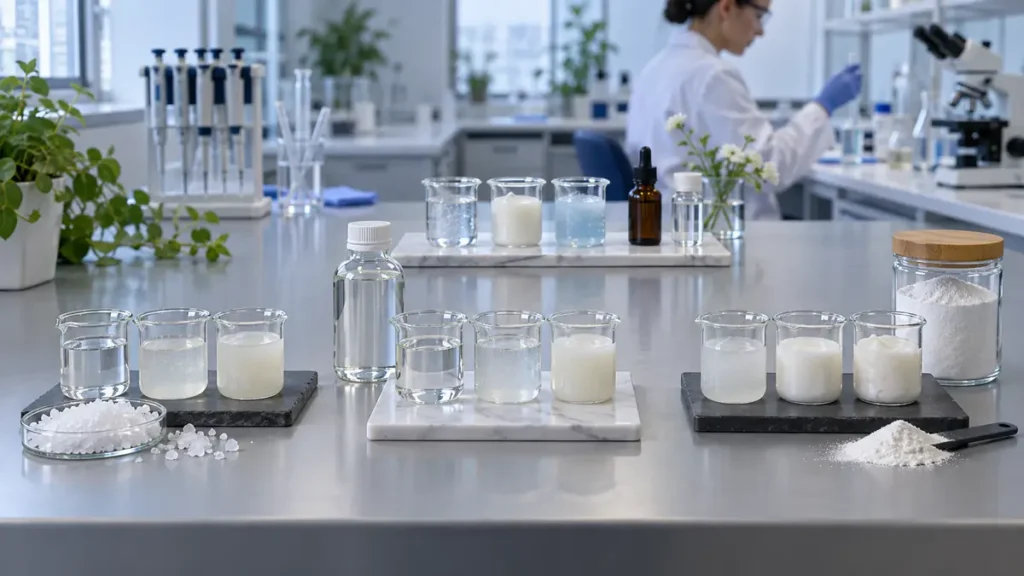
Prepare one homogeneous surfactant base and divide it by weight. This removes batch-to-batch mixing differences from the comparison. Keep the surfactant composition, water, temperature, mixing time and pH procedure identical. Reserve an untouched control. Add sodium chloride solution to the other samples in evenly spaced increments selected for the formula under study.
| Sample | Purpose | What stays fixed | What to record |
|---|---|---|---|
| Control | Baseline without added salt | Base composition, pH procedure, mixing, temperature | Appearance, pH, viscosity, measurement time |
| Salt 1 to Salt 5 | Reveal the direction and shape of the response | Same base and equal salt increments | Total salt, appearance, pH, viscosity after equal rest |
| Repeat point | Check whether one promising point is reproducible | Repeat the same preparation independently | Difference from the first result |
Do not read the samples immediately and call the curve finished. Use the same rest time and temperature for every measurement. Record the instrument, spindle or geometry, speed, temperature and reading time. A viscosity value without its method is difficult to compare, even inside the same project.
Also watch the whole series, not only the highest number. A rise followed by a fall indicates a peak region that may be sensitive to normal weighing or raw-material variation. A gentle plateau can be easier to manufacture than a sharper maximum, even if its peak viscosity is lower.
Four variables can change the answer
1. pH and neutralization state
Cocoyl glutamate is an anionic surfactant family. Changes in pH can alter ionization and intermolecular interactions, so a salt screen at the wrong pH may answer the wrong question. Fix the intended pH procedure before comparing routes, and recheck pH after the samples have equilibrated. Research on a sodium lauroyl glutamate and sulfobetaine model system found that pH and concentration affected micellar structures and viscoelastic behavior. It supports testing pH as a controlled variable, not assuming the exact result will transfer to cocoyl grades. The paper is available through Journal of Molecular Liquids.
2. Total surfactant composition
A formula described as a cocoyl glutamate cleanser may still contain amphoteric, nonionic or other anionic surfactants. Their ratios influence the aggregate structures available for salt thickening. Keep the ratio fixed during the first salt screen. If salt fails, change one surfactant ratio at a time in the cosurfactant lane.
3. The form in which the surfactant enters the batch
A powder and an aqueous blend do not enter a formula on the same basis. Water contribution, surfactant composition and processing differ. Calculate each formula from the supplier’s current compositional information and the project target. Do not replace one commercial grade with another at the same as-supplied percentage and assume that the screen remains comparable.
4. Late-stage ingredients
Fragrance, preservative systems, chelants, botanical extracts, acids and dissolved salts can shift viscosity or appearance. Their effect should be tested after a route has passed the simple base screen, not mixed into the first experiment. That sequence separates a weak thickening route from a late compatibility problem.
When to stop adding salt
Salt has earned a fair trial when the control and a compact incremental series were prepared from the same base, measured under the same conditions and repeated at one relevant point. Stop the salt route when any of the following patterns appears:
- The series remains nearly flat across the screened range.
- A narrow peak is surrounded by thin samples and offers little manufacturing margin.
- The required pH adjustment removes most of the viscosity.
- A necessary final ingredient consistently collapses the promising region.
- The salt level or appearance needed to reach the target is unacceptable for the product brief.
Do not rescue a failed series by changing several inputs together. That may create a thick sample, but it will not reveal which interaction caused the change or whether the result can be reproduced.
For a broader explanation of salt curves, measurement controls and failure patterns, use INNO’s amino acid surfactant thickening guide. The screen here serves a narrower purpose: deciding where the next development batch should go.
Choose the next lane by the failure pattern
| Observed pattern | Route to prioritize next | Reason for the choice | Early check |
|---|---|---|---|
| Some salt response, but the useful region is too narrow | Cosurfactant blend | A change in surfactant interactions may broaden or move the response | Small ratio ladder at fixed total surfactant and pH |
| Little salt response despite controlled preparation | Compatible polymer | Structure can be built through a different mechanism | Hydration, dispersion, pH compatibility and after-feel |
| Good base viscosity, poor final-formula retention | Test the disruptive ingredient first | The problem may be compatibility rather than the primary route | Add the suspect input separately at its intended level |
| Good viscosity but unacceptable haze or texture | Compare both alternative lanes | The target includes appearance and sensory handling, not viscosity alone | Clarity, pour, foam behavior and stability observations |
A cosurfactant is not automatically the gentler or simpler option, and a polymer is not automatically more dependable. A 2026 shampoo study that included disodium cocoyl glutamate and cocamidopropyl betaine reported different rheological behavior across thickener groups and surfactant combinations. Treat that as evidence for formulation-specific screening, not as a recipe or a ranking of materials. Review the open-access study in Cosmetics.
Place INNO grades into the screen correctly
INNO currently offers two cocoyl glutamate supply forms relevant to this work. KWCG-95 is listed as Sodium Cocoyl Glutamate, a white solid powder with 93.5 to 100 percent content, supplied in a standard 15 kg pack. KWCG-25 is a pale yellow or colorless transparent liquid listed as 75 percent water, 20 percent Disodium Cocoyl Glutamate and 5 percent Sodium Cocoyl Glutamate, with a standard 200 kg pack.
These details identify the commercial forms; they do not establish identical formulation behavior. When comparing them, normalize the batch calculation using the current product documents, then record the actual material level, water contribution, pH procedure and processing sequence. Product-specific viscosity and compatibility should be confirmed in the customer’s formula.
A short handoff record prevents repeat work
At the end of the screen, save more than the winning beaker. A useful handoff record contains the full base composition, supplier and grade, batch reference, pH before and after adjustment, salt amount, cosurfactant ratio where used, polymer identity and addition method, mixing history, rest time, measurement conditions and target viscosity range.
State why a route was stopped. “Salt series flat under the defined conditions” is more useful than “salt did not work.” It allows another formulator to judge whether a new raw-material lot, pH target or surfactant ratio justifies repeating the screen.
Frequently asked questions
Does sodium chloride always thicken sodium cocoyl glutamate?
No. Salt response depends on the complete surfactant system, concentration, pH, counterions and other dissolved materials. A controlled incremental screen is more reliable than a fixed universal dosage.
If the series is flat or peaks too narrowly, move to another route instead of assuming that the next salt addition will solve it.
How many salt levels should I test first?
A control plus five evenly spaced additions is a practical first screen. Repeat one promising point independently before treating the response as reproducible.
The correct increment depends on the formula and project limits. Record total added salt, including salt contributed by other raw materials.
Should pH be adjusted before or after the salt screen?
Set a consistent pH procedure that represents the intended formula, then apply it to every sample. Recheck pH after equal equilibration because the measured value can shift.
If process order is still open, compare two controlled sequences as a separate experiment rather than changing order within one salt series.
When should I move directly to a polymer?
Prioritize a polymer screen when controlled salt additions give little response, or when the salt window fails after required pH and final-ingredient checks.
Screen polymer hydration and compatibility first. A polymer that looks promising in water may behave differently in a concentrated surfactant base.
Can KWCG-95 and KWCG-25 use the same thickening plan?
Use the same decision framework, but not an assumed one-for-one formula. Their listed supply forms and compositions differ, so each needs its own normalized screen.
Confirm the current grade documents and calculate the water and surfactant contribution before comparing viscosity data.
Send INNO yoShare the cocoyl glutamate grade, total surfactant system, target pH, salt already tested, cosurfactants, target viscosity and measurement method. INNO can use that context to discuss the next sample screen.ur thickening brief