In my 15 years of scaling cosmetic formulas from 1-liter lab beakers to 2-ton manufacturing vessels, the most panicked calls have sounded much the same: “My lab sample was perfect, but the pilot batch separated overnight!”
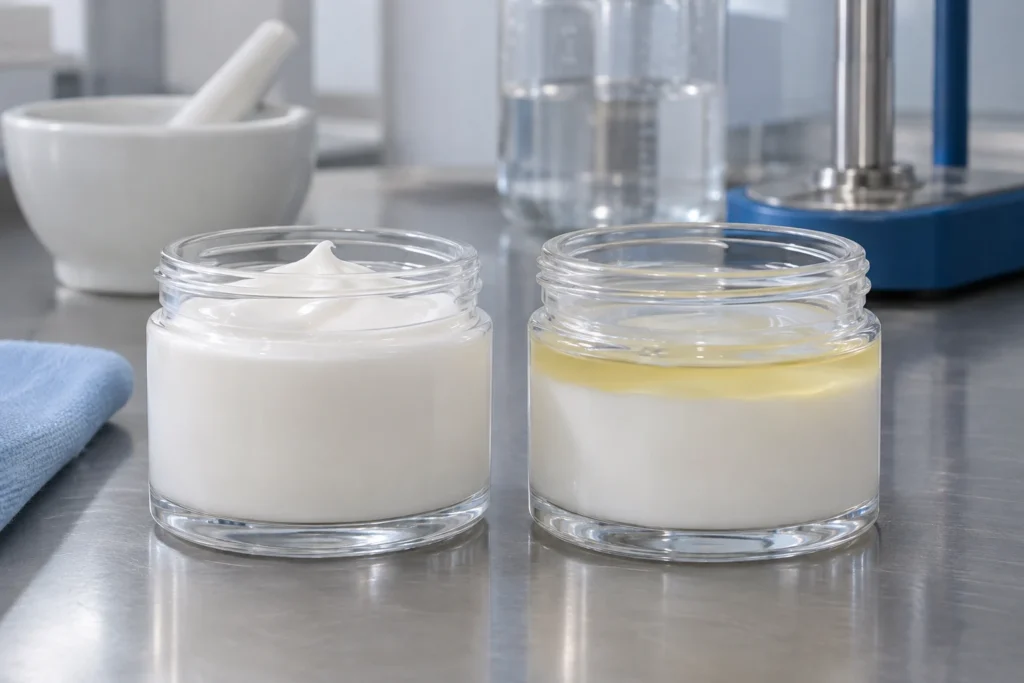
Whether it shows up as creaming, slow coalescence, or distinct layers after a stay in the 45°C stability oven, emulsion instability wastes raw materials and delays launches. It also makes formulators question a formula that seemed sound in the lab. Clean beauty ingredients can make that stability challenge harder.
When the formula works at the bench but fails in the pilot vessel, I focus on three areas: emulsifier balance, homogenization, and the cooling curve. Together, they explain why a change in batch size can expose a weakness that a lab sample never showed.
What Causes Emulsion Instability, and Why Does Lotion Separate?
A lotion can separate when its emulsifier system no longer keeps oil droplets apart, when the continuous phase cannot adequately limit droplet movement, or when processing leaves the system poorly structured. An HLB mismatch, insufficient homogenization, or an unsuitable cooling rate can each contribute during scale-up.
The visible symptoms describe different mechanisms. In flocculation, droplets cluster while remaining separate. In coalescence, they merge into larger droplets, which can eventually produce distinct oil and water layers. Creaming is droplet migration under gravity; it can occur while the droplets remain intact.
Fluid dynamics change with scale. A small lab rotor-stator concentrates shear in a small volume. A production homogenizer has to deliver sufficient droplet breakup and circulate the whole batch through its working zone. If that circulation falls short, some material may receive much less processing than the rest.
How Does HLB Mismatch Contribute to Separation?
The hydrophilic-lipophilic balance, or HLB, is a starting point for matching an emulsifier blend to the oil phase. If an oil blend has a required HLB near 10 and the emulsifier blend is near 14, that difference is worth investigating. The numbers alone do not make failure under thermal stress inevitable.
Calculating the required HLB of your plant oils, esters, and silicones gives you a basis for the first emulsifier trials. Use values for the actual raw-material grades wherever they are available.
Natural PEG-free systems, such as those based on Cetearyl Alcohol and Cetearyl Glucoside, also depend on the structure they build. A single HLB number does not describe the full lamellar network. When a formula separates under heat, adjusting the primary emulsifier ratio or adding a compatible co-emulsifier may improve the interfacial film.
| Lipid | Required HLB in the IFSCC reference |
|---|---|
| Jojoba oil | 6–7 |
| Caprylic/Capric Triglyceride | 5 |
| Dimethicone | 9 |
Source: IFSCC Monograph 4, Table 4. These published reference values are starting points for screening. Supplier-grade values and other reference tables can differ.
Why Does Homogenization Change During Scale-Up?
A lab homogenizer runs at high speed in a small volume, while a factory vessel has a much larger circulation task. If the production process does not deliver enough effective homogenization, larger droplets can remain and coalesce over time.
A common trap is comparing RPM alone. A lab unit running at 10,000 RPM and a factory unit running at 3,000 RPM cannot be compared without their rotor diameters. Tip speed depends on both diameter and rotational speed. Even matching tip speed does not match shear energy by itself: rotor-stator geometry, shear gap, processing time, and batch circulation also matter.

Addition order matters, too. Introducing an emulsifier through the oil phase, water phase, or main vessel changes the conditions under which droplets first form. Insufficient processing at that point can leave a weak emulsion. If your method includes phase inversion, that transition needs its own defined processing conditions.
IKA’s benchtop processing guidance identifies rotor diameter, speed, shear gap, and rotor-stator geometry among the variables used in scale-up calculations.
How Does the Cooling Curve Affect Lotion Stability?
Cooling too quickly or too slowly can disrupt wax crystallization and the formation of a lamellar gel network. An uncontrolled cooling curve can leave the emulsion without the structure it needs.
With fatty alcohols and liquid-crystal-forming emulsifiers such as Cetearyl Glucoside, cooling deserves as much attention as heating. These ingredients assemble into a structured lamellar network as the temperature falls.
Sending chilled water through the vessel jacket too rapidly can shock the system. Irregular wax crystallization can produce “false viscosity”: the lotion looks thick at first, yet develops oil bleeding weeks later as the poorly formed network changes. The cooling profile is therefore part of the process specification, rather than simply the time needed to reach filling temperature.
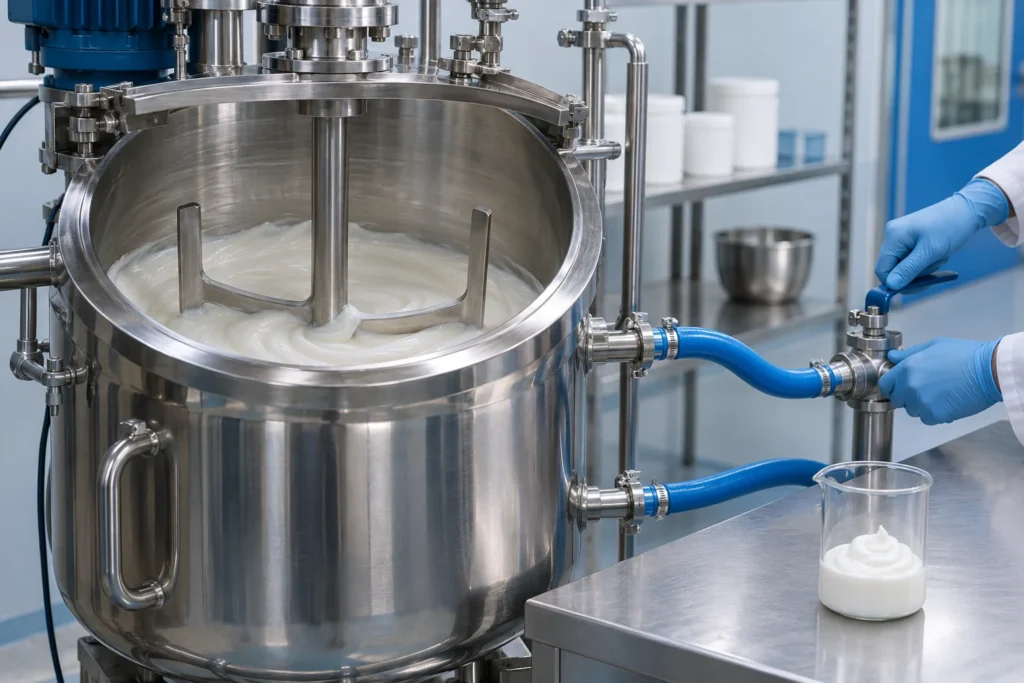
Jacketed processing equipment illustrating the cooling stage.
A Scale-Up Troubleshooting Checklist for Formulators
Before scrapping the formula, compare the failed production batch with the successful lab batch. The differences in emulsifier balance, water-phase structure, temperature, homogenization, and cooling give the investigation a direction.
- Water-phase stabilization: Does the continuous phase have a suitable rheology modifier, such as xanthan gum? For surfactant-rich cleansing systems, a PEG-120 Methyl Glucose Dioleate thickener may suit the surfactant blend. It should not be treated as an interchangeable replacement for a gum in a conventional leave-on lotion.
- Temperature control: Did the hot-process homogenization temperature remain high enough to melt the waxes fully? A processing range of 75–80°C needs to suit the highest-melting ingredient, emulsifier grade, and heat-sensitive components.
- Shear and circulation: Have you compared rotor diameter and tip speed as well as RPM? Include the shear gap, homogenization time, and circulation pattern; tip speed alone does not establish equivalent processing.
- Cooling: Did the production batch follow the intended temperature-time profile through the structure-forming stage, with suitable mixing?
- Emulsifier consistency: Is the emulsifier consistent from lot to lot, and does the chosen system tolerate the processing variations your equipment introduces?
If the emulsifier system is highly sensitive to normal processing variation, a different blend may be needed. INNO Biotechnology supplies stable, high-performance emulsifiers with formulation scale-up support to help your pilot batches succeed.
Discuss your emulsion scale-up problem with INNO, including the formula’s oil phase, batch size, homogenizer settings, and cooling record.
Frequently Asked Questions
Can I fix a separated emulsion batch?
A cold emulsion that has broken through coalescence is difficult to salvage by stirring alone. Re-emulsification may require reheating and homogenization; for a hot-process formula, that may mean returning to 75–80°C if the ingredients permit it. Reheating can damage sensitive actives and preservatives, so any rework needs a formula-specific procedure and reassessment before release.
Does adding more emulsifier solve stability problems?
Not necessarily. Excess emulsifier can introduce other problems, including soaping during application or changes in the system’s aggregate structure. Adjusting the co-emulsifier ratio or water-phase thickening may address the cause more effectively than increasing the primary emulsifier.
Why does my lotion bleed oil only after three months?
Delayed oil bleeding can be associated with slow coalescence, a weak internal gel network, or insufficient continuous-phase stabilization. Timing alone does not identify the mechanism. Comparing droplet size and structure before and after storage can help distinguish droplet merging from changes in the network.