In my 15 years in cosmetic chemistry and troubleshooting production scale-up around the world, I’ve seen countless batches fail in the 45°C stability oven. A common thread is an emulsification system that doesn’t suit the dosage form.
Clean beauty requirements have pushed brands away from conventional systems. But swapping ingredients without adjusting the formula can leave a greasy finish, cause frustrating white streaks during application, or lead to phase separation.
The three formulation frameworks below connect emulsifier selection to a specific texture: a fast-absorbing fluid lotion, a rich cream, or a mineral sunscreen with a high powder load. For clean beauty projects, natural PEG-free emulsifier selection provides the broader starting point; these examples focus on how the system behaves in each format.
What Matters When Selecting an O/W Emulsifier?
Choosing an oil-in-water (O/W) emulsifier depends on the amount and composition of the oil phase, target viscosity, and desired skin feel. HLB matching concerns the hydrophilic-lipophilic balance required by the oil blend; oil-phase percentage describes how much oil the system needs to carry. They are separate selection criteria.
HLB calculations are only part of the decision. The emulsifier’s chemical structure influences whether an emulsion breaks quickly on the skin for a watery sensation or forms a network with a richer, more nourishing feel. Matching plant oils, esters, and silicones with a compatible emulsifier system helps prevent oil bleeding over time.
| Target texture | Oil phase in the framework | Target skin feel | Emulsifier type |
|---|---|---|---|
| Serums and sprayable milks | 5–15% | Quick-break, watery, refreshing | Polyglyceryl esters for low-viscosity systems |
| Topical creams and emulsified body butters | 20–30% | Deep hydration, powdery finish, no greasy after-feel | Liquid-crystal-forming glucoside systems |
| Sunscreens and color cosmetics | 15–25%, with a high particulate load considered separately | Matte finish and suspension of dense particles | Phosphate-based anionic emulsifiers |
These are formulation frameworks, rather than complete tested formulas. Percentages refer to the total formula; the powder content is a separate formulation input.
Example 1: Light, Fast-Absorbing Lotions
Light lotions and fluid serums need a low-viscosity, fast-breaking emulsifier system, such as one based on Polyglyceryl-10 Laurate. In systems with less than 15% oil, the aim is to stabilize small droplets while delivering a refreshing, watery feel without a tacky or waxy finish.
For summer skin care, hydrating toners, and fluid emulsions, spreadability comes first. A heavy emulsifier system can leave an uncomfortable film on the skin.
Formulation Framework
Keep the total oil phase below 15%, with lightweight emollients such as Caprylic/Capric Triglyceride, squalane, or alternatives to volatile silicones.
Emulsifier Performance and Ingredient Selection
The desired quick-break effect gives a water-release sensation as the lotion is rubbed in. I recommend Polyglyceryl-10 Laurate as a primary emulsifier or co-emulsifier. It reduces interfacial tension in fluid systems while maintaining clarity and a lightweight feel.
Example 2: Rich, Nourishing Creams
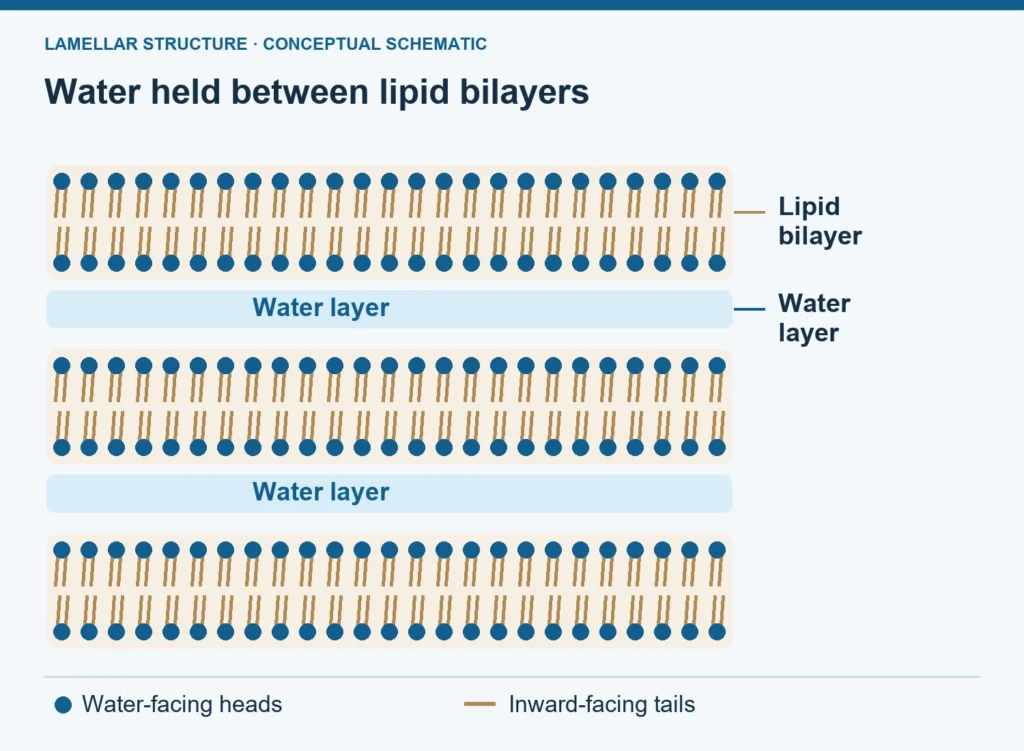
For topical creams with a high oil phase, liquid-crystal-forming emulsifiers such as Cetearyl Glucoside build a lamellar gel network that supports 20–30% oil loads. The network provides long-lasting hydration and thermal stability with a powdery finish.
Night creams, body butters, and barrier-repair formulas need enough structure to hold their shape. Relying solely on carbomers or gums for that thickness can result in pilling during application.
Formulation Framework
The oil phase typically ranges from 20% to 30%, with heavier lipids such as shea butter, jojoba oil, and ceramides.
Emulsifier Performance and Ingredient Selection
The emulsifier system creates a biomimetic lipid bilayer. Its lamellar structure holds water between lipid layers and releases it gradually. It also prevents the greasy after-feel associated with high-oil formulas, leaving a smooth, powdery dry-down.
A Cetearyl Alcohol and Cetearyl Glucoside emulsifier builds viscosity naturally and reduces the need for synthetic polymers.

Example 3: Sunscreens and High-Powder Systems
Emulsions with mineral UV filters or a high powder load need an emulsifier system that can handle solid particulates as well as oil droplets. Anionic emulsifiers such as Potassium Cetyl Phosphate help stabilize these demanding systems and can contribute to dispersion and water resistance.
Mineral sunscreens and liquid foundations introduce a separate suspension challenge. A standard nonionic system can struggle to keep dense mineral powders suspended, allowing sediment and hard caking to develop at the bottom of the bottle.
Formulation Framework
The system contains zinc oxide, titanium dioxide, or other functional powders. Powder loading must be considered alongside the oil phase.
Emulsifier Performance and Ingredient Selection
Anionic emulsifiers create electrostatic repulsion between emulsion droplets. Powder agglomeration and settling also depend on particle wetting, dispersion, and the formula’s rheology; stabilizing droplets alone does not resolve every powder-related problem.
Potassium Cetyl Phosphate emulsifier reinforces the oil-water interface in systems with dense mineral loads. Even particle distribution supports uniform coverage, but SPF and water resistance must be established by testing the finished sunscreen. The FDA describes these requirements in its sunscreen effectiveness testing guidance.

How to Maintain Stability in Topical Creams
Long-term emulsion stability comes from combining the primary O/W emulsifier with a compatible water-phase thickener, suitable co-emulsifiers, and a controlled homogenization process. Even a well-chosen emulsifier needs support in a demanding formula.
Hydrocolloids such as xanthan gum at 0.1–0.3%, or a suitable carbomer, help stabilize the continuous water phase during thermal stress.
For a hot-process framework, bring the oil and water phases to the required processing temperature, typically 75–80°C, before combining them. Match the heating and high-shear stages to the emulsifier grade and complete formula, then control cooling so the structure can develop.
At INNO Biotechnology, we provide ingredients and troubleshooting support for separation during scale-up. We can recommend customized emulsifier blends suited to your factory’s processing capabilities.
Discuss your lotion or cream formulation with INNO, including your oil phase, target texture, and production process.
Frequently Asked Questions
How do I prevent soaping in an O/W lotion?
Adjust the oil blend by combining fast-, medium-, and slow-spreading emollients. Silicone alternatives or adjustments to fatty alcohols such as Cetearyl Alcohol can also reduce foaming and whitening during rub-in.
Can I use the same emulsifier for a fluid lotion and a thick body butter?
Usually, I choose them separately. Some liquid-crystal emulsifiers are versatile, but a fluid lotion and a firm emulsified butter need very different oil loads and thickener ratios. An emulsifier designed for the target viscosity is the safer starting point.
Why does my O/W cream separate during a 45°C stability test?
Thermal separation often points to a mismatch between the oil phase and emulsifier, insufficient water-phase stabilization, or unsuitable homogenization and cooling conditions. Compare the oil blend, thickener system, mixing history, and cooling profile to identify which variable needs adjustment.
Technical reference: The AMPHISOL K formulation guidelines illustrate how a potassium cetyl phosphate grade is used in challenging emulsions. The guidance is specific to that supplier’s grade and does not establish INNO product performance.