Over my 10+ years of hands-on experience in cosmetic R&D, I have watched Clean Beauty shift from a niche marketing trend into a mandatory global standard. However, in our INNO application labs, I’ve seen countless brands struggle with this exact transition. Replacing a traditional PEG-based emulsifier is rarely a simple 1:1 drop-in swap—it often leads to severe formulation nightmares. I frequently help formulators troubleshoot catastrophic phase separations during 45°C thermal stability testing, unexpected viscosity drops, and the dreaded “soaping” effect (those persistent white streaks during application).
Based on years of market formulation trends, factory scale-up data, and real client troubleshooting cases, I have compiled this ultimate technical roadmap. This guide breaks down natural O/W emulsion systems, comparing skin feel, thickening performance, and stability parameters. Whether you are rescuing an unstable lotion or formulating a new clean beauty cream from scratch, my goal is to help you confidently select the right non-GMO emulsifier and pass your stability tests on the first try.
For skin care formulations, choosing a natural emulsifier starts with the texture you want, the oil phase you need to stabilize, and the process your equipment can deliver.

What Are Natural PEG-Free Emulsifiers, and Why Are Brands Switching?
Natural PEG-free emulsifiers are plant-derived surface-active agents synthesized entirely without polyethylene glycol. Formulators and brands are rapidly switching to these ingredients to meet strict clean beauty standards like Ecocert and COSMOS, significantly reduce skin irritation, and eliminate potential 1,4-dioxane contamination risks.
The main chemical difference is the synthesis route. Conventional ethoxylated emulsifiers are made through ethoxylation, a process that can leave trace amounts of 1,4-dioxane. Natural PEG-free alternatives use processes such as glycosidation or esterification, with hydrophilic and lipophilic groups derived from renewable feedstocks such as corn, coconut, or palm.
Consumer demand for sustainability drives this shift, but procurement teams also need to consider the non-GMO status of those feedstocks. Traceability across the supply chain is now mandatory for global cosmetic compliance.
How to Choose the Right Natural O/W Emulsifier for Your Formula
The right natural oil-in-water (O/W) emulsifier depends on your target viscosity, desired skin feel, and oil phase polarity. A light lotion may need a quick-break, watery sensation; a rich cream may need a stronger liquid-crystal network.

For Light, Fresh Lotions, Serums, and Milks
In low-viscosity formulas such as sprayable milks and fluid serums, the goal is to stabilize small oil droplets without building too much viscosity. Look for an emulsifier that gives a quick-break, watery sensation and avoids a heavy, waxy residue after application. Match the emulsifier system to the oil phase rather than selecting a lower HLB simply because the finished product needs to be fluid.
For Rich Creams and Body Butters
Thick night creams and emulsified body butters need enough internal structure to support a larger oil phase. Liquid-crystal-forming systems, such as a Cetearyl Alcohol and Cetearyl Glucoside emulsifier, build three-dimensional networks in the water phase to support long-term stability and a rich, nourishing feel.
How Does Cetearyl Glucoside Compare with Conventional Emulsifiers?
Cetearyl Glucoside systems form a biomimetic liquid-crystal structure that offers superior long-lasting hydration, stable thickening, and a rich, non-greasy feel without the tacky finish associated with some synthetic systems. Conventional PEG-based systems can also develop structure through their co-emulsifiers and fatty alcohols, so their stabilization cannot be attributed to steric hindrance alone.
Thickening and Stability
Conventional emulsifiers often need several rheology modifiers to maintain viscosity, especially when the oil phase exceeds 15%. Cetearyl Glucoside naturally boosts viscosity by forming a lamellar gel network. It effectively withstands high oil loads of up to 25–30% and demonstrates excellent thermal stability during freeze-thaw testing, reducing reliance on synthetic thickeners.
Differences in Skin Feel
Synthetic ethoxylated emulsifiers can sometimes leave a tacky or sticky finish. Cetearyl Glucoside delivers a smooth, powdery after-feel. Because its structure mimics the lipid bilayers of the stratum corneum, it integrates smoothly with the skin and improves the sensory profile of high-end skin care formulas.

Common Formulation Challenges with PEG-Free Systems
Phase separation under heat, soaping during application, and limited pH tolerance are common challenges with natural PEG-free systems. Matching the emulsifier to the oil phase, adjusting the emollient blend, and choosing suitable co-emulsifiers are central to resolving them.
Preventing Phase Separation
Natural emulsifiers often have a narrower working range than their PEG-based counterparts. A mismatch between the emulsifier system and the oil phase can show up as separation during elevated-temperature testing. Assess the oil blend and emulsifier balance together; natural hydrocolloids such as xanthan gum can help stabilize the water phase. An O/W emulsion stability test belongs in the R&D process, before scale-up.
Reducing the Soaping Effect
Soaping is the temporary whitening that appears as an emulsion is rubbed into the skin. To reduce it, adjust the oil blend by combining fast-, medium-, and slow-spreading emollients. Changes to the fatty alcohol balance or homogenization conditions may also help reduce visible whitening.
How to Maintain Quality and a Stable Supply for Clean Beauty Manufacturing
Consistent manufacturing depends on a supplier with non-GMO sourcing, batch-to-batch quality control, and transparent supply chain documentation. The essential documents include the COA, TDS, and SDS: the Certificate of Analysis, Technical Data Sheet, and Safety Data Sheet.
When production moves from a 1-liter lab beaker to a 1,000-liter vessel, consistency matters at every stage. Plant-derived ingredients are subject to crop variation, which makes the supplier’s quality control a direct concern for formula stability.
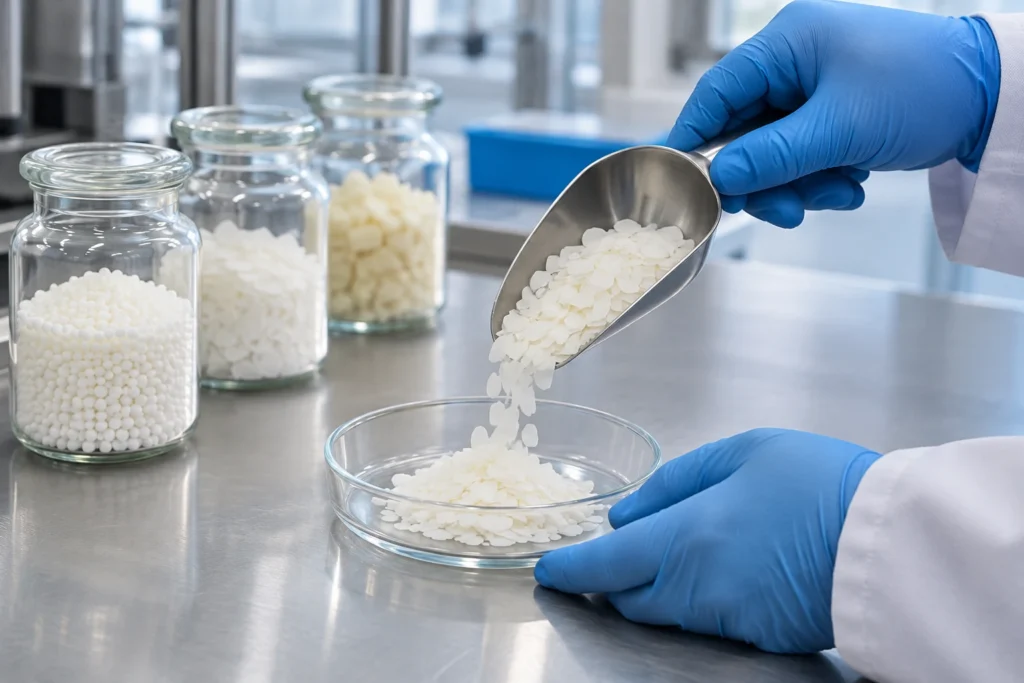
As a direct manufacturer, INNO Biotechnology supplies high-purity natural emulsifiers, including Cetearyl Glucoside systems, for large-scale cosmetic production. Along with raw materials, our technical team provides formulation frameworks and scale-up troubleshooting to ensure your batch passes stability testing the first time.
Discuss your emulsifier requirements with INNO, including your lotion or cream format and the formulation documents you need.
Frequently Asked Questions
Can I replace a PEG emulsifier 1:1 with a natural PEG-free alternative?
Rarely. Natural systems behave differently in interfacial tension and rheology. You will typically need to adjust the co-emulsifier ratio, revise the thickener system, and optimize processing temperatures to achieve the same stability.
Are all PEG-free emulsifiers non-GMO?
Not automatically. Plant-derived feedstocks such as corn or soy may be genetically modified. Ask the supplier for a non-GMO statement covering the feedstock source; a routine COA establishes only the results it actually reports.
Does Cetearyl Glucoside require a specific homogenization process?
Yes. To form the liquid-crystal network, Cetearyl Glucoside performs best when added to the heated oil phase, typically around 75–80°C, and combined with the water phase under suitable high-shear homogenization.
How does the shelf life of natural O/W emulsions compare with conventional systems?
When paired with a robust, broad-spectrum preservative system and processed correctly, natural O/W emulsions offer comparable stability and shelf life, often exceeding 24 months.