Before a KWLG-25 dosing skid is released for production, process, automation and quality teams need one shared answer: where does the measured transfer begin, where does it end, and how will they confirm the mass that reached the vessel? Settling that boundary during commissioning prevents a meter total, line residue and vessel gain from becoming three different versions of the same batch charge.
Automated liquid surfactant dosing is the controlled transfer of a liquid raw material from its supply container to the batch vessel through a defined pump, meter and line. A line is ready when it can deliver the intended mass repeatedly, account for hold-up, and leave a verified condition for the next batch.
For KWLG-25, line approval depends on the complete material path. The source container, suction conditions, pump, meter, hose, valves, vessel connection and rinse destination all influence the result. A representative commissioning trial shows how the installed route handles priming, transfer, hold-up and rinsing before the first production batch is scheduled.
The commissioning record then has a clear job: connect the meter total to an independent mass check, account for material left in the line and define the condition required before the next batch.
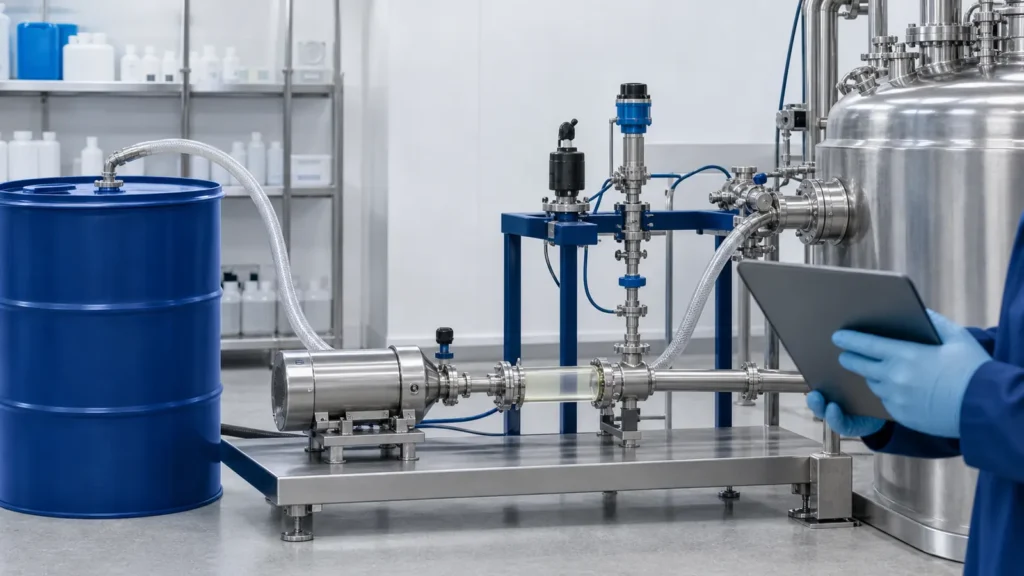
A dosing skid becomes useful when its meter total, material balance and cleaning state tell the same story.
Draw the material path before choosing settings
Start at the sealed supply container and follow the material to the point where it enters the moving batch. That path is the process boundary. Every hose, valve, bend, instrument pocket and low point inside it can affect priming, recovery or cleaning.
KWLG-25 enters the line as an aqueous, colorless to light-yellow grade. The current INNO product record places Sodium Lauroyl Glutamate at 24-26% and the commercial pack at 200 kg. Its behavior through your line at warehouse and production temperatures still belongs to the site trial.
One drawing should show the source, pump, flow meter, flexible connections, isolation points, vessel entry and the planned route for rinse liquid. Add any shared sections and dead legs. If the skid uses automatic valves, show their normal and failure positions as well. The drawing does not need to be elegant. It needs to match the metal on the floor.
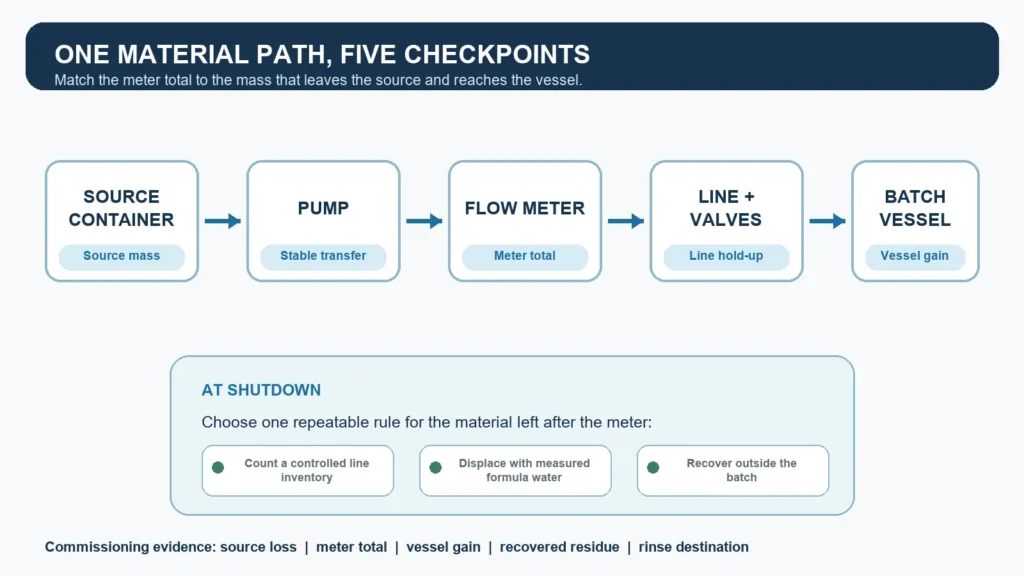
Five checkpoints turn a pipe diagram into a material balance: source, meter, vessel, line hold-up and rinse destination.
Match the pump and connections to the real transfer
Pump selection belongs to the actual transfer duty. The equipment must handle the material over the site’s operating-temperature range, at the required flow, with stable suction and acceptable aeration and residue. It also has to fit the plant’s cleaning and maintenance practice.
Ask the equipment supplier to review the available product properties and the actual duty: suction lift, hose length and diameter, fittings, target dose, required transfer time and expected start-stop frequency. Then run the candidate with representative material. A water-only trial can confirm valve logic and leaks, but it cannot prove how the surfactant will prime, drain or leave the meter.
Wetted materials, seals and hoses need the same attention. Compatibility should be confirmed against current supplier information and the site’s contact conditions. After the trial, look for swelling, softening, discoloration, leakage and material trapped at connections. A hose that works chemically but collapses under suction is still the wrong hose.
Make the flow meter answer to an independent mass
Treat the flow-meter total as a process signal and verify it independently. During commissioning, compare it with a mass change from a verified floor scale, load cell or receiving vessel. Use the same start and stop logic that production will use, including the low-level condition near the end of a container.
The comparison can be expressed as:
*Transfer difference (%) = (meter total – independent mass change) / independent mass change x 100*
Set the allowable difference from your batch tolerance, weighing system and quality procedure. A universal percentage would be misleading because a 5 kg trim addition and a 500 kg bulk charge do not carry the same relative measurement challenge.
Repeat the run at the smallest and largest planned doses. Watch the first charge after an empty line, a normal charge with a primed line, and the final charge before the source container runs low. If those three conditions deliver different results, one calibration factor will not fix the process.
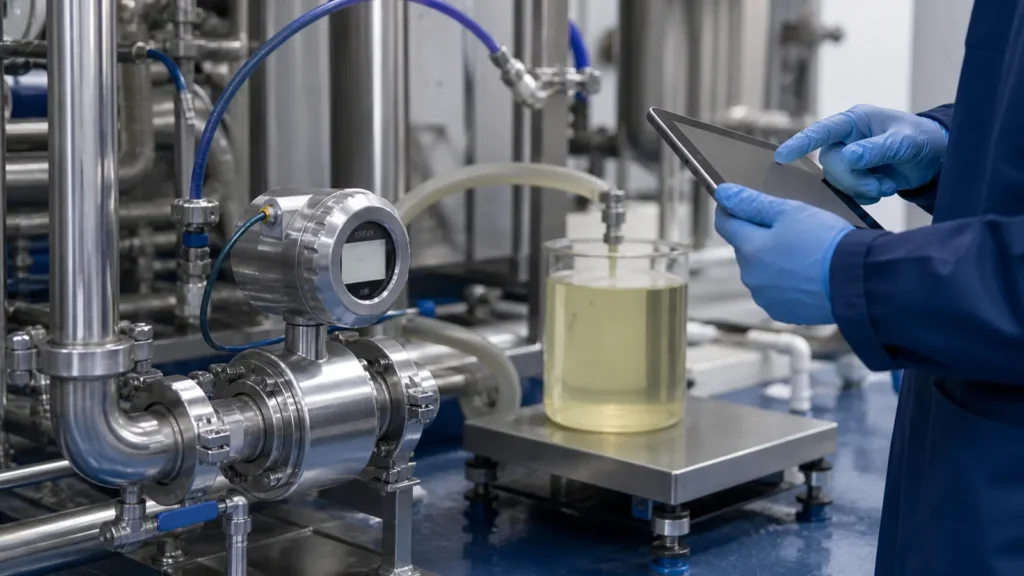
The meter earns trust by agreeing with an independent mass balance across the operating range.
Put line hold-up into the batch record
Some material remains between the meter and the vessel when the pump stops. The amount may be small, or it may be large enough to move the active contribution and batch yield. It depends on the internal volume, line geometry, valve arrangement, drainability and the stop sequence.
For a straight section, the starting estimate is:
*Line volume = pi x internal diameter squared x length / 4*
*Estimated material mass = line volume x measured material density*
Use actual internal dimensions and the density from the applicable material data or site measurement. Valves, instruments, branches and flexible hoses make the real hold-up different from a simple cylinder calculation, so confirm the estimate through a recovery or displacement trial.
The operating instruction then needs one clear rule. Either the metered dose includes a controlled line inventory, the line is displaced into the vessel with a defined amount of formula water, or the residual is recovered outside the batch. Mixing these approaches from one batch to the next creates a quiet source of variation.
Treat rinse water as an ingredient or a waste stream
KWLG-25 is supplied in an aqueous form. Any water used to push it from the line into the vessel adds to the formula water if it enters the batch. Record the rinse quantity and subtract it from the planned water charge. If the rinse goes to waste or recovery, confirm the collection route and the site’s disposal procedure.
A shared liquid raw material transfer line adds another question: what result is enough to release the line for the next ingredient? Visual clarity alone may miss residue inside a low point or valve pocket. The acceptance method should reflect the next product, the equipment design and the site’s risk assessment. It may use a defined rinse sequence, recovery measurement, conductivity, analytical testing or another approved check. The method and limit need site evidence rather than a copied industry number.
The FDA cosmetic GMP inspection checklist calls attention to clean transfer equipment, checked measuring devices and identified lines. ISO 22716 places production, control, storage and shipment inside a documented quality framework. Together, those principles support a simple rule: the line status should be visible and traceable before the next batch starts.
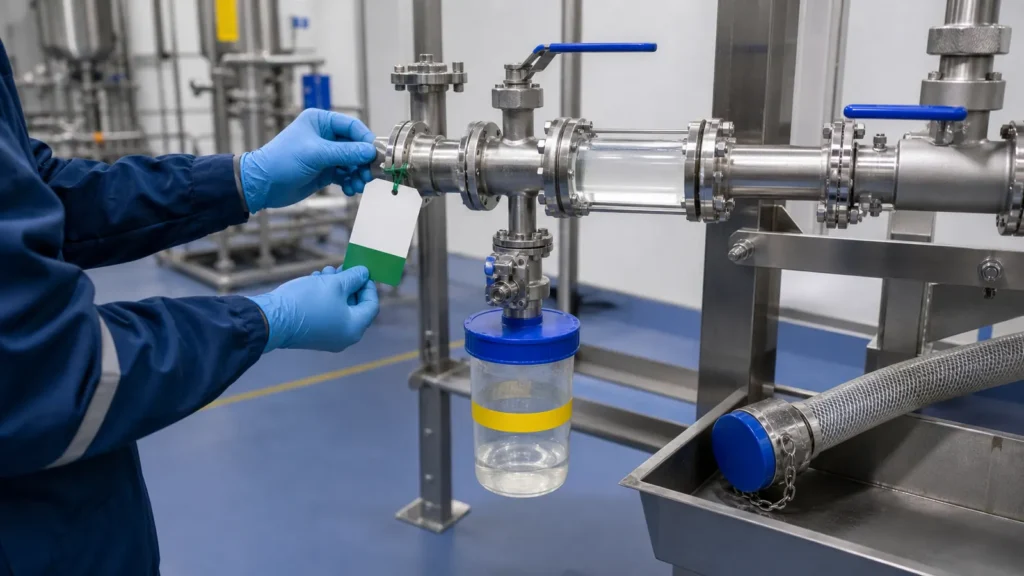
A changeover is complete when the rinse route, residual check and line status have all been recorded.
Commission the route in stages
A useful commissioning sequence moves from equipment function to measured transfer and then to the real batch. First confirm valve logic, leak control, alarms and safe shutdown with an appropriate plant-approved medium. Next transfer representative KWLG-25 through the complete route and compare source loss, meter total, vessel gain and recovered residue. Finally, run the intended rinse or changeover and review the full material balance.
The production record should capture the source lot, source mass, meter total, vessel gain, line state before transfer, rinse amount and destination, exceptions and final line status. Alarm limits, interlocks and acceptance criteria belong to the site’s engineering and quality teams and should be based on the installed line and batch requirements.
If the grade itself is new to the project, the Sodium Lauroyl Glutamate guide explains how supplied form and content differ from the INCI name. The wider amino acid surfactants guide helps place the chemistry in the finished cleansing system. Neither replaces the line trial, but both make the request clearer before engineering time is booked.
Bring us the line drawing and the dose
When you are considering KWLG-25 for an automated line, send us the source package, target dose per batch, line length and internal diameter, pump and meter models, plant temperature range, rinse destination and whether the route is shared. We can match the product information we hold to that duty and help you prepare a representative sample request. Equipment selection and plant acceptance remain with your engineering and quality teams.
Discuss a KWLG-25 dosing-line trial with INNO
Questions customers ask before commissioning
Can we calibrate the liquid surfactant flow meter with water?
Water is useful for checking valve logic, leaks and basic instrument function, but it does not prove transfer behavior with KWLG-25. Final verification should use representative material and compare the meter total with an independent mass change.
Should the line be primed before every dose?
The line state must be defined and repeatable before each dose. A primed line and an empty line carry different inventories, so the approved procedure should state which condition applies and how any retained material is counted.
Can rinse water be sent directly into the cleanser batch?
Rinse water can enter the batch only when the formula and process allow it. Its measured quantity must be included in the water balance, and the rinse must recover material without introducing an unapproved cleaning residue.
What is the quickest way to find a transfer loss?
Compare source-container mass loss, flow-meter total, vessel mass gain and recovered line residue in the same run. The first mismatch usually shows whether the loss sits before the meter, after the meter or in the line at shutdown.