The conversion sheet is correct. Both batches deliver the same Sodium Lauroyl Glutamate active. Yet the old cleanser sits neatly in the pump bottle while the new one pours like it has somewhere else to be.
A liquid surfactant viscosity change after replacing KWLG-95 with KWLG-25 usually comes from a composition or process variable left outside the active-matter calculation. KWLG-25 brings much more supplied water, a listed sodium chloride range and other declared components. The liquid route can also change addition order, pH history, fragrance response, aeration and the time at which viscosity is measured.
You can use the six checks below to close plausible causes in order before the team reaches for more salt or thickener.
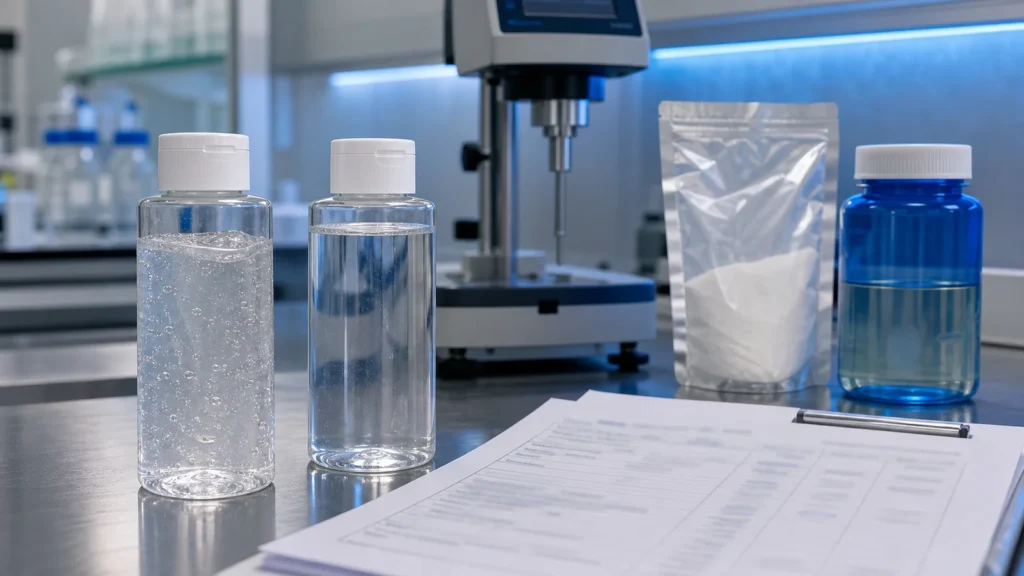
A viscosity difference is easier to solve when the old and new batches are compared as complete histories, not as two isolated numbers.
Check 1: confirm the active contribution that reached the batch
The first comparison belongs on an active basis. KWLG-95 is currently declared at 98.5% active, while KWLG-25 is listed at 24-26% Sodium Lauroyl Glutamate. A one-for-one weight replacement creates a much lower surfactant contribution and will change the entire micellar environment.
Even with correct spreadsheet arithmetic, the delivered charge deserves a quick reconciliation. Compare the approved active basis, intended raw-material mass and actual charge for both batches. For the liquid route, include any line residue and rinse that affects how much reached the vessel.
The full worked conversion and water-correction equation already belongs to the dedicated KWLG-95 to KWLG-25 conversion page. Here, the diagnostic question is simply whether the new batch received the intended active contribution. If it did, the investigation moves on without reopening settled arithmetic.
Check 2: rebuild the water balance to exactly 100%
Equal active matter requires substantially more KWLG-25 by weight. Its current composition listing contains 73-76% water. If the added water line was not reduced accordingly, the new cleanser is more dilute even though the surfactant active is matched.
Compare the complete formula totals and the water arriving from every aqueous raw material, not only the main water line. Then check the actual plant additions. A manual top-up, vessel rinse or transfer-line rinse can quietly move the result after the spreadsheet has been corrected.
This check often solves a thin batch with very little drama. It also prevents the next mistake: adding electrolyte to repair a dilution error and creating a formula that is difficult to reproduce.
Check 3: trace the ions and declared co-components
KWLG-25 is more than Sodium Lauroyl Glutamate plus water. The current product record also lists 0-0.5% Sodium Chloride, 0.2-0.6% Phenoxyethanol and 0.1-0.3% Caprylyl Glycol. At the new use level, those contributions enter the complete formula and may affect the preservation and rheology review.
Electrolyte response in a surfactant system is rarely linear across every concentration. A small ionic change can move viscosity in either direction depending on the blend, pH and thickening route. This is why a blind salt correction is a poor first move. The useful comparison is a complete electrolyte budget for the old and new formulas, including salts carried by surfactants, preservatives, pH adjusters, botanical solutions and process water.
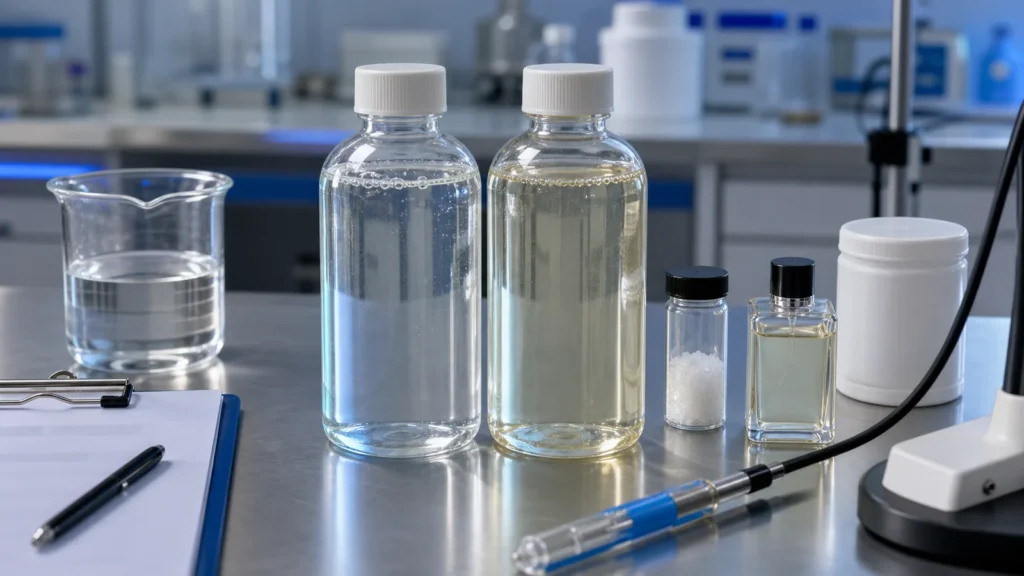
The raw-material change leaves clues across the formula. Water, ions, pH and finishing ingredients each get one place in the investigation.
If the new budget identifies an extra source, a small bench series can test that variable around the current formula. If it does not, leave the salt bottle alone and continue to the pH history.
Check 4: compare how the final pH was reached
The final pH number is only the end of the story. Two batches can finish at the same reading after different acid or base doses, local concentration spikes, addition temperatures and mixing times. Sodium Lauroyl Glutamate changes its ionization and association as pH moves, so that route can affect clarity and rheology before the final reading settles.
Place the two batch records side by side. Look at the adjustment solution, total dose, addition point, temperature, mixing time and pH after the normal hold. A large difference in titrant demand is useful evidence. It can point toward a composition mismatch, a different starting pH or an addition-history effect.
The deeper chemistry belongs in how pH changes amino acid surfactant system behavior. For this investigation, the practical goal is to reproduce one pH route in the control and candidate batches, then see whether the viscosity gap remains.
Check 5: repeat the finishing sequence in the complete base
Fragrance, solubilizer, preservative, polymer and final electrolyte additions can expose a difference that was invisible in the surfactant base. A fragrance dose that the old system carried comfortably may disturb the revised micellar structure. A polymer may hydrate differently when the liquid grade changes water timing or electrolyte exposure.
Retained samples are especially helpful here. Compare the old and new bases before fragrance, after fragrance, after final pH adjustment and after the rheology step. The first stage where viscosity separates tells the team which part of the formula deserves the next small trial.
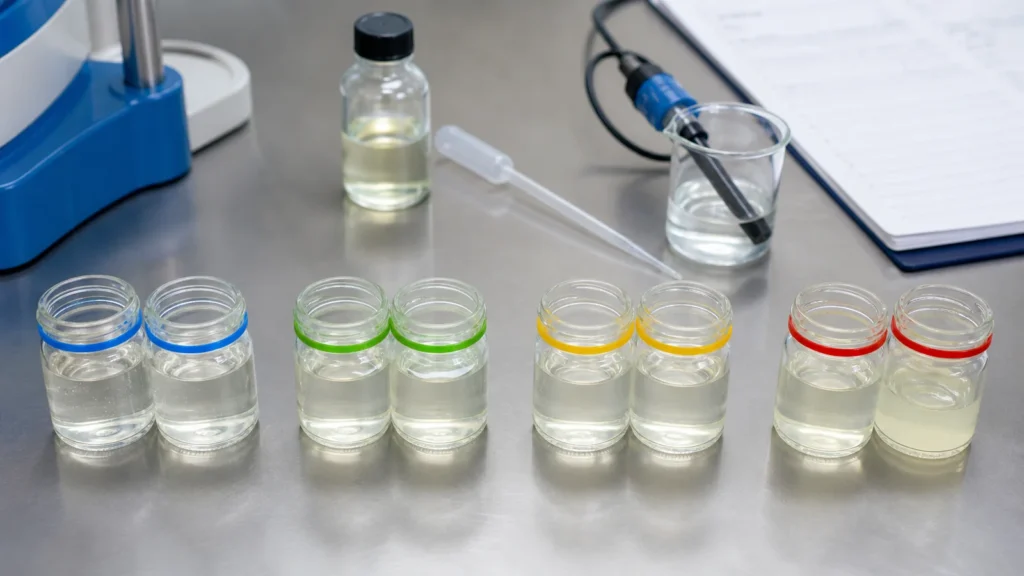
Paired retained samples give the viscosity change a timestamp. The first stage that separates points to the next useful trial.
If both bases are similar before fragrance and diverge immediately after it, the surfactant replacement has changed the fragrance environment. If they stay close until the thickener is added, the rheology route becomes the better target. The amino acid surfactant thickening guide covers those system choices in depth.
Check 6: make sure the two numbers mean the same thing
Viscosity is a method result. The instrument, spindle or geometry, speed, sample temperature, fill history, hold time and air content all influence what appears on the report. A warm fresh batch and a settled room-temperature control are not a valid pair, even when the same viscometer is used.
ASTM D2196 describes rotational-viscometer methods for non-Newtonian materials and notes that multiple speeds can characterize behavior better than one apparent-viscosity reading. Your internal method may differ, but it needs the same discipline: defined setup and matching sample history.
Repeat both samples together after the same conditioning period. Use the same container, sample volume, temperature, spindle, speed, reading time and deaeration approach. If the difference disappears, the raw-material investigation has just saved itself a reformulation.
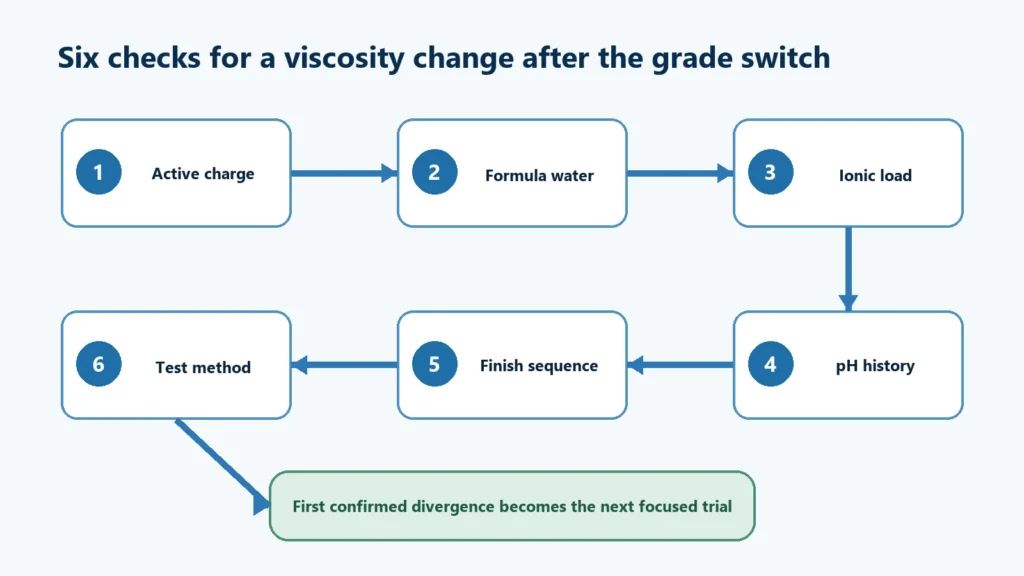
The sequence moves from mass balance to formula composition, process history and measurement. Each check removes one layer of uncertainty.
Turn the first confirmed cause into the smallest useful trial
Once one check produces evidence, the next batch can stay small and focused. A water mismatch calls for a corrected mass balance. An electrolyte difference calls for a limited response screen in the completed base. A pH-history difference calls for a matched adjustment route. A fragrance or polymer trigger calls for paired retained-sample work around that finishing step.
This approach preserves the parts of the formula that are already working. It also gives production a change that can be written into the batch record, rather than a lucky beaker that nobody can reproduce.
The current KWLG-25 product page is the route for product documents, packing information and samples. If you want INNO to review the change, send both formulas, the two grade and lot references, active basis, water correction, process order and temperatures, pH history, fragrance and thickener, plus the full viscosity method. We can usually tell which comparison will be most informative before another full pilot is mixed.
Ask INNO to review a KWLG-95 to KWLG-25 viscosity change
Questions
Can viscosity change even when the active-matter calculation is correct?
Yes. Equal active matter does not match supplied water, sodium chloride, other declared components, pH adjustment history, fragrance response, mixing history or the viscosity test conditions.
Should we add more salt as soon as the KWLG-25 batch looks thin?
No. First confirm active matter, total water and the complete electrolyte budget. More salt can move the system farther from its useful response range and hide the original cause.
How can we tell whether the raw material or the process caused the change?
Prepare the old and new grades on matched active and water bases, then use the same ingredients, process sequence and test method. Retained samples at key finishing stages show where the two routes first separate.
Why do two viscosity readings disagree on the same sample?
Different sample temperature, spindle, speed, hold time, air content or shear history can produce different apparent-viscosity results. A meaningful comparison uses the same conditioning and measurement method.
What should we send INNO for a useful troubleshooting review?
Send both complete formulas, grade and lot references, active-matter basis, water correction, actual charge records, process order and temperatures, pH history, fragrance, thickener and the full viscosity method.