A white ring follows the impeller around the vessel. The water is moving, but the powder is enjoying the view from the surface. Turning the mixer higher feels tempting. It may also pull in air while leaving the original wetting problem untouched.
For KWLG-95, the reliable starting sequence is simple: charge cold water, establish useful circulation, add the powder at a rate the surface can accept, let it disperse, and heat only after the visible powder has been wetted. INNO’s current TDS states this order directly: add to cold water under stirring, disperse, then heat. It does not prescribe one temperature, feed time, or mixer speed for every vessel. Those settings belong to your equipment and batch record.
The operator now has something more useful than a promise that the powder is “water soluble”: a sequence, observable checkpoints, and a clean handoff to the rest of the formula.
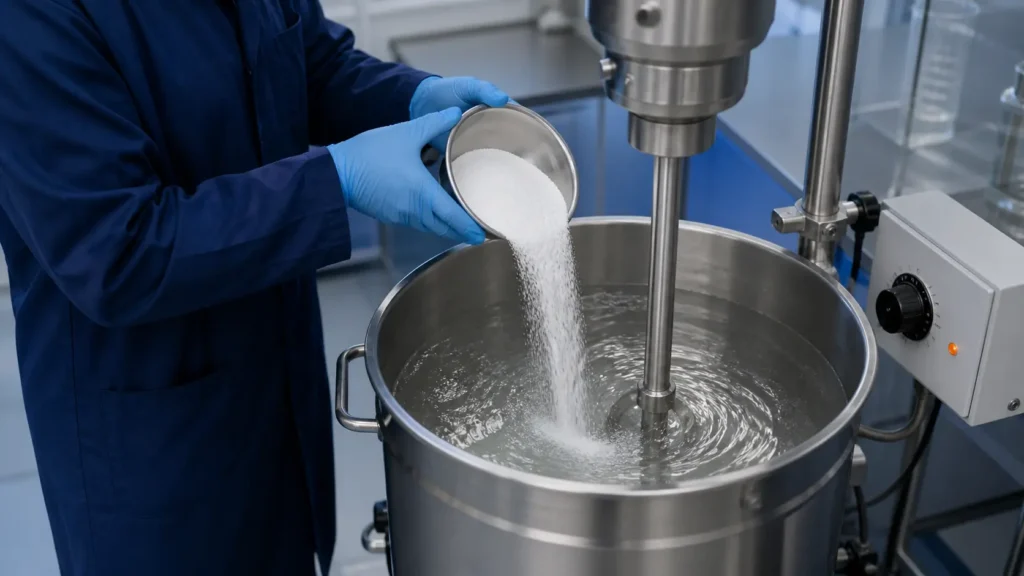
Conceptual process illustration.
How to dissolve Sodium Lauroyl Glutamate: wetting comes first
A review of powder wettability methods describes wetting as a precursor to dispersion and dissolution. Add KWLG-95 to the water phase under agitation and allow it to wet out uniformly before heating. Heating too early can leave floating powder or partially wetted agglomerates, making the later dispersion step unnecessarily difficult.
Cold water creates the first process window
KWLG-95 has a product-specific order of addition. Its current TDS calls for cold-water dispersion before heating. The plant instruction needs the actual starting water temperature and condition of the water phase. A generic “heat and mix” line copied from another surfactant leaves out the important part.
Cold water defines the order of operations. The exact starting temperature comes from the successful trial and becomes the reference for scale-up and later batch comparisons.
Heating belongs after visible powder has entered the liquid
Once the powder is wetted and distributed, heating can support the next stage of the process. Heating an untouched surface raft skips the step that the TDS puts first. The batch may become hotter while the same dry islands continue to circle the vessel.
The practical gate is visual: proceed when the surface, vessel wall, and bulk no longer show dry powder deposits. A later article can deal with cloudiness, viscosity, or foam in the finished system. Those are different questions from whether the raw powder has entered the water phase.
Give the surface a way to accept powder
Useful mixing turns over the surface and carries newly wetted material into the bulk. A deep, air-drawing vortex is a different condition. It may look energetic while sending powder toward the wall or pulling air into a surfactant-rich batch.
Before powder addition, look at the whole flow path. Water near the surface should move toward the bulk, and the lower part of the vessel should not sit still. The correct mixer setting depends on impeller type, diameter, position, liquid depth, vessel geometry, and batch size. A universal rpm would hide those differences.
Feed beside active circulation, not onto a quiet edge
The best feed location is where the water takes each portion below the surface. The exact position may change between a beaker and a baffled production vessel. The result is easy to recognize: powder meets moving liquid instead of a dry wall or stagnant corner.
This is easy to miss during scale-up. A lab operator can move a spatula around the beaker and rescue every stray particle. A fixed charging port has no such flexibility. Mark the successful feed position on the plant instruction.
Use enough motion to turn the batch over
Surface movement alone can hide a quiet lower zone. During the trial, compare samples or observations from more than one level after the powder has been added. If the top looks clean while residue collects below, the issue is circulation through the vessel rather than the chemistry of the ingredient.
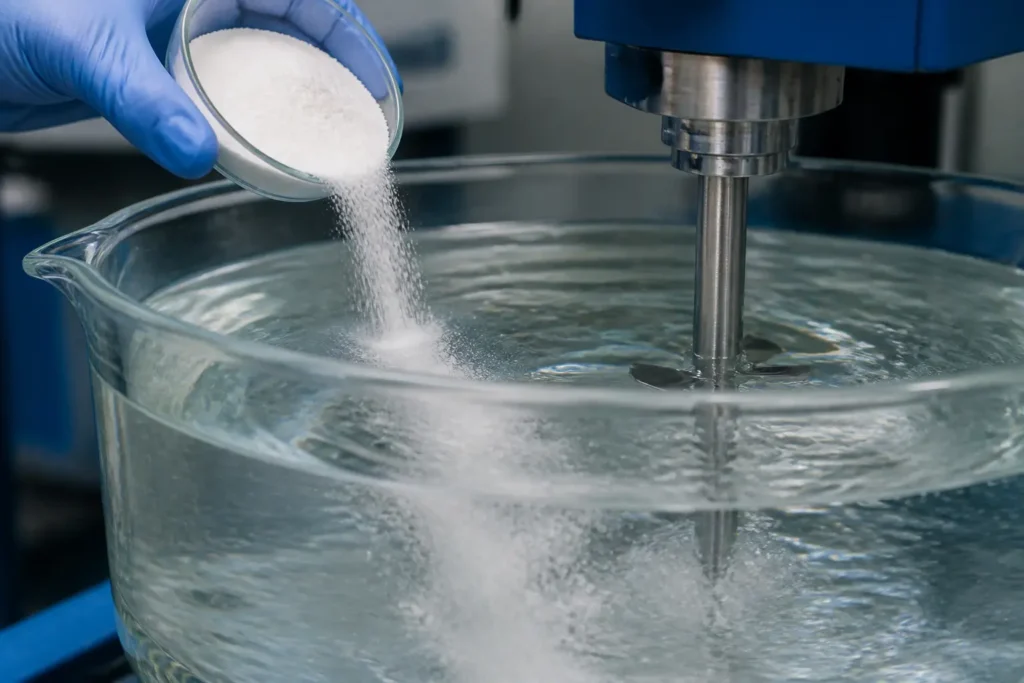
Conceptual illustration of powder meeting moving water. Actual circulation depends on the vessel and impeller.
Let the feed rate follow the wetting rate
The surface tells you how quickly it can accept powder. A thin stream that disappears into moving water is useful. A growing white raft, a ring on the wall, or soft pellets that return to the surface means the next portion is arriving before the previous one has been taken in.
The workable feed rate comes from the surface response in a representative trial. Record the total addition time and any planned pauses. The next operator then has a repeatable rhythm instead of having to interpret “add slowly” from scratch.
Break the charge into a continuous, observable operation
Keep the powder stream narrow enough for the liquid to wet it. If visible powder begins to accumulate, pause the feed and allow circulation to catch up. The batch is giving useful feedback; there is little value in covering that feedback with more powder.
Avoid dropping a large mass into one spot. The outside can wet quickly and form a soft shell around a dry center. That lump now needs time and mechanical action to undo a problem created in seconds.
Keep powder off the wall and shaft
Powder above the liquid line is outside the dispersion process. A wall ring often points to the charging position, splash pattern, or surface flow rather than a shortage of mixing time. Keep the feed inside the active liquid area and account for any material left in the charging container.
Good yield records also account for powder left in the charging container or on the vessel wall.
Define a hydration endpoint that another shift can recognize
A fixed mixing time can be useful after the process is qualified. It is a poor substitute for an endpoint during development. The first job is to describe what a complete dispersion looks like in your vessel.
A practical endpoint combines several observations:
- The surface and vessel wall are free of dry powder islands or a persistent white ring.
- Samples from the accessible upper and lower parts of the batch show the same general appearance.
- A small sample spread on a smooth surface contains no obvious dry cores or gritty powder residue.
- After a defined hold under the same mixing condition, visible solids do not reappear.
These checks confirm physical dispersion. Final clarity, stability, and viscosity come later, after pH, electrolytes, co-surfactants, fragrance, and polymers enter the picture.
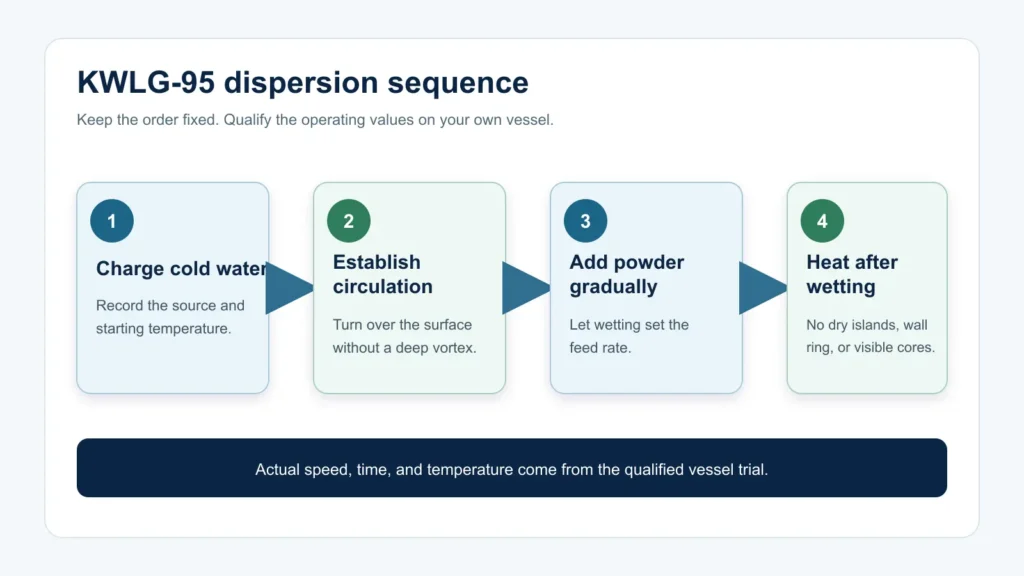
A process sequence for development and scale-up. Set actual operating values from your equipment trial.
Turn a successful beaker into a usable batch instruction
Scale-up works better when the record preserves what the powder experienced, not only the mixer rpm. A larger vessel changes liquid depth, surface area, feed distance, and the time needed for material to travel through the impeller zone.
Use the first plant batch to connect the lab route with the line. A compact trial record can carry the useful details without turning the batch sheet into a thesis.
| Process checkpoint | Record on the trial sheet | Why it helps the next batch |
| Water charge | Mass, starting temperature, and water source | Confirms the same starting phase |
| Mixer setup | Impeller type, position, speed, and liquid level | Describes the actual circulation condition |
| Powder addition | Feed position, total addition time, and pauses | Makes the wetting rate repeatable |
| Dispersion hold | Time, temperature, and visible endpoint | Separates the feed step from later heating |
| Heating step | Start point and temperature profile | Confirms that heating began after dispersion |
| Handoff sample | Appearance and sampling location | Gives production and R&D the same reference |
If the plant cannot reproduce the lab route, compare surface turnover and feed geometry before changing the formula. Those two differences often become much larger at scale.
Where KWLG-95 fits in this process
INNO KWLG-95 is a white powder grade of Sodium Lauroyl Glutamate with a current declared content of 98.5%. Its high supplied content can reduce the mass of diluted raw material entering a concentrated or low-water formula. The trade-off is straightforward: the plant must be able to weigh and disperse powder consistently.
The Sodium Lauroyl Glutamate guide covers the ingredient chemistry, common applications, and grade parameters. The process here ends with a repeatable water-phase base that is ready for the next formula step.
When you want us to review the route, send the batch size, vessel geometry, impeller type and position, starting water temperature, powder addition time, and a short video or timed photos of the surface. We can use that information to discuss the current product documents and a focused sample trial. Contact the INNO technical team when the process description is ready.
FAQ:
Can I add KWLG-95 directly to hot water?
INNO’s current KWLG-95 TDS specifies cold-water dispersion followed by heating. Build the first trial around that sequence, then record the actual temperature profile that works in your vessel.
How can I tell whether the powder is hydrated rather than only suspended?
Use an observable endpoint: no dry islands or wall ring, consistent appearance at more than one sampling level, no obvious dry cores in a spread sample, and no return of visible solids during a defined hold. Finished clarity alone is not a hydration test.
Can I pre-wet KWLG-95 in glycerin or another liquid?
The current TDS supports a cold-water-first route. Treat any alternative pre-wetting liquid as a separate development trial against that control because it changes the liquid-particle interface and the composition of the early batch.
Is higher shear always the answer when dispersion is slow?
Higher shear is useful only when it improves bulk turnover or breaks already wetted soft agglomerates without excessive air intake. A poor feed position or a powder raft still needs a better wetting path, not simply a larger speed setting.
What should I send INNO when the lab process will not scale?
Send the product lot, formula phase, batch size, vessel and impeller details, water source and starting temperature, powder addition time, mixing condition, temperature profile, and photos showing when the symptom first appears. That short record usually makes the first technical discussion much more productive.