The lab batch was fine. Production was less amused.
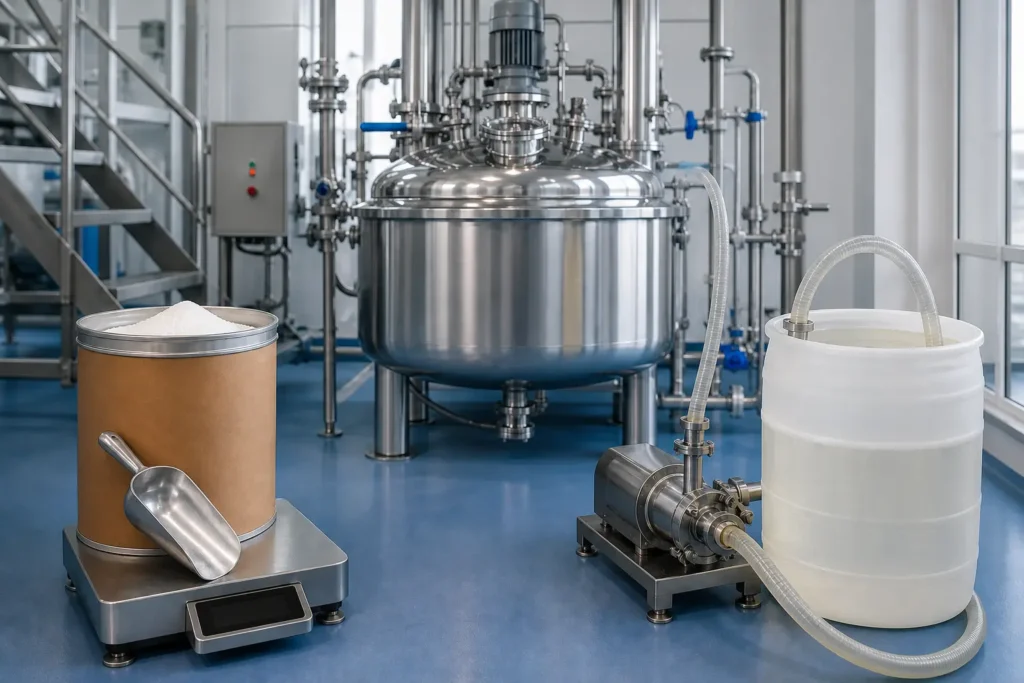
The powder floated on the surface, the operator slowed the feed, and a ten-minute addition became half an hour. A week later, the liquid trial went into the same vessel through a pump with no powder cloud at all. Purchasing then opened the freight sheet and found that the liquid route required far more delivered mass for the same surfactant target.
That is the real sodium lauroyl glutamate powder vs liquid decision. Choose powder when high active density, low supplied water and freight efficiency matter most. Choose liquid when direct dosing, closed transfer and a shorter batch route are worth more than the extra carrier you receive.
The INCI may match. The work arriving at your factory does not.
Start with the constraint that is already costing you time
Your plant bottleneck usually points to the better form faster than a long specification comparison.
| What is limiting the project? | Stronger starting choice | Why it usually fits | Check before committing |
| Limited formula water or a concentrated format | Powder | Brings more surfactant per kilogram supplied | Powder wetting, dust control and hydration capacity |
| High freight or warehouse cost | Powder | Moves and stores less non-active carrier per kilogram of surfactant | Drum handling, shelf protection and local labor |
| No practical powder charging system | Liquid | Can be pumped or metered into the aqueous phase | Pumpability, flowmeter accuracy, hose and line cleaning |
| Frequent small batches or many product changes | Liquid | Shortens weighing and wetting work | Residual material in the line and changeover procedure |
| Existing powder induction and controlled heating | Powder | Uses equipment you already own | Addition rate, circulation and hydration endpoint |
| Automated closed-transfer production | Liquid | Fits direct dosing and reduces open handling | Temperature, transfer repeatability and mass reconciliation |
Use the table to shortlist the form. Finished behavior still comes from the surfactant blend, pH, fragrance, electrolyte and rheology system working together. The broader amino acid surfactants guide covers those family-level formulation questions.
Sodium lauroyl glutamate powder vs liquid starts with active matter
A kilogram-for-kilogram comparison is misleading because the delivered concentrations are different.
Use one calculation:
Raw material required = Target surfactant amount / Supplied active fraction
INNO KWLG-95 has a current declared active content of 98.5%. KWLG-25 is supplied at 24-26% active; 25% is a useful nominal figure for planning.
If 1.00 kg of KWLG-95 contributes 0.985 kg of declared active material, the nominal amount of 25% liquid needed for the same contribution is:
0.985 / 0.25 = 3.94 kg of liquid grade
The extra 2.94 kg is the liquid grade’s non-active portion. Use the current composition documents when correcting batch water; a commercial liquid may also contain other declared components that matter to preservation, electrolyte load or the finished INCI list.
For a full explanation of percentage definitions and equal-active conversion, use the sodium lauroyl glutamate active-matter guide. LG-04 keeps the calculation short because the purchasing decision begins after the two offers share the same basis.
Powder buys density; liquid buys a shorter handling route
At the nominal figures above, one metric tonne of active material requires about 1.015 tonnes of 98.5% powder or 4 tonnes of 25% liquid. The difference is delivered carrier, and it appears in freight, storage and formula water.
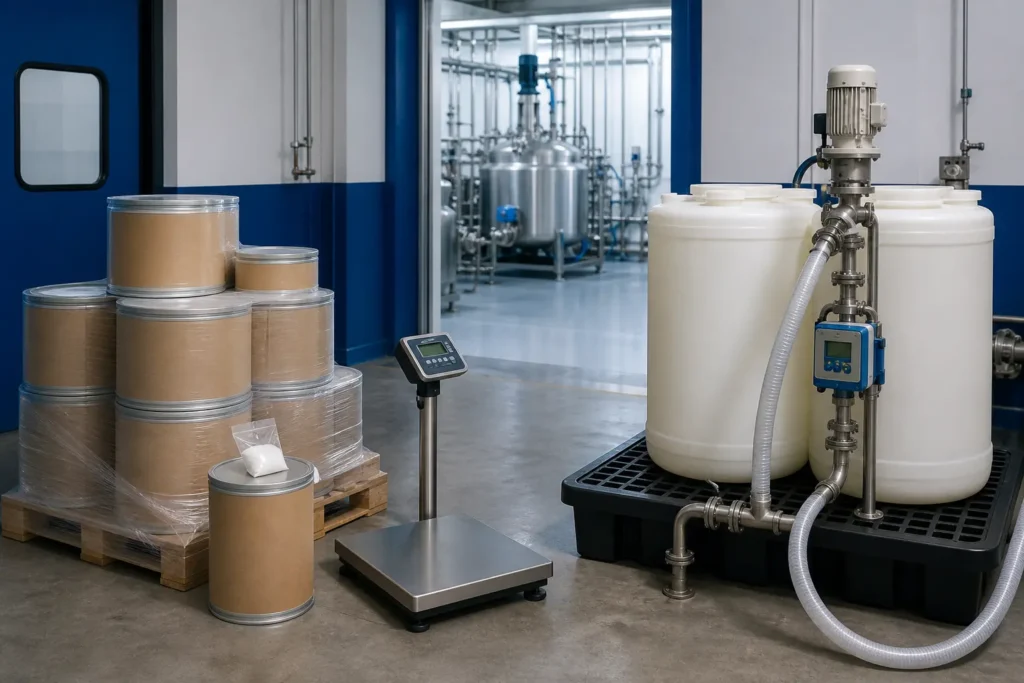
Powder reduces delivered mass per kilogram of active. Liquid trades that density for a transfer route that can be easier to repeat.
Powder normally has the stronger logistics case when long freight lanes, limited storage or concentrated product formats dominate the brief. It also gives the formulator more control over the water phase. Dry cleansers and cleansing tablets make the advantage obvious: supplied water is not welcome in a product designed to stay dry.
Liquid earns its place on the factory floor. A pump and calibrated meter can reduce open weighing, powder drift and operator-to-operator variation. The time saving is most useful on a line without a reliable way to wet fine surfactant powder.
Packaging changes the job too. KWLG-95 is supplied in 15 kg drums; KWLG-25 is supplied in 200 kg PE drums. The powder route involves more individual containers for the same delivered product mass, while the liquid route needs drum-moving and transfer equipment suited to a heavier package. Warehouse convenience has two very different meanings here.
The difference grows when the batch leaves the lab
Scale-up exposes the weak part of each route: powder must be wetted evenly, while liquid must be transferred accurately.
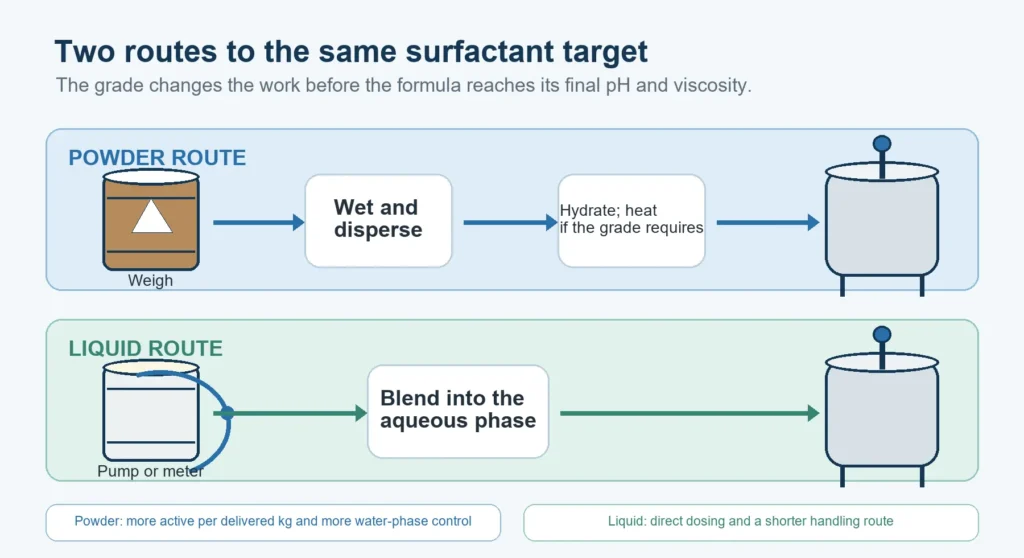
For a powder grade, protect the wetting step
A small beaker can hide poor powder addition because the formulator can change the vortex, scrape the wall and wait. A production vessel is less forgiving. Feed that is too fast can leave floating powder or wet shells around dry centers. Excessive surface agitation may pull in air before the powder is fully dispersed.
For KWLG-95, the current TDS gives a clear sequence: add to cold water under stirring, disperse, then heat. That order matters. Before the first production batch, write down the liquid level at addition, feed time, mixing condition, temperature profile and the point at which no undispersed powder remains. These are operating instructions your next shift can actually repeat.
For a liquid grade, qualify the transfer path
With liquid, process control shifts from powder wetting to the pump, hose, meter and line-rinse procedure.
Check whether the liquid transfers consistently at the plant’s usual storage temperature. Reconcile the meter reading with vessel weight gain. If a line is shared, confirm how much material remains after transfer and how the rinse enters the batch calculation. A clean-looking hose can still hold enough product to disturb a small batch.
Liquid also removes only one possible reason for heating. Your waxes, polymers, preservatives or viscosity route may still set the process temperature. Calling the whole batch “cold process” before checking the rest of the formula is how easy trials acquire expensive footnotes.
Calculate the full conversion cost
The fair commercial comparison begins with cost per kilogram of active material and ends at released batch time.
Delivered cost per kg active = Delivered price per kg / Active fraction
Then add the costs that your quotation cannot see:
- inbound freight and warehouse space;
- weighing, charging or pumping time;
- dust extraction or liquid-transfer equipment;
- heating, hydration and deaeration time;
- line rinse, vessel cleaning and unrecovered residue;
- extra quality checks during changeover and scale-up.
Powder often wins the first two lines because it brings less carrier. Liquid may win the middle of the list because the batch route is shorter and easier to automate. Neither advantage is universal. A plant with good powder induction can make liquid convenience expensive; a plant relying on manual scooping can make a cheap powder surprisingly costly.
When we compare the two routes with a customer, we use the planned batch size and annual production frequency. Saving fifteen minutes matters differently on a weekly 100 kg batch and on three shifts of commercial production. The spreadsheet needs your factory rhythm, not an industry average.
Where INNO KWLG-95 and KWLG-25 fit
INNO supplies both forms, so the useful recommendation starts with your production line.
| INNO grade | Supplied form | Current active basis | Packaging | Best first fit |
| KWLG-95 powder | White solid powder | 98.5% | 15 kg drum | High active density, tight water budget, concentrated or dry formats, plants equipped for powder dispersion |
| KWLG-25 liquid | Colorless to light yellow liquid | 24-26% | 200 kg PE drum | Direct liquid dosing, closed transfer and plants that want to remove the powder-wetting step |
Both use Sodium Lauroyl Glutamate as the surfactant identity; the PubChem record lists the commonly referenced CAS number as 29923-31-7. The supplied form and composition are what change the factory decision.
If you are choosing between them, send us five items: target batch size, current use level or active target, available charging equipment, the step slowing production today, and delivery destination. We can calculate the equal-active starting point, compare the two delivered routes and recommend which sample to put into the plant trial first. No grand redesign is required for the first conversation; a clear batch sheet is more useful.
Questions that usually arrive after the first trial
Can liquid sodium lauroyl glutamate replace powder one for one?
No. Convert the use level by active matter, then correct the formula for the water and other components supplied by the liquid grade. A one-for-one weight swap lowers the surfactant contribution sharply.
Does a liquid grade make the whole cleanser cold process?
A liquid grade removes the powder-wetting and hydration step. Other ingredients may still require heat, so review the polymer, wax, preservative, fragrance and viscosity route before changing the batch temperature.
Why did viscosity change after we moved from powder to liquid?
The switch changes supplied water, active matter and potentially electrolyte or preservation inputs. Recalculate the batch, set final pH after the complete surfactant blend is present, then rebuild the viscosity adjustment in the finished base.
Which form is cheaper after freight and processing?
Powder usually moves less mass per kilogram of active; liquid can reduce handling and batch time. Compare delivered cost per active kilogram, then add your actual labor, utilities, storage, cleaning and yield loss.
What should we record during the first plant trial?
Record the actual charged mass, addition or transfer time, temperature, mixing condition, end-of-transfer residue, final pH and stabilized viscosity. Those numbers show whether the next improvement belongs to the raw material or the process.