If you are selecting an amino acid surfactant for a cleanser, do not start by asking which INCI is the mildest or which family produces the most foam. Start with the finished formula.
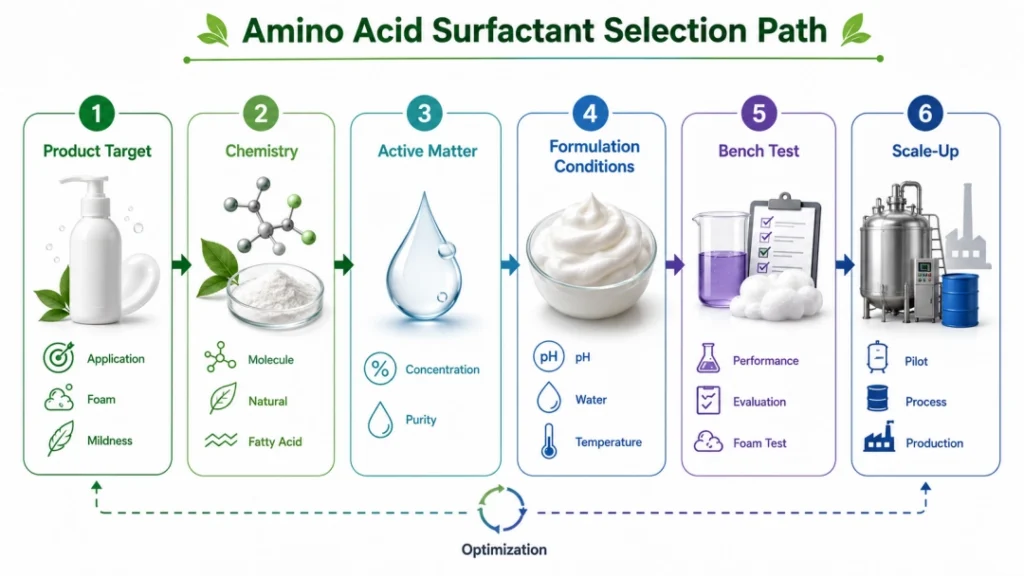
In our formulation work, we normally screen amino acid surfactants in this order:
product target → surfactant family → active matter → pH and ionic conditions → foam and rheology → processability → stability
There is a simple reason for this. The name glutamate, glycinate or taurate tells you something about the surfactant chemistry, but it does not tell you the concentration of the commercial grade, whether it is a sodium or potassium salt, how much inorganic salt it contains, whether it is supplied as a powder or liquid, or how it will behave with your fragrance, polymer, water and secondary surfactants.
If two materials are not compared at the same active surfactant level and under the same pH, water and processing conditions, the comparison is usually not meaningful.
That is the main point of this guide. We are not going to rank amino acid surfactants from “best” to “worst.” We are going to show you what the names actually mean, what variables matter, and how we would set up a first-round evaluation in the lab.
What Are Amino Acid Surfactants?
Amino acid surfactants are not one ingredient class with one fixed performance profile. They are a group of surface-active materials whose polar portion is derived from amino acids or related amino compounds and whose hydrophobic portion usually comes from a fatty-acyl chain. Their chemistry determines how they ionize, dissolve and organize in water.
View INNO Amino Acid Surfactants
The Chemistry Behind the Name
A surfactant needs two opposing regions: a hydrophobic part that prefers oil and a hydrophilic part that interacts with water.
In many personal-care amino acid surfactants, the hydrophobic portion is introduced through a fatty-acyl group, while the polar portion comes from an amino-acid-derived structure. Commercial examples include N-acyl glutamates, N-acyl glycinates and N-acyl alaninates.
When the concentration becomes high enough, surfactant molecules begin to form aggregates such as micelles. Cleansing, foam and rheology then depend not simply on one molecule, but on how these molecules organize together with everything else in the formula.
That is why a small chemical change can produce a noticeable formulation change.
A different head group changes charge distribution and hydration. A different counterion changes the ionic environment. A different fatty-acyl distribution changes the hydrophobic portion of the molecule. None of these differences can be read from the general phrase “amino acid surfactant.”
These structure–property relationships are also discussed in a recent review of amino acid-based surfactant development and physicochemical behavior.
“Amino Acid Surfactant” Is a Family Name, Not a Performance Claim
You will often see amino acid surfactants described as mild surfactants. That is useful as a category-level description, but we do not use it as a final formulation conclusion.
Finished-product mildness depends on the complete surfactant system, total active surfactant matter, pH, contact conditions and the method used to evaluate irritation or skin compatibility.
The same caution applies to claims such as “rich foam,” “easy to thicken” or “good skin feel.”
Those statements need a test condition.
When we evaluate a new grade, the first question is therefore not:
Is this surfactant mild?
It is:
Under what formulation and test conditions was that conclusion obtained?
That distinction prevents a great deal of wasted laboratory work.
What Are the Main Types of Amino Acid Surfactants?
For first-round selection, separate amino acid surfactants by head-group chemistry before comparing individual commercial grades. Glutamates, glycinates and taurates should not be treated as interchangeable names because their polar groups are chemically different.
Glutamates
Glutamate surfactants are derived from glutamic-acid-based structures. The parent amino acid contains two carboxyl groups, which makes glutamate chemistry different from glycine-derived surfactants.
In commercial personal-care materials, you may encounter different fatty-acyl groups, counterions and degrees of neutralization. Those details matter because the word glutamate alone does not fully define the material you are putting into the batch.
When you evaluate a glutamate, check the complete INCI and specification rather than stopping at the family name.
The next questions should be:
What is the active matter?
What is the salt form?
How is pH specified?
Is the material supplied as a powder or liquid?
Under what conditions was the specification measured?
Those answers are more useful than a generic statement that “glutamates are mild.”
Glycinates
Glycinates are based on glycine-derived chemistry and contain a carboxylate-type polar group.
Here, the counterion becomes particularly important to identify. For example, Sodium Cocoyl Glycinate and Potassium Cocoyl Glycinate are not the same raw material simply because both contain Cocoyl Glycinate in the name.
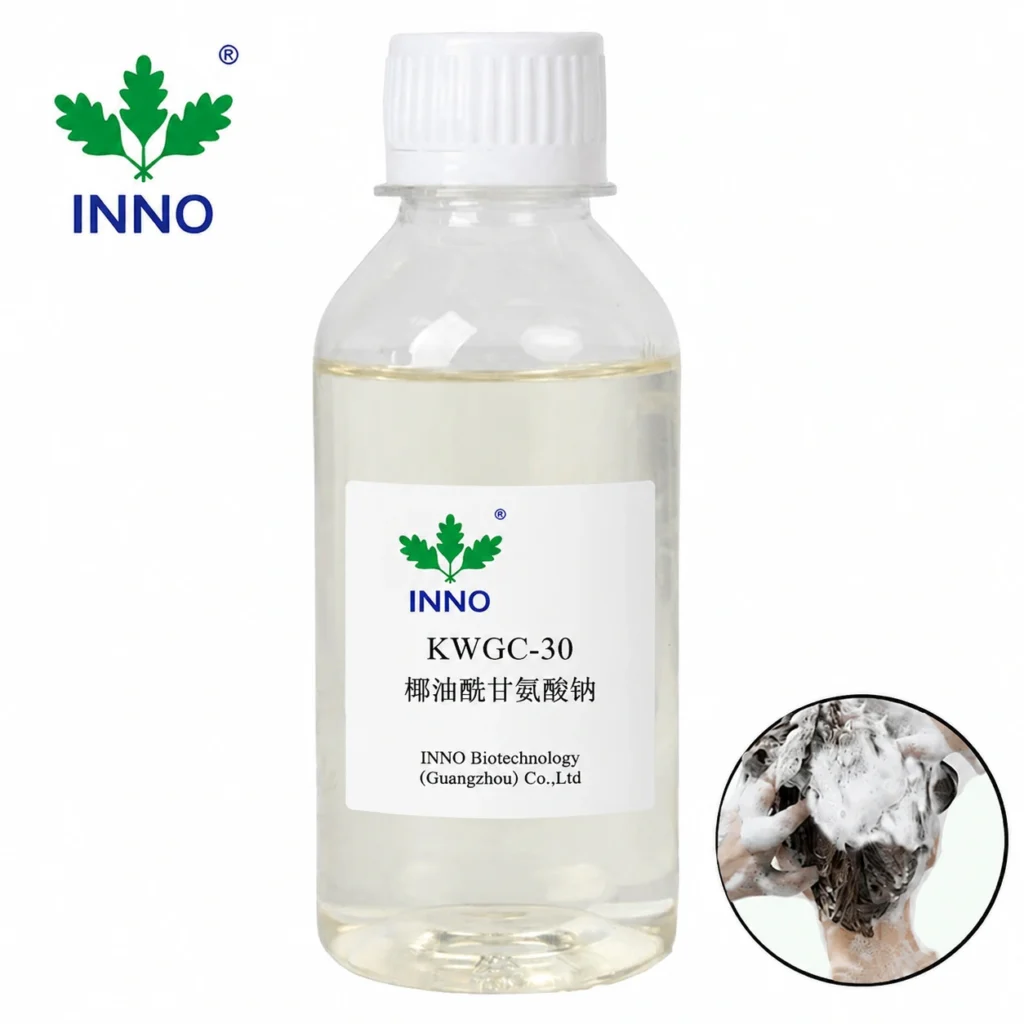
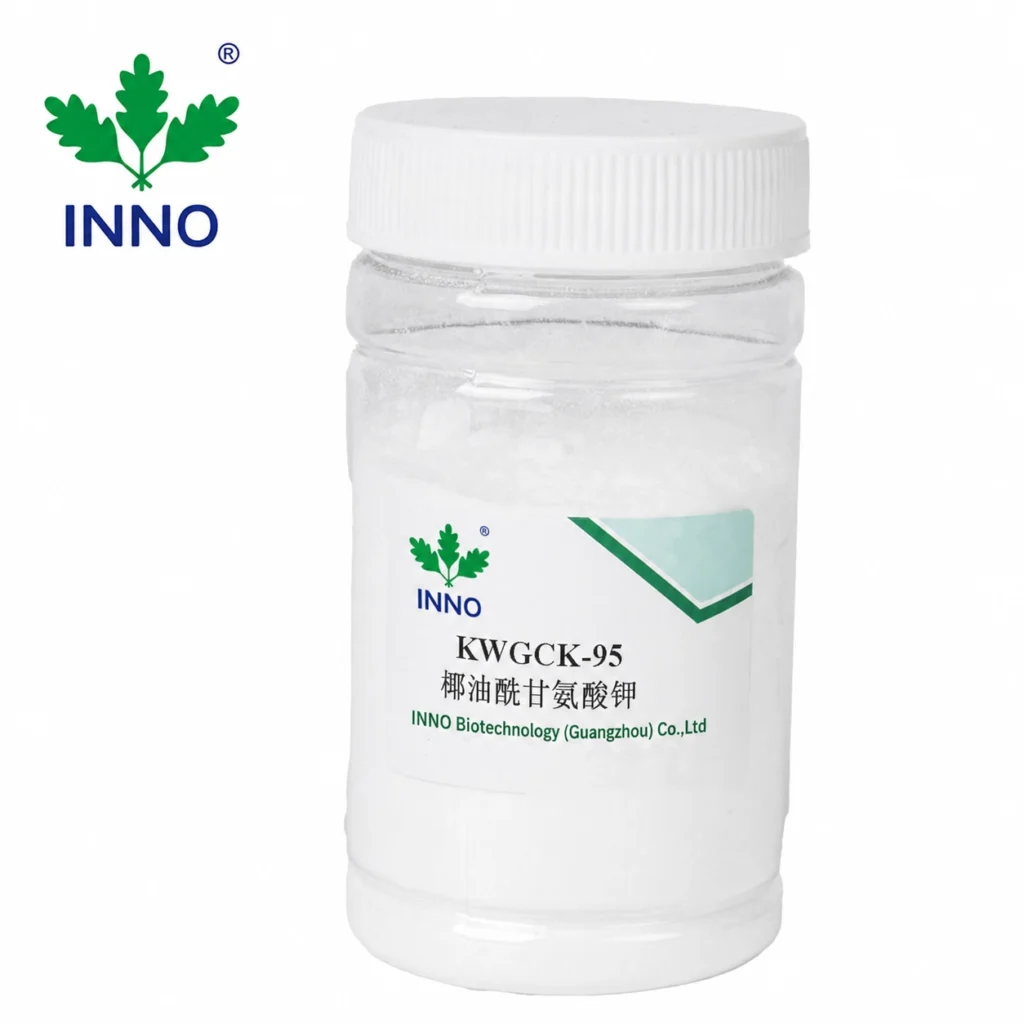
Liquid Sodium Cocoyl Glycinate (KWGC-30) and Liquid Potassium Cocoyl Glycinate (KWGCK-30)
We would not automatically assume one performs better than the other. Instead, we compare the sodium and potassium grades at the same active surfactant matter, then adjust them to the same finished-formula pH before interpreting viscosity, appearance or foam.
Otherwise, you may be measuring concentration or pH differences rather than a true counterion effect.
That sodium-versus-potassium comparison deserves its own controlled test and should not be reduced to a one-line rule.
Taurates and Related Families
Taurates are frequently discussed alongside amino-acid-based mild anionic surfactants in personal care, but there is an important chemical distinction.
The polar group in a taurate is sulfonate-based rather than carboxylate-based.
That means you should not assume its acid-base behavior will follow the same pattern as glutamates or glycinates simply because all three appear in the same “mild surfactant” category.
Other families, including alaninates, add further options to the formulation toolbox.
For selection purposes, we use the family name to narrow the candidates. We do not use it to predict the finished formula.
| Family | Key Chemical Distinction | What You Still Need to Check |
|---|---|---|
| Glutamate | Glutamic-acid-derived, carboxylate-based | Counterion, active matter, neutralization, physical form |
| Glycinate | Glycine-derived, carboxylate-based | Sodium/potassium form, active matter, formulation pH |
| Taurate | Sulfonate-based polar group | Grade composition, salt level, concentration, process behavior |
If you need to decide among these families, the next step should be a controlled Glycinate vs Glutamate vs Taurate comparison rather than a generic benefits list.
Compare Active Matter First, or the Result Can Be Misleading
Equal raw-material dosage does not mean equal surfactant dosage. Before comparing foam, viscosity, cost or cleansing performance, normalize the candidates by active surfactant matter.
This is one of the most common mistakes we see in preliminary screening.
The calculation is simple:
Active surfactant in formula (%) = Raw-material dosage (%) × Active matter (%) ÷ 100
Suppose you compare:
- a liquid containing 30% active matter, used at 10%;
- a powder containing 95% active matter, also used at 10%.
The first formula contains:
10% × 30% = 3.0% active surfactant
The second contains:
10% × 95% = 9.5% active surfactant
Those are not comparable formulas.
To supply approximately 3.0% active surfactant from the 95% active powder, the theoretical raw-material dosage would be:
3.0 ÷ 0.95 ≈ 3.16%
Now you have a much more useful starting point.
Active Matter Is the Baseline, Not the Whole Test
Matching active matter does not make two surfactants chemically equivalent. It simply removes one major source of error.
After active matter is normalized, we keep the other important variables as constant as possible:
pH, water source, batch size, temperature, mixing sequence and secondary surfactants.
Only then do differences in viscosity, appearance or foam become easier to interpret.
There is another practical detail: make sure the suppliers define active matter using comparable test methods. A value called “solids” is not automatically identical to “active surfactant matter.”
Read the specification method, not just the number.
Raw-Material pH Also Needs Context
The same rule applies to pH.
A TDS may report pH for a 10% aqueous solution, another may report a diluted solution under a different condition, and a liquid raw material may be measured directly.
Those numbers should not be compared as though they were obtained by the same method.
For formulation work, the pH that matters most is the finished system under a defined measurement condition.
pH, Electrolytes and Water Quality Must Be Controlled
If you change pH, salt level or water quality while comparing two surfactants, you are changing the experiment. These variables can change ionization, aggregate structure, clarity, foam and viscosity, so we treat them as controlled formulation parameters.
Why pH Matters
Glutamates and glycinates contain carboxylate-based groups.
As pH moves downward, the acid-base equilibrium shifts toward greater protonation of carboxylate groups. This changes the effective charge of the surfactant population and can affect solubility and the way molecules organize in solution.
That does not mean there is one universal pH at which every glutamate or glycinate suddenly fails.
The exact response depends on the grade and the rest of the formula.
For this reason, we do not take a generic pKa value and use it as a finished-product specification. We run the formulation through the pH range that actually matters for the project and observe the system.
Taurates require a different interpretation because their polar group is sulfonate-based. This is one reason why family-level chemistry should be understood before performance is compared.
Why Salt and Hard Water Matter
Electrolytes change the ionic environment around charged surfactants and can change micellar organization.
This is why “just add salt” is not a reliable universal thickening method.
You may see viscosity rise over one concentration range, reach a maximum, and then fall as more electrolyte is added. The position and shape of that response depend on the surfactant blend.
Water hardness introduces another variable.
Calcium and magnesium ions increase ionic content and can interact with anionic surfactant systems. Depending on the formulation, you may see changes in foam, clarity or overall stability.
If a formula behaves differently in two laboratories, we check the water before blaming the raw material.
For hard-water-sensitive projects, record water hardness or prepare standardized test water. “DI water” and “tap water” are not interchangeable experimental conditions.
Measure Foam and Viscosity With a Method, Not an Adjective
“Rich foam” and “high viscosity” are not usable technical data unless you define how they were measured. If you want two surfactants to be compared fairly, keep the test method identical and record enough information for someone else to reproduce it.
Foam Needs Controlled Conditions
Foam results are sensitive to concentration, water hardness, temperature, agitation and reading time.
If you do not have an automated foam analyzer, a simple laboratory screening method can still be useful—as long as you keep it consistent.
Use the same surfactant active level, same water, same volume, same container, same temperature, same agitation procedure and the same reading interval.
Then record more than foam height.
We normally look separately at:
initial foam generation,
bubble structure,
foam decay,
and how the foam changes after oils or fragrance are introduced.
A single photograph immediately after shaking can make two formulas look identical even when their foam stability is very different five minutes later.
Viscosity Also Needs a Test Condition
The same problem occurs with viscosity.
A statement such as “viscosity = 8,000 mPa·s” is incomplete if you do not know the measurement temperature, instrument, spindle, rotational speed and time after manufacturing.
A surfactant system may continue to equilibrate after the batch is finished. Comparing one formula immediately after production with another after 24 hours can give you a false conclusion.
In our lab, we therefore record the measurement condition together with the viscosity result.
The number only has value when the method travels with it.
This is also why we treat foam, rheology and sensory performance as separate development tasks. One raw material does not need to “win” all three. The finished product needs to meet the brief.
Powder or Liquid Is a Manufacturing Decision, Not Just a Specification
Choose the physical form according to your factory process and cost per kilogram of active material—not simply because powder looks more concentrated or liquid looks easier to use.
A high-active powder can reduce the amount of carrier water purchased and transported. On an active-matter basis, it may also reduce storage volume.
But that advantage is not free.
Powder handling can introduce dust, slower wetting, agglomeration or longer dissolution time if the charging procedure is poorly designed.
A liquid grade usually simplifies pumping and dosing and may shorten the dissolution stage. In return, you are generally handling more water per kilogram of active surfactant.
Neither form is automatically better.
For purchasing, a useful first calculation is:
Raw-material cost per kg active = Price per kg raw material ÷ Active matter fraction
A material priced at $3.00/kg with 30% active matter has a raw-material cost of:
$3.00 ÷ 0.30 = $10.00/kg active
A 95% active material priced at $7.00/kg gives:
$7.00 ÷ 0.95 ≈ $7.37/kg active
That does not yet prove the second material is cheaper in production. You still have to include dissolution time, labor, energy, dust control, equipment and logistics.
But at least you are comparing the same thing.
This is the correct starting point for a powder vs liquid amino acid surfactant evaluation.
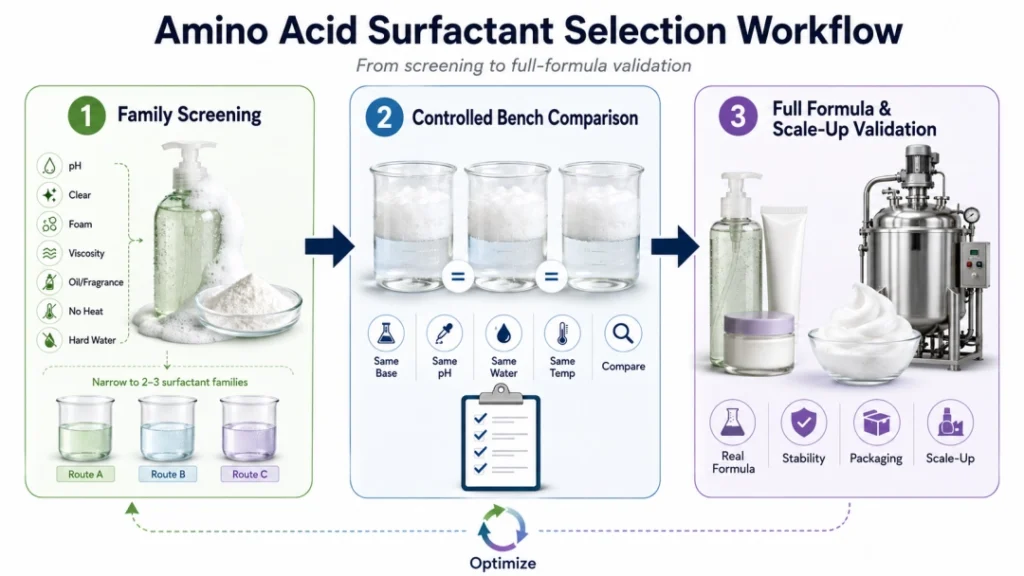
A Simple Screening Workflow Before Scale-Up
You do not need twenty raw materials in the first experiment. A small, controlled screening matrix usually tells you more than a large number of poorly controlled samples.
Step 1: Define the Finished Product Before Choosing the Raw Material
Write down the target before you open the sample cabinet.
For a cleanser, we normally define at least:
application, target pH, appearance, viscosity range, foam character, rinse profile, fragrance or oil load and manufacturing constraints.
If transparent appearance is mandatory, write that down.
If the plant cannot heat the batch, write that down.
If the product must tolerate hard water, write that down.
These constraints eliminate unsuitable routes much faster than a generic “mildness” comparison.
Step 2: Compare Two or Three Routes Under the Same Conditions
Prepare a common base and change as little as possible.
Normalize active surfactant matter. Use the same water. Use the same pH target. Keep the batch size, temperature and mixing sequence identical.
Then measure the differences.
If you change surfactant family, pH, polymer and fragrance at the same time, you have created four variables and learned almost nothing about any one of them.
When a result surprises us, our first question is:
What changed between these two beakers?
That is usually more productive than asking which ingredient is “good” or “bad.”
Step 3: Move the Winner Into the Real Formula
A screening formula is only a screening formula.
Once one or two candidates look promising, put them into the actual formulation with the real fragrance, oils, polymer, chelator, preservative system and packaging requirements.
Then run your normal stability and scale-up process.
This is the point where supplier data ends and your product data begins.
Common Mistakes We Would Avoid
Most poor surfactant selections are not caused by choosing the “wrong family.” They are caused by comparing materials under different conditions and then attributing every difference to chemistry.
The first mistake is comparing equal raw-material percentages instead of equal active matter.
The second is treating a TDS property as a finished-formula guarantee. A raw material can meet every specification and still behave differently when your pH, fragrance, water or surfactant ratio changes.
The third is changing several variables at once.
The fourth is using words such as mild, creamy or easy to thicken without defining the test behind them.
And the fifth is choosing a powder or liquid purely from purchase price without calculating cost per active kilogram and processing cost.
Avoid those five mistakes and your first screening round becomes much more useful.
Where Should You Go Next?
Once you understand the selection framework, the next article should answer the specific problem in front of you rather than repeat another general introduction to amino acid surfactants.
If you are still choosing between chemical families, continue with Glycinate vs Glutamate vs Taurate Surfactants: A Selection Framework.
If you are developing a facial cleanser, the more useful next step is How to Choose an Amino Acid Surfactant for Facial Cleansers.
If your problem is rheology, go directly to How to Build Viscosity in Amino Acid Surfactant Systems and Why Amino Acid Surfactant Systems Are Difficult to Thicken.
If the same formula gives different foam in different locations, look at How Water Hardness Affects Amino Acid Surfactant Foam.
If you are comparing supply forms or purchase economics, continue with Powder vs Liquid Amino Acid Surfactants and How Active Matter Changes the Real Cost of a Surfactant.
And when you already know the chemistry and physical form you need, that is the right time to move from the technical guide to our amino acid surfactant product range and compare individual grades.
FAQ
What are amino acid surfactants?
Amino acid surfactants are surface-active materials built from an amino-acid-derived or related polar group and a hydrophobic fatty-acyl portion. Glutamates and glycinates are carboxylate-based examples, while taurates use sulfonate chemistry. Their finished-formula performance depends on the specific grade and formulation conditions, not the family name alone.
How should two amino acid surfactants be compared?
Start by normalizing the active surfactant matter. Then keep finished-formula pH, water source, temperature, batch size, mixing sequence and other surfactants as consistent as possible. Compare appearance, viscosity, foam and stability only after those variables are controlled; otherwise concentration or processing differences may be mistaken for ingredient performance.
Why does pH affect amino acid surfactant formulations?
Carboxylate-based surfactants such as glutamates and glycinates undergo acid-base equilibrium as pH changes. This changes the proportion of ionized and protonated groups and can influence solubility, molecular interactions and aggregate structure. The practical response depends on the individual grade and complete formula, so it should be determined experimentally.
Should powder and liquid amino acid surfactants use the same dosage?
Usually not. Their active-matter concentrations may be very different. Calculate the required dosage from the desired active surfactant level rather than copying the same raw-material percentage. After normalizing active matter, compare dissolution, handling, processing time, finished-product performance and total cost before choosing the preferred physical form.
Is the INCI name enough to select an amino acid surfactant?
No. The INCI identifies the ingredient chemistry, but it does not fully describe active matter, physical form, counterion, fatty-acyl distribution, inorganic salt content or supplier-specific specification. Use the INCI to identify the chemical route, then use the TDS, formulation testing and process requirements to select the actual grade.