Over my 15 years in cosmetic R&D and troubleshooting emulsion scale-up at plants around the world, I’ve seen countless brands struggle when swapping out legacy emulsifiers. Procurement teams may be looking for a different sourcing option or a more economical alternative to an established grade such as Montanov™ 68 MB.
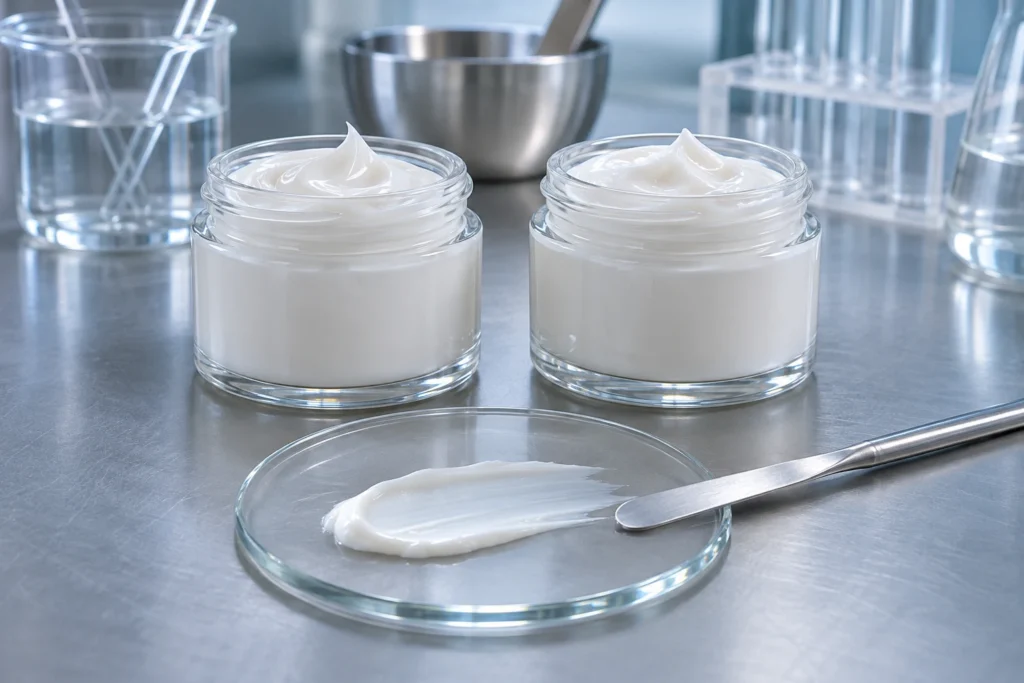
On the bench, the trade-off shows up quickly. A cream can separate in a 45°C stability oven or lose the powdery finish the original formula was designed to deliver. With a Cetearyl Alcohol and Cetearyl Glucoside emulsifier, the oil blend, heating, shear, and cooling all affect the result. The night cream prototype below gives you a starting point for comparing texture and stability in a hot-process oil-in-water (O/W) system.
What Makes Cetearyl Glucoside Useful in an O/W Cream?
Cetearyl Glucoside is a nonionic emulsifier commonly supplied in a blend with Cetearyl Alcohol. The blend can form a lamellar network that gives an O/W cream body and affects how it spreads on the skin.
The Chemistry of Fatty Alcohols and Glucosides
Glycosidation links glucose to a fatty alcohol. The glucose group is hydrophilic, meaning it has an affinity for water. The long fatty chain is lipophilic, meaning it has an affinity for oil. In the finished blend, Cetearyl Alcohol contains cetyl and stearyl fatty alcohols that help build structure alongside the glucoside.
Ethoxylated emulsifiers can stabilize droplets through steric hindrance. A fatty alcohol and glucoside blend can also organize into layers around droplets and in the continuous water phase. That structure matters when you want a cream that holds its shape in the jar and spreads easily during rub-in.
How the Lamellar Gel Network Forms
Heating and mixing bring the oil and water phases together. As the batch cools, the blend can form a layered gel network. Under polarized light, some lamellar structures show a pattern known as a Maltese cross. Check the finished emulsion’s stability separately from its appearance under the microscope.
- Hydration. Water can sit between the lipid layers. The finished cream’s moisturizing performance depends on the complete formula.
- Stability. A structured network can restrict droplet movement. Heat and freeze-thaw trials show whether that structure holds in your formula.
- Electrolyte tolerance. Salts and active packages can change viscosity and stability. Compare the base with a split batch containing the full active package.
How Does It Compare with an Established Emulsifier?
Montanov™ 68 MB and INNO’s KWM68A list the same two INCI ingredients. When evaluating a switch, look for comparable structure, viscosity, and skin feel in the finished cream. Make parallel batches at the same oil load, keep the process conditions comparable, and see whether the new sample meets the same acceptance criteria.
Thickening Efficiency and Rheology
Viscosity develops as the lamellar network forms during cooling. A cream can hold its shape at rest and thin under the shear of spreading. Compare viscosity after the samples have cooled and rested for the same length of time. If you adjust carbomer or xanthan gum, also check whether the cream pills when layered under makeup.
Spreadability and Finish
Look for a powdery dry-down, waxy drag, tack, and soaping, the white streaks that can appear during rub-in. Apply the same amount of each sample and compare them under the same conditions. A rich cream can spread smoothly, but its oil blend and emulsifier level both influence the finish.
Supply and Total Formulation Cost
Batch consistency, minimum order quantities, lead times, and technical support matter when you qualify a second source. Compare the full cost of the emulsifier and supporting ingredients at the use level that meets your stability and texture targets. Ask each supplier for a quote and terms for your expected order volume.
Montanov™ is a Seppic trade name. The benchmark discussed here is Montanov™ 68 MB.
How to Process the Emulsifier in a Hot-Process Cream
Add the blend to the heated oil phase, combine the phases, then homogenize and cool under controlled agitation. For the prototype below, 75 to 80°C is a starting range. Adjust the temperature, shear, and cooling schedule for the waxes in your formula and the equipment you use. The same skin care formulation considerations apply when the oil blend or active package changes.
Step-by-Step Processing Parameters
- Prepare the phases. Hydrate the xanthan gum in the water phase using your usual method. Heat the water and oil phases separately to 75 to 80°C for this bench trial.
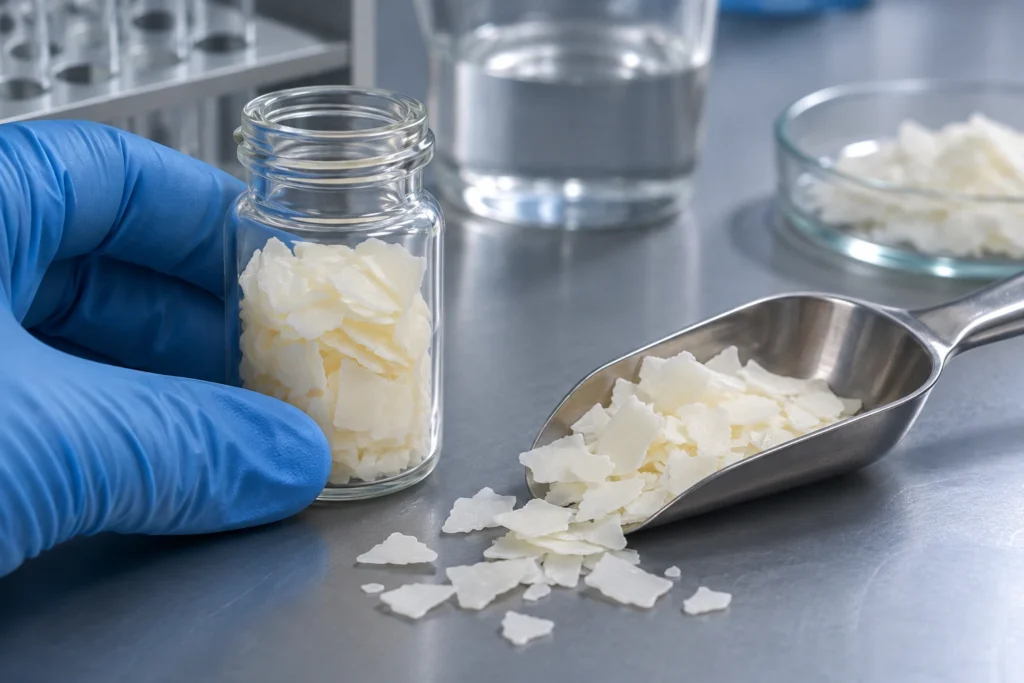
- Melt the emulsifier. Add the flakes or granules to the oil phase and stir until the waxes and emulsifier are fully melted and uniform.
- Combine and homogenize. Add the hot oil phase to the water phase under moderate stirring. For this bench trial, 3,000 to 5,000 RPM for 3 to 5 minutes is a starting point. Record the rotor diameter, mixer setup, batch size, and mix time so you have a basis for adjusting shear at pilot scale.
- Control cooling. Switch to low-shear sweep agitation and let the batch cool gradually toward 40°C. Record the cooling curve and allow the cream to develop its final texture before measuring viscosity.
Seppic’s published Montanov formulation examples show how the process varies with the formula and grade.
Oil Phase Compatibility
Squalane, isohexadecane, jojoba oil, rosehip oil, shea butter, cocoa butter, and silicone oils are examples of oils and butters you might screen. The prototype uses 20% emollients and butter, or 24% for the whole heated oil phase including the emulsifier. Keep those two figures separate when comparing oil loads. A study of lamellar structure in model creams describes how the composition of a fatty alcohol and glucoside system affects its organization.
Base Formulation Prototype for a Rich Night Cream
| Phase | Ingredient | % w/w |
|---|---|---|
| A · Water | Water (Aqua) | To 100 |
| A | Glycerin | 3.0 |
| A | Xanthan gum | 0.2 |
| B · Oil | Caprylic/Capric Triglyceride | 10.0 |
| B | Shea butter | 5.0 |
| B | Squalane | 5.0 |
| B | Cetearyl Alcohol and Cetearyl Glucoside (KWM68A) | 4.0 |
| C · Cooldown | Preservative | 1.0 trial allocation |
| C | Tocopherol | 0.5 |
| C | Active extracts | Set for the selected extract |
Set the actual preservative dose and addition temperature for the selected system. Add the extracts below 40°C if their supplier’s guidance permits. Adjust the water to bring the batch to 100%, then check the finished cream’s stability and preservation.

How to Check Consistency When Sourcing the Emulsifier
Moving from a 1-liter lab beaker to a 1,000-liter vessel can expose differences in how quickly the raw material melts or how the cream thickens during cooling. Ask for the grade’s melting guidance and appearance specification, then compare the incoming lot with the sample you approved.
- Documentation. Request the TDS, SDS, and batch COA. Use the TDS for processing guidance and the COA to compare the supplied lot with the agreed specification.
- Feedstock requirements. If non-GMO sourcing or a natural-origin calculation is part of your brief, request the declaration for the exact grade and review it against the buyer’s criteria.
- Scale-up support. Share your bench formulation, target viscosity, and mixing and cooling conditions when discussing the pilot batch with INNO.
Frequently Asked Questions
Can Cetearyl Glucoside Be Used in a Cold Process?
The waxy Cetearyl Alcohol and Cetearyl Glucoside blend used here is intended for a hot process. Add it to the oil phase and heat until it has fully melted. Follow the processing guidance for the specific grade if you are evaluating another form.
What Use Level Should I Start With?
The listed leave-on range for KWM68A is 1 to 5%. Within that range, 1 to 2% is a starting screen for a lighter lotion, often with a co-emulsifier, and 3 to 5% is a starting screen for a richer cream. The prototype uses 4%. Select the final level by comparing viscosity, rub-in, and stability at your intended oil load.
Is It Compatible with High Concentrations of Active Ingredients?
It depends on the active package and the complete formula. Compare a base sample with one containing the intended level of vitamin C derivative, niacinamide, or botanical extract. Check pH, viscosity, and separation after adding the actives and again after storage.
How Do I Reduce Soaping During Rub-In?
Adjust the balance of fast- and slow-spreading emollients, then compare the rub-in of matched samples. If dimethicone or a silicone alternative fits your brief, 0.5% is one trial point. Judge whitening after the samples have rested under the same conditions.
Request a KWM68A sample and current grade documents from INNO.