Over my 15 years of consulting for global cosmetic brands, I have found that formulating an elegant, stable product becomes exponentially harder once your lipid phase crosses the 30% threshold. Designing standard lotions is relatively straightforward, but trying to construct a luxurious massage cream or a trendy, heavy-duty cleansing balm using conventional O/W emulsifiers usually ends in disaster.
Formulators repeatedly face the same frustrating failures: the emulsion breaks completely in the oven, the finished product “sweats” oil (syneresis) in the jar after a few weeks, or it leaves a heavy, greasy residue on the skin that simply refuses to wash off.
This technical guide explains exactly why traditional systems fail under heavy oil loads and reveals how to select the right emulsifier for high oil phase formulations. We will explore the specific advantages of Polyglyceryl-10 Laurate and provide a cleansing balm formulation framework to help you plan your bench trials. If you are actively replacing synthetics across your entire product line, we recommend reviewing our complete natural PEG-free emulsifier guide before diving into these specific high-oil challenges.
Why Do Conventional O/W Emulsifiers Fail in High Oil Phase Emulsions?
Conventional O/W emulsifier systems are often designed for lower oil loads. As the oil phase increases, droplets can become more crowded and coalesce. Whether the emulsion separates or inverts during thermal stress depends on the complete formulation and process.
To understand this failure, we must look at the physics of the Phase Volume Ratio. In a standard oil-in-water (O/W) emulsion, water is the continuous phase, and oil is the dispersed phase. As the oil concentration rises, particularly as it approaches 50% or 60%, the dispersed oil droplets can become more tightly packed.
If the primary emulsifier is not highly efficient at structuring this crowded interface, the droplets will merge (coalescence). High-oil systems can also be prone to phase inversion. Under some combinations of shear and temperature, an O/W system can flip into a water-in-oil (W/O) system. This change can disrupt the intended texture. A conventional nonionic emulsifier chosen for a lighter lotion may need a different emulsifier balance or supporting structure at a higher oil load.
What Is the Best Emulsifier for High Oil Phase Cleansing Balms?
For high oil load wash-off products, Polyglyceryl-10 Laurate is one emulsifier to screen when the supplied grade is compatible with the oil phase. It helps disperse the oil into a milky emulsion upon contact with water.
When formulating cleansing balms, massage creams, or heavy makeup removers, consider both in-jar stability and performance on the skin. In an anhydrous cleansing balm, the wax blend holds the liquid oils in the jar, and the rinse emulsifier helps the balm wash off.
The Mechanism of the “Bloom” Effect
The defining characteristic of a premium cleansing balm is the “Bloom Effect.” When the consumer applies the anhydrous (waterless) or high-oil balm to their dry face, it melts and dissolves makeup. When they splash water onto their face, the balm must instantly turn milky white and rinse away completely without leaving a greasy film.
Polyglyceryl-10 Laurate is a hydrophilic ester. When a compatible grade comes into contact with rinse water, it can reduce interfacial tension and help disperse the oil, makeup, and excess sebum into rinseable droplets. The supplied INNO Polyglyceryl-10 Laurate grade contains Aqua and Phenoxyethanol and is recommended for addition to the water phase. For an anhydrous balm, screen an oil-compatible grade with a documented carrier and use range.
Polyglyceryl-10 Laurate vs. PEG-20 Glyceryl Triisostearate
Historically, formulators relied on PEG-20 Glyceryl Triisostearate for cleansing balms. Polyglyceryl-10 Laurate is a non-ethoxylated alternative to evaluate for projects that call for one. Compare both grades for oil compatibility and bloom in the same base. If the project calls for eco-certification, check the specific grade and full formula against the applicable standard. Croda’s PEG-20 Glyceryl Triisostearate grade is one benchmark for oil-based cleansers.
| Feature | Polyglyceryl-10 Laurate | PEG-20 Glyceryl Triisostearate | Standard O/W Emulsifiers (e.g., Polysorbate 60) |
|---|---|---|---|
| Oil Phase Load | Grade and formula dependent. Check carrier compatibility. | Confirm the intended oil blend and use level. | Check stability at the target oil load in the complete O/W system. |
| Wash-Off (Bloom Effect) | Screen for a milky bloom and check rinse residue. | Benchmark for a milky rinse in oil-based cleansers. | Rinse performance depends on the complete formula. |
| PEG-Free / Clean Beauty | Non-ethoxylated ester. Check the supplied grade and full formula against the applicable standard. | Ethoxylated. | Depends on the grade. Polysorbate 60 is ethoxylated. |
| Primary Application | Water-containing cleansers and emulsions for the aqueous INNO grade. Screen a suitable grade separately for anhydrous balms. | Cleansing balms and cleansing oils. | Standard lotions and creams. |
Formulation Example: How to Create a Stable Cleansing Balm
The example below combines waxes, esters, and plant oils. The rinse emulsifier grade and its use level need to be selected for that oil blend before the formula is closed to 100%.
Creating a cleansing balm is an exercise in managing wax crystallization and emulsifier distribution. If the waxes crystallize improperly, the balm will become grainy. If the emulsifier is insufficient, the product will not wash off.
Cleansing Balm Formulation Framework (Anhydrous System)
| Phase | Ingredient | % w/w |
|---|---|---|
| A · Structural Waxes | Synthetic Wax or Polyethylene alternative | 8.0 |
| A | Microcrystalline Wax or Candelilla Wax | 7.0 |
| B · Emollients & Solvents | Cetyl Ethylhexanoate (makeup solvent) | 35.0 |
| B | Caprylic/Capric Triglyceride | 20.0 |
| B | Plant Oils (e.g., Jojoba or Sunflower) | 10.0 |
| C · Emulsification System | Oil-compatible rinse emulsifier grade to confirm | 12.0 provisional allocation |
| D · Additives | Tocopherol (Vitamin E), Fragrance/Essential Oils | Less than 2.0 |
| Balance | Oil-phase balance after setting Phases C and D | To 100.0 |
The listed ingredients total 92% before additives when Phase C is allocated 12%. Select the oil-compatible rinse emulsifier and its use level, then balance the formula to 100%. The aqueous INNO grade has a published rinse-off use range of 0.5–5% for its recommended applications.
Critical Processing Parameters
- Melting Phase. Heat Phase A, B, and C together to 85°C–90°C for this trial if the selected rinse emulsifier is compatible with that process. Ensure all high-melting-point waxes are completely dissolved.
- Stirring. Mix with moderate shear. High-shear homogenization is usually unnecessary for anhydrous balms and can actually entrap unwanted air bubbles, creating a cloudy appearance.
- Cooling & Crystallization. This is the most critical step. Allow the batch to cool while stirring until it reaches the pour temperature, about 60°C–65°C for this trial if the wax blend still flows at that point. Pour into jars and control the cooling rate. Check the set balm for graininess and surface oil.
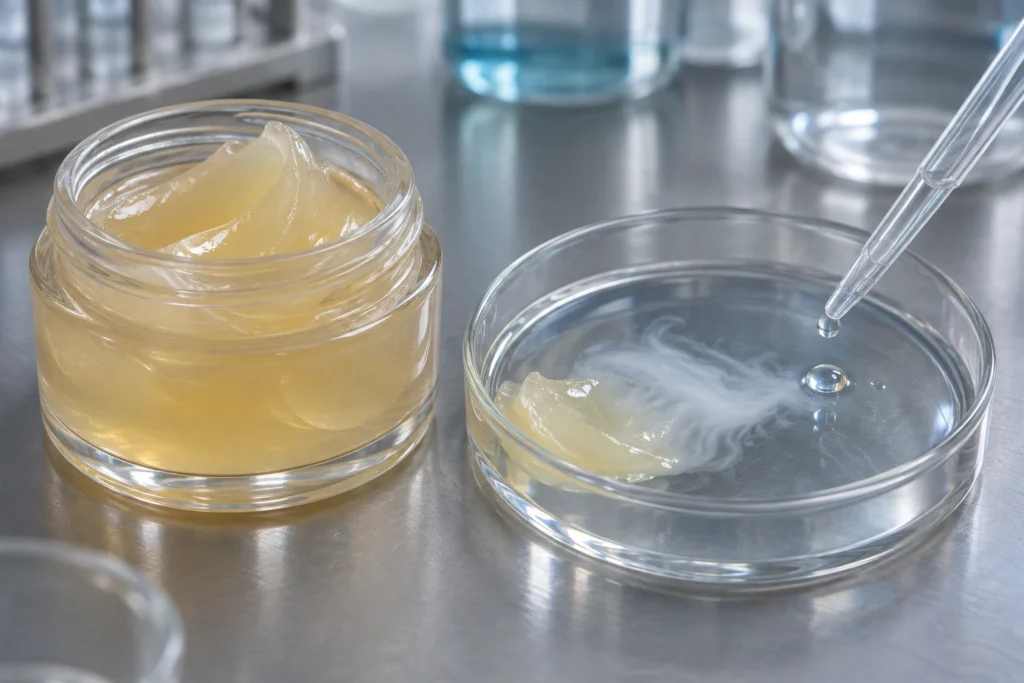
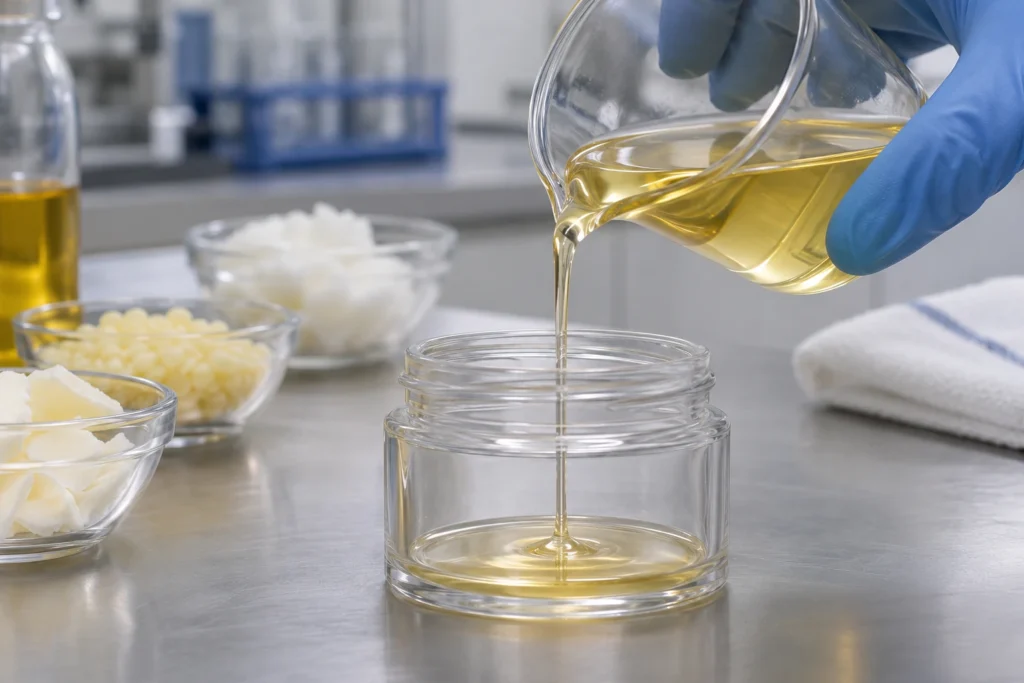
Seppic’s anhydrous balm example uses a melt stage, an addition during cooling, and a jar-fill step.
How to Troubleshoot Oil Bleeding (Syneresis) in Massage Creams?
Oil bleeding or “sweating” can be caused by an improper wax-to-oil ratio in an anhydrous balm or by emulsion instability in a high-oil cream. The formula and the cooling curve are both worth checking.
Syneresis occurs when liquid oils escape the structural matrix of the formulation, pooling on the surface of the cream or balm. This is a catastrophic failure for consumer perception. If your high-oil massage cream or balm is sweating, run through this formulation troubleshooting checklist:
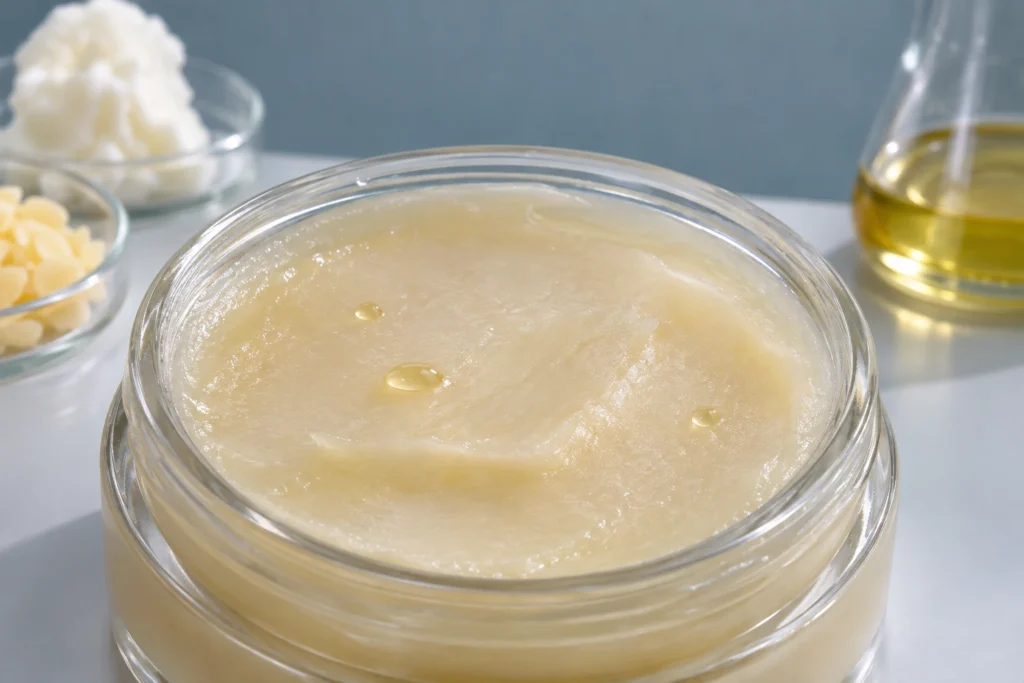
- Optimize Your Wax Cascade. Are you relying on a single wax? Compare it with a blend of waxes with different melting points at the same total wax level (e.g., a high-melting microcrystalline wax and a lower-melting beeswax or natural alternative). A different crystalline network can help trap the liquid lipids.
- Evaluate the Cooling Curve. Did the factory cool the batch too fast? Pumping ice water into the compounding vessel jacket can change how the waxes crystallize. Compare cooling rates to see whether the wax network releases oil over time.
- Verify Emulsifier Concentration. Is your emulsifier load high enough? In a high-oil emulsion, the emulsifier must stabilize the oil-water interface. In an anhydrous balm, screen the rinse emulsifier within its documented use range and check for oil bleeding separately from rinse performance.
For a water-containing cream, research on high internal phase O/W emulsions illustrates how the emulsifier and supporting polymer can change stability at high dispersed-phase volumes.
How INNO Biotechnology Supports Your High Oil Formulations
Scaling up high oil phase emulsions requires consistent raw materials. INNO Biotechnology supplies Polyglyceryl-10 Laurate for formulation trials and can provide specifications for the grade you plan to evaluate.
When moving a 60% oil phase cleansing balm from a lab prototype to a multi-ton factory batch, the margin for error is virtually zero. Minor fluctuations in raw material impurities, water content, or active matter can disrupt the wax crystallization process, leading to a grainy texture or a complete failure of the wash-off bloom effect.
INNO Biotechnology helps you manage this scale-up risk. As a direct manufacturer, we provide batch specifications for Polyglyceryl-10 Laurate. Request the Technical Data Sheet (TDS) and Certificate of Analysis (COA) for your grade and lot. Beyond supplying ingredients, our R&D team provides technical support and formulation frameworks to help you optimize your high-oil products.
Frequently Asked Questions (FAQs)
How much emulsifier do I need for a 40% oil phase cream?
For a leave-on massage cream (where the goal is long-term skin lubrication), 3% to 5% of a liquid crystal-forming emulsifier can be a trial range when supported by the grade’s use directions. For a rinse-off cleansing balm, choose an oil-compatible rinse emulsifier and screen its documented use range in the full wax and oil blend.
Can I use Polyglyceryl-10 Laurate for cold process formulations?
Polyglyceryl-10 Laurate can be used in fluid makeup removers such as micellar waters when the selected grade supports cold processing. Solid balms and thick massage creams containing waxes or hard butters often require heat to melt and blend those ingredients with the liquid oils. Set the temperature based on the selected materials.
Why does my cleansing balm leave a greasy residue after rinsing?
A greasy residue can indicate an unsuitable HLB balance or too little rinse emulsifier for the oil blend. Evaluate an oil-compatible emulsifier designed for wash-off applications. Compare how quickly each prototype blooms and how much film remains under the same rinse conditions.
Discuss Your Cleansing Balm Formulation with INNO
Ask INNO for a sample and the current grade documents. Share whether you are developing a water-containing cream or an anhydrous balm, along with the oil blend and the rinse or skin-feel target.