Liquid Potassium Cocoyl Glycinate grades may share the same surfactant name, but they are not necessarily equivalent raw materials.
This comparison looks at INNO KWGCK-30, Ajinomoto AMILITE® GCK-12K and the MIAMI PCG grades publicly associated with Potassium Cocoyl Glycinate. The comparison focuses on the information that matters during supplier qualification: exact commercial grade, complete composition, concentration basis, minor ingredients, document availability and the way each material enters the finished formula.
The first point to establish is the basis behind every percentage. Active matter, surfactant concentration, solids and SDS composition ranges are not interchangeable. A meaningful supplier comparison starts only after those fields are placed on the same basis.
For formulators and buyers, this distinction affects more than purchasing documents. Carrier water, electrolytes and declared preservation ingredients can change batch water, viscosity development, clarity and the conditions required for an equal-basis formulation trial.

“Liquid PCG” is a format, not a complete specification
Potassium Cocoyl Glycinate identifies the main anionic surfactant. A commercial liquid also needs enough carrier water to remain transferable, and it may contain electrolyte or ingredients used to support raw-material preservation. Those additions can affect formula water, ingredient declaration, preservation review, clarity and the route to viscosity.
Start every comparison with the exact commercial name and suffix. Similar codes can distinguish a regular liquid from a powder, a soap-containing grade or a region-specific version. A name shortened to “PCG” may be convenient in an email, but it is not precise enough for qualification.
Next, ask for the complete INCI declaration and composition range. Do not assume that an ingredient omitted from a short catalog is absent from the supplied material. The current TDS, SDS and purchasing specification should agree on the identity of the grade even when the documents serve different purposes.
Put every percentage under the right heading
Active matter, surfactant concentration and solids can be close numerically without being interchangeable. Solids may include surfactant plus dissolved inorganic material. An SDS composition range is written for hazard communication, while a purchasing specification defines the values used to accept a lot. A COA reports a result for one batch.
For a genuine equal-active comparison, obtain a comparable active-matter value and method for every candidate. The starting calculation is simple:
Required grade dosage = target surfactant contribution ÷ grade active fraction
If a formula needs 9% active surfactant and the verified grade is 30% active, the mathematical starting point is 30% supplied material. It is only a starting point. Water, salt, preservatives and the rest of the surfactant blend still need to be rebalanced.
If one supplier gives solids and another gives active matter, resist the urge to force them into the same spreadsheet column. Ask for the missing definition first. A blank cell is cheaper than a false equivalence.
Preservatives and electrolytes belong in the formula review
A liquid raw material that declares Phenoxyethanol or Caprylyl Glycol is not automatically a preserved finished cleanser. Those ingredients arrive at a diluted contribution after the raw material is dosed, and their suitability depends on the complete formula, pH, packaging, manufacturing hygiene and validation program.
The right response is neither to ignore them nor to count them twice. Include their delivered amount in the ingredient inventory, then design and validate the finished preservation system on its own merits.
Electrolyte deserves similar attention. Potassium Chloride or another salt may influence micellar structure, viscosity and clarity, but the raw material is only one source. Amphoterics, neutralization, preservatives, botanical extracts and deliberately added salt can all change the final ionic environment. Salt curves have a sense of humor: the extra pinch that thickens one base can flatten another.
Public information sets different comparison limits
Ajinomoto currently describes AMILITE® GCK-12K as an amino acid-derived anionic surfactant in aqueous solution form. Ajinomoto Healthy Supply’s current product list identifies its display composition as Potassium Cocoyl Glycinate and water, and lists face wash, cleansing, body wash and hair shampoo applications.
The public AMILITE page does not show a full concentration table, pH method, electrolyte specification or pack information. Those fields should come from the current regional document pack supplied with the quotation, not from a value remembered from an older brochure.
MIAMI PCG is listed in an industry database as a Miwon Commercial Potassium Cocoyl Glycinate grade. Public secondary sources also use several nearby names, including PCG(E), PCG(H) and PCG(P), with different forms or compositions. A current manufacturer TDS and the exact offered suffix are therefore essential before treating “MIAMI PCG” as one fixed liquid specification. The suffix should follow the material through the quotation, sample label, trial record and approval file.

How KWGCK-30 fits the liquid-grade comparison
INNO supplies KWGCK-30 liquid Potassium Cocoyl Glycinate for direct addition to the water phase. Its current TDS declares Potassium Cocoyl Glycinate, Phenoxyethanol, Caprylyl Glycol, Potassium Chloride and Aqua. The standard pack stated in the TDS is a 200 kg plastic drum.
The current SDS lists Aqua at 69 to 71%, Potassium Cocoyl Glycinate at 28.5 to 31%, Phenoxyethanol at 0.2 to 0.6%, Caprylyl Glycol at 0.1 to 0.3% and Potassium Chloride at 0 to 0.5%. These are composition ranges, not a promise that every field is measured as active matter. Ask for the current purchasing specification and method when calculating an equal-active trial.
| Qualification field | KWGCK-30 | AMILITE® GCK-12K | MIAMI PCG |
|---|---|---|---|
| Publicly confirmed form | Liquid | Aqueous solution | Confirm exact grade and suffix with supplier |
| Published ingredient detail | Full INCI declared in current INNO TDS | Potassium Cocoyl Glycinate and water on current official Japanese product list | Current manufacturer TDS required |
| Content basis available for calculation | SDS composition ranges available; request current active specification and method | Request current regional specification and method | Request exact-grade specification and method |
| Minor ingredients to account for | Phenoxyethanol, Caprylyl Glycol and Potassium Chloride are declared | Not detailed on the public pages reviewed | Do not infer from a different PCG suffix |
| Best next document | Current specification plus representative COA | Current TDS, SDS, specification and COA | Manufacturer TDS confirming suffix, composition and form |
This table is deliberately uneven because the public files are uneven. It is a request list, not a performance ranking. Supplier selection starts when the missing fields are returned on a comparable basis.
Run the same finished-formula trial for every candidate
Begin with a document gate. Confirm grade code, complete composition, active-matter definition, pH method, electrolyte, pack, shelf life and the document revision attached to the offered lot. Then calculate a common surfactant contribution and adjust water accordingly.
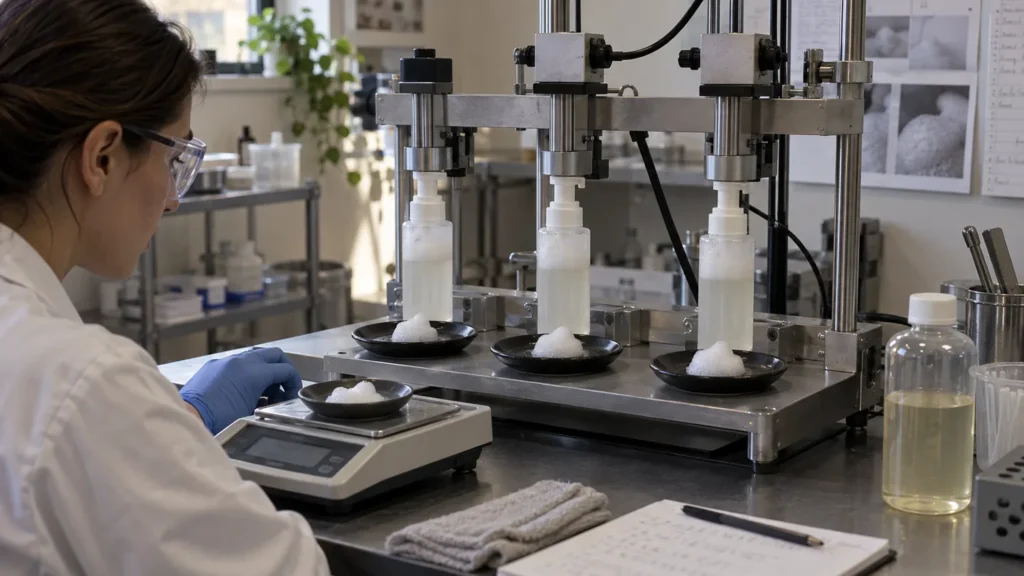
Use the same water quality, charging order, mixing energy, temperature history and pH adjustment sequence. Record ease of transfer, aeration, appearance after equilibration and any drift after adding fragrance, botanical extracts or other project-specific loads.
Measure what the product brief actually needs: stabilized viscosity, foam generation and persistence under one method, rinse feel, low-temperature appearance, accelerated stability and package dispensing. A liquid that pours beautifully from a sample bottle can still disappoint in a foaming pump, and a beautiful foam can still make a stubborn filling line.
For preservation, include the delivered raw-material components in the formula calculation, but validate the finished product using the market and test plan appropriate to the project. Supplier composition supports that review; it does not replace it.
Compare cost-in-use only after the basis is clean
Once the technical shortlist is real, compare cost per kilogram of verified active contribution rather than price per kilogram of liquid. Add inward freight, drum handling, usable yield, metering time and any formula changes demonstrated by the trial.
Keep assumptions visible. Do not assign a labor saving, viscosity benefit or lower preservative cost unless the site trial supports it. The winning grade should reduce uncertainty as well as fit the budget.
Frequently asked questions
Can three liquid PCG grades be compared at the same use level?
Not safely from the trade name alone. Confirm comparable active-matter values and methods, calculate a common surfactant contribution, rebalance water and then test the complete formula.
Does Phenoxyethanol in a raw material preserve the finished cleanser?
Not automatically. Count the delivered amount, review the complete formula and validate the finished preservation system for its pH, packaging, process and market.
Is MIAMI PCG a single liquid grade?
The short name is not enough for qualification because public secondary listings use multiple PCG suffixes. Ask the supplier to confirm the exact manufacturer code, form, complete INCI and current TDS.
What should accompany a KWGCK-30 comparison-sample request?
Send the incumbent TDS, target active contribution, cleanser format, pH, fragrance level, major co-surfactants, packaging, batch size and destination. Remove confidential details that do not affect selection.
Request a matched KWGCK-30 evaluation
Send INNO the exact liquid grade you are reviewing and the formula constraints that matter most. We can provide the current KWGCK-30 TDS, SDS, representative COA fields and a sample for an equal-basis comparison in your intended cleanser.