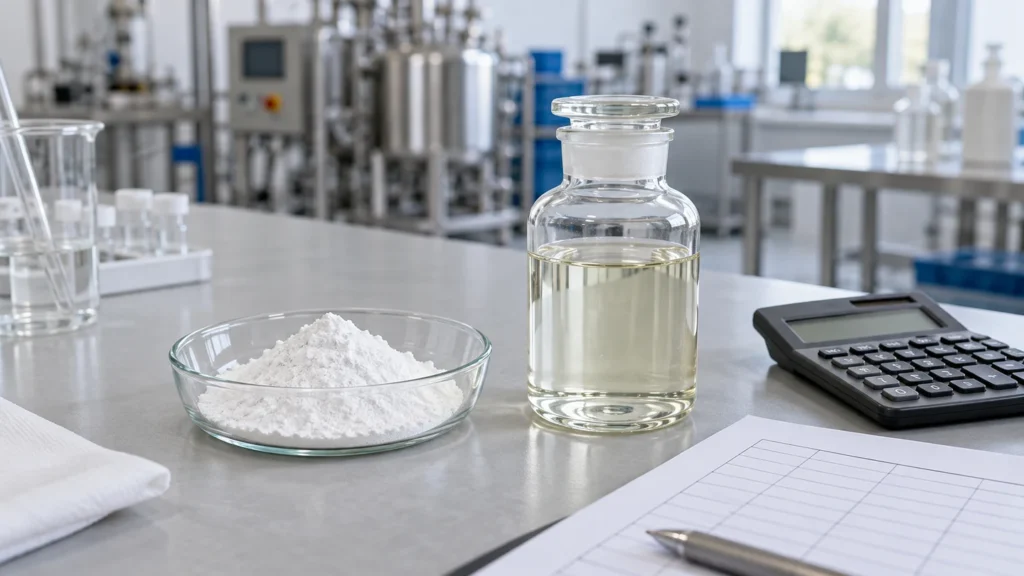
The powder quote looks expensive. The liquid is easier to pump. So which one actually costs less?
The useful answer begins after both offers are converted to the same active-surfactant basis. Then the production team gets a vote. Freight, storage, charging time, batch water and material left in the package can all change the result.
This is why a powder-versus-liquid decision belongs in a cost-in-use worksheet, not in a quick comparison of two prices per kilogram. The raw-material format that looks cheaper on the quotation may not be the one that runs more economically in your plant.
Price per kilogram is the wrong starting line
A kilogram of powder and a kilogram of liquid do not necessarily deliver the same amount of potassium cocoyl glycinate. Comparing their invoice prices directly is rather like pricing concentrated juice against the ready-to-drink bottle. The fruit sounds familiar, but the denominator is doing most of the work.
Start with the active matter stated in the agreed specification or commercial offer. Keep solid content in a separate column. Solids may include material that is not active surfactant, so the two figures should not borrow each other’s name badge.
Once both formats use the same basis, calculate how much raw material each route needs for the target surfactant contribution. Freight, labor and process costs can join the conversation after that first correction.
Normalize both quotes to active matter
The first calculation is short:
Raw material required per kilogram of active surfactant = 1 ÷ active-matter fraction
For illustration, suppose a powder is confirmed at 95% active matter and a liquid at 30%. Supplying 1 kg of active surfactant would require about 1.05 kg of powder or 3.33 kg of liquid.
Those percentages are calculation examples, not specifications for the commercial grades discussed later. Use the agreed values for the products and lots under review. The arithmetic travels well; the inputs do not.
Now convert the material quote:
Material cost per kilogram of active = price per kilogram of raw material ÷ active-matter fraction
If freight is quoted by raw-material weight, add it before dividing by the active fraction. A liquid can have an attractive unit price while requiring more shipped kilograms. A powder can have a higher unit price and still be competitive after normalization. Neither outcome is guaranteed, which is precisely why the calculation earns its place.
Carrier water travels, occupies storage and enters the batch
A liquid grade brings carrier water and its other declared components with it. That changes shipped mass, warehouse space and the water balance of the formula. A conventional high-water cleanser may accommodate the carrier easily. A concentrate has less room to be generous.
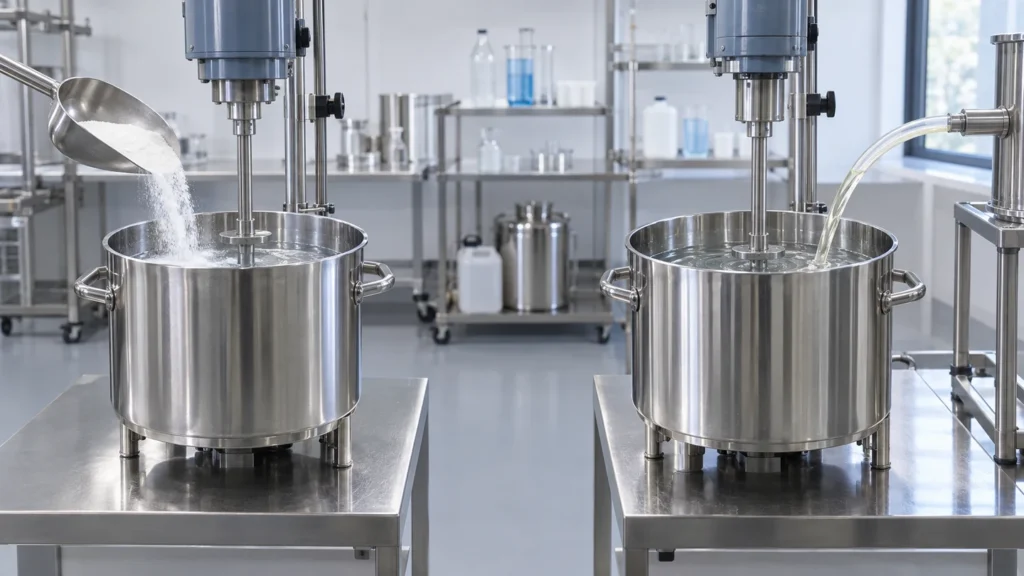
The powder route ships less carrier water but asks the plant to complete more preparation during production. Some work moves from the supplier’s drum to the mixing vessel. Freight and formula space may improve while charging and dispersion demand more attention.
Put annual demand, shipment unit, storage footprint and batch water on the same sheet. This usually settles more arguments than declaring a universal winner from the office chair.
The batch room may overturn the spreadsheet
Active-normalized material cost is necessary, but it is not the finish line. A plant designed around liquid transfer and metering may accept a liquid grade with little disruption. The same site may need extra handling time or revised charging controls for powder.
A factory that already handles powders well may reach the opposite conclusion. A powder grade can fit neatly when the vessel, dust controls and mixing sequence are ready for it. The useful question is not whether powder is difficult in general. It is whether powder is difficult in your plant.
| Cost input | Powder route | Liquid route |
|---|---|---|
| Receiving and storage | Smaller standard pack; confirm dry storage and powder-handling space | Larger standard pack; confirm drum storage and transfer access |
| Charging | Manual or controlled powder addition | Manual pour or liquid transfer and metering |
| Mixing | Dispersion step before the material is fully incorporated | Direct addition to the water phase with stirring |
| What to measure | Charging time, dispersion time and material recovery | Transfer time, drum residue and material recovery |
Measure these inputs during a representative trial instead of assigning a heroic efficiency to either format. Spreadsheets are wonderfully obedient; factories tend to have opinions.
How KWGCK-95 and KWGCK-30 differ in practice
INNO currently supplies potassium cocoyl glycinate as KWGCK-95 powder and KWGCK-30 liquid. Their different supply forms and addition routes matter more to this decision than a tidy winner-and-loser list.
| Selection point | KWGCK-95 | KWGCK-30 |
|---|---|---|
| Supply form | White solid powder | Colorless to light yellow liquid |
| Declared INCI components | Potassium Cocoyl Glycinate, Aqua, Potassium Chloride | Aqua, Potassium Cocoyl Glycinate, Phenoxyethanol, Caprylyl Glycol, Potassium Chloride |
| Addition guidance | Disperse in cold water under stirring, then heat | Add directly to the water phase and stir well |
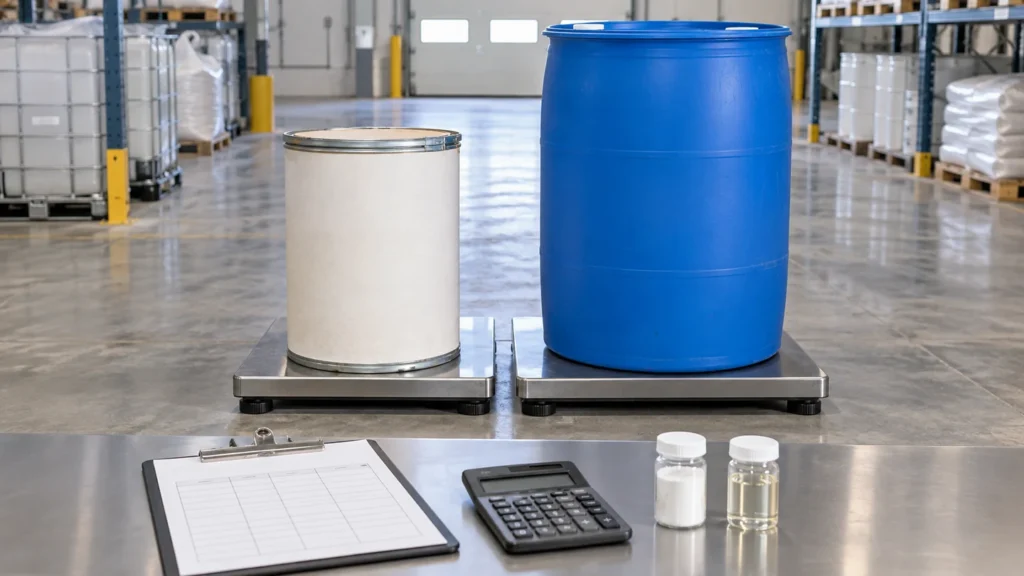
| Standard pack | 15 kg per drum | 200 kg per plastic drum |
KWGCK-30 is not merely KWGCK-95 plus water. Its complete declaration includes phenoxyethanol and caprylyl glycol, so the composition review must cover more than water balance. KWGCK-95 also contains Aqua and Potassium Chloride; powder form should not be translated into a claim of pure or anhydrous surfactant.
Before calculating a commercial conversion, request the current grade documents and agree on the active-matter basis. That avoids turning a solid-content figure or one batch result into a purchasing assumption.
Build a cost-in-use comparison that can survive purchasing review
For each route, calculate the cost for one production batch or one kilogram of delivered active surfactant. Use the same boundary on both sides.
Total converted cost = active-normalized material cost + inward freight + receiving and handling + process time and utilities + packaging handling + measured material loss
Some inputs may be small at pilot scale and important at annual volume. Pack utilization is a good example. A 200 kg liquid drum can suit a large regular batch, but it may create inventory or partial-pack questions for smaller runs. A 15 kg powder drum changes the replenishment pattern. Use your batch size and ordering rhythm rather than assuming that fewer packages or fewer kilograms automatically means lower cost.
Keep quality failures and rework outside the base case unless you have actual site data. Inventing a failure rate makes a tidy spreadsheet and a very shaky decision. If a trial reveals a repeatable difference, add that measured result as a separate scenario.
When each grade is the better starting point
Start with KWGCK-95 when formula space and shipped active matter carry more weight, and your plant can disperse powder in cold water before heating. It also deserves the first look for concentrated systems where carrier water is a genuine constraint.
Start with KWGCK-30 when direct liquid addition fits the existing equipment and production team. It can be the more practical route when easier transfer and metering outweigh the extra raw-material mass.
If both routes remain plausible, compare them at the same target active contribution in one representative batch size. Record material used, time spent and material recovered. You do not need a twelve-tab model. You need the few numbers that actually change the decision.
Frequently asked questions
Is KWGCK-95 always cheaper because it is concentrated?
No. Concentration can reduce raw-material mass and freight per kilogram of active, but powder handling and dispersion also carry costs. Compare both grades on the same active basis and add your plant’s actual process inputs.
Can I compare powder and liquid by using the same dosage?
No. The same raw-material percentage can deliver different active-surfactant contributions. Convert each grade to the target active matter first, rebalance the formula water, then compare processing and finished-product results.
Does the liquid grade only add water to the formula?
No. KWGCK-30 also declares Phenoxyethanol, Caprylyl Glycol and Potassium Chloride. Include the complete composition in the formula review, especially when assessing the preservation system and ingredient declaration.
What information does INNO need for a powder-versus-liquid recommendation?
Send your batch size, target active contribution, product format, mixing and dosing equipment, expected order volume and delivery destination. These inputs allow a more useful process and cost comparison than a price-per-kilogram request alone.
Request a comparison built around your batch
Send INNO your target active contribution, batch size, available charging equipment, expected order quantity and destination. We can provide the current KWGCK-95 and KWGCK-30 documents and samples so your team can compare the two routes on a common basis.