A laboratory RPM is not a scale-up instruction. A reliable transfer records what the process must accomplish, then rebuilds the operating window around the production vessel, feed system and chosen surfactant form.
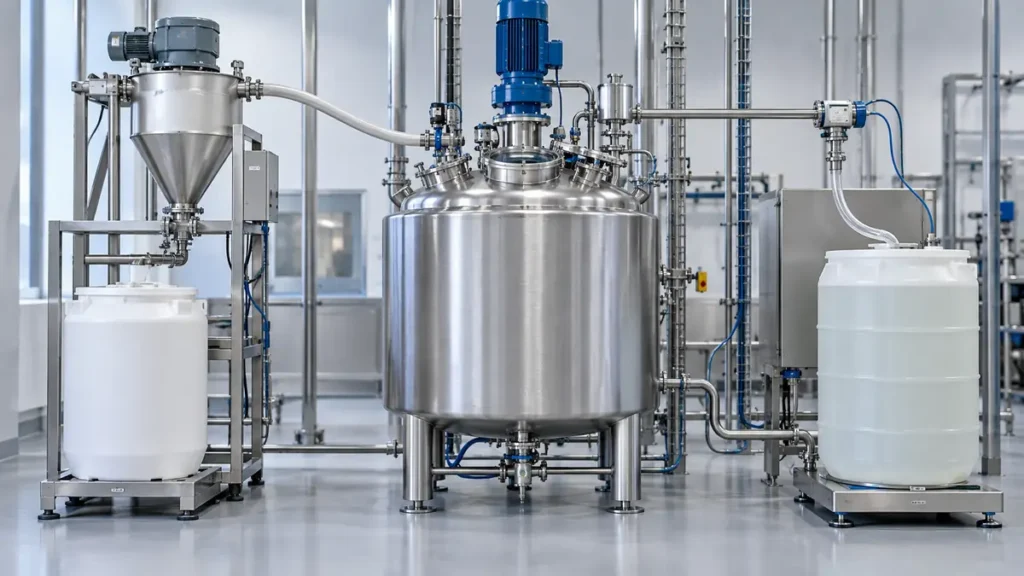
A 10 kg cleanser batch can look calm and uniform while a 1,000 kg batch develops floating powder, a long hydration tail or more foam than expected. The formula may be unchanged. The equipment conditions are not. Vessel diameter, liquid depth, impeller size, recirculation, feed location and batch turnover all change the way new material enters and moves through the liquid.
That is why scale-up should begin with a process transfer sheet rather than a copied mixer speed. Published mixing guidance describes several possible scale-up criteria, including tip speed, power per volume, Reynolds number and mixing time. Holding one criterion constant changes others. The AIChE discussion of stirred-tank scale-up and the SPX FLOW guide to fluid mixing both support defining the task before selecting a scale rule.
Transfer the process function, not the lab setting. Record how powder becomes wetted, how liquid is measured and delivered, how the vessel turns over, and how uniformity is confirmed. Production settings can then be established against those functions.
Separate what stays fixed from what must be rebuilt
The first page of the transfer sheet should divide variables into two groups. Formula basis, ingredient sequence, target batch stage and release endpoint normally belong in the fixed group. Feed rate, impeller speed, recirculation rate, addition position and hold time belong in the re-established group because they depend on production equipment.
| Process item | Powder route | Liquid route | Production record |
|---|---|---|---|
| Quantity basis | Verified mass of powder | Delivered mass plus the grade’s water and surfactant composition | Target, actual and weighing method |
| Entry control | Feed point and rate relative to wetting capacity | Pump, line, valve and return-path behavior | Start, stop, interruptions and total addition time |
| Mixing task | Draw powder below the surface and distribute wetted material | Disperse the incoming liquid throughout the batch | Impeller, speed, liquid level and recirculation state |
| Endpoint | No visible dry powder or persistent agglomerates under the agreed check | Delivered quantity confirmed and batch uniform under the agreed check | Sampling points, method, result and time |
| Changeover | Dust and dry residue locations | Line hold-up, drainback and rinse path | Plant-approved cleaning check |
This separation prevents two common errors. One is treating a different feed system as a minor equipment detail. The other is changing several production settings at once, then losing the reason why the first batch worked or failed.
The powder route: match feed rate to wetting capacity
Powder dispersion contains distinct steps. Particles must contact the liquid, become wetted, and then lose any agglomerated structure while the material is distributed through the batch. A technical overview from Wiley separates powder dispersion into wetting, breaking wetted clumps and preventing reagglomeration. That framework is general rather than specific to KWCG-95, but it explains why a faster impeller does not automatically correct an overloaded addition point. See the Wiley overview of powder dispersion.
At production scale, define the powder route around four observations:
- Where does the powder land? The feed point should be related to the actual surface flow, not simply the center of the vessel.
- Does each portion disappear below the surface? Persistent rafts or islands show that addition is outrunning the local process, even if the total batch is moving.
- Where can wetted material circulate? A strong local vortex does not prove that the bottom, wall and upper zones exchange effectively.
- What defines the end? Use an agreed visual and sampling check. Do not rely only on elapsed mixing time.
Record powder mass before charging and reconcile any remaining material in the bag, hopper or transfer device. If dust control is required, select it through the plant’s handling assessment and the current safety documentation. This article does not set ventilation, protective equipment or combustible-dust controls.
The liquid route: delivery accuracy includes the whole line
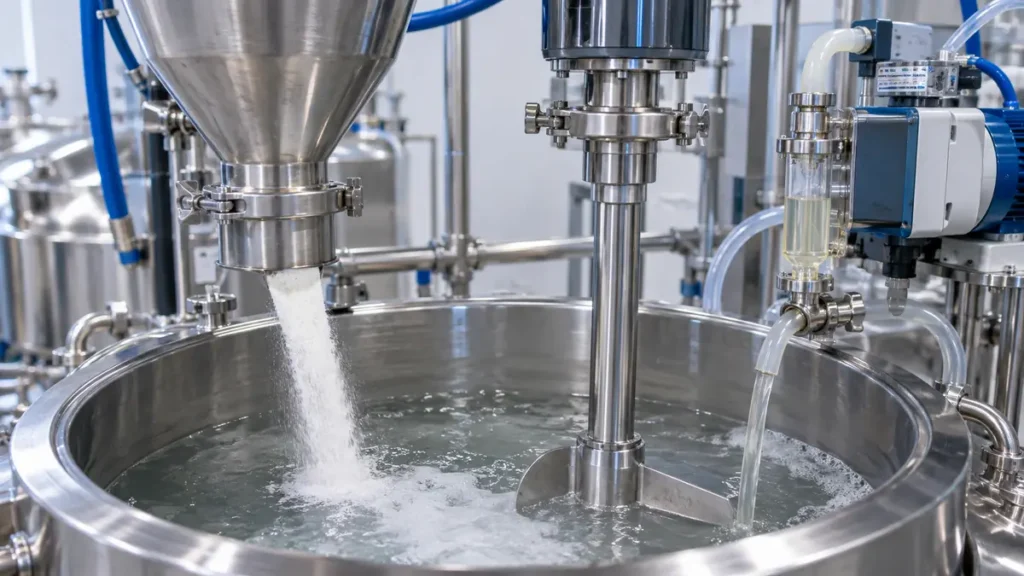
A liquid feed removes the powder-wetting step, but it creates its own transfer questions. The set point on a pump is not the same as verified delivered mass. Product temperature, viscosity, suction conditions, line length, valves and discharge pressure can affect a metering system. The ProMinent metering technology catalog lists these as equipment selection inputs. It is a general engineering reference, not an INNO process recommendation.
For the first production transfer, weigh or otherwise verify what reaches the batch. Note line priming, pauses, drainback and the quantity left in hoses or a day tank. Decide whether the line will be flushed and, if so, whether the flush enters the formula. A rinse that reaches the vessel changes batch water; a rinse sent elsewhere does not.
Volume-based dosing needs another check. A volumetric set point assumes a density at defined conditions, while the formulation record is often mass-based. Use the current lot documentation and the plant’s approved measurement method. Do not convert from volume using an unverified generic density.
Mixing intensity is not one number
In the lab, an operator sees the entire vessel and can respond instantly. In production, a similar-looking surface may hide slow exchange near the wall or bottom. Document the production impeller type and diameter, liquid height, baffles, recirculation loop and feed position. If the plant has no validated mixing model, use a controlled first run with conservative operating boundaries rather than claiming that one equation guarantees equivalence.
Mixing time may also change during the batch as viscosity and liquid level change. An addition made early in a water-like phase can behave differently from the same addition after other surfactants or thickeners have entered. The transfer sheet should therefore identify the batch stage, not only the ingredient order.
Do not hide a scale-up miss with an extended hold. If production requires much longer mixing than the lab, record where the delay begins. The cause may be feed overload, poor turnover, line delivery or the selected batch stage.
How INNO’s current KWCG grades enter the decision
INNO currently offers two cocoyl glutamate supply forms that require different process planning. KWCG-95 is listed as Sodium Cocoyl Glutamate, a white solid powder with 93.5 to 100 percent listed content. Its standard pack is 15 kg. KWCG-25 is listed as a pale yellow or colorless transparent liquid containing 75 percent water, 20 percent Disodium Cocoyl Glutamate and 5 percent Sodium Cocoyl Glutamate. Its standard pack is 200 kg.
These details support an early route comparison, but they do not decide the finished formula. KWCG-95 puts powder wetting, charging and dust handling into the process. KWCG-25 puts liquid storage, line delivery and the grade’s water contribution into the process. The two grades also differ in listed surfactant composition, so they should not be treated as interchangeable versions of one active at equal as-supplied percentages.
If a formulation team is comparing quantities, calculate on the declared composition relevant to the project and confirm the basis with the current lot documentation. The separate surfactant active-matter calculation guide covers that arithmetic. Scale-up begins after the formula basis is clear.
Use the first production batch as a planned experiment
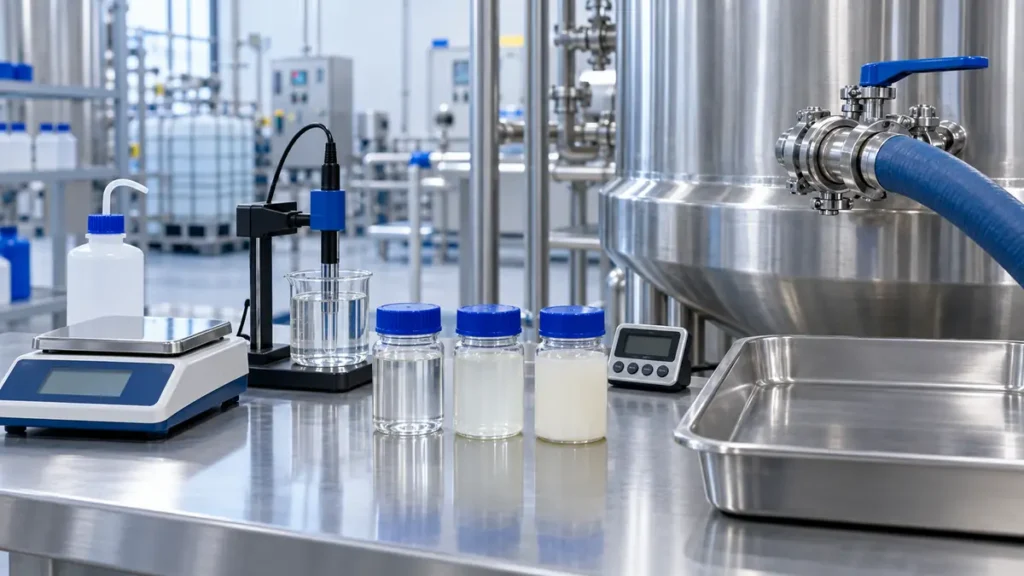
Build observation points into the batch record before manufacturing starts. Take samples that can distinguish time from location. For example, compare early, middle and late addition stages, then compare the agreed vessel or loop locations after the hold. The exact sampling plan depends on the plant, but every sample should carry a time, location, batch stage and temperature.
Choose checks that answer the transfer question. Powder dispersion may require inspection for dry material and breakable agglomerates. Liquid dosing requires delivered quantity reconciliation. Both routes may need appearance, pH and a viscosity result measured by a stated method. Release specifications remain separate from process-development observations.
Finally, record cleaning and changeover findings. Powder may remain around a charging port or dry transfer path. Liquid can remain in a hose, pump head, valve or low point. Cleaning conditions and endpoints must follow the site’s approved procedure. The useful scale-up record identifies residue locations and measured rinse or inspection results without inventing a universal cleaning cycle.
Frequently asked questions
Can we copy the laboratory mixer RPM to the production vessel?
No. Equal RPM does not preserve tip speed, power per volume, circulation or mixing time when vessel and impeller dimensions change.
Define the production task first, then select and verify a scale criterion with the equipment team. Record the resulting operating window and sampling evidence.
What is the correct powder addition rate for KWCG-95?
There is no universal rate. Set it so the production liquid can wet and draw in each portion without persistent surface accumulation.
Vessel geometry, batch stage, liquid level, viscosity, impeller and feed location all affect that capacity. Establish the rate during a controlled trial and record interruptions.
Should KWCG-25 be dosed by weight or volume?
Use the plant’s approved method, but a mass-based formula needs verified mass delivery or a validated density conversion.
If volume is used, document the density source and conditions. Include line hold-up, priming and drainback in the delivery reconciliation.
How should a powder hydration endpoint be defined?
Define an observable, repeatable check such as no visible dry powder plus acceptable samples from agreed locations after a stated hold.
Elapsed time alone is weak evidence. The endpoint should distinguish complete bulk distribution from a clean-looking surface.
Should the first production trial use the full commercial batch size?
Use the smallest plant-representative scale that provides valid mixing, feeding and sampling conditions under your site’s approved trial procedure.
A vessel filled far below its working range may not represent normal circulation. A full batch also increases the cost of an unresolved transfer risk, so involve production and quality teams in the decision.
Prepare a useful scale-up discussion
Send INNO your target batch size, vessel geometry, impeller and recirculation details, addition point, temperature, ingredient sequence and intended endpoint. Include whether you are evaluating KWCG-95 powder, KWCG-25 liquid or both.