The same INCI name can sit on two quotations while the commercial grades, document versions, manufacturing scope and behavior in your cleanser remain different. Approval begins when those details connect.

A buyer asks for Sodium Cocoyl Glutamate and receives a TDS, an SDS, a certificate and a sample. The file looks complete. Yet four questions may still be unanswered: Does the quoted grade have the expected salt form and supply form? Does the certificate cover the entity and site involved? Will the COA match the shipment lot? Does the sample work in the customer’s actual formula?
That is why document collection is not the same as supplier qualification. A useful review follows one traceable line:
Commercial grade identity → current product and safety documents → stated manufacturing and certification scope → batch evidence → representative sample → application decision.
If the line breaks, pause approval at that point. More attachments do not repair a mismatch between product, lot and test material.
Gate 1: Define the grade before comparing suppliers
Start with the material you intend to formulate, not the INCI name alone. Request the supplier’s product code, declared INCI, commercial composition, physical form and relevant specification. For cocoyl glutamate, the powder or liquid presentation changes the water entering the formula and may change processing. A sodium and disodium blend should not be treated as an unnamed equivalent to a predominantly sodium salt grade.
The buying brief should state the intended application, target market, annual or trial quantity, preferred pack size and any parameter that is critical to incoming control. Separate a requirement from a preference. For example, a defined assay range may be an approval limit, while a pack-size preference may be negotiable.
Pass The quotation, sample label and requested documents use the same supplier code and commercial grade name.
Hold The documents show only a generic ingredient name, or the offered sample cannot be tied to the quoted grade.
Gate 2: Give each document one job
TDS, SDS, specification and COA are related, but they answer different questions. INNO’s TDS, SDS and COA guide gives a general introduction. During supplier approval, use the more exact division below.
| Record | Decision it supports | Review points | What it cannot prove alone |
|---|---|---|---|
| TDS | Whether the commercial grade deserves technical review | Product code, composition or typical properties where stated, uses, storage, revision | That a delivered lot meets every requirement |
| Product specification | Which attributes and limits will govern acceptance | Test items, limits, methods or method references, agreement status | The actual result for a shipment lot |
| SDS | How hazard communication, handling and emergency review should proceed | Identity, supplier details, revision, jurisdiction or language, classification and sections relevant to use and transport | Formulation performance or batch conformity |
| COA | Whether one identified batch reports results against listed limits | Grade, batch number, test items, limits, results, issue or approval information | That an unlisted property was tested or that another lot is identical |
| Certificate or statement | Whether a specific claim has third-party or supplier support | Issuer, holder, sites, products or activities, standard, dates, exclusions and verification route | Suitability for your formula or every market |
For US workplace hazard communication, OSHA Appendix D specifies the minimum information required in SDS sections. In the European Economic Area, ECHA describes the SDS as a source for substance or mixture properties, hazards, handling, disposal, transport and first-aid information under the relevant REACH context. These are jurisdiction-specific references, not proof that one file automatically satisfies every destination. Check the OSHA SDS requirements and ECHA safety data sheet guidance against the market and shipment route.
Gate 3: Check names, versions, sites and scope
A certificate logo is not the review. Read the details that surround it. Which legal entity holds it? Which location is covered? What activities, products or services are in scope? Who issued it, and can its status be verified? ISO explains that certification is a written assurance by an independent body, while accreditation is the formal recognition of a certification body’s competence. ISO itself does not perform certification. See the ISO explanation of certification.
Scope language matters because a certificate can be valid and still be irrelevant to the quoted supply chain. ISO and IAF auditing guidance says the scope should let users discern the activities, products and services covered, along with associated sites where applicable. Review the ISO 9001 auditing guidance on scope.
- Match the legal entity on the quotation, document header and certificate.
- Identify the manufacturing site, sales entity and any distributor involved.
- Record document revision dates and the date your team reviewed them.
- Ask what event triggers an updated TDS, SDS or specification.
- Confirm how planned material, process, site or specification changes are communicated.
Gate 4: Connect the COA to receiving control
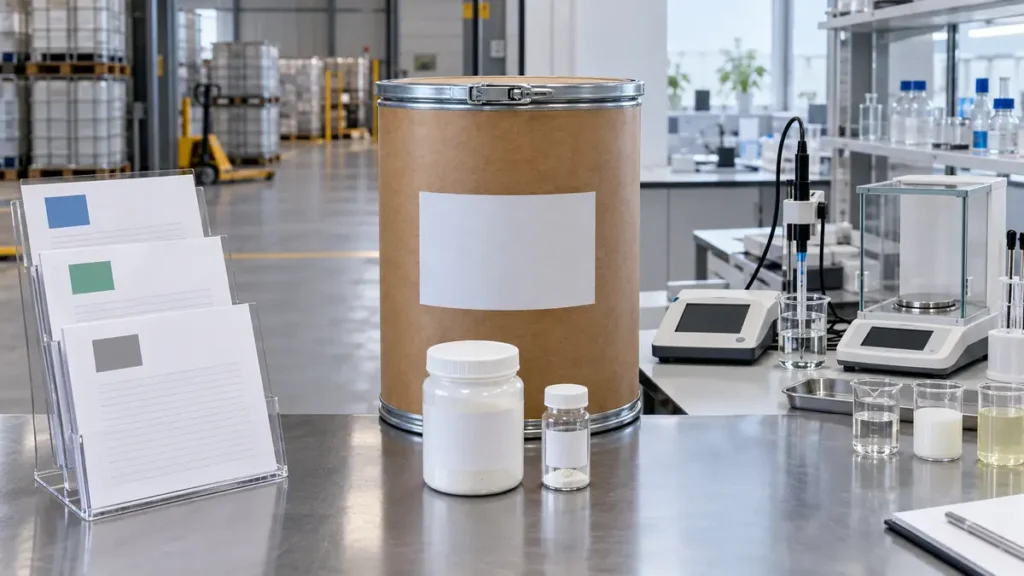
A model COA can show format, but it cannot approve a future shipment. Before the first order, agree which specification governs, which COA items will be reported and how a discrepancy will be handled. At receipt, match the COA grade and batch number to the package labels. Compare reported results with the approved limits rather than with a typical value copied from marketing material.
Build an incoming checklist around risks that matter for this specific commercial grade. It may include package condition, label identity, lot number, appearance and selected confirmatory tests. The exact plan belongs to the customer’s quality system and intended use. The US FDA’s cosmetic ingredient supplier fact sheet also reminds suppliers that cosmetic components must meet applicable requirements and that careful manufacturing and maintenance help support finished-product safety. That source applies to the US cosmetics context; it is not a supplier approval certificate. Read the FDA fact sheet for cosmetic ingredient suppliers.
Gate 5: Make the sample answer a formulation question
“Please send a sample” is incomplete. State which grade you want, the amount, the intended formula, the reference material, the trial conditions and the decision criteria. Request the sample lot number and available lot document. If the supplier later proposes commercial material from a different route, site or materially different lot context, decide whether bridging work is required.

For a cleanser project, a practical test plan may record dissolution or dispersion procedure, pH, appearance, odor, viscosity method, foam observations and behavior after required fragrance or preservative additions. Choose endpoints that match the product brief. A short, controlled formula can screen material differences; the final formula and stability program confirm suitability.
Use the same formula, water, equipment, addition order, temperature, mixing time, rest time and measurement method for the candidate and reference. Keep samples blind-coded where practical. If several inputs change together, the trial cannot isolate the supplier or grade effect.
Where INNO’s current cocoyl glutamate grades fit
INNO currently offers KWCG-95, listed as Sodium Cocoyl Glutamate in a white solid powder form with 93.5 to 100 percent content and a standard 15 kg pack. INNO also offers KWCG-25, listed as a pale yellow or colorless transparent liquid composed of 75 percent water, 20 percent Disodium Cocoyl Glutamate and 5 percent Sodium Cocoyl Glutamate, with a standard 200 kg pack.
Those are the starting identity and supply-form details for a discussion, not a substitute for the current document pack, lot-specific COA or customer application test. Tell INNO which grade and destination market you are reviewing so the document request can be scoped correctly.
Use a one-page approval record
A final review is easier when procurement, quality, regulatory and formulation teams see the same summary. Record the approved supplier and site, exact grade, approved specification revision, SDS version and jurisdiction, certificates reviewed with their scope and validity, sample lot, application protocol, result owner, open questions and the conditions for re-evaluation.
Do not hide open items inside email threads. Mark them as document gaps, test gaps or commercial follow-ups. A supplier may proceed to price discussion while a sample is being tested, but final technical approval should not be inferred from a quotation or a complete-looking folder.
Frequently asked questions
Do I need TDS, SDS and COA before ordering?
Review the current TDS, specification and applicable SDS before approval. Request a representative COA for format review, then match the shipment COA to the actual lot.
Your regulatory, quality and logistics teams may require other documents based on destination, use and company procedure.
Can a supplier certificate replace a raw-material audit?
No. A certificate supports only the standard, organization, activities and sites within its stated scope. Supplier qualification must also address the product and supply chain you will use.
Verify the issuing body and certificate status, then decide what questionnaire, remote review or on-site audit your risk level requires.
Is a sample COA enough to approve future batches?
No. A sample COA helps you review the format and listed tests. Each received batch should be matched to its own COA and approved specification.
Ask how atypical, out-of-specification or missing results are investigated and communicated before the first commercial order.
How much sodium cocoyl glutamate sample should I request?
Request enough for the planned bench batches, one confirmation repeat and retained material. Calculate the quantity from your formula level and batch size rather than choosing an arbitrary amount.
If stability, packaging or pilot work is planned, list those stages separately so the supplier understands the full sample requirement.
Can KWCG-95 and KWCG-25 be evaluated with one formula?
They can share a test framework, but the formulas must account for their different listed compositions and water contribution. Do not substitute them one for one as supplied.
Document the calculation and processing used for each grade, then compare them against the same project-specific acceptance criteria.
Choose your next qualification step:
Keep document review and sample testing as separate requests so each team receives the information it needs.