A purchasing comparison for teams deciding between concentrated powder and a directly metered aqueous grade.
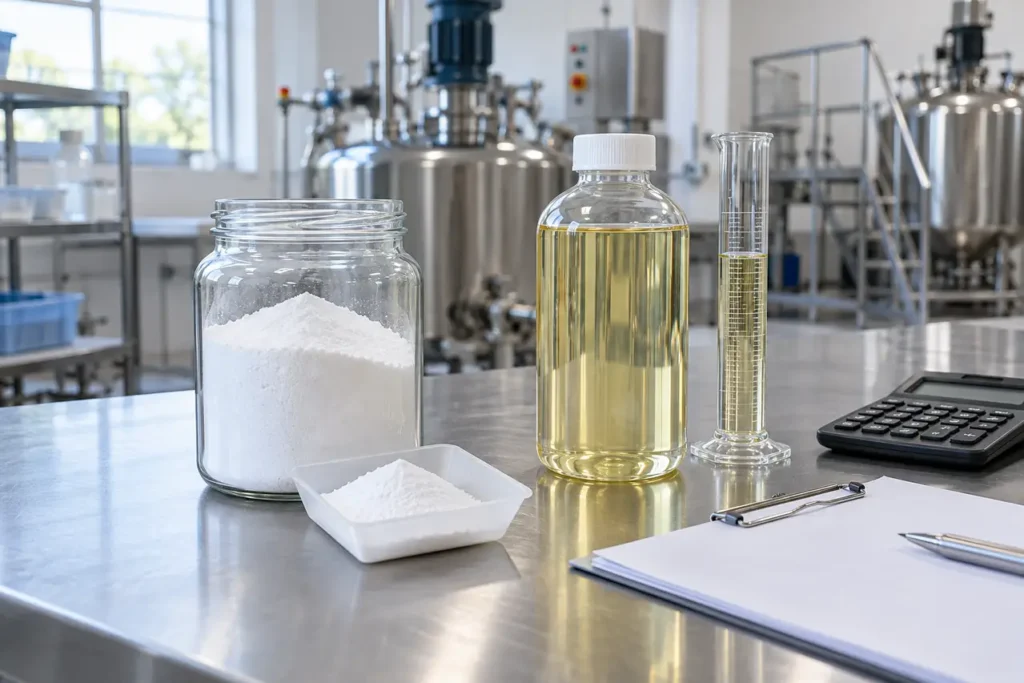
A lower price per delivered kilogram does not necessarily mean a lower cost in the finished batch. A liquid surfactant grade may contain substantial carrier water, while a concentrated powder may require controlled charging and longer dispersion. If purchasing compares drum price with bag price, the calculation misses both effects.
For KWCG-95 and KWCG-25, the practical answer is conditional. KWCG-95 suits projects that need a concentrated powder and have a workable powder-handling route. KWCG-25 suits plants that prefer liquid metering and can accommodate its water contribution. Compare the two on the same declared cocoyl glutamate basis first, then add the costs created by your equipment and batch procedure. A final formulation trial remains necessary because the two grades also have different salt-form compositions.
Start with usable ingredient contribution
The first comparison should remove carrier water from the purchasing picture. Choose a documented basis, such as declared cocoyl glutamate composition, and use it consistently for both grades. Do not switch between composition, active matter, solids, or assay unless the supplier documents show that the terms and methods are comparable.
The basic conversion is:
Raw material required (kg) = target declared cocoyl glutamate contribution (kg) / declared fraction
A grade with a declared fraction of 0.25 needs four delivered kilograms to supply one kilogram on that basis. A grade with a declared fraction of 0.95 needs about 1.05 delivered kilograms. This arithmetic does not say that different salt forms will perform identically. It gives purchasing and formulation teams a common mass basis before they compare price or run a trial.
Carrier water affects more than the formula
Water supplied with a liquid grade must be deducted from the separate water charge. In a conventional aqueous cleanser, this may be straightforward. In a concentrated base, paste, or water-limited format, the same carrier water can take up formula space needed for other ingredients.
The water also travels through the supply chain and the plant. It occupies package volume, warehouse space, handling capacity, and batch capacity. Those consequences vary by shipment size, warehouse layout, and production plan, so they belong in the buyer’s calculation rather than in a universal claim that powder or liquid is cheaper.
Package size matters here. A smaller pack may suit pilot production or sites with limited handling equipment. A larger drum may reduce the number of packages opened for a production run, but it can require pumps, drum handling, and a plan for residual material. Compare the pack with the normal batch size, not with an idealized full-container order.
Powder charging and liquid metering create different work
A concentrated powder reduces the mass of carrier water received. The plant still needs a controlled route from storage to the vessel. Review weighing accuracy, dust containment, operator exposure controls, wetting, addition rate, agitation, and the time needed to reach a uniform batch. The applicable SDS and site risk assessment should define the handling controls.
A liquid grade can move through a pump or measured transfer line. That can simplify charging when the equipment already exists. It can also add hose connections, drum or tote management, line hold-up, rinsing water, and residual material. A small plant that transfers liquid manually may not receive the same benefit as an automated line.
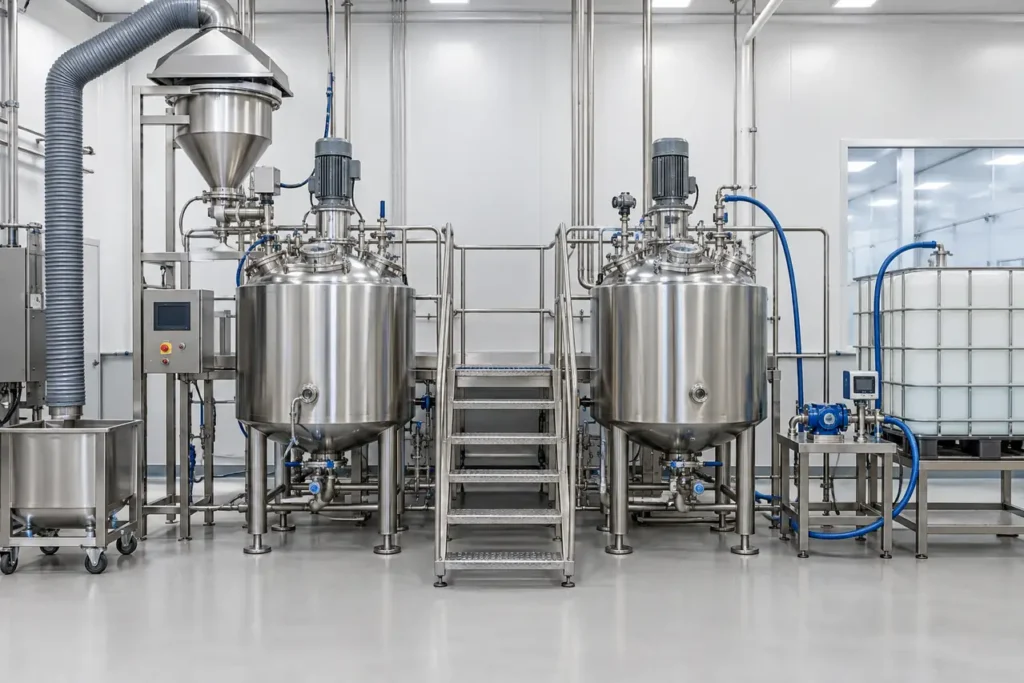
Cleaning also needs a real observation. Record the time, rinse water, product loss, and labor needed after each route. Do not assume that a liquid always cleans faster or that a powder always creates more loss. Vessel geometry, transfer lines, surface condition, and the formulation itself can change the result.
Build a total converted cost, not a price comparison
Calculate the landed raw-material cost per kilogram of the chosen declared basis:
Landed cost per kg declared content = landed price per kg raw material / declared fraction
Add only the operating costs that differ between the two routes:
Total converted batch cost = raw-material cost + receiving and storage + charging labor + utilities + cleaning + measured process loss
| Cost input | Evidence to collect | Common comparison error |
|---|---|---|
| Landed raw-material price | Same destination, quantity, currency, Incoterm, and quote date | Comparing an ex-works bag price with a delivered drum price |
| Declared content basis | Current specification and method definition | Treating content, active matter, and solids as interchangeable |
| Receiving and storage | Pack size, pallets, storage days, and equipment used | Ignoring the volume and number of packages handled |
| Charging and mixing | Recorded operator time, mixer power, temperature, and cycle time | Using a standard labor allowance that does not match the process |
| Cleaning and loss | Rinse volume, cleaning time, residue, and line hold-up from trials | Assuming either physical form has zero handling loss |
Batch size can change the result
A cost comparison should use the site’s normal batch and order pattern. If a trial or small production run uses only part of a 200 kg liquid pack, the calculation needs a realistic plan for the remaining material. Record how it will be closed, stored, identified, and used under the applicable supplier guidance and site procedure. Do the same for opened powder packs. Do not assume that every kilogram purchased immediately enters saleable production.
At larger scale, count how many packs must be opened and how many transfers the batch requires. A route that looks labor intensive in a 20 kg pilot may become efficient in a 2,000 kg batch, while a manual step that seems minor in the laboratory may become the production bottleneck. Calculate at the planned batch size and test the likely low and high order quantities. This shows whether the choice is stable or depends on one volume assumption.
Inventory policy also belongs in the model. Use the quoted minimum order, normal consumption, storage capacity, and approved storage period to estimate how long each shipment will remain on site. Keep this as a planning input until the current supplier documents and the site’s inventory rules confirm the allowable conditions.
Current comparison of INNO KWCG-95 and KWCG-25
INNO currently offers KWCG-95 as Sodium Cocoyl Glutamate powder and KWCG-25 as an aqueous blend of Disodium Cocoyl Glutamate and Sodium Cocoyl Glutamate. The current listed data provide the following starting comparison.
| Item | KWCG-95 | KWCG-25 | Purchasing consequence |
|---|---|---|---|
| INCI or composition | Sodium Cocoyl Glutamate | 75% Water, 20% Disodium Cocoyl Glutamate, 5% Sodium Cocoyl Glutamate | The liquid adds carrier water and a different salt balance. |
| Declared cocoyl glutamate content | 93.5% to 100% | 25% combined listed cocoyl glutamate salts | Compare cost per kilogram on the same declared basis. |
| Physical form | White solid powder | Pale-yellow or colorless transparent liquid | Charging equipment and process steps differ. |
| Standard pack | 15 kg | 200 kg | Match package handling with batch size and storage conditions. |
For a formula target of 5 kg combined declared cocoyl glutamate salts per 100 kg batch, KWCG-95 requires about 5.00 to 5.35 kg. KWCG-25 requires 20 kg and contributes 15 kg of water. The formulator should subtract that 15 kg from the separate batch-water charge.
The same data also give a raw-material break-even ratio. Before operating costs, the powder can cost about 3.74 to 4.00 times the liquid price per delivered kilogram and still have the same cost per kilogram of declared cocoyl glutamate content. The exact ratio depends on the applicable KWCG-95 content within its 93.5 to 100 percent listed range. This is a composition-based purchasing calculation only. It does not establish equal performance or an actual market price position.
Confirm the decision in one production-relevant trial
Run the first comparison at equal declared cocoyl glutamate contribution and constant final batch mass. Rebalance water, keep the surrounding surfactant system unchanged, and use the charging procedure intended for each physical form. Set the finished pH after the complete blend is present.
Record total cycle time rather than mixing time alone. Include weighing or pumping, transfer, rinsing, cleaning, and any hold needed for full dispersion. Measure residual material in the package or line where practical. Then compare the finished samples for appearance, pH, viscosity, foam in the chosen method, and stability at defined conditions.
A laboratory trial can screen formulation fit, but it may not expose the production cost difference. A pilot or observed plant batch is more useful for labor, cleaning, loss, and equipment capacity. Keep those operating records separate from the technical acceptance results so purchasing can see why the final route was selected.
Selection rule
Choose KWCG-95 for evaluation when formula water is limited, a concentrated powder improves the material balance, and the site can charge and disperse it safely. Choose KWCG-25 for evaluation when liquid metering fits the line, a 200 kg pack matches production, and the formula can absorb the 75 percent carrier water. If neither route fits the current equipment, the equipment constraint should be resolved before a price comparison decides the grade.
Request a batch-specific comparison
Send INNO your target product format, batch size, planned cocoyl glutamate contribution, target pH, available powder and liquid handling equipment, current process time, destination, and normal order quantity. INNO can prepare a KWCG-95 versus KWCG-25 starting calculation, current document pack, and sample plan for the conditions that determine your total converted cost.