A supplier evaluation guide for separating grade identity, content basis, physical form, documentation, and formulation performance.
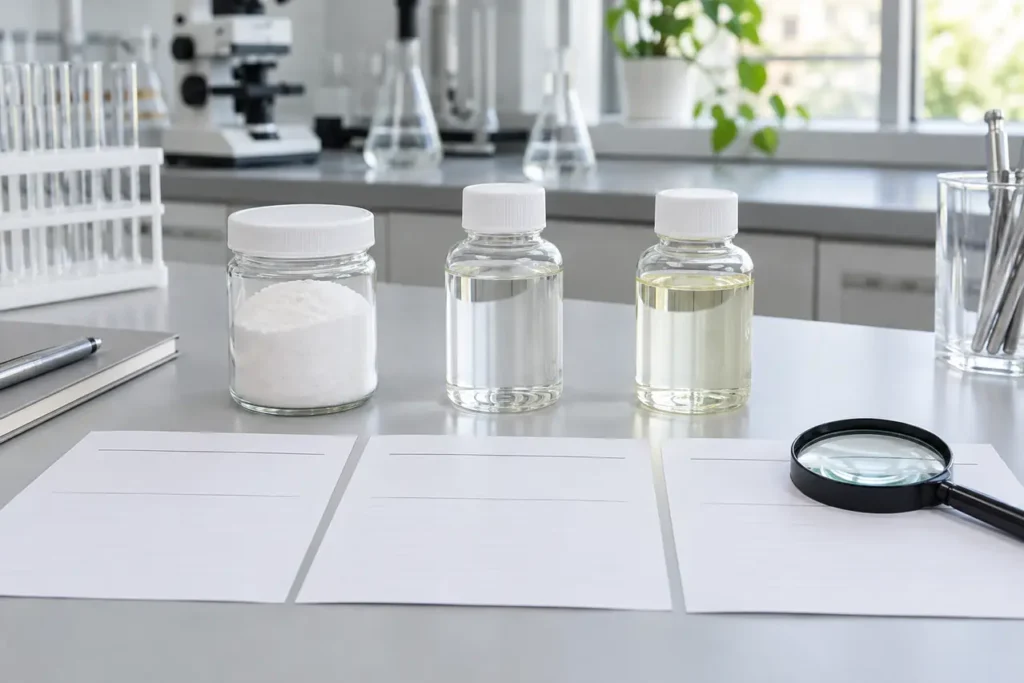
A brand family can include several salt forms and concentrations. Start with the exact grade code and current documents.
An “AMISOFT alternative” or “PROTELAN alternative” is not specific enough for a purchase or formulation trial. Each product family contains different grades, and those grades may differ in salt form, concentration, carrier water, and physical form. Comparing only the brand name can put a concentrated powder beside a 25 percent liquid and call them equivalent.
The useful first question is simpler: which exact supplied material are you replacing? For a concentrated Sodium Cocoyl Glutamate powder route, the relevant shortlist is different from the shortlist for a liquid blend of Disodium Cocoyl Glutamate and Sodium Cocoyl Glutamate. Match that route first. Then compare document definitions and samples under the same conditions.
Start with the complete grade identity
Write the supplier, trade name, full grade code, and complete INCI on one line. Do not shorten the entry to “cocoyl glutamate.” Sodium Cocoyl Glutamate and Disodium Cocoyl Glutamate describe different salt forms, and a commercial liquid may contain both. Water and any additional INCI components also belong in the comparison.
This identity check prevents a buyer from comparing different salts and helps the formulator account for carrier water. It also stops a plant from receiving a physical form that does not fit its charging equipment. A single percentage cannot resolve any of these differences.
Ask the supplier to confirm whether the grade name covers regional, preservative, certification, or physical-form variants. A suffix can matter. The controlled documents attached to the current quotation should identify the exact material being offered.
Build separate powder and liquid shortlists
For a concentrated powder project, compare powder grades with the same complete INCI before considering aqueous options. Ajinomoto’s 2022 amino acid ingredients brochure lists AMISOFT CS-11 and CS-11(F) as Sodium Cocoyl Glutamate in powder and flake forms, with 100 percent shown in the composition column. That public brochure is useful for route selection, but a current controlled specification is still needed for an actual order.
For a 25 percent mixed-salt liquid project, the same Ajinomoto brochure lists AMISOFT CS-22 as a 25 percent aqueous solution containing 20 percent Disodium Cocoyl Glutamate, 5 percent Sodium Cocoyl Glutamate, and 75 percent water. The separate AMISOFT CS-22 product brochure also describes 25 percent active ingredient in aqueous solution.
Zschimmer & Schwarz’s 2023 Personal Care product list lists PROTELAN AG 37 as a liquid with Disodium Cocoyl Glutamate and Sodium Cocoyl Glutamate and 25 percent active matter. The document does not give the ratio of those salts in the table. That missing detail should be confirmed before treating the grade as compositionally matched to another 25 percent liquid.
Do not rank percentages until the definitions match
Supplier documents may use terms such as composition, content, active matter, solids, or assay. The numbers can look comparable while representing different analytical routes. A brochure composition column may describe the formula of the supplied grade. An active-matter result may come from a defined test. An assay may measure a named chemical component. These fields should not be placed in a winner-and-loser table without the definitions and methods.
For each candidate, request the specification name, unit, test method, sample preparation, and acceptance range. If the method is proprietary, the supplier can still state what the result represents. Purchasing can then calculate on a declared basis and QA can decide whether the methods are close enough for direct comparison.
Use this calculation only after selecting one documented basis:
Required raw material = target contribution on the chosen basis / grade fraction on the same basis
Equalizing the number is a starting control, not proof of equal cleansing, foam, viscosity, mildness, or stability. The salt balance, impurities, carrier, pH, and surrounding formulation still influence the finished product.
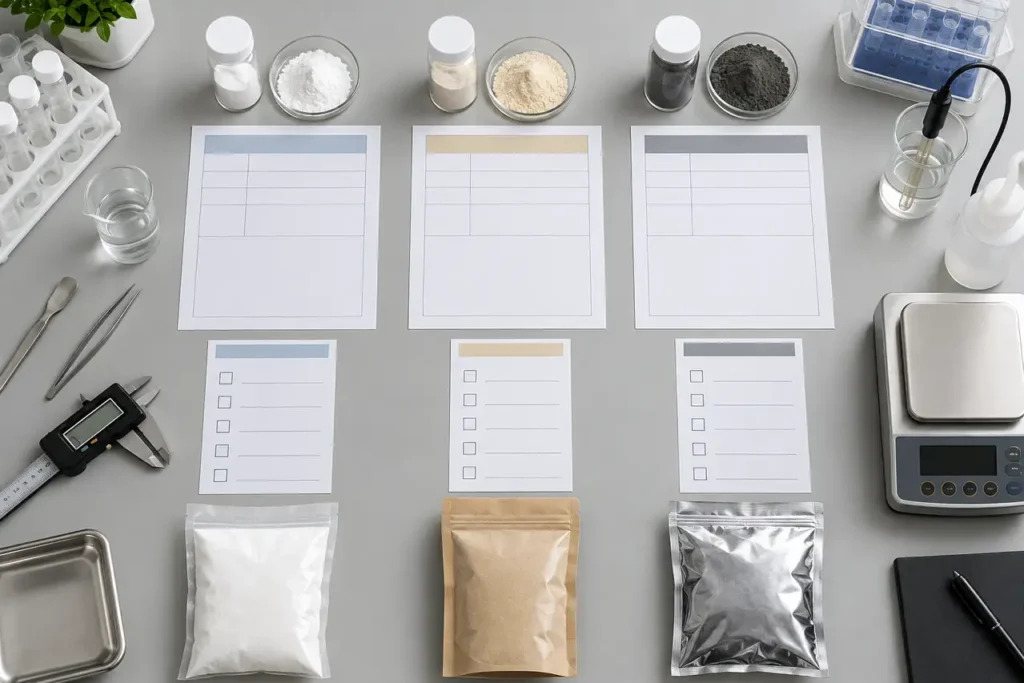
Compare the document field and its method before comparing the number. The image is illustrative and shows no approved supplier result.
The document pack should answer six questions
| Question | Document or evidence | Decision supported |
|---|---|---|
| What enters the batch? | Complete INCI and composition statement | Salt form, carrier water, and label review |
| What does the reported percentage mean? | Controlled specification and test method | Dosage and cost normalization |
| What must each lot meet? | Specification limits and representative COA format | Incoming quality plan |
| How should the material be handled? | Current SDS and storage guidance | Site handling and storage review |
| Which physical form and pack are offered? | Quotation, TDS, and packaging statement | Equipment, warehouse, and batch-size fit |
| Which project claims need support? | Current supplier declarations or certificates for the named grade and scope | Market-specific approval without extending a document beyond its scope |
A public brochure helps create the shortlist. It should not replace the current specification, SDS, COA format, and declarations supplied with a commercial offer. Document dates matter because product names, regional versions, and acceptance limits can change.
Current route comparison for KWCG, AMISOFT, and PROTELAN
INNO currently offers KWCG-95 for the concentrated Sodium Cocoyl Glutamate powder route and KWCG-25 for the 25 percent mixed-salt liquid route. The table below uses only fields shown in the current INNO product list and the cited public competitor brochures.
| Route | INNO | AMISOFT public reference | PROTELAN public reference | What remains to confirm |
|---|---|---|---|---|
| Concentrated Sodium Cocoyl Glutamate solid | KWCG-95: Sodium Cocoyl Glutamate; 93.5% to 100% listed content; white powder; 15 kg pack | CS-11 / CS-11(F): Sodium Cocoyl Glutamate; 100.0 in the 2022 brochure composition column; powder / flake; 15 kg carton | No directly matching concentrated Sodium Cocoyl Glutamate powder is shown in the reviewed 2023 PROTELAN surfactant table | Current specification, method, physical variant, and commercial availability |
| 25% mixed-salt aqueous liquid | KWCG-25: 75% Water, 20% Disodium Cocoyl Glutamate, 5% Sodium Cocoyl Glutamate; liquid; 200 kg pack | CS-22: 75% Water, 20% Disodium Cocoyl Glutamate, 5% Sodium Cocoyl Glutamate; 25% aqueous solution; 18 kg can, 200 kg drum, 1 t container in the 2022 brochure | AG 37: Disodium Cocoyl Glutamate, Sodium Cocoyl Glutamate; 25% active matter; liquid in the 2023 product list | Current methods and limits; exact PROTELAN salt ratio and carrier composition |
The table does not declare a universal substitute. It identifies which candidates deserve the next document request. KWCG-95 and AMISOFT CS-11 are closer process comparators for a concentrated powder route. KWCG-25, AMISOFT CS-22, and PROTELAN AG 37 belong in a liquid-route review, but AG 37 still needs a full current composition and method check before dosage is aligned.
Compare cost on the approved basis
Use quotations with the same currency, quantity, destination, Incoterm, and date. Divide each landed price by the fraction established on the approved comparison basis. Then add the route-specific costs for storage, powder charging or liquid metering, mixing, cleaning, package residue, and quality control.
A price per kilogram of raw material cannot settle the decision when one grade is concentrated and another contains mostly water. Nor can an equal-cost calculation settle the formulation choice. Keep the commercial calculation and the technical trial side by side, then approve a grade only when both fit the project.
Use coded samples in a matched trial
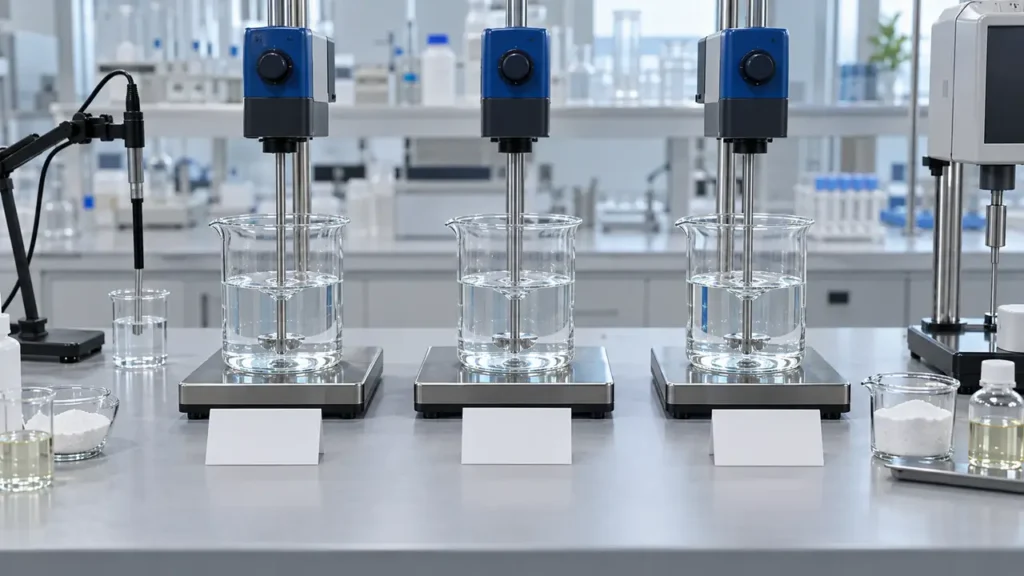
Prepare a written trial sheet before samples arrive. Give each sample a code so the first visual and handling observations do not depend on the brand name. Record lot number, received condition, document version, calculation basis, and the exact raw-material amount used.
Keep the base formula, final batch mass, water contribution, addition order, temperature, shear, mixing time, and final pH consistent. If powder and liquid routes require different charging steps, document the necessary difference rather than forcing one procedure onto both. Compare appearance, pH, viscosity, foam using the selected method, odor, and stability at defined time points.
Repeat the preferred candidate at least once before scale-up, then confirm it in the intended production process. A single clear beaker does not prove manufacturing fit or long-term supply suitability. QA and purchasing should also agree on the incoming specification fields that will control future lots.
Sample approval and supplier approval are separate
A sample can pass the formulation trial while the commercial grade still lacks a document needed by QA or the target market. Before final approval, connect the tested sample code to its supplier lot, exact grade suffix, manufacturing or distribution source, and document versions. Confirm that the quoted material is the same grade that entered the trial.
Set the change-control expectations before the first purchase. Ask how the supplier communicates changes to composition, specification, test method, production site, or regulatory documents. Define which changes require notice, a document review, or a new sample. This is especially useful when a brand family has regional or physical-form variants that share a similar name.
Purchasing should also compare minimum order quantity, pack options, lead-time basis, shelf-life documentation, and the process for handling a quality question. These fields are not reasons to assume that one supplier is better. They determine whether an approved laboratory result can be supported under routine buying and production conditions. Use current written offers for the comparison, since public brochures rarely contain all of these commercial details.
Selection rule
For a concentrated powder project, compare KWCG-95 with a current AMISOFT CS-11 or other exact powder offer on the same documented basis. For a 25 percent mixed-salt liquid project, compare KWCG-25 with the exact AMISOFT CS-22 and PROTELAN AG 37 offers after confirming current composition and methods. If the candidate changes both salt form and supply form, treat it as a reformulation trial rather than a routine supplier switch.
Request a matched grade assessment
Send INNO the current supplier and full grade code, the TDS, specification, SDS, and representative COA, plus your use level, calculation basis, target pH, product format, batch size, and charging process. INNO can return a field-by-field comparison against KWCG-95 or KWCG-25 and prepare samples for a controlled side-by-side trial.