A scale-up mismatch becomes actionable when the laboratory and factory routes can be compared stage by stage. In a 2019 shampoo scale-up case, the raw-material suppliers and formula proportions stayed the same, while the factory used a different mixing sequence. The record gives us one confirmed process divergence. This article helps you identify the first meaningful process difference, build a practical comparison sheet and decide what one controlled production trial should test next.
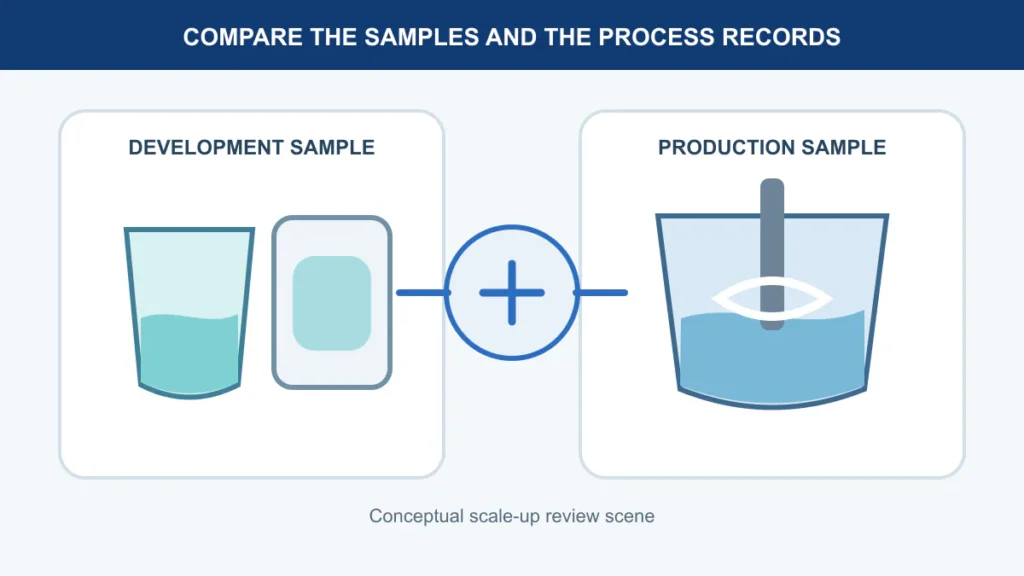
Conceptual comparison of development and production samples before their process records are aligned.
The 2019 record isolates one process divergence
The shampoo formula had gone through several development adjustments before it moved to an OEM factory. The development sample met the customer’s target, but repeated factory samples differed from it.
The review established two fixed points: the raw-material suppliers had not changed and the formula proportions had not changed. The factory process had. Its usual sequence introduced homogenization early to speed AES dissolution instead of following the development route.
| Recorded point | Case detail |
| Year | 2019 |
| Development status | The adjusted development sample met the customer’s target |
| Recorded fixed variables | Raw-material suppliers and formula proportions |
| Recorded process difference | The factory used its usual sequence and homogenized to speed AES dissolution |
| Engineer’s attribution | The early homogenization stage affected the high-molecular-weight conditioning polymer |
| Reported consequences | Product performance, viscosity and stability were affected; no numerical results were recorded |
Source: a 2019 case shared by an INNO collaborating formulation engineer in the shampoo formulation and process training resource, page 80. Customer and factory identities are omitted.
The engineer connected the early homogenization step with the high-molecular-weight conditioning polymer and the resulting change in product performance, viscosity and stability. The source does not identify the exact polymer grade or provide measured before-and-after values. Those details remain outside the evidence available for this case.
Build a lab-to-factory process-equivalence sheet
A useful scale-up review puts both routes into the same structure. The aim is to show where the two processes first stop being equivalent and what each ingredient experiences at that point.
Define the property that must transfer
“The factory sample is different” leaves several possible investigations open. We would first name the property that changed, such as viscosity, conditioning feel or a stability observation, and record how and when both samples were evaluated. This gives the next trial a defined output instead of a general request to reproduce the lab sample.
Compare process stages rather than equipment names
Laboratory and factory equipment do not need the same name or scale. Their process purpose and endpoint still need to be comparable. The review becomes clearer when addition, wetting, dissolution, polymer preparation, homogenization, finishing and equilibration are shown as stages.
| Comparison field | Laboratory record | Factory record | Why it belongs in the review |
| Formula version and batch basis | Version and batch size used for the approved sample | Version and batch size used in production | Confirms that the comparison starts from the intended formula |
| Ingredient identity | Supplier and grade recorded for relevant materials | Supplier and grade recorded for the factory batch | Separates a material change from a process change |
| Addition sequence | Stage and order used in development | Stage and order used in production | Reveals the first point at which ingredients met different conditions |
| Mixing operation | Mixer type, purpose, duration or endpoint | Mixer type, purpose, duration or endpoint | Makes “mix” and “homogenize” operationally comparable |
| Temperature and pH history | Readings at relevant stages | Readings at the same relevant stages | Shows whether the material experienced another process environment |
| Evaluation | Method, timing and result for the target property | Matching method, timing and result | Prevents a test-method difference from being mistaken for a process effect |
Record what the conditioning polymer experienced
For this 2019 case, the process sheet needs to show when the conditioning polymer was prepared, when it entered the main batch and whether high shear occurred before or after that stage. The historical record points to early homogenization, but a new project still needs its own grade, equipment and process information.
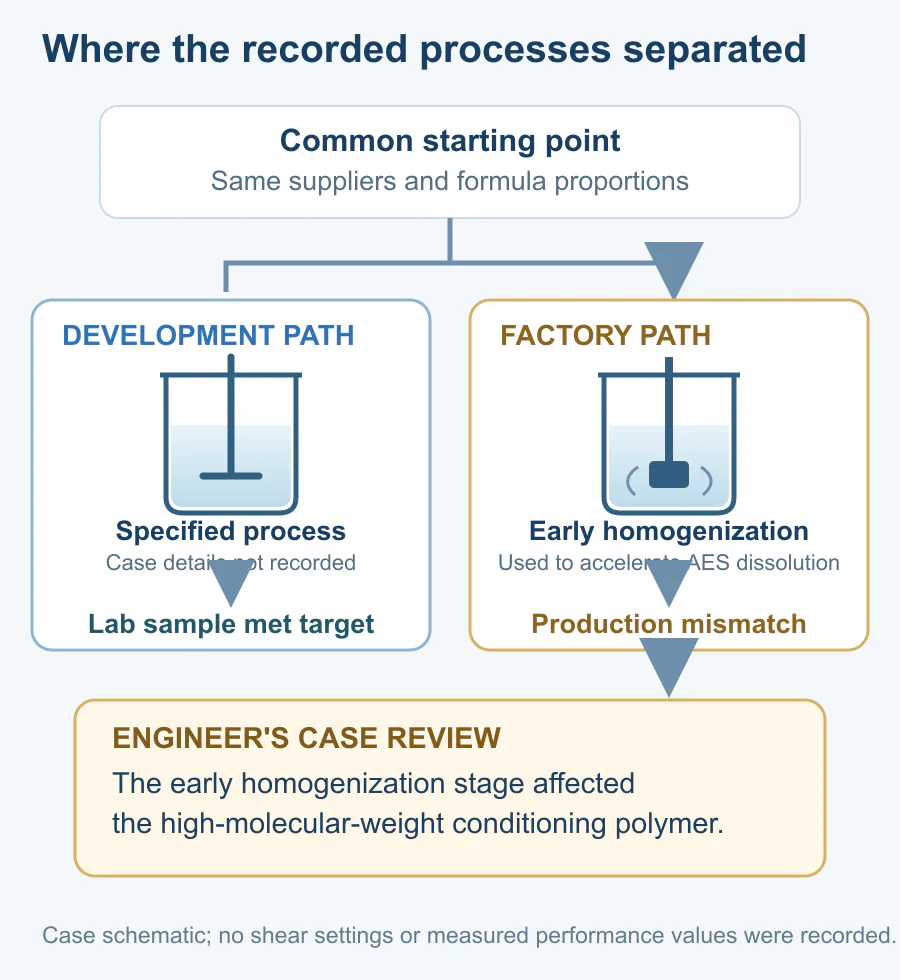
Process sequence reconstructed from the 2019 case record. It separates the common starting point from the first recorded divergence.
Use the first divergence to design one confirmation trial
Once the first meaningful divergence is visible, the next comparison can change that feature while keeping the rest of the test readable. In a case like this, one route can follow the documented development sequence and the other can use the proposed factory sequence under recorded conditions.
| Trial element | Control route | Comparison route | Record used for the decision |
| Formula and relevant grades | Held constant | Held constant | Batch sheet and material identity |
| Process sequence | Documented development route | One selected factory-stage difference | Time-stamped process record |
| Target property | Same agreed method and timing | Same agreed method and timing | Viscosity, stability or sensory result defined for the project |
| Other changes | Kept outside this comparison | Kept outside this comparison | Deviation record if an additional change occurs |
The measurement should follow the original mismatch. If viscosity changed, both samples need the same method, temperature and equilibration time. If conditioning feel changed, the evaluation basis should be agreed before the samples are compared. Stability observations need their own conditions and schedule.
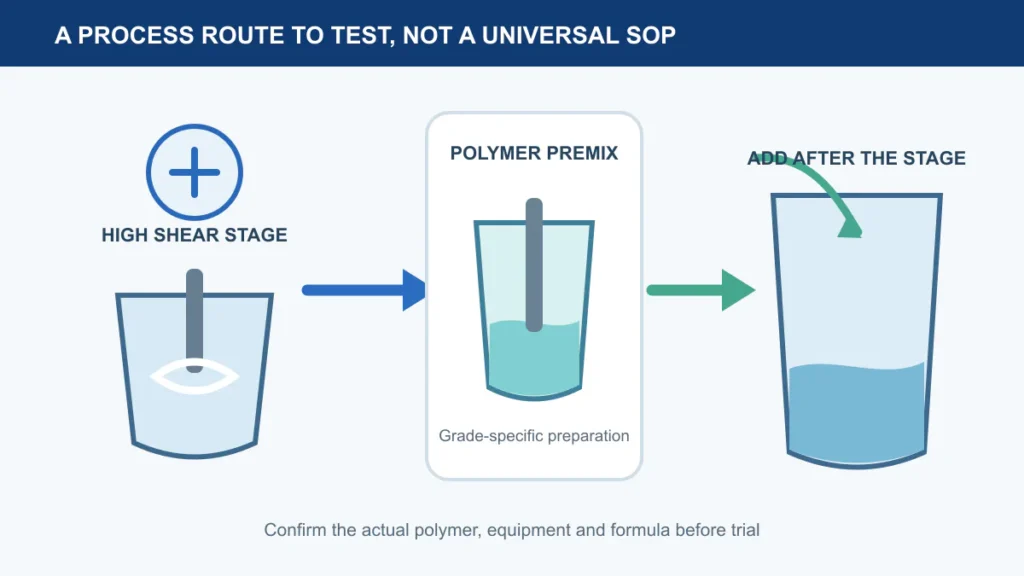
One comparison route discussed in the historical review places conditioning-polymer addition after the high-shear stage. The suitable route still depends on the actual grade and process.
The source ends with an engineering attribution and a proposed process route. It does not record a recovery trial, quantified improvement, saved batch or cost reduction. The table above is a method for the next investigation, not a claimed result from 2019.
Turn the comparison into a usable factory handoff
A useful handoff carries the conditions that the approved sample depended on. It can remain short if each line has a clear purpose:
- approved formula version and batch basis;
- relevant ingredient supplier and grade;
- preparation and addition sequence;
- mixing purpose, equipment and endpoint at each relevant stage;
- temperature, pH and hold points;
- target property, test method and evaluation time.
This record does more than tell production to copy a beaker procedure. It explains which process conditions support the target and which observations confirm that the larger batch remains comparable.
Choose the investigation that matches the symptom
This page is for a shampoo that matched the brief in development but changed during factory replication. If the main problem is small semi-transparent particles that remain after mixing, our transparent particles in shampoo case review provides the more relevant preparation-record investigation.
For a wider view of how INNO organizes shampoo and body wash discussions, see our formulation support update.
Start an INNO scale-up review with two facts
If your production sample does not match the lab sample, send us two facts: which property changed and whether both samples used the same formula. We can then place the two process sequences beside each other and identify the first records needed for a useful comparison.
Our Shampoo & Scalp Care application page provides the wider formulation context. INNO’s formulation support services cover the route from requirement discussion to sample evaluation.
Share the property that changed and whether both samples used the same formula. A process sequence can follow once the mismatch is defined.
FAQ
Does production need to use the same equipment as the lab?
Different equipment can be acceptable when both teams understand the purpose and endpoint of each step. Mixer type, batch size, operating stage and relevant settings make the process difference visible instead of hiding it behind an equipment name.
What if the factory instruction only says “homogenize”?
The useful details are the stage, purpose, relevant settings, duration or endpoint, and the ingredients present at that time. Together, they show what the polymer experienced and support a controlled comparison with the lab process.
Should every shampoo avoid homogenization?
Homogenization should be assessed against the formula, polymer grade, equipment and processing stage. In this recorded case, the engineer linked an early homogenization step to the mismatch. Another shampoo needs its own process review and confirmation trial.