Transparent particles in shampoo can remain visible even after another round of homogenization. In a 2015 case reviewed by an INNO collaborating formulation engineer, small, semi-transparent particles became smaller but did not dissolve. The review linked the defect to incomplete polymer hydration after preparation was interrupted. This case helps you identify the process records worth comparing before deciding whether further mixing is a sensible next step.
What happened when polymer preparation was interrupted
The production team prepared part of an afternoon shampoo batch before a midday break. After compounding, small, semi-transparent particles appeared in the bulk. Homogenization reduced their size, but the particles remained undissolved. The case record states that the whole batch was discarded.
The engineer attributed the problem to stopping preparation before the conditioning polymer had fully swollen. The discussion names cationic guar and cellulose as relevant conditioning-polymer types, but it does not identify the exact commercial grade used in that batch.
| Recorded point | Case detail |
| Year | 2015 |
| Preparation context | Part of the later batch was prepared before a break |
| Visible defect | Small, semi-transparent particles after compounding |
| Later intervention | Homogenization made the particles smaller; they remained undissolved |
| Engineer’s diagnosis | Incomplete polymer hydration during interrupted preparation |
| Recorded outcome | The batch was discarded |
Source: a case review shared by an INNO collaborating formulation engineer, in the shampoo formulation and process training resource, page 79. Customer identity is omitted.
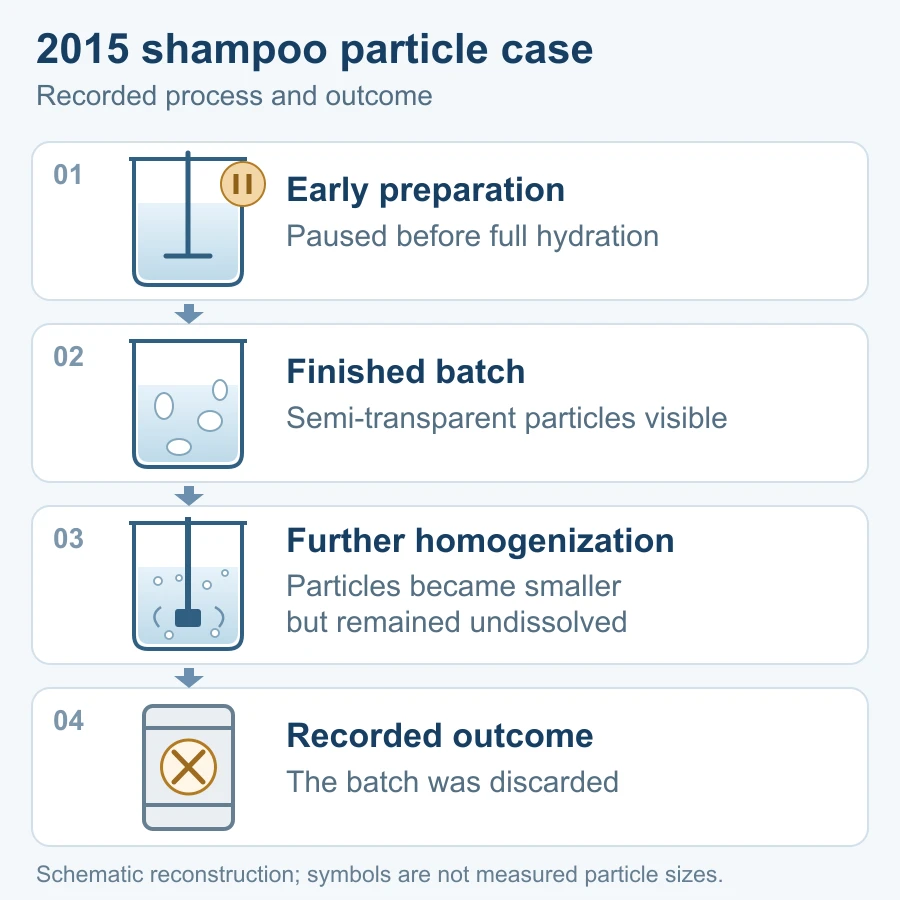
Schematic reconstruction of the recorded sequence. Vessel and particle symbols are illustrative, not sample photographs or measured particle sizes.
Smaller particles did not mean complete hydration
In this shampoo case, the visible response to homogenization was a reduction in particle size, not a return to a uniform finished product. That distinction matters when judging a proposed correction. A change that makes a defect less conspicuous has not necessarily resolved the underlying preparation problem.
Dispersion and hydration describe different parts of polymer preparation. Dispersion distributes material through the liquid; hydration involves water entering and hydrating the polymer. Silverson’s technical explanation of gum and thickener hydration describes how partially hydrated agglomerates can retain a dry powder core. This offers a possible explanation for persistent lumps, but the case record contains no analysis proving the internal structure of these particular particles.
The same equipment source describes applications in which high shear is useful for dispersion. The lesson is therefore specific: further homogenization did not resolve this recorded shampoo defect. A decision about shear in another formula needs the polymer grade, its preparation requirements, and the stage at which the mixer is used.
The preparation record is the best place to narrow the question
For a shampoo defect that resembles this case, the most informative comparison is between the intended polymer preparation and what actually happened before the particles appeared. Three parts of that record deserve attention.
Identify the polymer before choosing a hydration route
A trade name, grade, and current supplier instruction provide a firmer basis than the word “guar” or “cellulose” alone. The original review describes a guar preparation sequence involving dispersion, transfer, acid addition, and swelling before other ingredients. It also discusses cellulose preparation separately.
For a specific ingredient, the supplier’s technical guidance is the basis for reviewing preparation conditions. The useful follow-up is to compare that guidance with the liquid medium, addition order, pH conditions, and mixing stage used in the batch.
Locate the interruption, not just the total mixing time
An interruption before the intended hydration stage is complete is central to this case. A single total mixing time can hide that interruption: time before the break, time standing, and time after restarting describe different parts of the process.
A timeline can show when the polymer entered the liquid, whether mixing continued during addition, what condition the preparation had reached before stopping, and what happened next. The purpose is to identify the missing or changed step, rather than assume that a longer final mixing period recreates the intended preparation.
Connect each later addition with the first observation
The first point at which particles were observed helps define the investigation. A retained preparation sample, an operator observation, or a clear photograph may show whether the defect was present before the remaining ingredients entered the batch.
If particles were noticed only at final inspection, that is a gap in the observation record, not proof that they formed at the end. Keeping the observation time separate from the assumed formation time makes the next technical discussion more precise.
A confirmation trial should answer one process question
A useful next trial would test the proposed preparation explanation under controlled conditions. For example, the team could compare its documented current sequence with a supplier-supported hydration sequence while holding the polymer grade and formula version constant. This is a proposed investigation, not a recovery trial reported case.
The comparison should state what will be observed and when. Particle persistence and bulk uniformity address the visible problem. If viscosity or conditioning performance is also part of the product brief, each needs an appropriate comparison; a smooth appearance alone cannot establish those results.
The trial record should retain the grade, preparation medium, addition stages, relevant temperature and pH readings, mixing equipment, and any interruption. A practical decision can then be tied to the observed difference. Additional ingredients or process changes belong in a separate comparison if they would make the cause difficult to distinguish.
Rework and release of an affected batch require a decision by the manufacturer’s quality and technical teams under an approved procedure. The proposed comparison trial is an investigation, not release authorization.
Start the discussion with the symptom you can describe
A product type and a particle photograph or short description are enough to begin a discussion with INNO. It helps to say whether the particles remain after mixing and when you first noticed them.
Through INNO’s formulation support services, the next discussion can focus on the relevant polymer and preparation records once the symptom is understood. That keeps the information request connected to your batch problem.
Discuss my shampoo particle problem
Share your product type and a particle photograph or one sentence describing the defect.
FAQ
Can a photograph identify the material inside a shampoo particle?
A photograph can document appearance, shape, and distribution. It cannot establish chemical identity. Material identification may require a sample examination and an analytical method selected for the suspected cause.
Should a replacement polymer grade use the previous grade’s preparation time?
The replacement grade needs a review against its own supplier instructions and a controlled formulation check. A time taken from another grade or training example is not a verified preparation condition for the replacement.
Is a retained sample useful when the production timeline is incomplete?
Yes. A retained sample can support a comparison with another batch or preparation stage. Its label, source, and storage history still matter, and it cannot reconstruct an unrecorded mixing interruption by itself.