A cleanser plant wants to cut a heating stage from a short production run. The surfactant is available as a liquid, so the proposal sounds easy: charge it, mix the batch, and keep the steam valve closed. Then the first pilot stays hazy because the surfactant was only one reason the old process used heat.
A cold process liquid amino acid surfactant can remove a powder-specific wetting and hydration step. The whole formula determines whether the process can stay cold. The lower-temperature route works when every other ingredient can be incorporated at that temperature, the chosen rheology develops correctly, the batch stays uniform, and the finished product passes its normal quality program.
For KWLG-25, the practical question is narrower and more useful: can its liquid form remove the heating associated with preparing Sodium Lauroyl Glutamate in your current batch? You can use the review below to identify the remaining thermal jobs and set up one paired trial without redesigning five things at once.
A liquid surfactant may shorten the route into the vessel. The rest of the formula still decides how low the process temperature can go.
Find out what the heating stage is doing
Heating usually survives in a batch sheet because it completes a specific job. Sometimes that job is powder dispersion. In other formulas it melts a structurant, helps a polymer hydrate, supports a premix, or simply follows an old process that nobody has challenged recently.
One short process review usually reveals whether the temperature is still earning its place. For each heated step, record the ingredient present, the condition before heating, the visible or measurable endpoint, and what happens downstream. If the endpoint is already reached after a liquid surfactant charge at the proposed lower temperature, that stage becomes a credible candidate for removal.
| Why the current process uses heat | What the lower-temperature trial must show |
| Disperse or hydrate a surfactant powder | The liquid route reaches a uniform aqueous phase without powder residue or a separate hydration hold |
| Melt a fatty material or waxy structurant | The ingredient enters the batch completely through an approved premix or another feasible route |
| Hydrate a polymer | The polymer develops the required flow and remains free of fisheyes under the revised sequence |
| Improve solubilization of fragrance or oil | The completed batch remains acceptably clear or homogeneous after the normal hold |
| Follow a legacy batch instruction | The lower-temperature control gives equivalent processing and finished-product results |
This distinction keeps the project honest. Changing KWLG-95 powder to KWLG-25 liquid may remove the first row. It says nothing by itself about the other four.
What KWLG-25 changes in the vessel
The current product record describes KWLG-25 as a colorless to light-yellow aqueous liquid containing 24-26% Sodium Lauroyl Glutamate. The listed carrier and co-components are 73-76% water, up to 0.5% Sodium Chloride, 0.2-0.6% Phenoxyethanol and 0.1-0.3% Caprylyl Glycol.
Its physical form changes the addition route. The batch no longer needs the powder-specific charging, wetting and dispersion sequence used to prepare a concentrated solid grade. It also changes the mass balance because most of the supplied material is the aqueous carrier and other declared components. A lower-temperature trial therefore starts from an equal-active, water-corrected formula rather than a one-for-one replacement by weight.
The Sodium Lauroyl Glutamate guide covers the wider difference between ingredient identity and supplied grade. For this process decision, the useful takeaway is simple: liquid form may remove one thermal job, while supplied composition creates a new formula accounting job.
The formula sets the real temperature floor
A plant can charge KWLG-25 at a modest temperature and still need heat later. Fragrance premixes, pearlizers, fatty thickeners, some solubilizers and some rheology systems can each set their own process requirement. The lowest workable temperature is therefore the highest minimum required by any essential step in the complete formula.
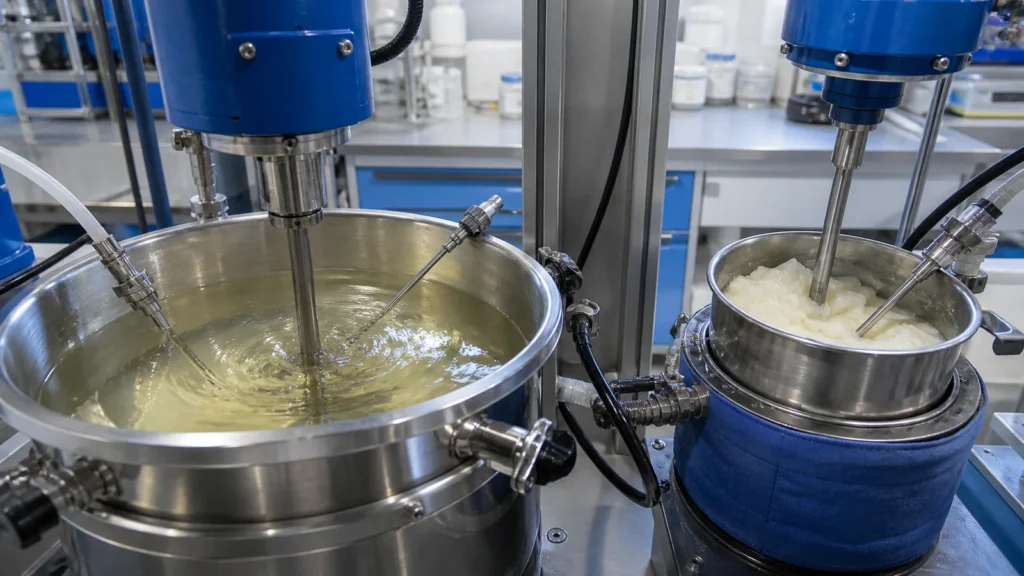
The surfactant route and the formula’s remaining thermal jobs can be separated. That often saves more energy than forcing every ingredient into one cold vessel.
This opens a useful middle ground. A batch may run mainly at lower temperature while a small side phase receives the heat it genuinely needs. The gain is then measured across the whole process: heating time, peak temperature, cooling time, mixing time and cleaning. A lower peak that adds a long premix or a difficult transfer is a trade, not a free saving.
The first screening discussion is often settled by four questions:
- Does any ingredient need to melt or hydrate above the proposed vessel temperature?
- Can the fragrance, oil and preservative route remain uniform under the revised sequence?
- Does the viscosity system build after final pH and all electrolytes are present?
- Can production reproduce the sequence with its actual mixer, charge rate and hold times?
Those answers define the candidate process before the pilot starts. They also prevent a good liquid-surfactant idea from being blamed for an unrelated wax or polymer problem.
Compare a thermal control with one lower-temperature route
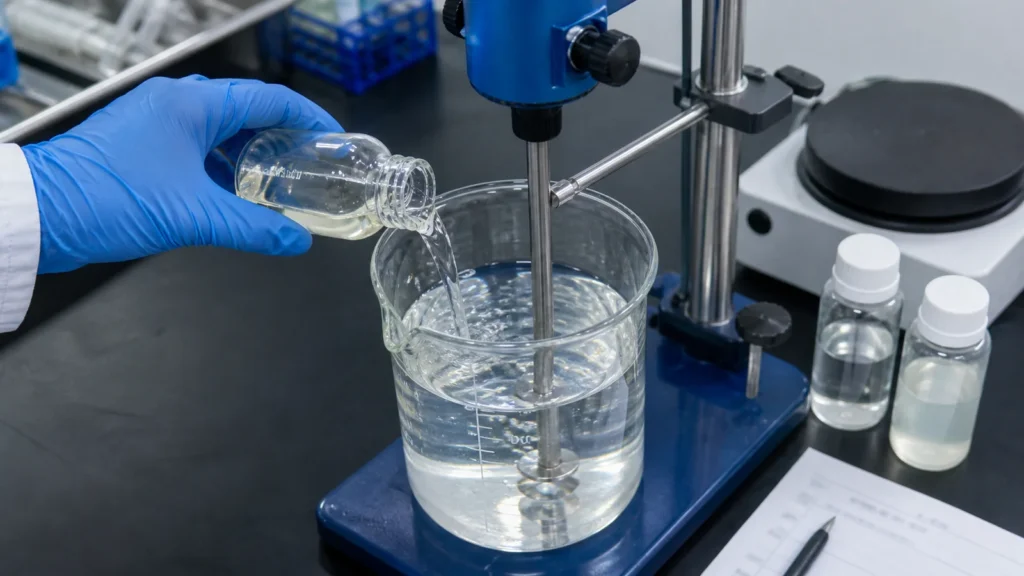
The cleanest experiment uses the current heated process as the control and changes only the temperature path and the surfactant addition route in the candidate. Both batches should use the same raw-material lots, active contribution, formula total, mixer geometry and final test schedule as far as the equipment allows.
During processing, record the time to a uniform phase, actual batch temperature, mixing time, visible residue, aeration and any corrective addition. After the normal hold, compare appearance, pH, viscosity under one defined method, odor and the performance tests that belong to the product brief. The finished package and filling behavior matter if lower process temperature changes deaeration or flow at the filler.
Fresh appearance is only the first checkpoint. The lower-temperature sample enters the same stability, preservation and package-compatibility program as the control. Cosmetics Europe guidance on cosmetic stability testing supports building the program around the product’s relevant aesthetic, functional and package characteristics rather than relying on one universal schedule.
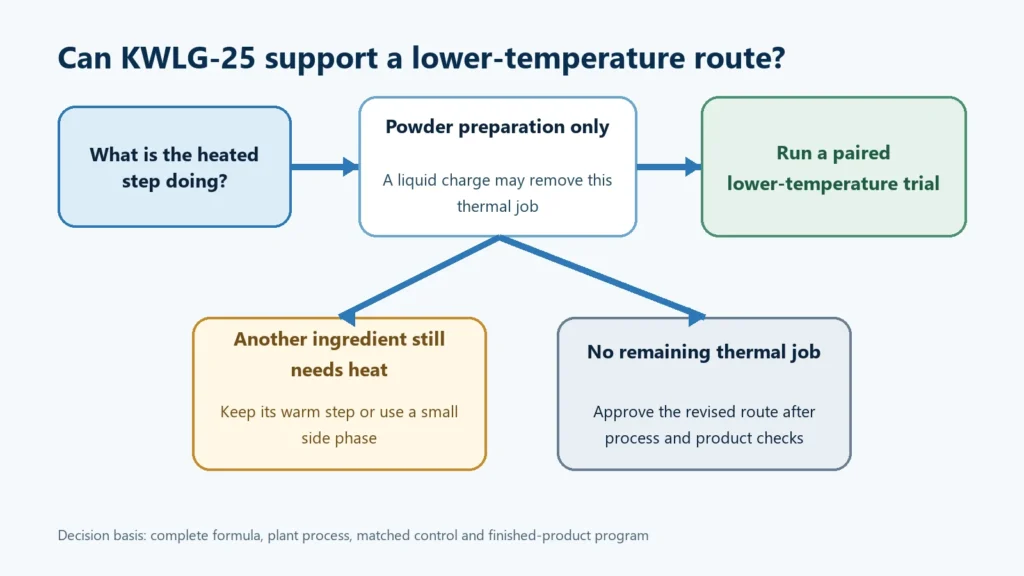
The decision follows the remaining thermal jobs, the complete formula and the plant result. The liquid grade is one part of that route.
Give production a process it can repeat
A successful beaker trial still needs a usable batch instruction. The revised record should identify the permitted charge-temperature window, addition order, mixing endpoint, any separate warm premix, pH adjustment point, final hold and the checks that release the batch to filling. It should also state what production does when a step misses its endpoint.
That level of control is proportionate to the change. ISO 22716 covers the quality aspects of cosmetic production, control, storage and shipment. A temperature reduction belongs in that controlled process, with an approved instruction and a traceable result rather than an operator’s memory of the pilot.
When the route works, the benefit is tangible: less time spent preparing a surfactant powder, a lower thermal load where the formula allows it, and a shorter path from raw-material charge to finishing. When another ingredient still sets the temperature, KWLG-25 can still simplify the surfactant stage. The project does not have to claim “fully cold process” to be worthwhile.
Bring INNO the process question, not a generic cold-process request
The KWLG-25 product page is the place to request current documents, packing information and a sample. A focused request includes the product format, current surfactant grade, target active contribution, batch size, present heating stages, water available in the formula, rheology route, target pH and the step you hope to remove.
We can use that information to help you set a sensible KWLG-25 starting trial. If an ingredient or process constraint still needs heat, we will treat it as part of the project instead of pretending that a liquid raw material can negotiate with a wax.
Discuss a lower-temperature KWLG-25 trial with INNO
Questions
Does KWLG-25 make the whole cleanser cold process?
No. KWLG-25 can remove the powder-specific preparation step, while other ingredients and the rheology route may still require heat. The complete formula sets the lowest workable process temperature.
What should we compare between the heated and lower-temperature batches?
Compare processing time, actual temperature history, homogeneity, aeration, final pH, viscosity under the same method, appearance, package behavior and the product’s normal stability and preservation results.
Can a clear fresh sample approve the lower-temperature process?
No. A fresh sample confirms initial appearance only. Approval still depends on the finished product’s quality criteria, stability plan, preservation assessment and package compatibility.
Is a small heated premix still considered a useful process improvement?
Yes. Keeping the main vessel at a lower temperature while heating only the phase that needs it can reduce the overall thermal load. The plant should compare the complete cycle, including premix handling and cleaning.
What information helps INNO prepare a KWLG-25 process trial?
Send the current formula type, surfactant active target, batch size, heating sequence, available water, pH and thickening route, key temperature-sensitive ingredients and the production step you want to shorten.