A raw material can work in a lab beaker and still cause trouble in the first commercial batch. Document revisions, handling, mixing, storage, or test methods can change what your team sees. A capable personal care ingredient manufacturing partner keeps the grade, evidence, and supply record connected while your team validates the finished formula at scale. This nine-question guide helps you decide whether a sample is ready to become a controlled commercial purchase.

Here, an ingredient manufacturing partner means the supplier of a personal care raw material, not a finished-product OEM or ODM. The supplier supports grade selection, documents, samples, technical discussion, and bulk delivery. Your team remains responsible for approving the finished formula under its own process, package, intended use, and market requirements.
Where a successful sample can lose its meaning
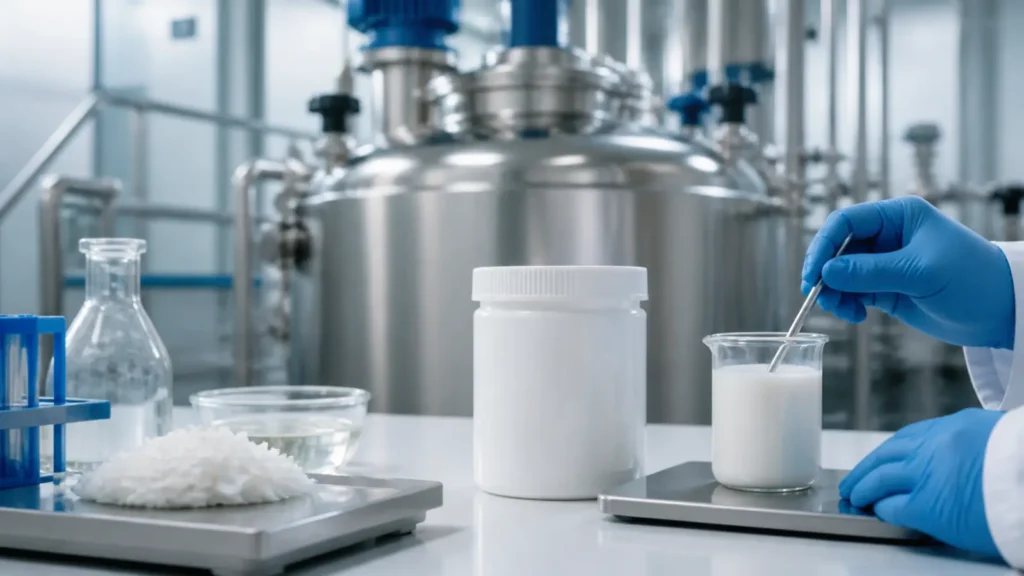
A beaker result represents one material sample, one formula version, and one preparation method. The first production run introduces different equipment, mixing conditions, hold times, storage, packaging, and release decisions. If these changes are not recorded, a team may blame the ingredient when the real difference sits elsewhere in the transfer.
The useful question is therefore not simply, “Did the sample work?” It is, “Do we have enough connected evidence to place a controlled first commercial order?” The following nine questions create that decision record.
Nine questions to resolve before the first commercial order
1. Are we evaluating the same grade and document set?
The transfer record should identify the exact grade, INCI, supplied form, concentration or active basis where applicable, sample lot or reference, and the TDS, SDS, specification, and COA versions used during evaluation.
This matters when two materials share a similar trade name or INCI but differ in carrier, concentration, neutralization state, moisture, particle form, or another application-relevant feature. Confirming the reference set early prevents a later bulk order from being compared with an undefined sample.
2. What result will make the formula acceptable?
“The sample looks good” is difficult to reproduce. A short acceptance record gives R&D, purchasing, quality, and the supplier the same definition of success.
| Decision field | Useful record |
| Formula | Controlled formula version and exact raw-material grade |
| Process | Addition order, temperature, mixing basis, time, and hold points |
| Test | Method, sample preparation, timing, conditions, and units |
| Decision | Target, limit, approved reference, and decision owner |
The relevant result depends on the product. A cleanser may be reviewed for appearance, pH, viscosity, foam, rinse, odor, stability, package delivery, and preservation. An emulsion will need a different set. The purpose is not to test everything, but to define the few outcomes that decide whether the material can move forward.
3. Which raw-material attributes matter to this formula?
The supplier specification sets release limits for the ingredient. Your formula may be particularly sensitive to only part of that specification. A useful technical discussion links the application concern to a documented material attribute and an agreed test method.
A COA reports listed results for one lot. It does not by itself prove how the finished formula will behave. ISO guidance on supplier selection and buyer requirements also places the intended use, requirements, approvals, and necessary checks with the buyer. The practical outcome is a shared evidence plan, not a certificate used as a substitute for application validation.
4. Which process variables will change at larger scale?
Scale changes the way energy, heat, and time reach the formula. The transfer review becomes more useful when it records the variables most likely to change:
- addition point and order;
- batch temperature and heating or cooling rate;
- mixer or homogenizer type and the basis for speed;
- mixing time, hold time, and aeration;
- dilution water, pH adjustment, and when measurements are taken.
This does not require the ingredient supplier to design the customer’s entire manufacturing process. It gives both teams a clear basis for interpreting a result that differs from the lab sample.
5. What uncertainty should the pilot or first bulk batch close?
A pilot is most valuable when it answers a named question. That question might concern dispersion time, viscosity recovery, foam, color, odor, filtration, transfer loss, storage, or package performance. If the available production setup is already representative and the risk is low, the first commercial batch may serve as the controlled confirmation batch.
Either route needs a written purpose, acceptance criteria, retained records, and a decision on what happens if the result falls outside the expected range.
6. How will sample approval connect to the supplied batch?
The approved sample, document revision, purchase description, commercial lot, COA, package label, and receiving record should point to the same grade. That connection allows the customer to confirm what was evaluated, what was ordered, and what arrived.
It also makes a later investigation faster. Without a clear batch link, teams may repeat tests on the wrong reference or compare results produced under different methods.
7. How will changes or conflicting results be handled?
Before the first order, it helps to know who receives a change notice, what information can be shared, and how the parties will compare results. If supplier and customer data differ, the next step should preserve the sample identity, method, conditions, units, instrument basis where relevant, and the timing of the test.
The aim is not to promise that variation will never occur. It is to make the response traceable enough for a technical decision instead of an exchange of unsupported conclusions.
8. Could packaging, storage, or transport change the material?
Package size, closure, headspace, temperature exposure, moisture, light, handling, and storage time can affect some raw materials. The transfer discussion should compare the evaluated sample with the proposed commercial package and shipping route, then identify any controls that matter for receipt and use.
Before ordering, the customer can also align the document set using INNO’s guide to TDS, SDS, and COA. Each document answers a different question, so none should be treated as a replacement for the others.
9. What control continues after the first order?
Commercial transfer is complete only when routine orders can be received, checked, released, stored, used, and investigated under a repeatable record. Relevant controls may include approved specifications, incoming checks, batch records, retained samples, document control, complaint handling, and agreed change communication.
The FDA cosmetic GMP inspection checklist identifies written procedures, raw-material status, laboratory controls, records, reserve samples, and complaint files among the areas manufacturers should examine. Its value here is practical: the first order should establish the records that later orders will rely on.
Use a five-gate transfer record
The nine questions become easier to manage when they are grouped into five decision gates. Each gate closes one type of uncertainty before more volume or cost is committed.
| Gate | Evidence to retain | Decision |
| 1. Requirement | Formula function, target result, market and document needs | Is the project brief clear enough to select a grade? |
| 2. Sample | Exact grade, reference, documents, formula version and lab result | Is the sample suitable for controlled evaluation? |
| 3. Scale check | Changed process variables, test methods and acceptance criteria | What must the pilot or first bulk batch confirm? |
| 4. First order | Purchase description, lot link, COA, packaging, storage and shipment plan | Can the first commercial quantity be released with known controls? |
| 5. Routine supply | Receiving, traceability, change and complaint records | Can later orders follow the same evidence path? |
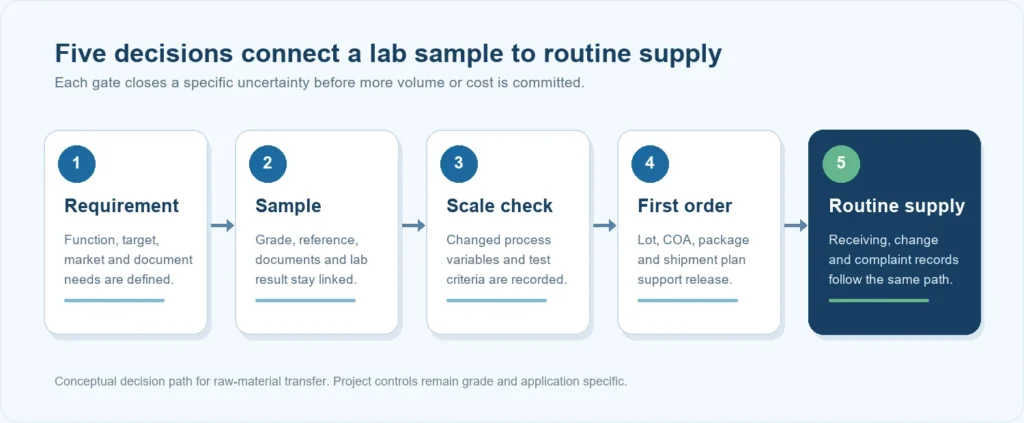
This record can be brief. Its value comes from keeping the ingredient identity, application result, process change, and supply evidence on one path.
What a Buyer Can Verify With INNO
| Procurement concern | Evidence available from INNO |
|---|---|
| Manufacturer identity | Factory and manufacturing information |
| Quality system | Relevant certification documents |
| Grade identity | TDS, specification, INCI and SDS |
| Batch release | COA / lot-specific quality records where applicable |
| Application evaluation | Samples and application testing support |
| R&D capability | Application/R&D facilities and test records |
| Export preparation | Packing, shipping and export documentation |
| First-order review | Grade, quantity, packaging, destination and timing discussion |
What INNO can provide for a focused transfer review
INNO’s published technical service process covers requirement analysis, product selection, sample and testing support, documentation support, and delivery coordination. For a scale-up discussion, the most useful starting point is the evidence needed for the next decision.
| Your next decision | Information INNO can provide or discuss |
| Confirm the commercial grade | Grade-specific TDS, SDS, specification, and representative or batch-specific COA basis where applicable |
| Plan the next formula check | Grade sample, application context, and technical discussion around the defined result |
| Compare an existing benchmark | Competitor benchmarking and reverse-optimization support within an agreed project scope |
| Review a preservation route | Preservative testing and formulation customization within an agreed project scope |
| Prepare the first order | Documentation and delivery coordination based on grade, quantity, packaging, destination, and timing |
To start a useful review, share the grade or function you need, formula type, current process, planned batch size, package and destination, the test method behind your result, and the one issue blocking the next decision. This gives the technical and commercial teams enough context to respond with relevant evidence rather than a generic catalogue.
FAQ
Is a pilot batch always required before commercial production?
No. The decision depends on process similarity, formula sensitivity, batch risk, and available evidence. The first bulk batch can sometimes serve as a controlled confirmation batch.
Must the commercial order come from the same batch as the sample?
Not necessarily. The key is a defined commercial grade, controlled specification, document link, and a clear way to compare the approved sample with supplied lots.
Which documents should be reviewed before the first order?
Review the grade-specific TDS, SDS, specification, COA basis, package information, storage conditions, and any market or shipment documents required for the destination.
Can an ingredient supplier guarantee the finished formula at scale?
The supplier can support grade selection, evidence, samples, and troubleshooting. The customer must validate the finished formula under its own process, package, use, and market requirements.