The mixer has been running long enough for everyone to become suspicious. A white collar still circles the vessel, soft lumps return to the surface, and the operator reaches for more speed.
The location and shape of the remaining powder usually give a better first clue than the elapsed time. A floating raft points toward surface wetting. A soft shell with a dry core points toward feed rate and local over-wetting. A wall ring points toward charging position or splash. Bottom residue points toward bulk circulation. Once the visible particles are gone, later haze or viscosity drift belongs to the complete formula and needs a different investigation.
For INNO KWLG-95, keep one process fact in view: the current TDS calls for cold-water dispersion before heating. Troubleshooting starts by finding where that sequence broke down, then changing the part that matches the symptom.
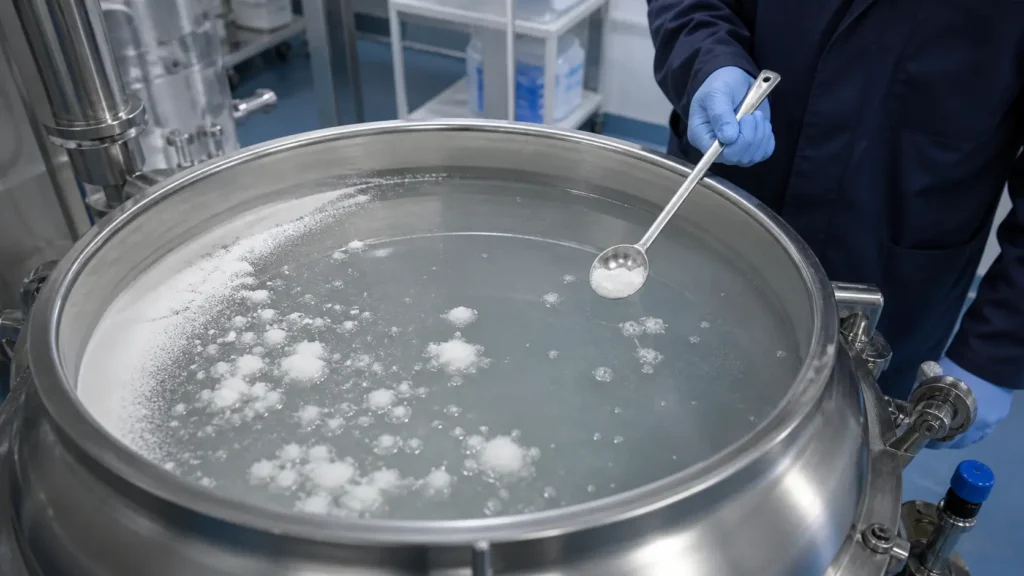
Conceptual troubleshooting illustration.
Name the symptom before changing the batch
“Not dissolving” can describe several different physical states. Give the symptom a more exact name while the evidence is still visible, then match it to the first useful check.
| What you see | Most useful first check | What it suggests |
| Dry powder raft at the surface | Surface turnover and feed location | Liquid is not wetting and carrying powder into the bulk fast enough |
| Soft lump with a dry center | Addition rate and size of each charge | The outside wetted before water reached the center |
| White ring above or at the liquid line | Charging position and splash pattern | Powder is landing outside the active liquid path |
| Residue at the bottom | Impeller position and vessel turnover | Surface motion is not reaching the lower zone |
| No visible solids, but the batch later turns hazy | pH, electrolyte, co-surfactants, fragrance, or temperature history | The dispersion step may be complete; the formulation now owns the problem |
Take a close photograph and note when the symptom first appeared. A picture taken after speed, heat, and pH have all changed is harder to interpret.
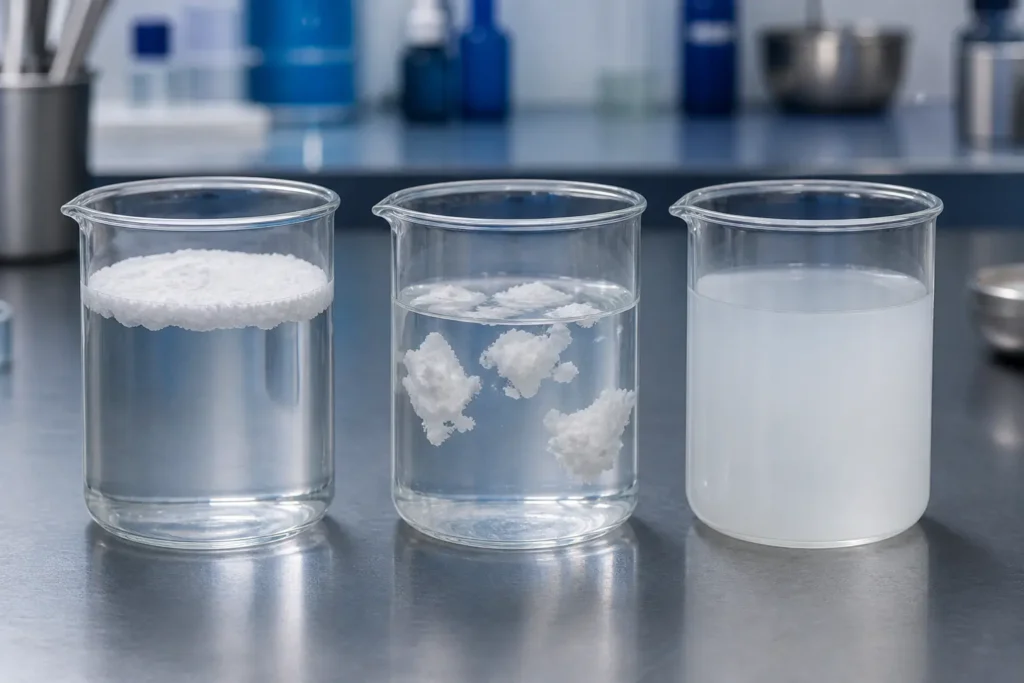
Conceptual comparison of three physical states. It is not measured KWLG-95 performance data.
A floating raft is a surface problem first
A soluble powder still has to cross the air-water interface. Reconstitution involves wetting, sinking, disintegration, and dissolution, often at the same time. The review of water-soluble powder reconstitution separates those jobs clearly.
When KWLG-95 remains as a loose layer on top, watch the surface rather than the speed display. A useful circulation pattern takes newly wetted powder below the surface and replaces it with fresh liquid. A narrow vortex can pull in air while a quiet area beside it holds the powder raft in place.
Compare the feed point with the path into the bulk
Powder should meet water where the liquid is already moving downward or inward. If it lands on a quiet edge, the operator may create a white island faster than the mixer can remove it. Moving the feed location can be more effective than increasing speed across the entire batch.
Let the existing raft clear before adding more
A growing surface layer blocks fresh powder from reaching liquid. Pause the charge and allow the water to take in what is already there. The total addition time may become longer, but the batch stops manufacturing its own barrier.
A wet shell with a dry core points to local overfeeding
A powder charge can look wet from the outside while remaining dry in the center. Water has joined the outer particles into a soft shell, and fresh liquid now has to penetrate that shell before the core can disperse.
Research on wetting and nucleation in agitated powder systems describes the liquid bridges that form between neighboring particles during early wetting. The paper addresses granulation, but the mechanism explains how a concentrated liquid contact can bind an outer layer before water reaches the whole mass.
Reduce the size of each local powder deposit
A narrower, better distributed feed gives more particle surface access to water. Large scoops dropped into one location create the opposite geometry: a small outside area has to wet a large dry interior.
If the same soft clumps appear at lab and plant scale, compare the powder feed per unit time and the area over which it enters. Plant scale often changes both even when the formula and rpm look unchanged.
Use shear after wetting has started
Mechanical energy can help break a soft, wetted agglomerate. It has less access to a dry core sealed inside a large lump. Recovery is therefore easier when water first reaches the agglomerate, followed by enough local motion to separate it.
More speed also changes air intake and foam. Raise it only when the flow pattern improves, and record the effect on both solids and air.
A wall ring and bottom residue point to different flow paths
Powder on the wall never had a fair chance to disperse. It may have missed the liquid, followed a splash, or collected where the surface level moved during charging. Bring the feed inside the liquid’s active area and include wall deposits in the yield check.
Bottom residue tells a different story. The surface may look busy while the lower part of the vessel turns over slowly. Check impeller position, batch depth, and whether the powder appeared at the bottom early or settled there after an incomplete hold.
Use location as the diagnostic shortcut
Surface, wall, and bottom symptoms belong to different parts of the vessel. That location helps the team discuss a real flow path instead of debating whether the ingredient is generally “easy” or “difficult” to dissolve.
The distinction also saves unnecessary formula changes. A feed port that throws powder onto the wall will not improve because fragrance, salt, or preservative has been adjusted.
Recover the batch without erasing the evidence
Recovery works faster when each change has a reason. If the batch has visible powder, stop the feed, photograph the symptom, record the current temperature and mixing condition, and take a representative sample if the site procedure allows it. Then address the matching physical cause.
For a surface raft, restore a path from the surface into the bulk. For soft wetted clumps, give water and controlled mechanical action time to reach the center. For wall deposits, return the material to moving liquid through the plant’s approved handling method. For bottom residue, correct the vessel turnover before extending the clock.
KWLG-95 heating still follows dispersion under the current TDS route. Heating while dry powder remains at the surface makes the batch history harder to compare with the documented process.
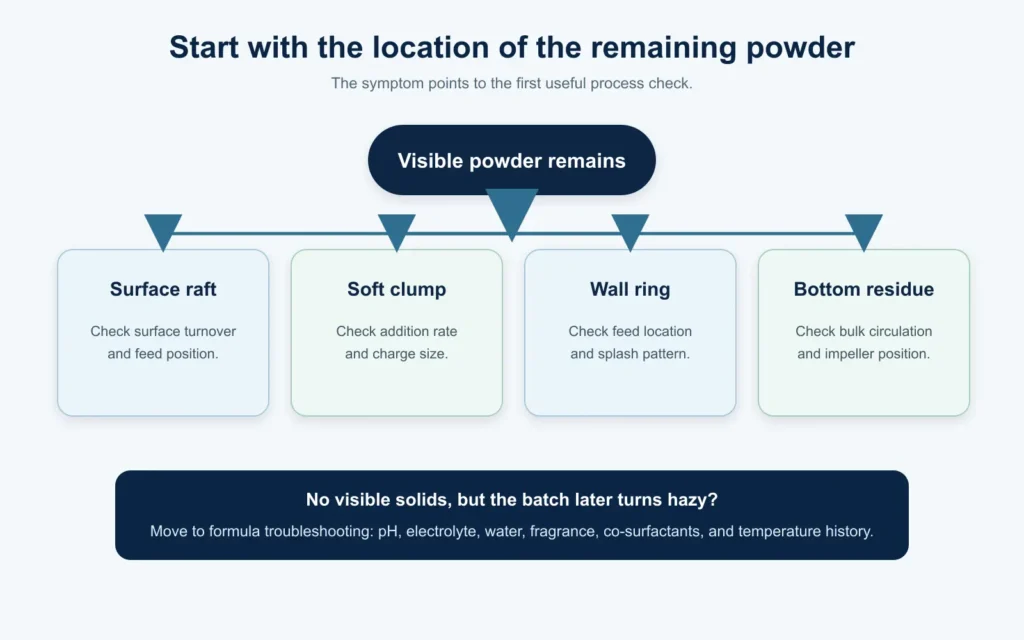
Use the location and physical form of the residue to choose the first process check.
Know when the problem has moved beyond dispersion
Once the batch contains no visible solids, later cloudiness, precipitation, viscosity loss, or unstable foam can reflect pH, electrolytes, water quality, fragrance, co-surfactants, or temperature history. At that point, move to a formula-level check instead of continuing to adjust the powder feed.
Decide whether the powder route still fits the line
INNO KWLG-95 is a high-content powder option for plants that want concentrated Sodium Lauroyl Glutamate and can control powder charging. Its current TDS supplies the cold-water-first sequence. Your vessel trial supplies the operating window.
If the line repeatedly struggles with open powder handling, the process decision may be larger than a mixer adjustment. A liquid Sodium Lauroyl Glutamate grade removes the dry-powder wetting step but brings more supplied water and a different transfer job. The Sodium Lauroyl Glutamate guide helps compare the grade parameters before that choice is made.
For a focused technical review, send the product lot, batch size, water source, starting temperature, vessel and impeller details, feed location, addition time, mixing history, and photos showing the first visible symptom. Send the batch history to INNO and we can discuss whether the next useful step is a corrected powder trial, a smaller recovery study, or a liquid-grade screen.
FAQ:
Can I rescue a clumped KWLG-95 batch with more shear?
Sometimes, but shear works best after the clump has been wetted. First check for a soft shell with a dry core, then apply only enough mixing to improve liquid contact and breakup without turning air intake into a second problem.
Why does Sodium Lauroyl Glutamate powder float if it is water soluble?
Wetting and sinking happen before complete dissolution. Fine powder can remain at the air-water interface when surface turnover is weak or the feed arrives faster than liquid can enter the particle bed.
Should I heat a batch that still has floating KWLG-95 powder?
The current KWLG-95 TDS places heating after cold-water dispersion. Bring the visible powder into moving liquid first so the batch follows a process that can be compared with the documented route.
When should a suspicious raw-material lot be held instead of reworked?
Hold the lot when its appearance, odor, package condition, or dispersion behavior differs materially from the approved incoming standard and the process history does not explain the change. Compare the lot with the purchase specification and COA before releasing it to a production vessel.
What evidence helps INNO diagnose the problem remotely?
A timed photo sequence plus the lot, formula phase, water source, starting temperature, vessel, impeller, feed position, addition time, and mixing history is usually more useful than a final photo of the clumped batch alone.