A development guide for balancing powder dispersion, jar texture, foam release, rinsing, and finished-product stability.
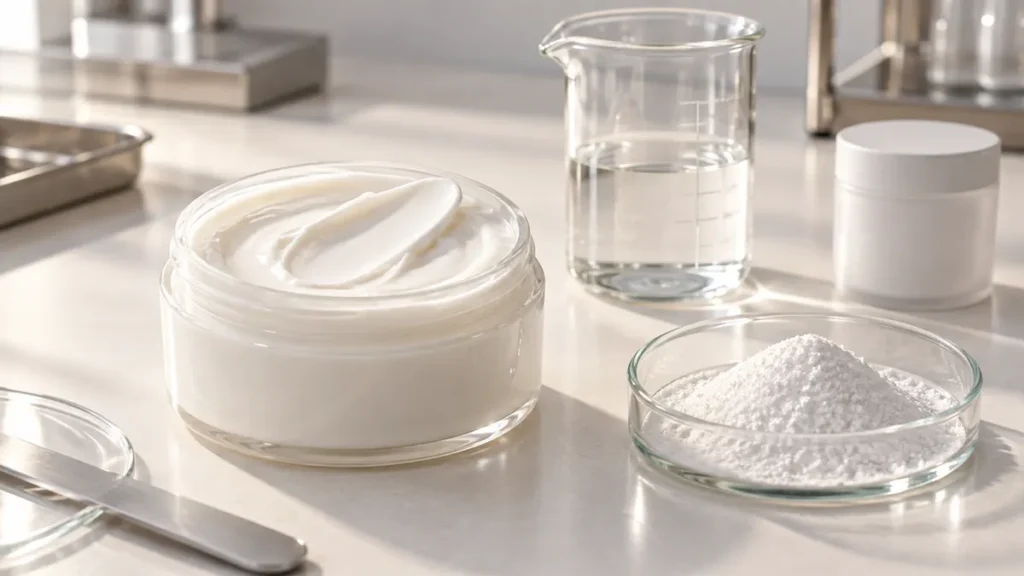
A cream cleanser can look smooth in the jar and still disappoint in use. Hidden powder agglomerates may appear during storage. A very firm paste may resist spreading or release foam slowly. A softer sample may dispense well but lose its shape at warm storage. These problems are connected, so adding more thickener after each failure rarely produces a clean answer.
When working with sodium cocoyl glutamate powder, make dispersion the first decision gate. Build a uniform surfactant phase before asking the formula to hold a cream or paste structure. Then add body in controlled steps and test the product with water as well as with a spatula. This separates a raw-material wetting problem from a rheology problem.
Choose the product architecture before choosing the process
The term cream cleanser can describe several different structures. One formula may be a concentrated surfactant paste. Another may be an emulsion containing an oil phase. A third may combine surfactants with fatty structuring materials. These formats do not use the same mixing order or acceptance tests.
| Design question | Why it matters | Useful early check |
|---|---|---|
| Is the body created mainly by surfactants or by a separate structuring system? | It changes where viscosity is built and how the powder must be incorporated. | Prepare a surfactant-only control before adding the structurant. |
| Does the formula contain a dispersed oil phase? | Emulsion stability and cleansing performance must be assessed together. | Compare appearance before and after surfactant addition. |
| Will the product be filled into a jar, tube, or pump? | The required yield, flow, recovery, and air control are different. | Test the intended package with an aged sample. |
| How should it open when water is added? | A dense jar texture can delay dispersion, foam, and rinsing. | Use a fixed product dose, water amount, and working time. |
Write the intended structure in plain terms before the first batch. For example: a smooth, opaque paste that holds a spatula peak, spreads with wet fingers, foams within a defined working time, and rinses without visible residue. The laboratory can then screen measurable attributes that support that experience instead of chasing one viscosity number.
Pass the powder-dispersion gate first
Dry powder can form wet shells around dry cores when it meets water too quickly. High local concentration, a poor addition point, insufficient bulk movement, or an unsuitable charging rate can make those agglomerates difficult to remove. More shear is not always the first answer because it may introduce air or damage a developing structure.
Start with a simple dispersion trial based on the actual equipment. Record the liquid phase, ingredient order, batch temperature, charging time, agitation type, mixing time, and rest period. Inspect a thin smear as well as the bulk beaker. A glossy surface can hide small grains that become obvious when the product is spread.

If the first trial contains lumps, change one process variable at a time. Possible screens include the point of addition, powder feed rate, pre-wetting route, temperature, or mixer geometry. The correct choice depends on the complete formula, the applicable ingredient documents, and plant capability. Without a product-specific process study, an exact universal temperature or mixing time would be misleading.
Keep a control sample that contains the dispersed surfactant phase but not the final structuring system. If both the control and finished paste show grains, return to dispersion. If only the structured paste develops defects, investigate compatibility, cooling, and rheology rather than repeating the same powder-charging step.
Balance structure across the whole use cycle
A cleansing paste spends its structure in several places. It must resist separation in the package, move under finger or pump force, spread when diluted, release surfactant into water, and rinse from skin. Maximizing body in the jar can work against the last three tasks.
For each candidate, record firmness or yield behavior under a repeatable method, then run a use-dilution test. Keep product mass, water mass, water temperature, working time, and motion constant. Compare how quickly the sample opens, when foam appears, the character of the foam, and how much water is needed for a clean rinse. A controlled method is more informative than simply calling one sample creamier.
pH and surfactant ratio belong in the same experiment as rheology. Research on a model sodium lauroyl glutamate and lauryl hydroxysulfobetaine system found that pH and concentration affected micellar structure and viscoelastic properties. This does not predict KWCG-95 performance, but it explains why a formula may change body when pH or co-surfactant level changes. See the peer-reviewed model-system study.
A separate study of model N-acyl glutamate and aspartate surfactants also showed pH-dependent protonation and aggregate changes. Use this as a reason to measure and control pH throughout development, not as a reason to copy a result into a cocoyl formulation. The published self-assembly research describes the model conditions.
Where INNO KWCG-95 fits
INNO currently offers KWCG-95 as Sodium Cocoyl Glutamate. Its current listed details describe a white solid powder with 93.5% to 100% content. The standard listed pack is 15 kg.
The concentrated physical form lets the formulator set the formula water balance rather than receiving a large carrier-water contribution with the surfactant. That can be useful when screening a concentrated cream or paste. It also means the development plan needs a suitable route for weighing, charging, wetting, and confirming uniform dispersion.
These listed details do not establish an exact use level, hydration time, processing temperature, finished pH, foam profile, rinse feel, or stability result. Request the current technical and safety documents for the intended lot and market. Use a sample to determine whether KWCG-95 fits the actual co-surfactants, oils, structurants, preservatives, fragrance, process, and package.
Build the formula through decision gates
The following sequence keeps each question visible. It is a screening plan rather than a finished formula.
- Uniformity gate: disperse KWCG-95 in the simplest practical liquid phase and check the bulk sample and thin smear for undispersed material.
- Surfactant gate: add the planned co-surfactants at controlled ratios. Record pH, appearance, flow, and dilution behavior after a defined rest.
- Structure gate: introduce the selected oil phase or rheology system according to its process requirements. Compare several structure levels rather than correcting one batch repeatedly.
- Finishing gate: add preservative, fragrance, chelator, color, and pH adjustment in traceable steps. Retain the sample before each high-risk addition.
- Use and package gate: measure texture, dispensing, water opening, foam release, rinsing, and stability in the intended package.
Keep formula changes and process changes in separate trials whenever possible. If the powder level, mixer speed, thickener, and pH all change together, the best-looking sample cannot teach the team which variable mattered. A small designed screen with a few meaningful factors is usually more useful than many unstructured batches.
Read defects by when they appear
| Observation | Likely area to isolate | Next controlled comparison |
|---|---|---|
| Grains appear immediately after powder addition | Wetting, feed rate, liquid-phase choice, bulk movement | Repeat the simple dispersion with one process change |
| Sample is smooth at first but grains appear later | Incomplete dispersion, crystallization, or compatibility | Compare the surfactant control with the fully structured paste |
| Paste holds shape but opens slowly with water | Excess structure or slow surfactant release | Run matched structure levels in a fixed dilution test |
| Foam falls after fragrance or oil addition | Oil load, solubilization, surfactant ratio | Compare the retained pre-addition control at equal test conditions |
| Warm storage softens the product | Rheology, phase structure, package interaction | Review the full time and temperature history, not one endpoint |
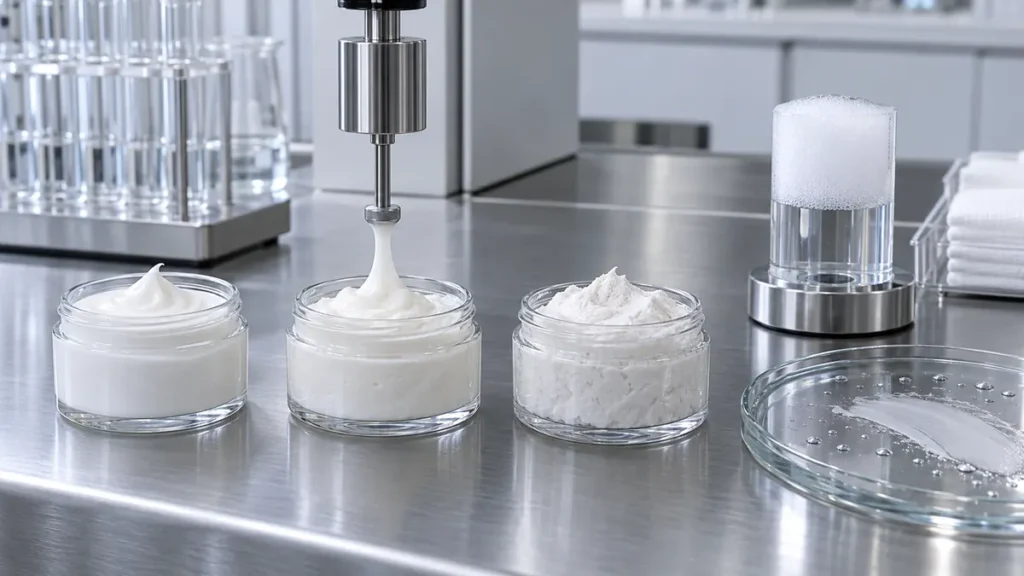
After selecting the most promising structure, run the appropriate stability, microbiological protection, and package-compatibility program. Cosmetics Europe identifies physical integrity, chemical and microbiological stability, and content-container compatibility as relevant parts of cosmetic stability assessment. Its stability guideline leaves the exact program to the formula type and the manufacturer’s experience.
Frequently asked questions
Why does KWCG-95 form lumps when added to water?
Fast wetting at the surface can trap dry powder inside agglomerates, especially when the addition point has weak bulk movement.
Screen feed rate, addition point, pre-wetting route, temperature, and mixer geometry one at a time. Confirm the applicable supplier process guidance before scaling up.
Should the cleanser be thickened before the powder is fully dispersed?
Usually, confirm a uniform surfactant phase first; early thickening can reduce movement and make hidden agglomerates harder to diagnose.
Some rheology systems require an earlier addition step, so follow their process instructions while retaining a simple dispersion control.
Why does a firm cleansing paste produce foam slowly?
The structure may delay product breakup and surfactant release when water is added, even when the paste looks attractive in the jar.
Compare matched structure levels with a fixed dose, water amount, temperature, and working time. Record both foam onset and rinse behavior.
Can more thickener fix a cream cleanser that separates?
Not reliably. Separation may come from incomplete dispersion, phase incompatibility, process history, or package and temperature conditions rather than low viscosity alone.
Identify when the defect first appears and compare the simplest retained controls before changing the rheology system.
Request a KWCG-95 sample and process discussion
Send INNO your current formula skeleton, target pH and texture, intended package, batch size, powder-charging method, mixer type, process limits, foam target, and rinse expectations. We can prepare a KWCG-95 sample and discuss a small-batch screening route suited to your equipment.