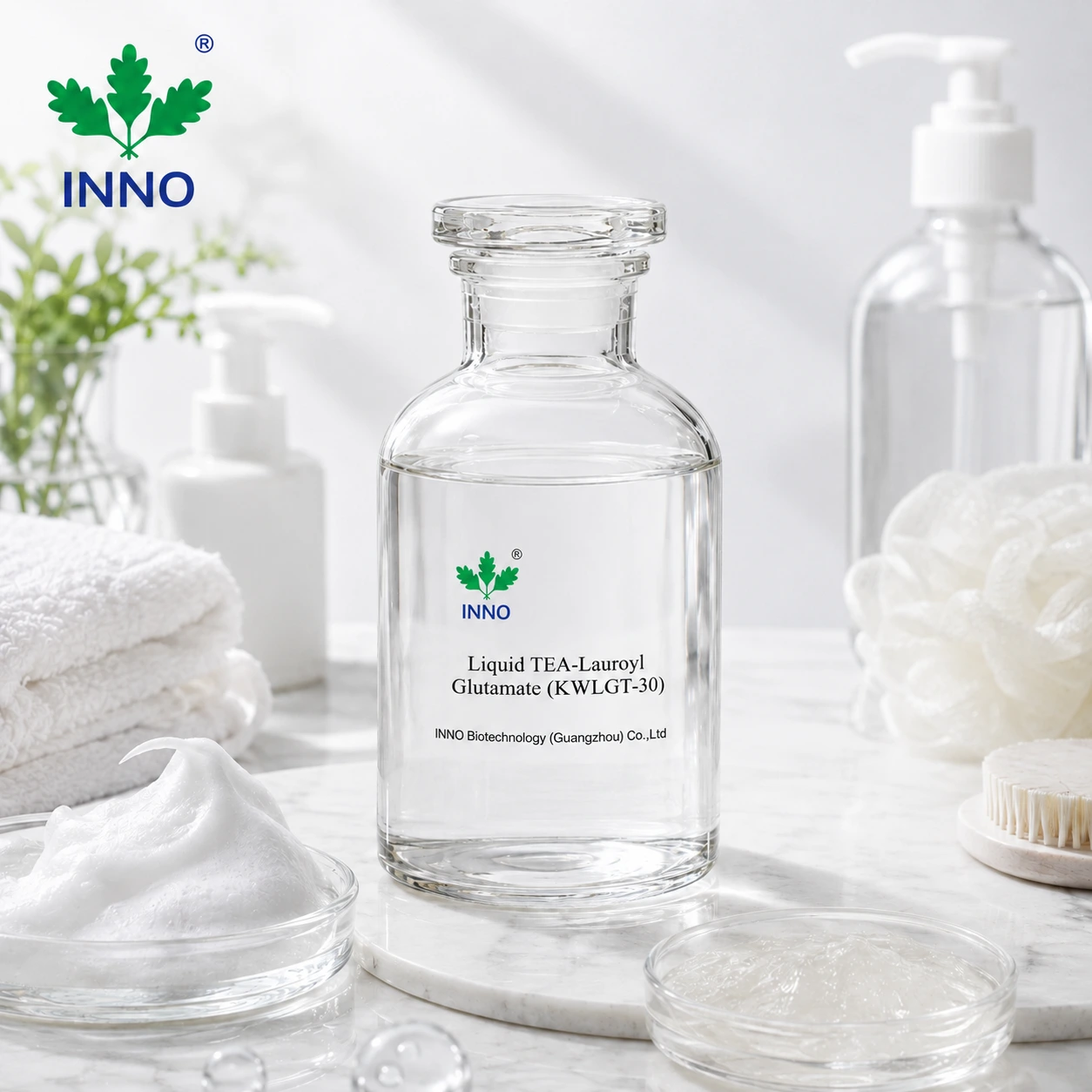
We supply Liquid TEA-Lauroyl Glutamate as INNO KWLGT-30, a cosmetic-grade liquid TEA-lauroyl glutamate surfactant for mild cleansing and cold processing.
Key Benefits of Liquid TEA-Lauroyl Glutamate (KWLGT-30)
- KWLGT-30 is designed for transparent, mildly acidic cleansing products. It supports clear formulas in the pH 4.5 to 6.5 range, where conventional sodium amino-acid surfactants are often less suitable.
- The liquid remains uniform at about 5 degrees C without visible precipitation or separation. This low-temperature stability is a clear advantage for transparent products that may face cold storage or transport.
- It can be added through cold processing without a separate heating step. Direct liquid dosing shortens the batch route and makes the grade practical for foaming washes, gels and other clear cleansing formats.
- KWLGT-30 foams quickly, produces dense creamy lather and keeps foam stable in hard water. The finished cleanser combines a clean rinse with a comfortable, non-stripping skin feel.
- In shampoo, the grade improves wet slip, reduces tangling and leaves processed hair smoother. INNO provides the supporting compliance documents required for the controlled ingredients in this commercial blend.
| Content of solids | 30±1 |
| Heavy Metals (PPM) | ≤20 |
| Arsenic Content (PPM) | ≤2 |
Recommended applications
- KWLGT-30 is the preferred option for transparent facial cleansers and gels in a mildly acidic pH range, especially when low-temperature clarity is part of the stability brief.
- Use it in pump foams and cleansing liquids that need cold processing, direct dosing and no separate heating step.
- In shampoo for processed or tangle-prone hair, the grade adds wet slip, reduces knotting and leaves a smoother finish after rinsing.
- It also suits premium body wash and hand wash that need dense foam in hard water and a comfortable, non-stripping skin feel.
Formulation and commercial details
| Grade | Cosmetic Grade |
|---|---|
| Packaging | 200 kg PE drum |
| Gross weight | 209.5 kg |
| Packing dimensions | Ø58xH91cm |
| Storage | Store sealed in a dark, cool, dry place (current TDS). |
| How to use | Add the liquid through the aqueous phase under controlled agitation. Set the final pH and viscosity after all surfactants, electrolyte, fragrance and the preservation system are present. |
| Compatibility | Compatible with the co-surfactants described above. Set the final electrolyte, polymer, fragrance and preservation system in the complete formula. |
Choosing between related INNO products
KWLGT-30 uses the TEA salt and is well suited to cold-process and transparent systems. Sodium and potassium glutamate grades provide different pH and handling options.
Frequently asked questions
Can KWLGT-30 replace a sodium glutamate liquid one for one in a clear cleanser?
No direct weight-for-weight substitution should be assumed. Match active matter, correct the water phase, and rebuild the pH and electrolyte profile because the counterion changes solubility and the clarity window.
What belongs in a low-temperature clarity test for KWLGT-30?
Test the complete formula, not a surfactant dilution. Include the final pH, electrolyte, fragrance, preservative and packaging, then check for haze, crystals, separation and recovery after the cold cycle.
How should the addition sequence change when a KWLGT-30 formula moves from hot to cold processing?
Prepare any fragrance or oil-soluble premix separately, build the surfactant blend under controlled mixing, and adjust acid in small steps. Set viscosity last, after every clarity-sensitive ingredient has been incorporated.
How can reversible cold haze be distinguished from a real precipitation problem?
Use a defined cold hold followed by controlled recovery at room temperature. Record clarity, sediment and redispersion at each point; material that does not recover consistently should be investigated before the formula is approved.
Why work with INNO?
INNO provides both low-pH formulation support and the controlled documents needed for this commercial blend. Samples are available for cold-stability and clarity screening.