A useful phenoxyethanol shortlist starts with the full trade name, the specification and the application it needs to support. That sounds less exciting than finding the highest purity number. It is also a better way to avoid ordering a sample on the strength of somebody else’s product document.
When comparing Proextend, Protectol PE and Phenoxetol, first establish which exact grades are on offer. Then compare like-for-like specification fields and decide what the candidate must demonstrate in your formula. The shared ingredient name gets a material onto the shortlist; it does not finish the qualification.

Why does the full trade name matter before you compare specifications?
Because a suffix can identify a separately documented product. Chemical identity helps confirm the substance; the complete grade name connects that substance to the supplier’s application information and specification.
One chemical identity, several commercial offerings
A commercial grade is the material a supplier offers under a particular product name and set of documents. Two grades can identify the same chemical while differing in their specification, intended application or supporting statements. An INCI name or CAS number alone does not describe all of those purchasing requirements.
BASF lists Protectol PE with home-care and industrial preservation applications. It separately lists Protectol PE CO and Protectol PE GMP; the GMP page describes pharmaceutical applications. These are reasons to preserve the full name in a comparison, not to transfer one grade’s claims to another.
A similar name does not make the documents interchangeable
Clariant’s Phenoxetol page lists household-cleaning applications. Its separate Phenoxetol SG page identifies a cosmetic preservative and lists personal-care applications. For a cosmetic project, that distinction deserves a question before the samples arrive.
An application list is not a complete statement of every permitted or prohibited use. Ask whether the offered grade and its documents cover your intended application and market. The two extra letters may be doing more work than the headline.
| Product entry | What to resolve before comparison |
|---|---|
| Proextend Phenoxyethanol / Proextend PE | Match the INNO product identity, applicable specification and supplied sample. |
| Protectol PE | Confirm that this exact offered grade has the application documents your project requires. |
| Protectol PE CO / PE GMP | Keep each full name and its supporting documents separate from the unsuffixed PE entry. |
| Phenoxetol / Phenoxetol SG | Confirm which material is quoted; do not combine the two application descriptions into one grade. |
Which specification fields make the comparison useful?
Assay, relevant impurities, water content and appearance can help define the candidate, provided you compare the same units, methods and document types. A higher-looking number is not persuasive until you know what it measures.
Separate the specification limit from the batch result
A specification sets an acceptance requirement. A certificate of analysis reports the listed results for a particular batch. Comparing one supplier’s minimum assay with another supplier’s measured batch assay mixes two different kinds of information.
Put the specification limits side by side first. Review the corresponding batch results separately, with their methods and reporting basis. One favorable batch result does not establish what every future delivery will contain.
Keep assay and impurity questions distinct
An assay describes the measured content under the stated method. It does not replace individual requirements for water or a named impurity. Where your specification calls for a phenol limit, for example, compare that field directly rather than assuming the overall phenoxyethanol percentage answers it.
Different method names or missing method details should prompt a technical check. Even when units match, the underlying tests may not support a direct numerical ranking. The appropriate acceptance limits come from the agreed material and project requirements, not from selecting the strictest-looking value in several unrelated brochures.
| Field | Record for each grade | Avoid this shortcut |
|---|---|---|
| Assay | Limit, method, reporting basis and batch result. | Ranking a minimum against a measured result. |
| Named impurity | Specific analyte, limit, units and method. | Using total assay as an impurity specification. |
| Water content | Its own specification and test basis, where required. | Assuming every assay method accounts for water identically. |
| Color or odor | Stated criterion and observation or test conditions. | Treating a marketing adjective as a measured comparison. |
Leave unanswered fields visible
If a document omits a method or limit, record the gap and request the applicable information. Filling a blank with a value from a neighboring grade makes the table neater and the decision less reliable. A shortlist can remain useful before every field is complete, as long as the missing fields remain visible.
What can clear appearance and low odor actually tell you?
They can help assess an appearance or sensory requirement under defined conditions. They cannot establish identical composition or equivalent antimicrobial protection.
Compare observations under consistent conditions
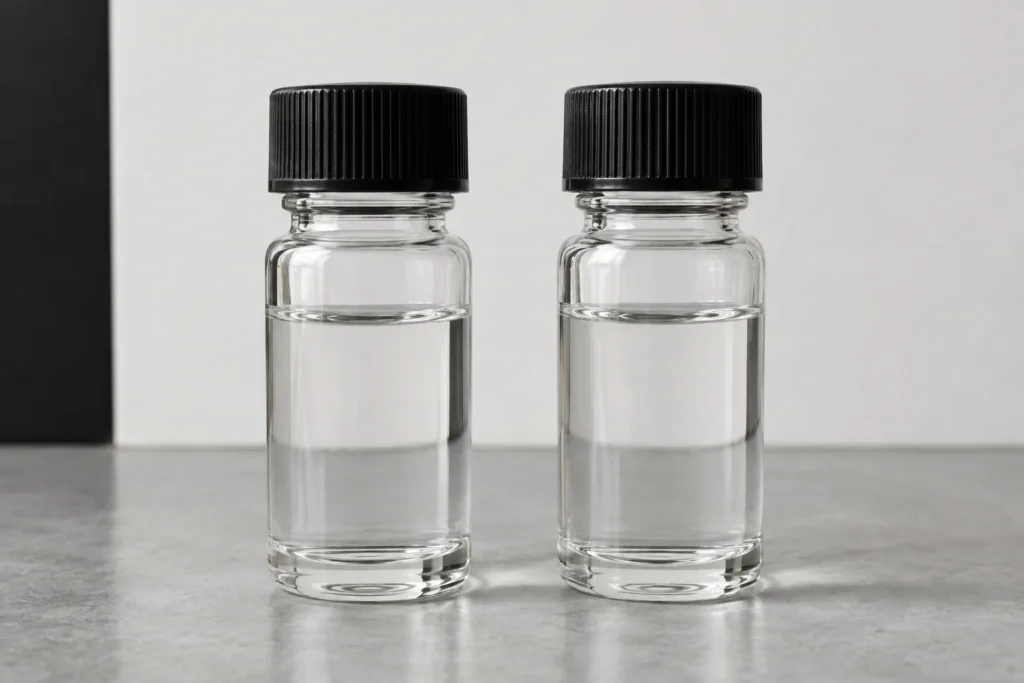
If visual appearance matters to the project, agree on how the samples will be observed. Comparable containers, sample depths, backgrounds and lighting make an informal screening comparison easier to interpret. A contractual color requirement still needs its specified method.
Odor comparisons also need an agreed procedure and appropriate handling precautions. A supplier’s description of “low odor” is not a substitute for checking whether the material meets your product’s sensory requirements. Assess those requirements in the intended formula as well as at the raw-material stage.
Keep sensory acceptance separate from preservation
A candidate may meet the appearance brief and still need further formulation evaluation. Conversely, an unexpected color or odor observation should trigger an investigation of the material, sample handling and formula rather than an immediate claim of preservative failure.
INNO’s phenoxyethanol technical guidance calls for compatibility and preservation challenge testing in the finished formulation. The raw-material review and the finished-product review answer different questions; neither should disappear because the sample looks reassuring.
When is a candidate ready for a replacement trial?
When its identity and relevant documents are clear enough to define what will change, and the team has agreed how to judge the result. A trial should test a known candidate against a stated requirement.
Set the comparison basis before opening the sample
Decide whether the trial will keep the raw-material addition level constant or match the documented phenoxyethanol contribution. Those are not necessarily the same basis. Keep any difference in composition or preparation visible in the trial record.
The same discipline applies to the base formula, process and packaging. If several things change at once, the trial may still help select a product, but it becomes harder to attribute the result to the new grade.
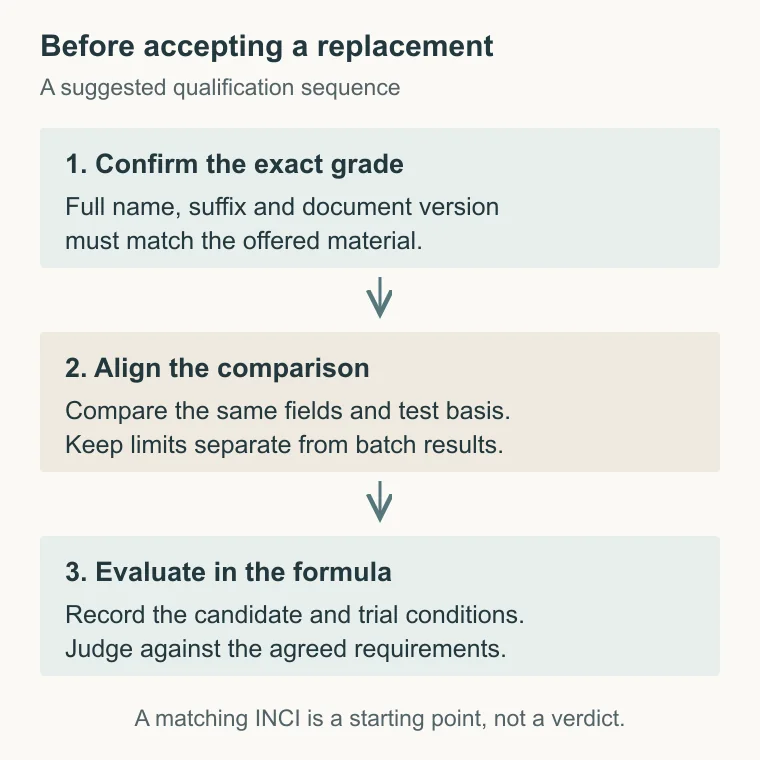
Use a qualification sequence the team can follow
- Match the full grade name across the quotation, specification and sample.
- Check the application documents and the project-critical specification fields.
- Resolve gaps that would prevent interpretation of the trial.
- Record the sample identity and all deliberate formulation or process changes.
- Evaluate against the agreed compatibility, preservation and product requirements.
This is a suggested evaluation sequence, not evidence that any two named products are equivalent. Acceptance should identify the candidate and conditions actually evaluated, rather than approving an entire brand family by association.
How should Proextend Phenoxyethanol enter your shortlist?
As a defined candidate for your specification and formulation requirements. Start with the product identity and applicable documents, then assess whether it meets the same criteria you set for the alternatives.
Connect the product to a specific requirement
INNO’s Proextend Phenoxyethanol has the INCI name Phenoxyethanol and CAS number 122-99-6. Its technical guidance covers personal-care applications, including creams, lotions and shampoos, with suitability to be verified in the finished formulation.
For a grade comparison, ask which specification and batch documents apply to the material being offered. These give the review a defined starting point without assuming that a shared ingredient name guarantees a direct replacement.
Ask a question the supplier can answer precisely
Provide the complete current grade name, the intended application and the specification fields that matter to your project. Include the target market and any particular sensory or processing requirement. You do not need to disclose a confidential full formula to start that discussion.
That brief turns “Is it the same?” into specific questions about documents, sample suitability and the evaluation still needed.
FAQ
Does the same INCI name prove that two phenoxyethanol grades are equivalent?
No. It identifies the ingredient, not the full commercial specification or suitability for your formula. Compare the exact grades and relevant methods, then evaluate the candidate under the project’s defined conditions.
Can I use Protectol PE GMP documents to qualify Protectol PE?
Only if the supplier confirms that the document applies to the exact material offered. Otherwise, retain separate records for each complete grade name and request the documents for the purchased grade.
Does a higher batch assay automatically make a better cosmetic grade?
No. A batch assay is one result under a particular method. Suitability also depends on the agreed specification, application requirements and formulation evaluation. Compare batch results separately from specification limits.
What if a supplier does not disclose a required impurity limit?
Keep the field unresolved and request the applicable specification or supporting information. If the limit is necessary for your qualification, do not treat the review as complete or substitute another grade’s value.
To assess Proextend Phenoxyethanol against your current requirements, send INNO the complete reference grade and your specification checklist. Ask about the applicable technical and batch documents, then arrange a sample for the evaluation you have defined.