Suppose you move a familiar phenoxyethanol system from a lotion into a clear cleanser. Keeping the same phenoxyethanol percentage does not guarantee the same preservation performance when the base formula changes. Surfactants, emulsifiers, oil phase, companion preservative ingredients and packaging can all change the conditions in which the preservative system works.
The surfactants, oil phase and other preservation ingredients can change how the system performs. Phenoxyethanol is a useful preservative ingredient, but choosing it is only part of protecting a finished cosmetic. Separating ingredient identity, dose accounting and formula performance makes it easier to compare samples fairly and decide what the next trial needs to establish.

What is phenoxyethanol, and what does it do in cosmetics?
Phenoxyethanol is an organic compound used as a preservative and solvent in cosmetics. Its INCI name is Phenoxyethanol and its CAS number is 122-99-6. It can be supplied as a single ingredient or within a blend, with performance determined in the finished formulation rather than by the ingredient name alone.
One substance, several ways of naming it
Phenoxyethanol and 2-phenoxyethanol refer to the same substance. Its structure combines an aromatic ring, an ether linkage and an alcohol group, as recorded in the SCCS assessment of phenoxyethanol. The INCI and CAS number help you reconcile a label with a technical document when the names differ.
A commercial grade still needs its own specification. Two documents can list the same INCI while setting different requirements for assay, appearance or impurities. Identity tells you which substance you are buying; the specification describes the material the supplier agrees to deliver.
Preservation and solvency are separate jobs
As a preservative, phenoxyethanol helps control microbial growth. As a solvent, it can help incorporate certain ingredients with limited water solubility. Both functions matter, but they answer different questions.
A clear, uniform sample shows that you have achieved the desired appearance at that moment. It cannot establish preservation efficacy. Equally, haze calls for an investigation of the ingredient combination and preparation conditions; it does not identify the preservative as the culprit on sight.
Is a phenoxyethanol blend interchangeable with phenoxyethanol alone?
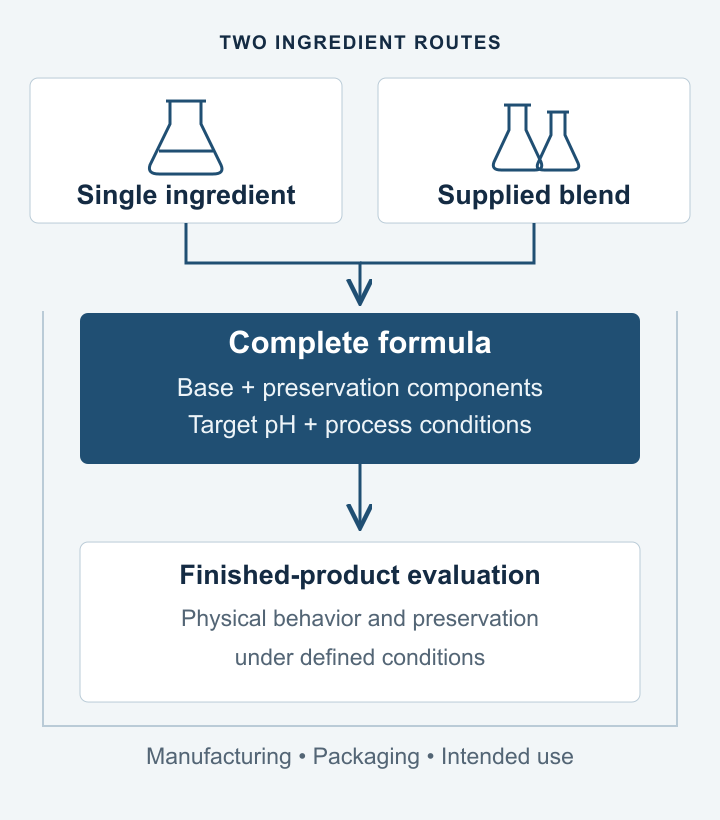
No. A supplied blend brings additional ingredients into the formula. Replacing it with phenoxyethanol alone changes that composition, even when the phenoxyethanol contribution is matched. A fair comparison needs both the complete ingredient list and a calculation on the same mass basis.
The second ingredient deserves a look
Clariant’s Nipaguard PE 9010, for example, combines phenoxyethanol and ethylhexylglycerin. That makes it a different formulation input from a single-ingredient phenoxyethanol grade. The shared word on the front of the description does not cancel the rest of the composition.
With phenoxyethanol alone, you choose any companion ingredients separately. A supplied blend fixes the combination you receive. The choice depends on how much control you need over those components and how the candidate behaves in your base.
| Comparison | Single ingredient | Supplied blend |
|---|---|---|
| Composition | One named ingredient, with its grade specification. | All listed components and their documented composition. |
| Dose calculation | Use the grade’s documented assay. | Use the documented fraction of this ingredient. |
| Companion ingredients | You select and add them separately where needed. | They enter with the supplied combination. |
| Performance check | Evaluate the finished formula. | Evaluate the finished formula. |
The calculation compares inputs, not outcomes
The phenoxyethanol contribution equals the amount of supplied material added multiplied by its documented phenoxyethanol mass fraction. Express the addition level as a percentage by mass of the finished formula and the fraction as a decimal; the result is the phenoxyethanol percentage by mass.
Supplier composition information supplies that fraction. A trade name is not a substitute. Once the calculation matches, you have matched one input, not demonstrated equivalent protection. Removing ethylhexylglycerin, for instance, still changes the formula.
Why can the same preservative behave differently in a new formula?
Because the surrounding ingredients and preparation conditions affect the system in which it works. Oil phases, emulsifiers, surfactants and solubilizers can influence preservative distribution or availability. A change of base deserves a fresh look even when the preservative line on the formula sheet is untouched.
The base has a say
A study of preservative compatibility in surfactant-rich emulsions found that performance depended on the excipients, preservative composition and formulation conditions. The finding supports evaluating the combination. It does not justify a blanket claim that nonionic surfactants deactivate phenoxyethanol.
If an emulsifier or solubilizer changes, a useful trial holds the rest of the base as consistent as possible and checks physical behavior alongside preservation. Changing several ingredients at once may produce an attractive sample, but it makes the explanation for any different result much harder to pin down.
The process belongs in the comparison
Final pH, addition stage and mixing conditions describe the sample you actually made. They are more informative than the intended process if the two diverged during preparation.
INNO’s technical guidance notes that heating can help dissolution and cautions against excessive heating time because of possible material loss. That is a reason to establish a suitable incorporation process, not a universal instruction to add phenoxyethanol at a particular temperature.
The package is part of the product
A cream in an open jar and a product dispensed through a pump have different patterns of consumer handling. Packaging and intended use therefore belong in the preservation assessment. A package change is a reason to review the risk, rather than an automatic invitation to lower the preservative level.

What should you check before approving a phenoxyethanol system?
Approval needs evidence about the supplied ingredient and the finished cosmetic. Technical documents establish what you are evaluating; compatibility, stability and preservation assessment establish how that formula behaves. A satisfactory raw-material COA cannot answer the finished-product question.
A trial brief worth keeping beside the balance
A short written brief gives the laboratory and the buyer the same starting point. For a proposed comparison:
- Identify the product format, intended use, destination market and packaging.
- Record the exact candidate grade, full INCI and the composition information needed for dose accounting.
- Describe the base, including its pH, emulsifier or surfactant system and planned addition process.
- Check whether other raw materials introduce preservation components of their own.
- Agree on the physical properties and preservation results that will determine acceptance.
- Link the sample identifier to its batch documents, formula version and preparation record.
The last step rarely makes an exciting photograph. It does make a later result much easier to interpret, especially when several versions of a base are circulating.
TDS, SDS and COA answer different questions
A TDS gives technical and use information. An SDS addresses safety and handling. A COA reports the listed results for a specific batch. These documents complement one another; none is a test report for your finished cream or cleanser.
The distinction also prevents a purchasing misunderstanding. A batch assay can confirm the reported content against the applicable specification. It cannot establish how that batch will perform with a different emulsifier system or a newly added fragrance.
A challenge assessment asks a different question from a routine count
ISO 11930 addresses evaluation of the antimicrobial protection of a cosmetic product. The testing laboratory should confirm the applicable method and interpretation for your product. A routine microbial result and a preservation efficacy assessment provide different evidence.
Keep the report connected to the tested formula and its preparation record. When composition, processing or packaging changes, assess whether the existing evidence still covers the revised product. Otherwise, a perfectly valid report can end up answering yesterday’s formulation question.
How can you start evaluating INNO’s phenoxyethanol?
Start with a defined application and the documents for the grade you intend to sample. INNO’s Proextend Phenoxyethanol is a phenoxyethanol ingredient for personal-care formulation work; the next step is to assess it in your base against your project’s acceptance criteria.
Match the grade to the intended product
Proextend Phenoxyethanol has the INCI name Phenoxyethanol. Its technical information describes rinse-off and leave-on applications, including creams, lotions and shampoos. These application descriptions provide a starting point for screening, with compatibility and preservation checks still needed for the finished formulation.
Give the sample request enough context
Your product type, destination market and main formulation constraints are enough to start a focused discussion. If you are considering a replacement, include the current preservative’s complete name and available composition information. Comparing a single ingredient with an unidentified blend leaves too much of the calculation to guesswork.
The enquiry can stay brief. A clear evaluation question is more useful than a long list of hoped-for benefits.
FAQ
The complete supplier specification settles identity questions; the formula and conditions define where a test result applies. Both matter when deciding whether two materials are interchangeable.
My supplier lists 2-phenoxyethanol. Is that a different INCI?
No. 2-Phenoxyethanol names the substance whose INCI is Phenoxyethanol, CAS 122-99-6. Ask the supplier to confirm whether the offered material is a single-ingredient grade or a blend before comparing its specification.
Can I replace a PE 9010 blend at the same addition percentage?
Not on the trade name alone. Obtain the exact composition, calculate the phenoxyethanol contribution and account for companion ingredients. Matching the addition percentage of two supplied materials may still produce different formulas.
If phenoxyethanol alone worked in one formula, can I use that result for another?
The result belongs to the tested formula and conditions. Review changes in the base, process and packaging before deciding what additional evaluation is needed. Success in one product is a starting point for investigation, not automatic approval of another.
For your next trial, ask INNO about grade-specific technical documents and sample arrangements, with your product type, target market and main formulation constraints. That gives the discussion a formula to work with.