Two surfactants can share the words “cocoyl glycinate” and still send a formula in different directions. The small change at the end of the INCI name, potassium or sodium, can alter aqueous phase behavior, solubility and the way structure develops in a cleanser.
That does not make one salt universally better. Potassium deserves attention when the project needs easier incorporation or a broader clear-liquid window. Sodium may be worth screening when a dense or structured cleanser is the target. The formula, concentration and temperature decide whether either expectation survives the beaker.
The counterion is part of the formulation decision
Both ingredients are anionic amino acid surfactants built around a cocoyl glycinate portion. The difference is the counterion paired with the negatively charged surfactant: potassium in Potassium Cocoyl Glycinate and sodium in Sodium Cocoyl Glycinate.
The counterion may look like a minor naming detail, but it participates in how the material behaves in water. It can influence phase boundaries and how readily a concentrated surfactant system remains clear, opaque or structured at a given temperature. A substitution therefore changes more than the ingredient declaration.
An Ajinomoto technical flyer comparing sodium and potassium cocoyl glycinate grades presents different water-solubility phase diagrams for the two salts. Those diagrams belong to the named Ajinomoto grades and conditions, but they make the broader point neatly: counterion choice can move the phase boundary.
Solubility, clarity and viscosity are connected
A surfactant has to reach the intended phase state before a viscosity result means much. Partly dissolved powder, a temporary opaque phase or a cooling batch can all produce a number that looks final and then changes by the next morning.
Potassium and sodium salts should be screened at the same surfactant contribution, water quality and temperature profile. Keep the co-surfactant ratio, electrolyte load and pH adjustment sequence unchanged. Otherwise, the counterion gets blamed for work done by half the formula.
Viscosity deserves the same patience. A thicker fresh sample is not automatically the more robust option. Record appearance and viscosity after a defined equilibration period, then repeat the reading after the storage conditions relevant to the product. The goal is a usable structure, not a single impressive spindle reading.
Foam and after-feel need a finished-formula comparison
Counterion choice can change the phase behavior around the surfactant, but the foam in a finished cleanser also responds to active matter, pH, water hardness, amphoterics, nonionics, fatty acids, oils and polymers. A salt name cannot carry all of that on its back.
Compare foam at equal active surfactant contribution and the same test conditions. Note initial volume, bubble texture, persistence and rinse behavior separately. A tall foam column may look heroic for a minute and still lose the argument at the pump or on wet skin.
After-feel is even more formulation dependent. Evaluate the complete cleanser using the intended dosage, fragrance, preservation system and packaging. Supplier descriptions can help build a shortlist, but they cannot replace a controlled sensory comparison of the formula that will actually be sold.
Separate salt form from commercial supply form
A potassium liquid and a sodium powder differ in at least two ways: counterion and supplied format. Water, preservatives, salt and the addition route can easily overshadow the chemistry you meant to compare.
Use two powder grades or two liquid grades when the first question is counterion choice. Check the complete INCI, active-matter basis, moisture or carrier water, inorganic salt and test methods before setting the starting dosages.
| Decision area | What to hold comparable | What to observe |
|---|---|---|
| Solubility and clarity | Active contribution, water quality, temperature and mixing history | Clear, opaque or undissolved state after equilibration |
| Rheology | Co-surfactants, pH, electrolyte and polymer | Stabilized viscosity, flow and temperature response |
| Foam | Active matter, method, water hardness and test time | Volume, texture, persistence and dispensing |
| Sensory result | Complete formula, dosage and rinse protocol | Slip, rinse speed, residue and post-rinse feel |
| Manufacturing | Batch size and available powder-handling process | Wetting, dispersion time, aeration and repeatability |
Let the product brief decide which difference matters
A micellar-style liquid, a foaming pump wash and a cleansing paste do not ask the surfactant system to perform the same job. Write the non-negotiables before opening the sample bags. For a clear liquid, define the acceptable appearance at room temperature and at the lowest expected storage temperature. For a pump product, add a flow and dispensing window. For a paste, specify whether the structure must hold in a tube, jar or foaming net format.
Then rank the variables. Clarity may be essential in one project and irrelevant in an opaque cream. High fresh viscosity may help a jar product but become a filling headache in a narrow-neck package. Even foam needs a job description: quick flash foam, dense cushion, persistence during use or clean rinsing. When every attribute is called critical, the trial has no referee.
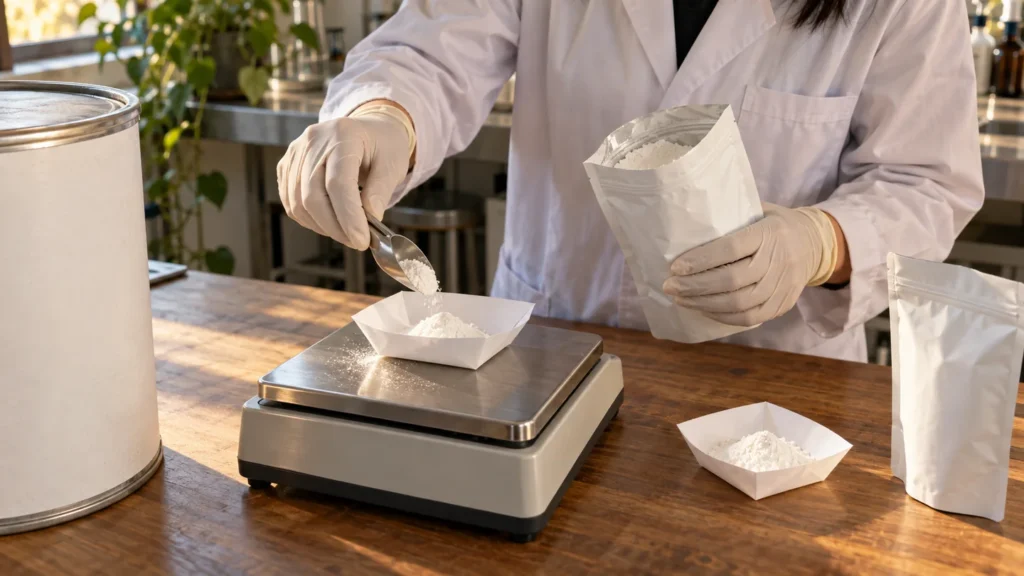
The first screen can stay compact. Prepare both salts at a common surfactant contribution, use one mixing and temperature history, and record appearance after a fixed rest. Move only the candidates that pass into rheology, foam, sensory and stability work. This sequence prevents an elegant foam result from rescuing a sample that never reaches the required phase state.
Packaging belongs in that early screen. Check pump recovery, tube extrusion or jar pickup after the sample has equilibrated, not while it is still warm from processing. The customer uses the product from the package, not from a laboratory beaker with excellent manners.
How INNO supplies the two salt options
INNO currently offers the powder grades KWGCK-95 Potassium Cocoyl Glycinate and KWGC-95 Sodium Cocoyl Glycinate. Comparing these two keeps the supplied form, standard pack and broad addition route aligned while changing the counterion.
| Documented field | KWGCK-95 | KWGC-95 |
|---|---|---|
| Primary INCI | Potassium Cocoyl Glycinate | Sodium Cocoyl Glycinate |
| Complete TDS declaration | Potassium Cocoyl Glycinate, Aqua, Potassium Chloride | Sodium Cocoyl Glycinate, Aqua, Sodium Chloride |
| Appearance | White solid powder | White solid powder |
| TDS pH line | 7.0 to 8.5, 10% aqueous sample | 7.0 to 8.5, 5% aqueous sample |
| Addition guidance | Disperse in cold water under stirring, then heat | Disperse in cold water under stirring, then heat |
| Standard pack | 15 kg per drum | 15 kg per drum |
The pH lines use different sample concentrations, so they are not a direct performance comparison. Request the current documents for both grades and agree on one laboratory method before building a salt-selection claim.
Choose the next sample by product format
For a clear liquid cleanser or a process sensitive to low-temperature dissolution, begin with a solubility screen and include the potassium grade when the target concentration challenges clarity. For a dense paste or cream cleanser, screen the sodium grade under the same active matter and water conditions rather than assuming that its fresh viscosity will remain stable.
If both candidates pass, move the decision to the finished product. Compare dispensing, foam texture, rinse feel and stability in the intended package. Salt form earns a place on the shortlist; the complete formula signs the approval.

Frequently asked questions
Can potassium and sodium cocoyl glycinate be swapped at the same percentage?
No. Confirm the active-matter basis and complete composition first. Set equal surfactant contribution, rebalance water and salts, then repeat the pH, viscosity, foam and stability checks.
Does the same pH range mean the two salts behave the same?
No. A reported pH range does not describe solubility, phase state or rheology, and values prepared at different sample concentrations should not be treated as a direct comparison.
Which salt is better for a cleansing paste?
Neither salt wins by name alone. Screen both at the intended active matter, polyol level, pH and temperature, then compare stabilized structure and pack dispensing.
What should accompany a paired sample request?
Send the product format, target active contribution, pH, co-surfactants, water hardness, batch process and packaging. These details let INNO prepare a more relevant potassium-versus-sodium comparison.
Request matched potassium and sodium samples
Send INNO your cleanser format, target active matter, expected pH and preferred batch process. We can provide the current TDS, SDS, representative COA fields and paired powder samples for a controlled salt-form evaluation.